
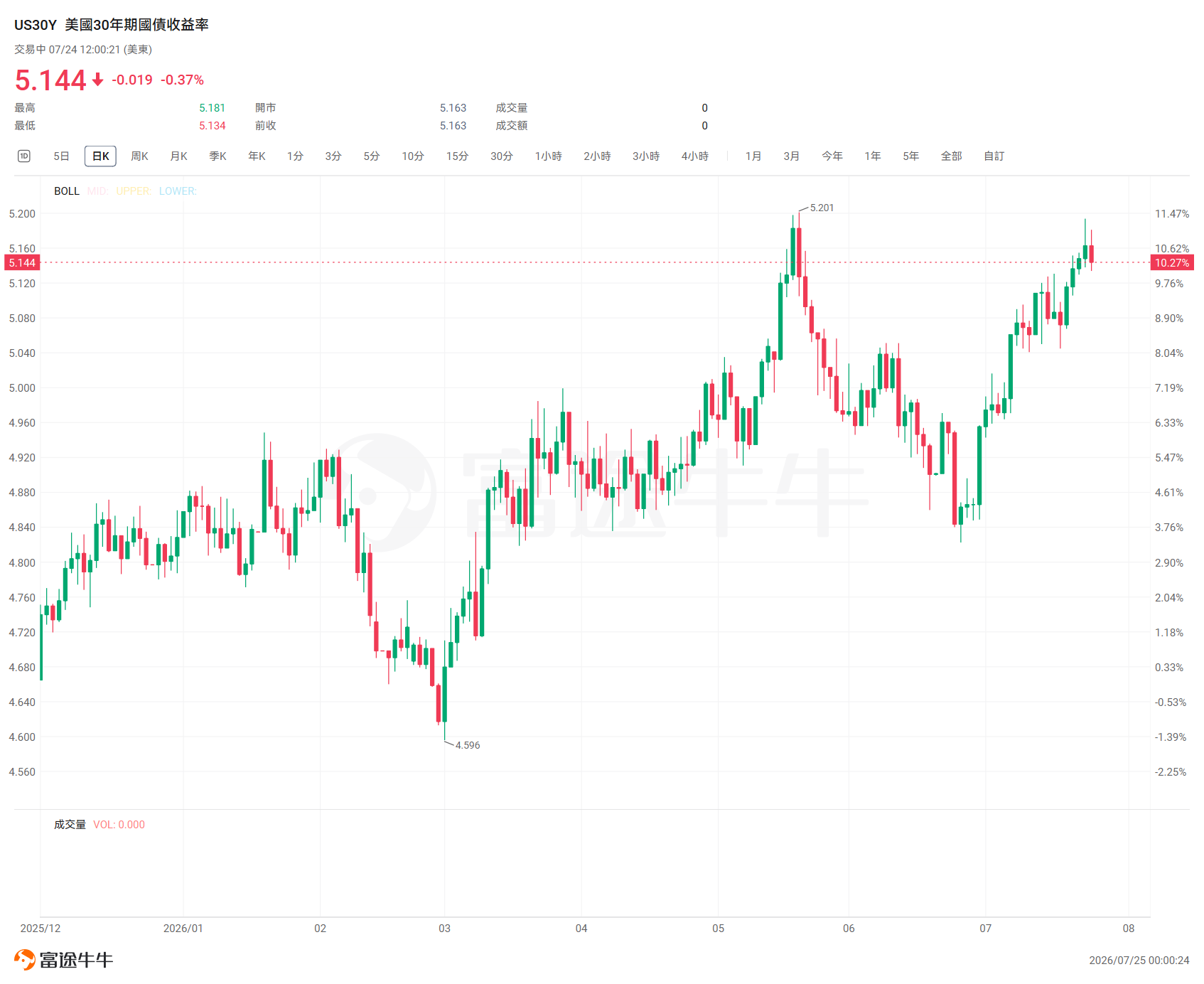
The real yield on the U.S. 30-year Treasury note has risen to 3%, reaching its highest level since the 2008 financial crisis. Michael Hartnett, chief strategist at Bank of America, believes that if newly appointed Fed Chair Kevin Warsh aims to stabilize the long end of the yield curve, he may need to proactively raise interest rates. "Investors are advised to shift toward defensive sectors and long-duration assets while avoiding bank, technology, and industrial stocks."
U.S. long-term Treasury yields continue to rise, putting pressure on the bond market, and Bank of America's chief strategist suggests that a 'panic rate hike' might be just the medicine the bond market needs.
The real yield on the U.S. 30-year Treasury has risen to 3%, its highest level since November 2008 during the global financial crisis. In the latest strategy report, Michael Hartnett, Chief Investment Strategist at Bank of America, noted that new Fed Chair Kevin Warsh may need to raise rates to stabilize the long end of the yield curve.
 Markets currently assign a 38% probability to a rate hike at the Fed’s next meeting and have fully priced in an increase at the September 16 meeting.
However, this outlook faces political constraints. Hartnett pointed out that whether the Trump administration—described by him as 'equity-market-friendly'—is willing to tolerate a rate hike that could act as a brake on equities ahead of the November midterm elections remains a key variable.
Tightening financial conditions are already underway—23 central banks globally have raised rates year-to-date, and Bank of America expects another 18 hikes by year-end. Meanwhile, sustained expansion in AI-related capital expenditures is turning cash flows negative for a large number of S&P 500 constituents, implying that future share buyback volumes will shrink accordingly.
Hartnett currently recommends that investors rotate into defensive sectors and long-duration assets while avoiding bank, technology, and industrial stocks.
Real yields on long-term Treasuries hit a 16-year high, with pressure on the bond market continuing to build.
The rise in the real yield on the U.S. 30-year Treasury to 3% not only clearly reflects tightening financial conditions but also exerts systemic pressure on risk asset valuations.
Hartnett argues that for markets to shift focus from the negative impact of tightening financial conditions toward the positive drivers of earnings growth, the Federal Reserve under Warsh’s leadership must take action by raising interest rates.
Warsh has already abandoned the Fed’s forward guidance, and Hartnett notes that the current inflation environment does not support inaction: annual consumer price index (CPI) growth remains in the 3%–4% range, and there are no signs yet of labor market disruption from AI.
Political pressure has become the biggest constraint on interest rate hikes, and tighter financial conditions are already a fait accompli.
Hartnett stated plainly that regardless of how Waller negotiates with the government, the trend toward tighter financial conditions is unavoidable.
Global central banks have already delivered 23 rate hikes year-to-date, and Bank of America expects another 18 by year-end. Against this backdrop, the likelihood that Waller will be compelled to respond to bond market pressures is rising, although a 'equity-friendly' policy stance could further complicate the timing of any rate hike.
Current market pricing implies a 38% probability of a rate hike at the next Federal Reserve meeting, but such a move is fully priced in ahead of the September 16 meeting.
This distribution of expectations reflects an inherent contradiction in market views on the policy path—concerned simultaneously about persistent inflation and rising yields, yet wary of the impact of tightening policy on equity markets.
The concurrent rise in yields and bank stocks may reverse, triggering deleveraging across risk assets.
Hartnett noted that markets have recently exhibited a pattern of rising bond yields alongside gains in bank equities, but warned this relationship could reverse—higher yields could instead weigh on bank stocks, potentially sparking a broad deleveraging wave across risk assets.
In this context, he regards the U.S. dollar as the optimal hedge. In theory, higher rates would widen the yield differential between U.S. and other markets, drawing capital into U.S. Treasuries and supporting a stronger dollar.
Semiconductor stocks have declined more than 20% from their June peak this year. Hartnett views 'blue-collar' semiconductor firms—including Texas Instruments, Analog Devices, NXP, Microchip, ON Semiconductor, and STMicroelectronics—as leading indicators of the industrial cycle, specifically serving as bellwethers for the AI industry cycle.
Based on this assessment, Hartnett and his team—Jessica Guo, Anya Shelekhin, and Myung-Jee Jung—recommend overweighting defensive sectors, dividend-paying assets, and long-duration bonds, while underweighting banks, brokerages, technology, and industrial sectors.
Editor/Stephen