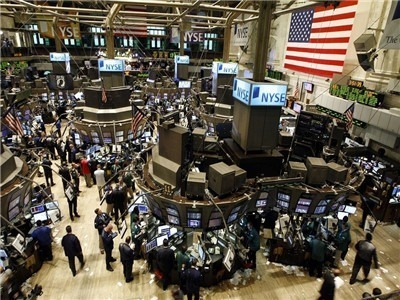
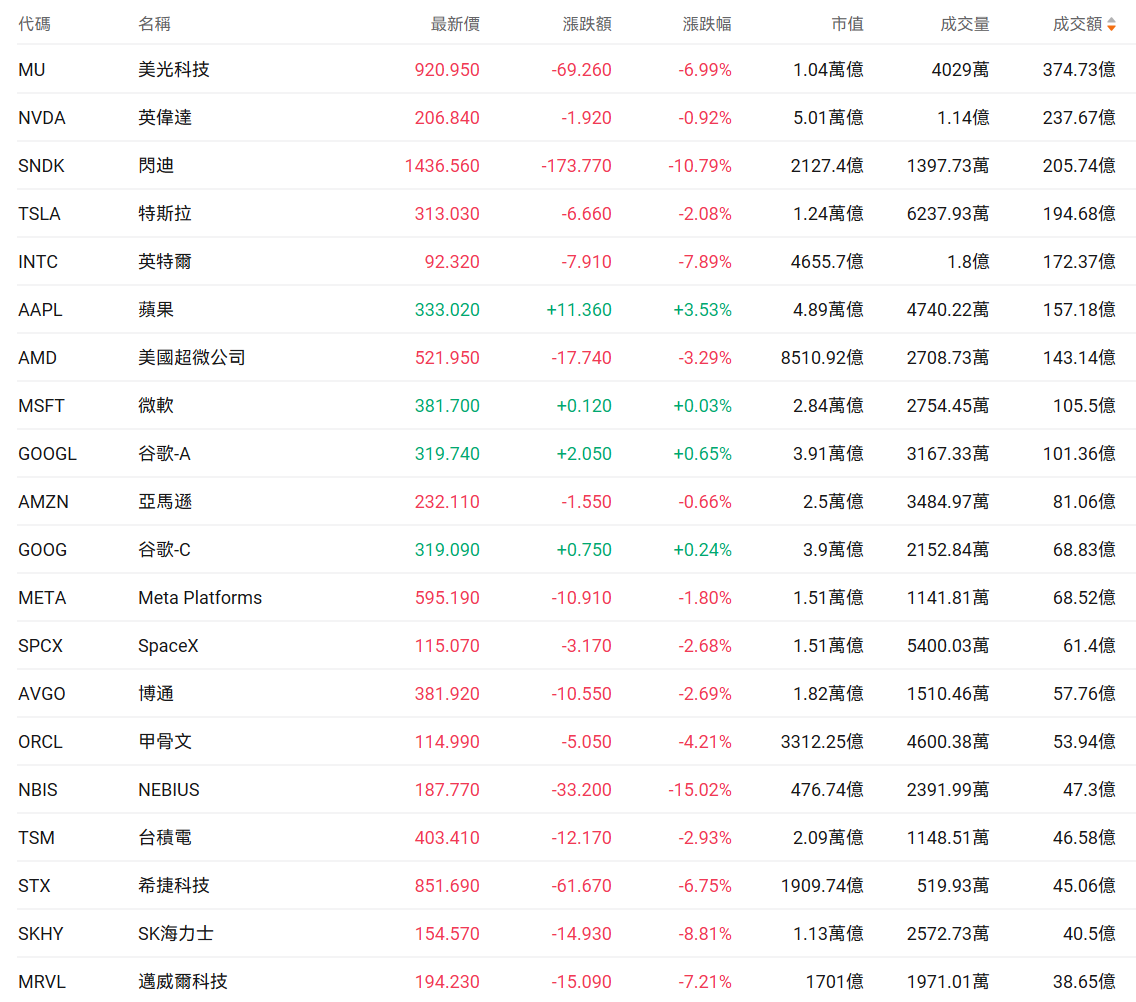
Top by trading volume on U.S. stock markets on Friday$Micron Technology (MU.US)$Closed down 6.99%, with $37.473 billion in trading volume.
Micron Technology declined on Friday as investors took profits following this week's gains, while intensifying competition from Chinese memory chip manufacturers weighed on the stock.
Earlier this week, Micron had surged after$Tesla (TSLA.US)$CEO Elon Musk stated during the company’s second-quarter earnings call that the automaker had secured a substantial supply of Micron memory chips under favorable terms. However, the gains were reversed as traders reassessed the outlook for the memory chip market.
 Chinese memory producers continue to expand their market share, raising questions about the future competitive landscape for server memory. Meanwhile, some bearish analysts have noted that DRAM pricing could soften as AI computing costs evolve.
Micron’s shares pulled back following recent gains, though Wall Street analysts remain broadly optimistic about the company’s long-term prospects.
2nd place$NVIDIA (NVDA.US)$Closed down 0.92%, with $23.767 billion in trading volume.
To address the explosive growth in demand for AI infrastructure and strengthen the U.S. domestic semiconductor supply chain, chip giant NVIDIA has entered into a strategic partnership with a leading semiconductor assembly and testing company,$Amkor Technology (AMKR.US)$securing a multi-year strategic collaboration agreement valued at $1.5 billion.
Under the agreement, NVIDIA will provide Amkor with an advance payment to support its expansion of advanced packaging and testing capacity in the United States, particularly in Arizona. The two parties will jointly develop advanced packaging technologies for next-generation AI and accelerated computing platforms, with a focus on key areas such as high-density interconnects and heterogeneous integration, aiming to integrate different types of chips into a single package to enhance the performance and energy efficiency of AI processors.
Currently, advanced packaging has become a critical bottleneck for both the performance and delivery of AI chips. Against the backdrop of$Taiwan Semiconductor (TSM.US)$insufficient CoWoS capacity, this collaboration represents another strategic move by NVIDIA—following its earlier efforts to secure supplies of critical materials such as memory and glass substrates—to ensure the shipment volumes of its AI processors.
Jensen Huang posted his first tweet—NVIDIA and more than 20 other technology companies signed an open letter supporting open-weight AI models. Elon Musk and$Microsoft (MSFT.US)$the CEO both publicly expressed their support. Musk later posted again, stating, “Next month, all code related to the X system will be open-sourced and made subject to audit.” OpenAI and Anthropic did not sign the letter. OpenAI CEO Sam Altman stated that he hopes the U.S. prevails in open-source AI and that he “welcomes” Jensen Huang’s social media statement.
3rd place$SanDisk (SNDK.US)$Closed down 10.79%, with trading volume reaching $20.574 billion.
Mehdi Hosseini, an analyst at investment bank Susquehanna, lowered SanDisk’s price target from $3,250 to $3,050 but maintained a “Buy” rating. The new target implies approximately 80% upside potential from the current share price.
Hosseini noted that the price target reduction primarily stems from the company’s revised revenue and earnings-per-share forecast errors in its prior financial model. Additionally, uncertainty remains regarding storage architectures for AI inference applications—if AI companies adopt KV Cache offloading solutions, enterprise SSD demand would surge significantly; conversely, if they continue relying on DRAM/HBM, demand for SanDisk’s flagship products would fall short of expectations.
Despite the lowered price target, Wall Street maintains a consensus “Strong Buy” rating on SanDisk, with an average target price of approximately $2,368, implying over 40% upside potential over the next 12 months. Of the 24 analysts tracked by FactSet, 21 have issued “Buy” or “Strong Buy” ratings.
4th place$Tesla (TSLA.US)$ Closed down 2.08%, with trading volume reaching $19.468 billion.
Tesla closed at $313.03 on Friday (July 24), plunging nearly 18% for the week—the worst single-week performance since 2022.
Renowned investor Michael Burry stated that he is intensifying his bearish bets on several tech stocks, increasing his short positions in NVIDIA and the VanEck Semiconductor ETF, while emphasizing that he has not yet closed his profitable short position on Tesla.
Burry gained global recognition for accurately predicting and shorting the 2008 U.S. subprime mortgage crisis and served as the real-life inspiration for the protagonist in the Oscar-winning film 'The Big Short.'
“I haven’t closed my Tesla short position. It’s shrinking on its own,” Burry wrote in a new post on Substack on Friday.
Shares of the electric vehicle maker plummeted 15% on Thursday following the release of disappointing quarterly earnings. Burry had disclosed at the end of June that he shorted Tesla at $416.22 per share.
5th place $Intel (INTC.US)$ It closed down 7.89%, with trading volume reaching $17.237 billion.
Intel reported second-quarter earnings on Thursday, posting total revenue of $16.1 billion and adjusted earnings per share of $0.42—both exceeding market expectations. This marks the company’s strongest single-quarter revenue growth in nearly 15 years, and its guidance for the third quarter also surpassed analyst estimates.
The AI infrastructure boom has driven strong demand for server processors, propelling Data Center Group revenue up 59% year-over-year to $6.3 billion. Client Computing Group (PC) revenue rose 13% year-over-year to $8.9 billion. The company has already secured 10 long-term supply agreements, facing tight capacity constraints. Foundry revenue surged 31% year-over-year to $5.8 billion, with gross margin rebounding from 2.5% a year earlier to 42%. Despite the stellar results, Intel’s stock declined on Friday, falling 28% in July, though it remains up more than 170% year-to-date.
During the earnings call, the company simultaneously announced that it is raising its 2026 capital expenditure guidance from $18 billion to over $20 billion and explicitly stated that its 2027 capital spending will be "significantly higher" than the 2026 level. CFO David Zinsner further disclosed that between 2021 and 2026, Intel’s combined capital expenditures on tools and facilities in the United States have approached $100 billion, exceeding any other semiconductor company’s single-market investment during the same period. The company is actively securing equipment purchase orders, accelerating cleanroom construction, and ensuring supply of substrates and memory.
6th place$Apple (AAPL.US)$ It closed up 3.53%, with trading volume reaching $15.718 billion.
According to the latest report from market research firm Counterpoint Research, the foldable smartphone market is expected to reach a pivotal turning point in 2026, when Apple will launch its first foldable iPhone. The firm forecasts that Apple could capture 25% of the market share in its debut year, emerging as a key force reshaping the competitive landscape.
Additionally, market sources indicate that Apple is developing the next-generation MacBook Neo, which will be powered by the A19 Pro chip. In terms of performance, the A19 Pro is approximately 10–15% faster than the A18 Pro in both single-core and multi-core CPU benchmarks. Reports note an even more significant improvement in GPU performance, with benchmark tests showing up to a 40% increase in performance for the A19 Pro.
7th place $Advanced Micro Devices (AMD.US)$ fell by 3.29%, with a trading volume of USD 14.214 billion.
On Friday, Bank of America Global Research raised its price target for Advanced Micro Devices from USD 560 to USD 620.
U.S. robotics startup Foundation Future Industries announced it will collaborate with Advanced Micro Devices to co-develop autonomous humanoid robots powered by AMD chips for military and industrial applications.
Notably, the key backer behind Foundation Future Industries is none other than Eric Trump, the younger son of U.S. President Donald Trump.
12th place $Meta Platforms (META.US)$ Fell 1.8%, with trading volume of USD 6.852 billion.
Meta is seeking $12 billion in financing for a nearly 1-gigawatt data center in Texas, with preliminary discussions indicating yields exceeding 7%—a risk premium approximately 40 basis points higher than its previous transaction nine months ago. Bond markets are repricing the tech giant's spending spree, and bonds tied to Meta’s previous $27 billion 'Hyperion' project have dropped this week to 96 cents on the dollar.
13th place$SpaceX (SPCX.US)$ Fell 2.68%, with trading volume of USD 6.14 billion.
The stock declined 7.19% cumulatively this week, marking its third consecutive week of losses.
Morgan Stanley analysts noted that recent selling pressure on SpaceX shares has driven the stock price to a level implying near-zero valuation for its artificial intelligence (AI) business. The firm believes the significant disconnect between current market pessimism and the company’s fundamentals presents an attractive entry opportunity for investors.
Since completing its record-breaking USD 86 billion initial public offering (IPO) in mid-June, SpaceX shares have faced persistent downward pressure. After an initial post-listing rally, the stock has steadily declined, briefly touching a low of USD 110.85 earlier this week—down 18% from its IPO price.
In a research report published on July 25, Morgan Stanley analyst Adam Jonas emphasized that many investors anticipate SpaceX’s share price could fall further to around USD 100 per share following the unlocking of the first tranche of lock-up shares next month. He noted that such a valuation would imply not only a complete disregard for the value of its AI business but even assign it a negative worth.
Jonas reaffirmed his “overweight” rating on SpaceX stock and maintained a USD 300 price target. In his sum-of-the-parts valuation, more than 50% of the total value derives from the company’s AI business. He stated that most investors are heavily discounting SpaceX’s AI assets, such as Grok and Cursor, primarily due to concerns over high capital expenditures, uncertain economic returns, and the substantial management attention required.
SpaceX has officially launched its biggest strategic gamble in history: it is no longer accepting commercial launch orders for Falcon 9 beyond 2028, has already ceased production of certain non-reusable components, and is fully betting on Starship—a rocket that has yet to achieve commercialization. However, Starship has faced repeated setbacks, with two test launches postponed this week alone. With only about 18 months remaining until the 2028 commercialization window, a failure to successfully transition could plunge global orbital launch capacity into a severe shortfall.
14th place$Broadcom (AVGO.US)$Closed down 2.69%, with trading volume of USD 5.776 billion.
Major Wall Street banks have begun trading the initial tranche of a USD 35 billion financing package intended to support Broadcom and Anthropic PBC’s expansion of AI infrastructure. This also means that the largest private credit transaction in history is now being opened up to a broader investor base.
According to informed sources, several banks, including Bank of America and Morgan Stanley, have been trading portions of the debt over the past week. These banks are part of a USD 24 billion syndicated distribution team for the overall debt package.
According to other anonymous informed sources,$Apollo Global Management (APO.US)$The company has also been marketing this debt offering to institutional investors. It partnered with Blackstone to arrange the USD 35 billion financing package for the borrower—a special purpose vehicle (SPV) tasked with purchasing custom-designed chips developed by Google and Broadcom and leasing them to Anthropic.
Rank 15$Oracle (ORCL.US)$Closed down 4.21%, with trading volume of USD 5.394 billion.
The U.S. Department of Defense announced on Thursday that it has signed a landmark 10-year contract worth approximately USD 7 billion with Oracle Corporation.
Ranking 16th $NEBIUS (NBIS.US)$ Closed down 15.02%, with trading volume of USD 4.73 billion.
NVIDIA filed a Schedule 13G with the U.S. Securities and Exchange Commission (SEC) this week, disclosing its holdings in$NEBIUS (NBIS.US)$22,256,400 Class A ordinary shares of the company, representing a 9.3% stake. The filing indicates that this holding includes 1,190,500 ordinary shares previously reported in NVIDIA’s Form 13F for the quarter ended March 31, as well as 21,065,900 shares issuable upon exercise of a pre-funded warrant.
Meanwhile, Northland significantly raised its price target for NEBIUS from $248 to $410, maintaining its “outperform” rating, implying potential upside of over 124%. The firm applied a valuation framework similar to that used for$CoreWeave (CRWV.US)$and expects NEBIUS to capture approximately 14% market share in the long term within the $800 billion AI-as-a-Service (AIaaS) market, with an estimated terminal-period free cash flow margin of 30%.
19th place$SK hynix (SKHY.US)$Closed down 8.81%, with trading volume of USD 4.05 billion.
South Korea's semiconductor giant$Samsung Electronics (005930.KR)$and$SK Hynix (000660.KR)$is preparing to announce multiple major AI cooperation agreements in Silicon Valley, involving long-term supply contracts for high-bandwidth memory (HBM) chips and investments in AI data centers. These agreements come as South Korean President Lee Jae-myung visits San Francisco to attend an AI summit.
Want to select stocks or get a stock diagnosis? Curious about the opportunities and risks in your portfolio? For all your investment questions,Just ask Futubull AI!

Editor/Liam