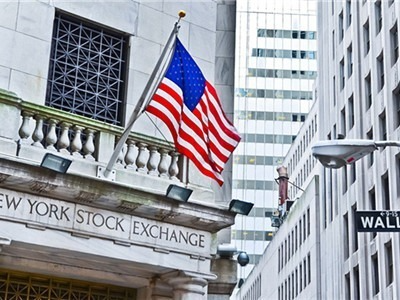
During U.S. market hours,$NASDAQ-100 Index (.NDX.US)$down 1.2%. The U.S. memory chip sector plunged more than 6.4%, withSanDisk (SNDK.US)falling 9.4%, Micron Technology down 6.6%,$Western Digital (WDC.US)$down 5.8%,$Seagate Technology (STX.US)$down 4.9%. Both Brent and WTI crude oil prices declined by over 2%.
News that Pakistan facilitated the resumption of U.S.-Iran negotiations briefly boosted risk sentiment, while falling oil prices led to a slight decline in U.S. Treasury yields, helping U.S. equities open higher.
However, reports in the afternoon that Trump and his advisers discussed escalating strikes against Iran, coupled with credit default swap (CDS) spreads for mega-cap tech firms hitting record highs, weighed on U.S. equity indices toward the close, leaving the three major benchmarks mixed.
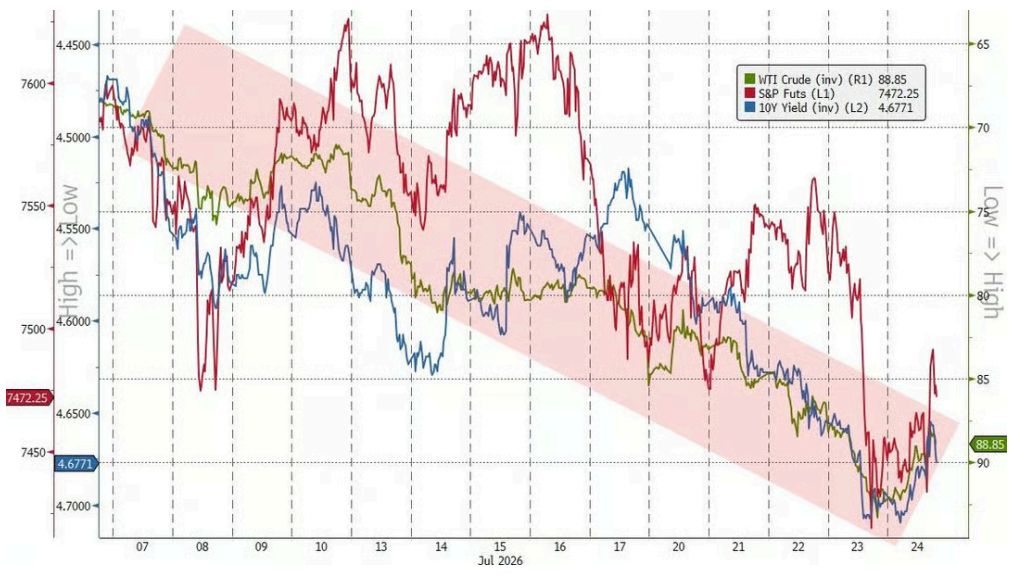
 This week, the Nasdaq underperformed among U.S. equity indices, as technology stocks faced dual pressures from both macroeconomic and fundamental factors throughout the week.
Next week will see an unusually high concentration of key events: the FOMC interest rate decision and earnings releases from companies including Meta Platforms,$Microsoft (MSFT.US)$Apple,$Amazon (AMZN.US)$and others that collectively account for 34% of the S&P 500’s total market capitalization. Implied one-week SPX volatility for next week has already reached 1.85%.
TACO trade emerges as Pakistan-mediated diplomacy pushes oil prices below $100
According to shipping data provider Kpler, only six vessels passed through the Strait of Hormuz on Thursday—the lowest level since early May—and weekly traffic has fallen to roughly one-tenth of pre-conflict levels in Iran.
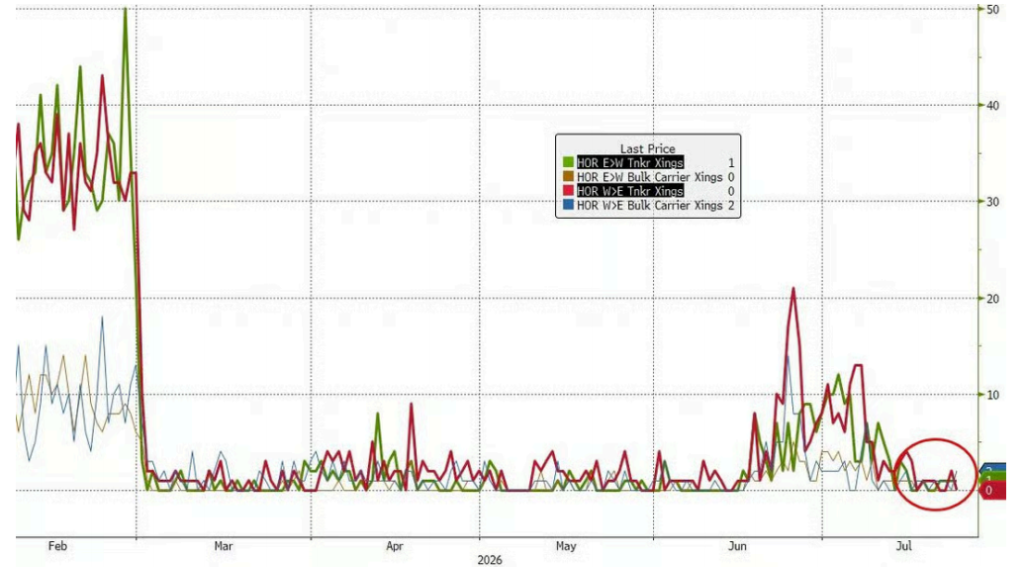
The situation in Iran has forced Saudi Arabia to reroute its oil exports via the Bab el-Mandeb Strait at the southern end of the Red Sea, but the Houthis announced this week attacks on two Saudi tankers, declaring a blockade on Saudi vessels—rendering even this alternative route increasingly precarious.
Some vessels have diverted to the Suez Canal, but this route is too shallow for fully laden very large crude carriers (VLCCs), requiring transshipment onto smaller vessels and further straining shipping capacity. Meanwhile, escalating tensions in Ukraine have led to attacks on Kazakhstan’s Black Sea export terminals, further reducing output.
According to Michelle Wiese Bockmann, an analyst at Windward, these factors collectively place approximately 25% of global oil supply at risk.
Brent crude reached an intraweek high of $100.28 per barrel before retreating on Friday amid diplomatic optimism, closing at $96.78—a weekly gain of nearly 10% and marking its third consecutive week of increases.
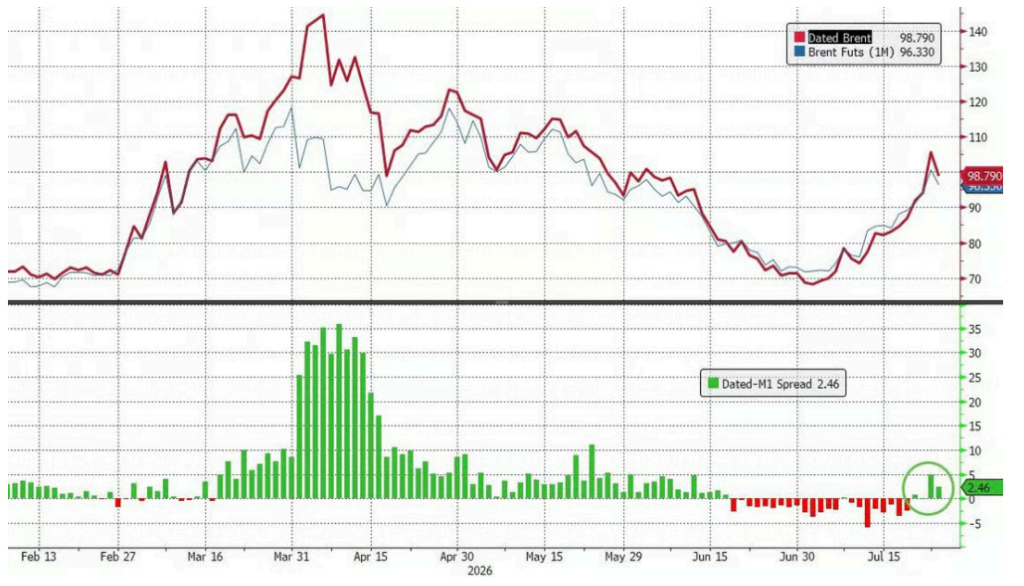
Refined product prices remain elevated at levels seen since the onset of hostilities in Iran, keeping inflation market participants on high alert.
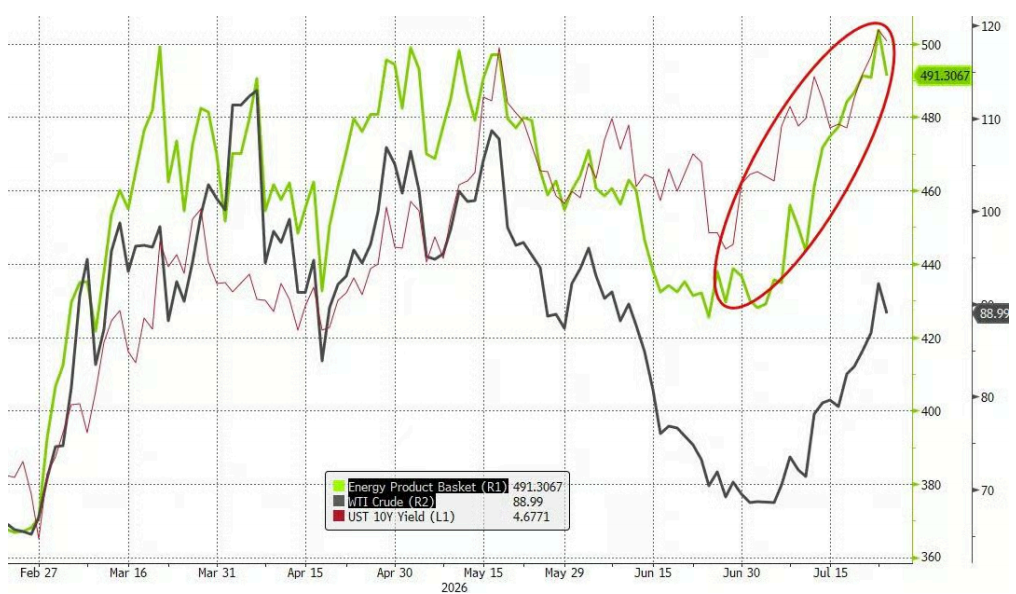
The 'TACO Index'—developed by Signum Global Advisors to measure the probability of Trump actively de-escalating—indicates, based on linear extrapolation, that the most likely window for de-escalation falls between July 26 and July 30. However, analysts stress this outlook is highly contingent on no further deterioration in the situation.
Interest Rates: Rate Hike Expectations Shift from 'Ruled Out' to 'Base Case'
Persistently rising oil prices have fundamentally reshaped the narrative in interest rate markets this week.
Just a week ago, markets were pricing in 'peak inflation' based on last week’s CPI/PPI data; this week, that narrative has been completely reversed.
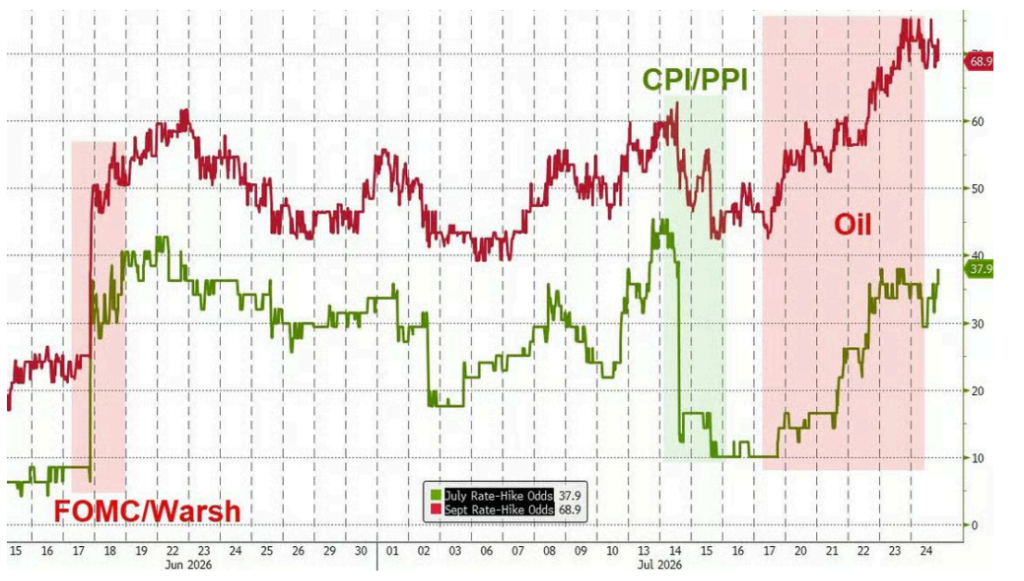
The yield on the 10-year U.S. Treasury note rose by approximately 10 basis points this week to 4.679%, reaching its highest level since the start of Trump’s second term; the 30-year Treasury yield neared 5.163%, just shy of its 19-year high. Short-end rates proved even more fragile, with the 2-year yield underperforming the long end, causing the yield curve to flatten once again.
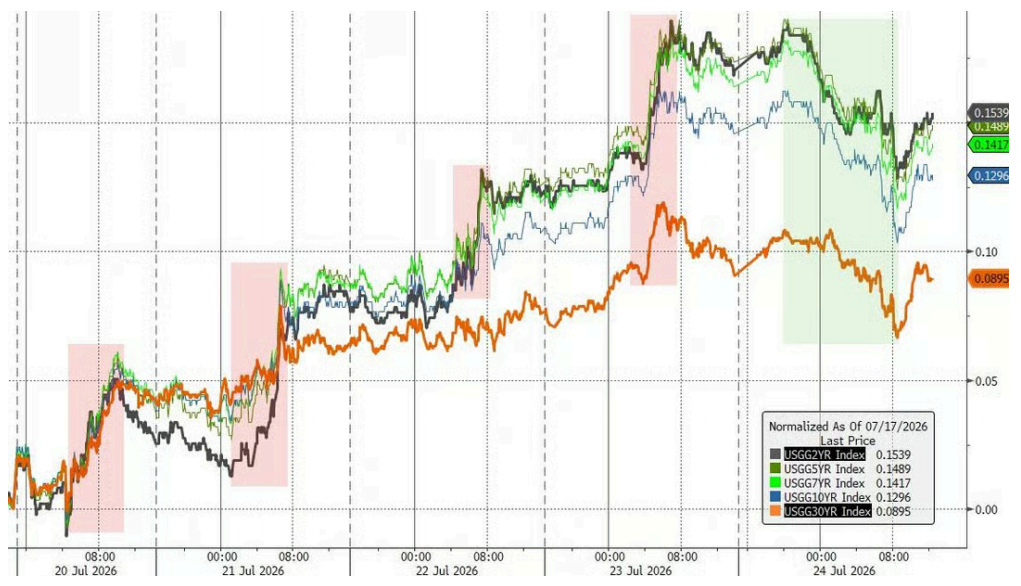
Markets are currently pricing in two Federal Reserve rate hikes this year, with about a one-in-three probability of a hike at next week’s FOMC meeting.
In a report, John Davies, U.S. rates strategist at Standard Chartered, wrote that uncertainty surrounding the Fed’s interest rate path and balance sheet will continue to weigh on the U.S. Treasury market over the coming months, noting that markets will test whether Fed Chair Waller is truly willing to 'walk the walk' on his commitment to price stability.
Brian Garrett, derivatives strategist at Goldman Sachs, pointed out that if the FOMC stands pat next week, it would constitute—within the reference frame of Powell’s tenure—the second-largest 'dovish surprise' since the 50-basis-point rate cut in 2024.
Hyperscale tech stocks: The capital expenditure narrative begins to crack
Alphabet, Google’s parent company, was the first among hyperscale tech firms this week to report earnings.
Cloud revenue surged 82% year-over-year and search revenue grew 17%—undoubtedly impressive metrics—but the company simultaneously raised its 2026 capital expenditure guidance by 8% to $195–205 billion.
The market responded by driving the stock down roughly 8%—investors’ message was clear: against the backdrop of rapidly advancing open-source models and uncertain AI monetization prospects, higher capital spending represents greater risk exposure, not a stronger moat.
$GE Vernova (GEV.US)$As a key supplier of power infrastructure for data centers, the company reported a 66% year-over-year increase in electrification orders and a backlog of 116 gigawatts, yet still saw its shares close down 3% for the week—markets worry it is overexpanding capacity late in the cycle.
$Tesla (TSLA.US)$It posted the steepest decline, falling nearly 20% for the week, as second-quarter non-GAAP earnings per share came in below expectations and investors expressed disappointment over progress on its humanoid robotics and AI product lines.
A deeper signal emerged from the credit markets: CDS spreads on mega-cap tech stocks rose to record highs this week, signaling that credit markets have begun a systematic reassessment of these companies’ refinancing capacity and earnings outlook.
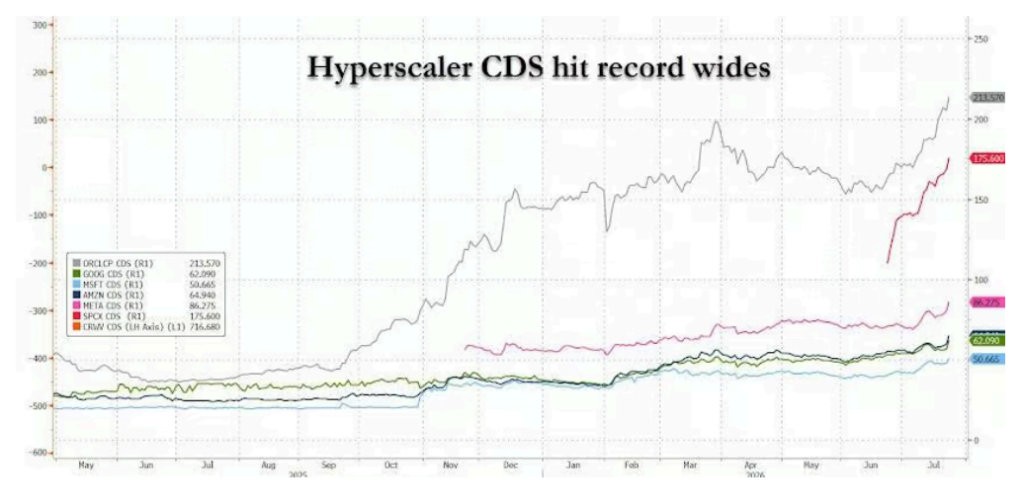
According to Goldman Sachs, $489 billion in AI-related debt has been issued year-to-date, up 50% from the full-year total in 2023. Of this, 60% was issued by non-hyperscaler firms with mixed credit quality, which analysts expect will exert gradual upward pressure on credit spreads.
On the same day, Goldman Sachs’ trading desk noted that there were virtually no large-scale buy orders throughout the session. Selling pressure in tech stocks primarily originated from long-only institutional investors, whose aggregate net selling reached one of the highest levels on record in recent history.
The Nasdaq Tech Index closed down more than 1.2% on Friday, while the semiconductor index declined over 4.2%.
U.S. equity benchmark indices:
$S&P 500 Index (.SPX.US)$It gained 3.68 points, or 0.05%, closing at 7,411.98 points, marking a weekly decline of 0.61%, following a gap-down open on July 23.
The Dow Jones Industrial Average rose 235.60 points, or 0.46%, to close at 51,947.25 points, posting a weekly loss of 0.38%.
The Nasdaq Composite fell 161.869 points, or 0.64%, closing at 24,975.824 points, for a weekly decline of 2.13%. The Nasdaq 100 dropped 326.466 points, or 1.15%, to close at 28,128.342 points, ending the week down 1.62%.
$Russell 2000 Index (.RUT.US)$It declined 0.35% to close at 2,929.999 points, marking a weekly loss of 1.09%.
The VIX fear gauge closed down 0.70% at 18.57, recording a weekly decline of 1.07%.
U.S. stock sector ETFs:
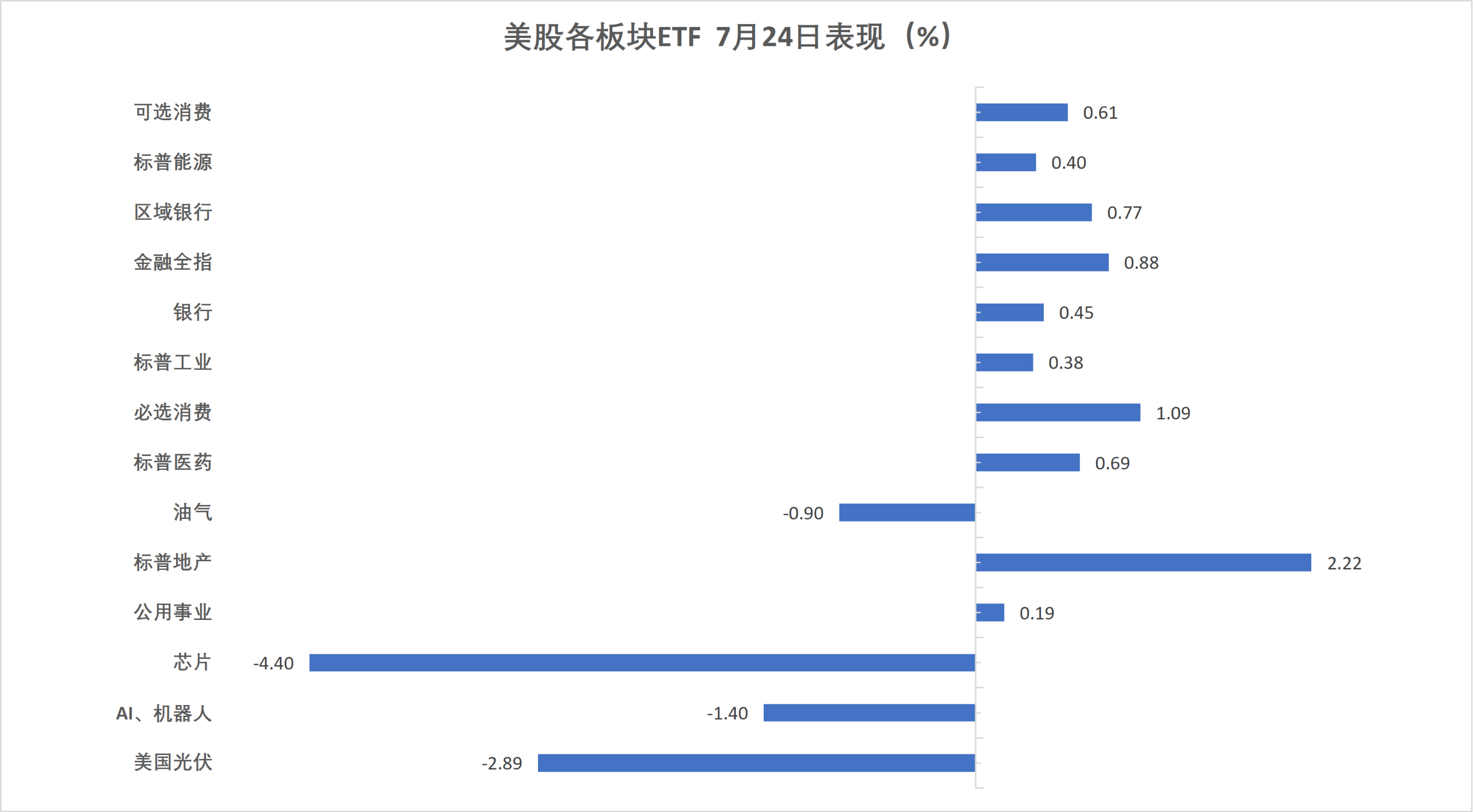
Most U.S. sector ETFs closed higher, with the Global Airlines ETF up 2.66%, the Internet Index ETF up 0.44%, and the Energy Sector ETF up 0.4%. The Technology Sector ETF declined 1.44%, the Global Technology Index ETF fell 1.69%, and the Semiconductor ETF dropped 3.27%.
Year-to-date through 2026, the Semiconductor ETF’s cumulative gain has narrowed to 55.83%, while the Energy Sector ETF is up 35.19%. The Global Technology Index ETF and Technology Sector ETF have gained at most 26.76%, the Internet Index ETF is down 3.73%, and the Consumer Discretionary ETF has fallen 8.01%.
Mag 7:
The Wind U.S. Mag 7 Index rose 0.27%.
Tesla closed down 2.08%, and Meta fell 1.80%,NVIDIA (NVDA.US)down 0.92%, Amazon declined 0.66%, Microsoft rose 0.03%, Google A gained 0.65%, and Apple surged 3.53%.
Semiconductor stocks:
$PHLX Semiconductor Index (.SOX.US)$closed down 524.952 points, or 4.25%, at 11,818.885, posting a weekly gain of 1.24%.
$Taiwan Semiconductor (TSM.US)$ADR fell 2.88%, and AMD dropped 3.29%.
U.S.-listed Chinese stocks:
The Nasdaq Golden Dragon China Index closed down 0.66% at 6,104.64, marking a weekly decline of 2.80%, continuing its downward trend.
Among actively traded Chinese ADRs,$ASE Technology Holding (ASX.US)$down 6.8%,$Nio (NIO.US)$, XPeng fell over 3%, Tencent rose 0.4%, and Meituan gained 1%.
Other stocks:
$Circle(CRCL.US)$down 0.34%.
Dragged down by a plunge in memory stocks, the Direxion Daily 3X Long Korea ETF (KORU) closed down 18.9%, while the iShares MSCI South Korea ETF (EWY) fell 6.27%.
Among cloud computing service providers,$NEBIUS(NBIS.US)$down 15.02%,$CoreWeave(CRWV.US)$down 11.37%, CBRS down 9.49%, IREN down 8.65%,$Hut 8 (HUT.US)$down 6.53%,Oracle (ORCL.US)Decreasing by 4.21%.
As crude oil prices retreated, airline service stocks strengthened,$American Airlines (AAL.US)$up 6.79%,$JetBlue Airways (JBLU.US)$,rose 5.61%,$Delta Air Lines (DAL.US)$gained 3.77%. Telecom stocks advanced,$Verizon(VZ.US)$up 5.84%,$T-Mobile US(TMUS.US)$rose 5.67%,$AT&T(T.US)$increased 5.1%.
Three optical communication stocks—ALAB (-10.82%), CRDO (-9.87%), and$Coherent (COHR.US)$(-9.84%)—led the declines, with ARM falling 8.14% and Intel dropping 7.89%,$Marvell Technology (MRVL.US)$down 7.21%.
Storage-related stocks declined across the board, with the Roundhill DRAM ETF closing down 8.75%. Western Digital fell 10.79%,$SK Hynix (SKHY.US)$down 8.81%,Micron Technology (MU.US)Down 6.99%, Western Digital fell 6.9%, and Seagate Technology declined 6.75%.
Company News
[Microsoft, NVIDIA, and other tech giants jointly state: Open weights help expand AI applications and maintain competitiveness]
Brad Smith, President of Microsoft, along with other U.S. tech industry leaders, published an article titled “Open Weights and U.S. AI Leadership,” calling for the advancement of open-weight artificial intelligence models, arguing that an open ecosystem helps broaden AI adoption and foster competition. Signatories to the article include Microsoft, NVIDIA, Meta, IBM, and several other AI-related organizations and companies.
[Verizon and Google strike over $1 billion dark fiber deal to provide connectivity for AI data centers]
Dan Schulman, CEO of U.S. telecommunications provider Verizon, stated that the company has entered into a dark fiber connectivity agreement with Google valued at over $1 billion to provide network connectivity services for Google's data centers. Schulman made the remarks during an earnings call following Verizon’s second-quarter results, adding that the company expects to announce additional partnership agreements by year-end, with these deals collectively generating several billion dollars in revenue over the coming years.
[New features for Meta AI app and Meta.ai to roll out gradually in select markets starting July 24]
$Meta Platforms (META.US)$It was announced that new features for the Meta AI app and Meta.ai will begin rolling out gradually in select markets starting July 24. Over the coming weeks, these new Meta AI capabilities will expand to additional countries and platforms, including WhatsApp. Powered by Muse Spark 1.1 technology, Meta AI can now create plans, connect email and calendar apps, generate presentations, and handle various tasks on behalf of users.
【Qualcomm (QCOM.US)Product prices will be increased by a double-digit percentage.]
Qualcomm informed customers that due to rising costs, it will have to raise product prices by a double-digit percentage. The company stated that the price increase will apply to products shipped after September 1. Qualcomm added that its ability to absorb supplier cost increases has been exhausted and that it has already attempted to source alternative components through new channels.
The eurozone blue-chip index rebounded more than 1.1% on Friday, with component SAP surging over 9.2%. For the week, the energy and materials sectors rose at least 3%, while the telecommunications sector declined 3.1% cumulatively. Germany's stock market rebounded more than 1.3% on Friday, the UK benchmark index gained approximately 1.3% for the week, and the Bloomberg Aerospace & Defense Index rose 3.6% cumulatively.
Pan-European Equities:
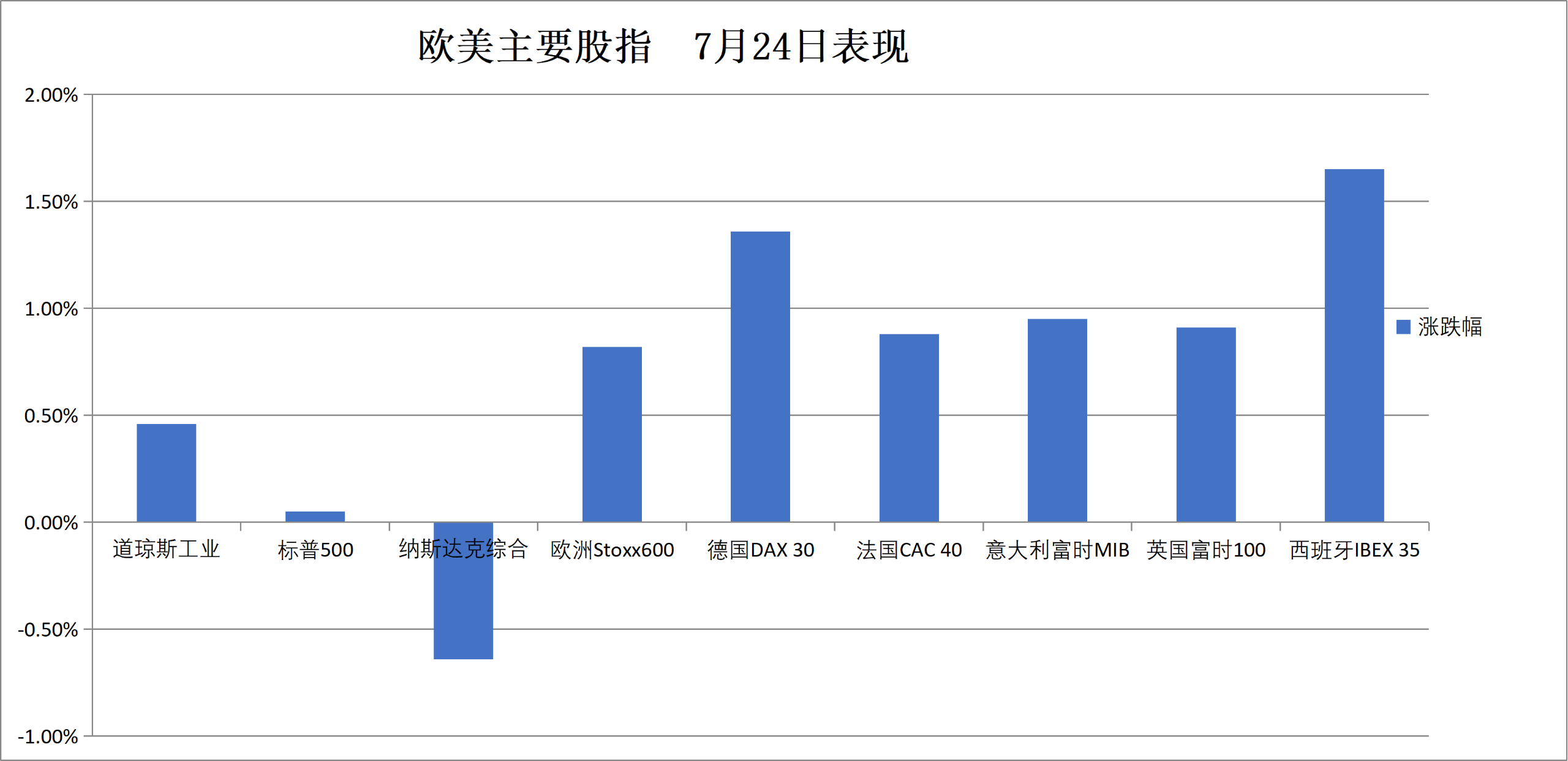
The STOXX Europe 600 Index closed up 0.82% at 644.51 points, posting a cumulative weekly gain of 0.46%.
The Eurozone STOXX 50 Index closed up 1.14% at 6,280.94 points, posting a weekly gain of 0.80%.
National stock indices:
Germany's DAX 30 Index closed up 1.36% at 25,099.00 points, recording a weekly increase of 1.08%.
France's CAC 40 Index closed up 0.88% at 8,372.28 points, with a weekly gain of 0.40%.
$FTSE 100 Index (.FTSE.GB)$It closed up 0.91% at 10,736.23 points, for a weekly gain of 1.28%.
Sector and individual stock performance:
Among Eurozone blue-chip stocks, SAP SE rose 9.26%, Wolters Kluwer gained 4.52%, Banco Santander advanced 3.17%, Safran climbed 2.61%, and BBVA increased by 2.56%.
Among all constituents of the STOXX Europe 600 Index, Valmet surged 22.05%, Acerinox rose 10.7%, and SAP ranked third in performance. Nokia (NOK.US)It declined 5.49%, ranking seventh-worst, while Sweden’s Securitas AB fell 10.97%.
By sector, the STOXX 600 Oil & Gas Index rose 4.12% for the week, the Basic Resources Index gained 3%, the Banks Index advanced 2.25%, the Industrial Goods & Services Index increased by 1.65%, and the Technology Index rose 0.57%.
Want to select stocks or get a stock diagnosis? Curious about the opportunities and risks in your portfolio? For all your investment questions,Just ask Futubull AI!

Editor/Liam