
Approximately 34% of S&P 500 constituents will report earnings next week, including four of the 'Mag7' tech giants—Microsoft and Meta are scheduled to release results on Wednesday, followed by Apple and Amazon on Thursday. Meanwhile, the Federal Reserve will announce its interest rate decision on Wednesday, with markets currently pricing in about a 30% probability of a rate hike at this meeting. The convergence of earnings reports and policy signals makes next week a pivotal juncture for third-quarter market direction.
Markets ended a turbulent week, but the real test has yet to come.
Oil prices surged nearly 10%, institutional investors dumped technology stocks en masse, and U.S. Treasury yields hit a year-to-date high—three simultaneous pressures remain unabsorbed. Next week, the busiest earnings week of the second-quarter reporting season will coincide closely with the Federal Reserve’s interest rate decision, creating the most potent combination of market catalysts seen so far this year.
 $S&P 500 Index (.SPX.US)$Approximately 34% of the index constituents will release earnings reports next week, including four of the Magnificent Seven tech giants appearing in succession—$Microsoft (MSFT.US)$and $Meta Platforms (META.US)$ scheduled to report results on Wednesday, July 29, $Apple (AAPL.US)$ and$Amazon (AMZN.US)$will follow on Thursday, July 30.
Meanwhile, the Federal Open Market Committee (FOMC) will announce its rate decision on Wednesday. Markets currently price in a roughly 30% probability of a rate hike at this meeting. The convergence of earnings reports and monetary policy signals makes next week a pivotal juncture for third-quarter market direction.
Options markets have already reacted to this risk window, with traders actively positioning for sharp post-earnings moves in large-cap tech names. Implied volatility has risen significantly: Meta’s one-day implied move stands at 7.4%, Amazon’s at 6.6%, Microsoft’s at 6.4%, and Apple’s at 3.7%. The S&P 500’s implied weekly move is approximately 1.85%, prompting Goldman Sachs’ trading desk to advise clients to increase protective positions.
Earnings season reaches its peak as tech giants face scrutiny over capital expenditures
Next week will be the busiest of the second-quarter earnings season, with 34% of S&P 500 constituents reporting results. Meanwhile, this week has seen collective skepticism toward hyperscalers’ AI-related capital spending.
Alphabet was the first to report: cloud revenue rose 82% year-over-year and search revenue increased by 17%, reflecting solid underlying performance—but it raised its 2026 capital expenditure guidance by 8% to $195–205 billion, resulting in negative free cash flow and a weekly share price decline of approximately 8%.
$Tesla (TSLA.US)$disappointed the market as well. Its Q2 non-GAAP EPS fell short of expectations, sending its stock down nearly 20% for the week, as investors grew increasingly impatient with the pace of delivery on its humanoid robotics and AI product lines.
Ken Mahoney, CEO of Mahoney Asset Management, noted that investors are deeply concerned these companies are pouring all their cash flow into AI and data centers, leaving no room for share buybacks or dividends, while returns on these investments remain largely conceptual.
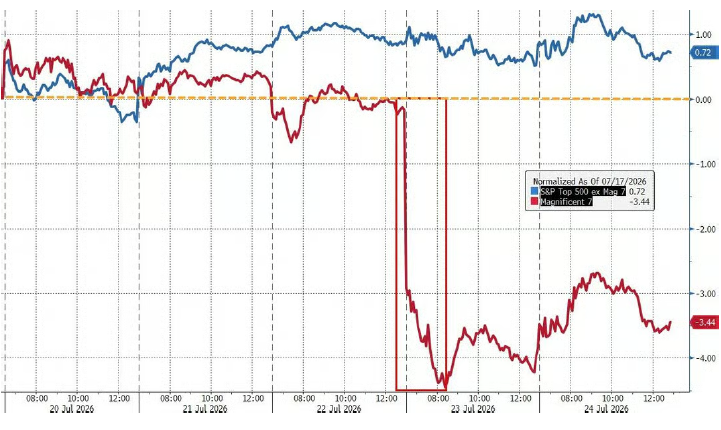
The Roundhill Mag7 ETF (MAGS) fell more than 5% this week, while semiconductor ETFs posted gains—a divergence described as 'hyperscalers punished, chipmakers rewarded.' However, this dynamic is now undermining the very foundation of the semiconductor rally: chip stocks’ gains depend on continued heavy investment by hyperscalers, who are currently being penalized by the market.
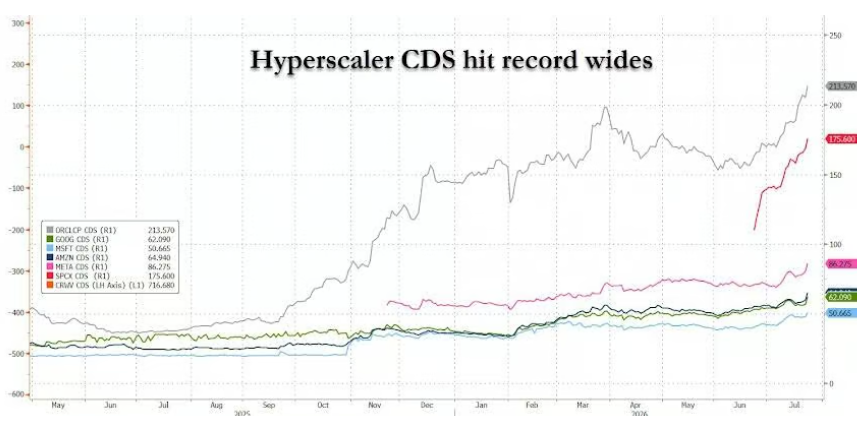
Signals from the credit market are also noteworthy: CDS spreads for hyperscalers have risen to record highs. Year-to-date, AI-related debt issuance has reached $489 billion, up 50% year-over-year, with 60% issued by non-hyperscalers.
Some traders have also noted another variable: the growing strength of the open-source model camp (with both Jensen Huang and Elon Musk publicly expressing support). The logic chain is clear—cheaper models → lower spending requirements → weaker ROI expectations → reflexively reduced capital expenditure → semiconductors reverting to their cyclical nature.
Next week will bring the busiest stretch of earnings season. Microsoft and Meta report after market close on Wednesday, July 29; Apple and Amazon follow after market close on Thursday, July 30. According to ORTS data, options markets are pricing in the following single-day implied volatility for these companies on their earnings dates: Meta at 7.4%, Amazon at 6.6%, Microsoft at 6.4%, and Apple at 3.7%.
Goldman Sachs’ trading desk flow data is also hard to ignore: overall net selling bias stands at 12.6%, with long-only (LO) funds showing a net selling bias of 21%. Selling pressure is concentrated in consumer and real estate sectors. The desk noted they are 'seeing almost no bids,' highlighted that the S&P 500 (SPX) has broken below its 50-day moving average, pointed out that market makers are in a negative gamma position, and observed a significant increase in inquiries related to CTA trigger thresholds—indicating deteriorating technical conditions.
The Fed: A 30% Uncertainty
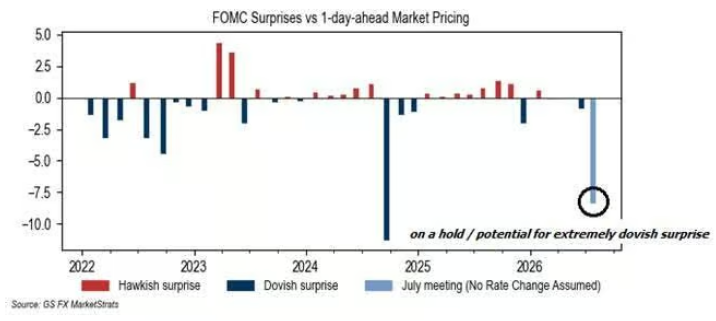
The FOMC will announce its interest rate decision on Wednesday. Market consensus expects a rate hike in September, but federal funds futures are pricing in a roughly 30%–35% probability of a hike next week. Brian Garrett, derivatives strategist at Goldman Sachs, noted that if the Fed holds rates steady, it would mark the largest 'dovish surprise' since the 50-basis-point rate cut in 2024.
Against the backdrop of oil prices pushing up inflation expectations, whether the Fed acts preemptively is the biggest macro uncertainty for next week. Key data releases scheduled for the same week include the preliminary Q2 GDP estimate, core PCE, and personal income and spending figures.
A Warning from the Volatility Market
Bloomberg analysts Neil Campling and Christian Dass pose three questions to the market: Has the AI capex trade peaked? Is the excess return from volatility dispersion trades about to end? And is risk fully priced into markets?
Extremely low implied correlation has raised concerns among some investors about a potential reversal. Some traders have already shifted to 'reverse dispersion trades'—buying index volatility while selling individual stock volatility. In the event of a macro shock triggering disorderly unwinds and broad-based equity declines, crowded positioning could amplify the rise in index volatility.
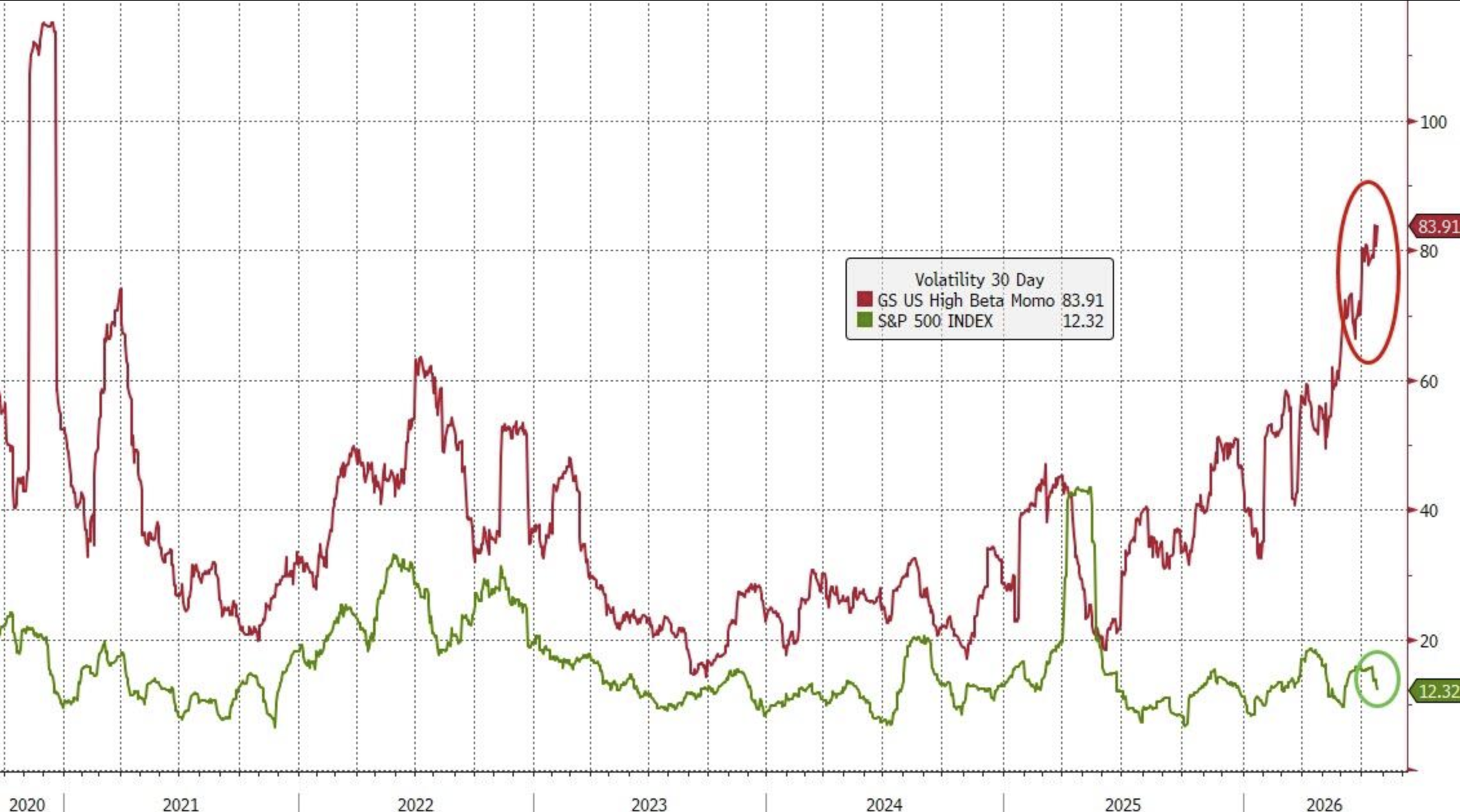
Sebastian Raedler, Head of European Strategy at Bank of America, put it more bluntly: 'Profit margin expectations, five-year forward earnings growth, and the global market capitalization-to-GDP ratio are all at historical highs, while the risk premium sits at a 20-year low—the market is pricing in a perfect, best-case scenario.'
Supportive factors have not disappeared. S&P 500 earnings for Q2 are expected to rise 38% year-over-year, far exceeding initial forecasts—corporate earnings remain the bulls’ strongest card. Dirk Willer, Global Head of Macro Strategy at Citi, remains bullish but acknowledges that risks are 'plentiful.' 'Markets continue climbing the wall of worry.' However, if July ends in the red, August and September historically rank as the weakest months in midterm election years—with average S&P 500 declines of 0.4% and 0.8%, respectively.
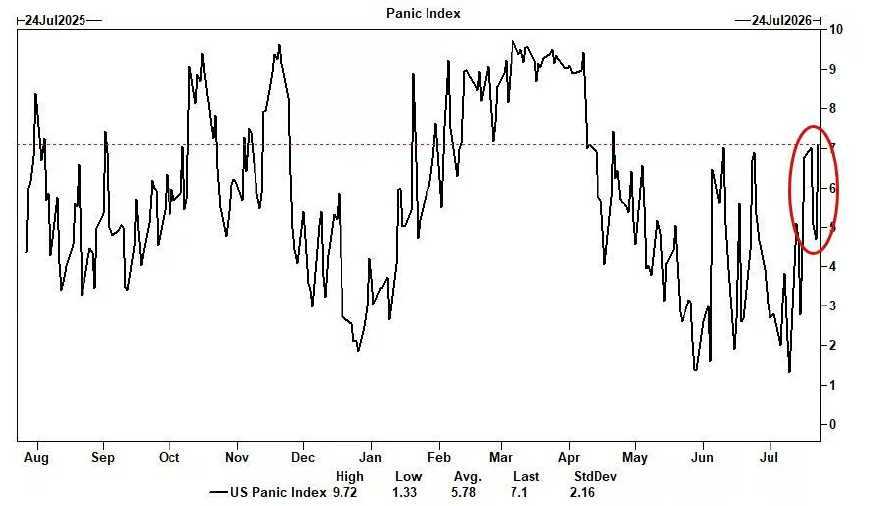
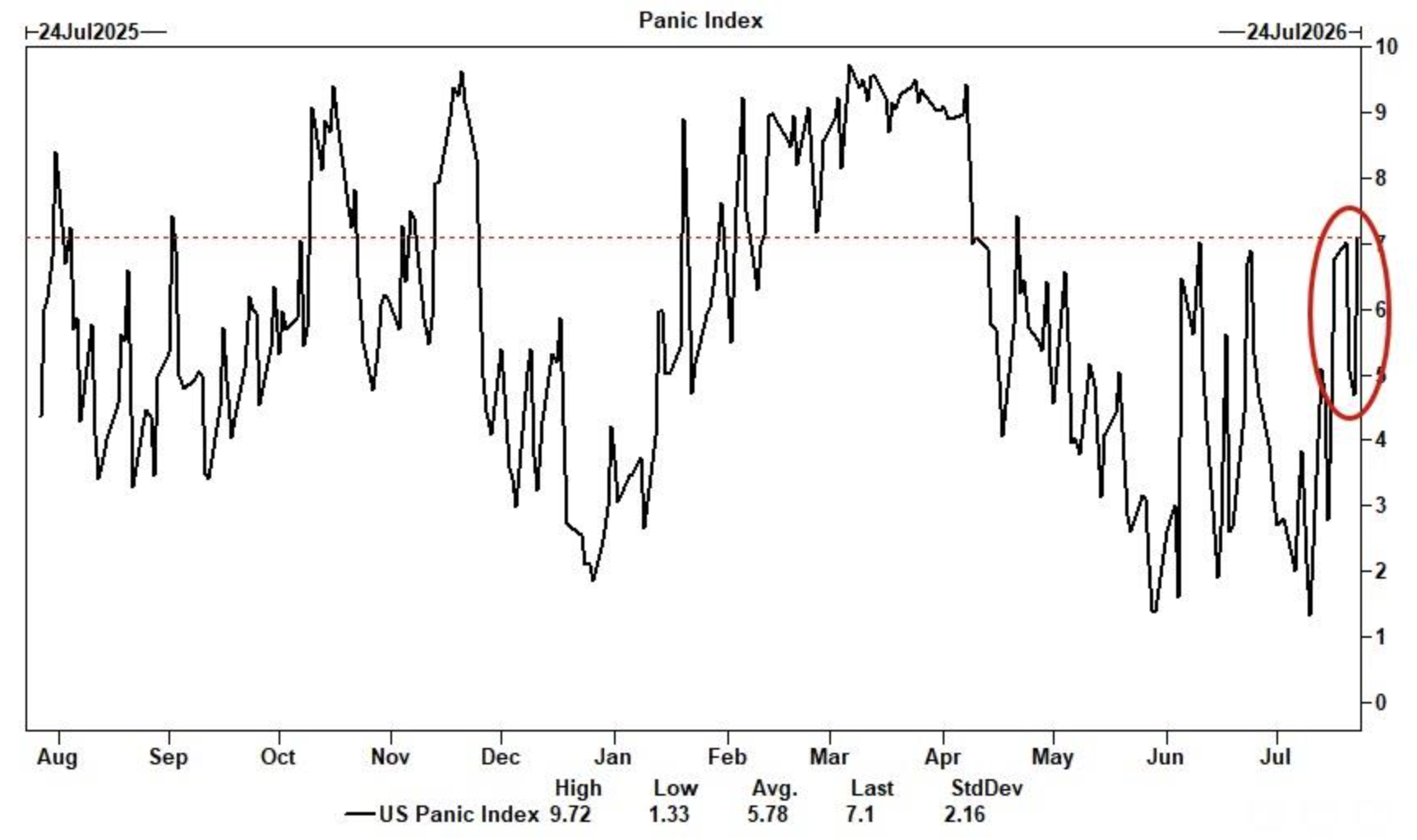
Goldman Sachs' fear gauge has returned to levels last seen during the Iran war. Next week, 34% of the S&P 500’s market capitalization reports earnings, four of the Magnificent Seven face scrutiny, and the Federal Reserve delivers its decision—the answers are coming soon.
Edited by Jeffy