
NVIDIA has gained only 10% this year, with its valuation falling to a five-year low and its price-to-earnings ratio halved compared to its historical average, while AMD and Micron have surged by 142% and 213%, respectively—suggesting the market has effectively 'downgraded' it from a growth stock to a mature large-cap stock. However, analysts estimate its fair value is undervalued by more than 30%. With cloud providers continuing to expand their capital expenditures and NVIDIA’s share of the inference chip market rising despite headwinds, it could emerge as the ultimate safe haven should an AI winter arrive.
$NVIDIA (NVDA.US)$ Its stock price has risen just 10% this year, and its valuation has fallen to a near-five-year low, while competitors $Advanced Micro Devices (AMD.US)$ and $Micron Technology (MU.US)$ yet surged by 144% and 222%, respectively. Market pricing appears to anticipate that every potential adverse outcome will materialize—but analysts believe this precisely creates opportunities for investors with a long-term horizon.
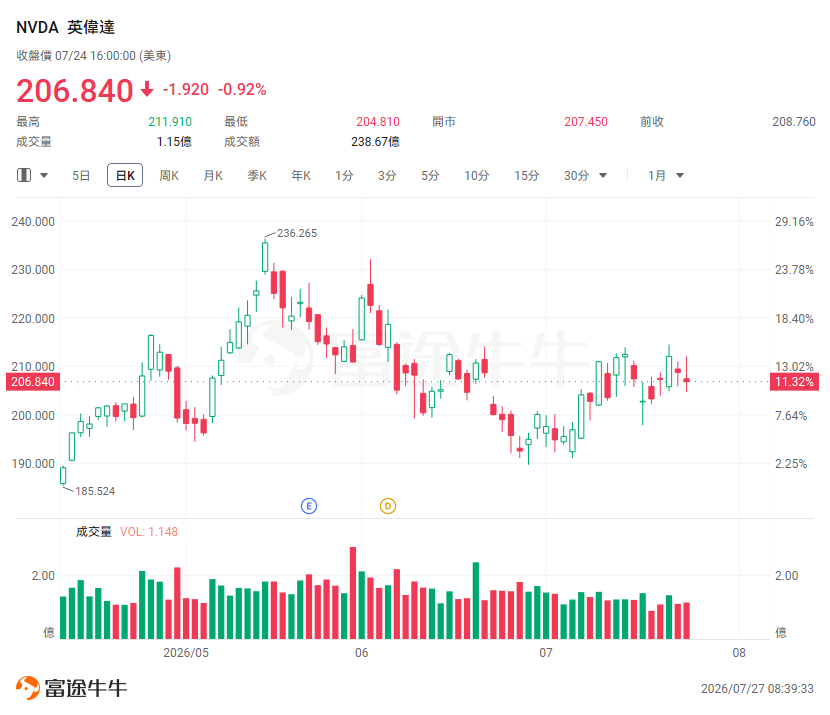
Morningstar analyst Brian Colello noted that NVIDIA’s current share price of approximately $212 implies the company will see virtually no growth beyond 2027. He believes the stock’s fair value should be closer to $280, or roughly 16 times its expected fiscal 2029 revenue. According to S&P Global Market Intelligence, NVIDIA’s current EV/EBITDA multiple stands at about 17 times next year’s expected earnings—well below its five-year average of 36 times and at its lowest level since July 2021.
 Meanwhile, capital expenditures by hyperscale cloud providers show no signs of peaking. Alphabet raised its capital spending outlook for 2026 this week and indicated it would further increase investments next year, providing sustained support for AI chip demand.
Rivals Surge as NVIDIA’s Valuation Falls into 'Value Stock' Territory
Against the backdrop of $PHLX Semiconductor Index (.SOX.US)$ a 71% gain so far this year, NVIDIA’s performance appears particularly lackluster. Advanced Micro Devices trades at 53 times next year’s expected earnings and is viewed by the market as a growth stock; Micron Technology, meanwhile, has benefited from surging AI data center demand, with its shares up more than 200% year-to-date.
John Belton, portfolio manager at Gabelli Funds, stated that semiconductor investors are chasing names they believe exhibit “the strongest supply-demand imbalances and untapped growth opportunities.” He added, “NVIDIA currently doesn’t meet any of those criteria.” Belton has recently continued adding to his positions in AMD and Micron Technology but has held steady on NVIDIA, maintaining his existing stake without increasing it.
Underlying this valuation divergence is the market’s reclassification of NVIDIA—from a growth stock to a large, mature technology company.
Bearish Narrative: New Entrants Emerge, Scale Constrains Growth
A clear narrative has emerged around NVIDIA’s challenges. Since OpenAI launched ChatGPT, the AI chip market has attracted numerous new entrants: startups such as SambaNova and $Cerebras Systems (CBRS.US)$ have introduced their own chips; Google, which developed its proprietary AI chips years ago, now sells them externally and leases them via the cloud;$Amazon (AMZN.US)$ others are following closely behind; $Meta Platforms (META.US)$ 、$Microsoft (MSFT.US)$ Amazon, OpenAI, and Anthropic are all advancing their own in-house chip development initiatives.
AMD is set to begin shipping its first AI server rack system, Helios, later this year—a highly integrated system comprising AI chips and complementary hardware designed to directly compete with NVIDIA’s Grace Blackwell and Vera Rubin product lines.
Moreover, the sheer scale of its revenue itself imposes a ceiling on growth rates. NVIDIA’s revenue base is already substantial, making direct comparisons of its growth rate with smaller competitors inherently incomparable in magnitude.
Bulls counter: Valuation is overly pessimistic; growth prospects are undervalued
There is a clear disconnect between analysts’ forecast data and current market pricing.
According to analyst estimates, NVIDIA’s revenue for the next fiscal year (ending January 2028) is projected to grow by 42% to $560 billion, followed by another 23% increase the following year. In contrast, while AMD is expected to see revenue growth of 57% in 2027 and 36% in 2028, its absolute scale—projected at only around $78 billion in 2027—is orders of magnitude smaller than NVIDIA’s, making it difficult to justify AMD’s current valuation premium of 53 times.
Brian Colello noted that NVIDIA is "remarkably cheap when valued on a multi-year horizon," with the key question being whether capital expenditures by hyperscale cloud providers and enterprises will remain robust two years from now and whether NVIDIA can maintain its market share.
"We believe the answer is yes, which is precisely why the stock is undervalued," he said, forecasting that NVIDIA will achieve annual revenue and adjusted earnings per share growth exceeding 45% through fiscal year 2029.
Moat remains intact: Rising inference market share and countercyclical resilience should not be overlooked
Despite mounting competitive pressures, NVIDIA’s dominant position in the AI chip market remains unshaken. According to a recent report by The Information, NVIDIA’s share of the inference chip market—the chips used to run models rather than train them—has actually increased.
More notably, NVIDIA’s countercyclical resilience may be underestimated by the market. If tech companies like OpenAI scale back AI investments, many firms that have only recently entered chip development may abandon in-house efforts and return to NVIDIA’s ecosystem—meaning an AI downturn could impact NVIDIA less severely than newer chip designers whose products have yet to be fully validated by the market.
Moreover, NVIDIA's strategic investments in$NEBIUS (NBIS.US)$、$CoreWeave (CRWV.US)$and other emerging cloud service providers, although recently questioned, are expected to provide a buffer for its business during market downturns. At a time when hyperscale capital expenditures continue to expand, whether NVIDIA's pricing truly reflects its fundamentals has become the central point of market debate.
Editor/rice