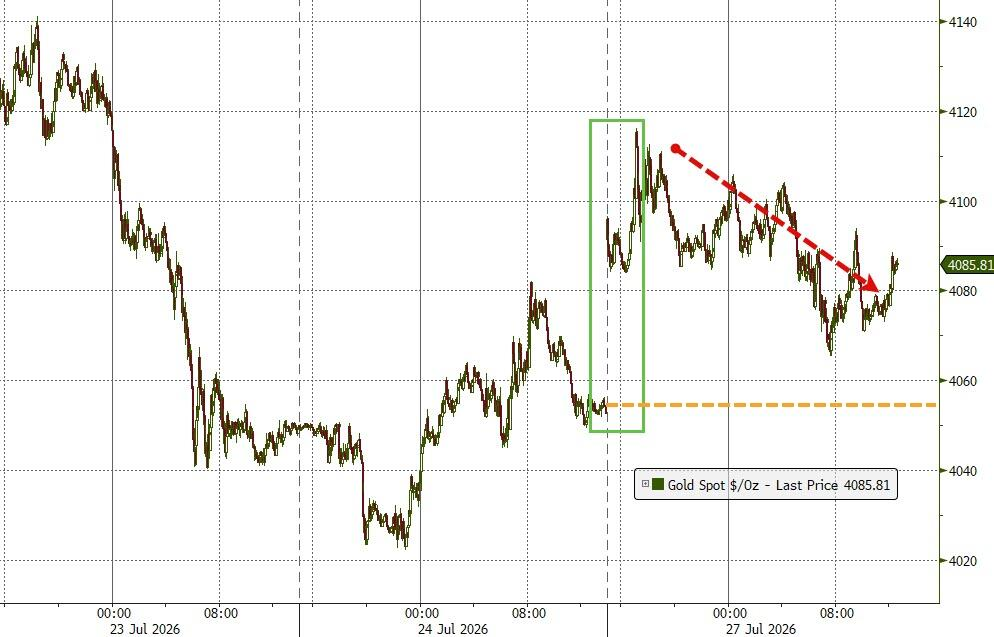
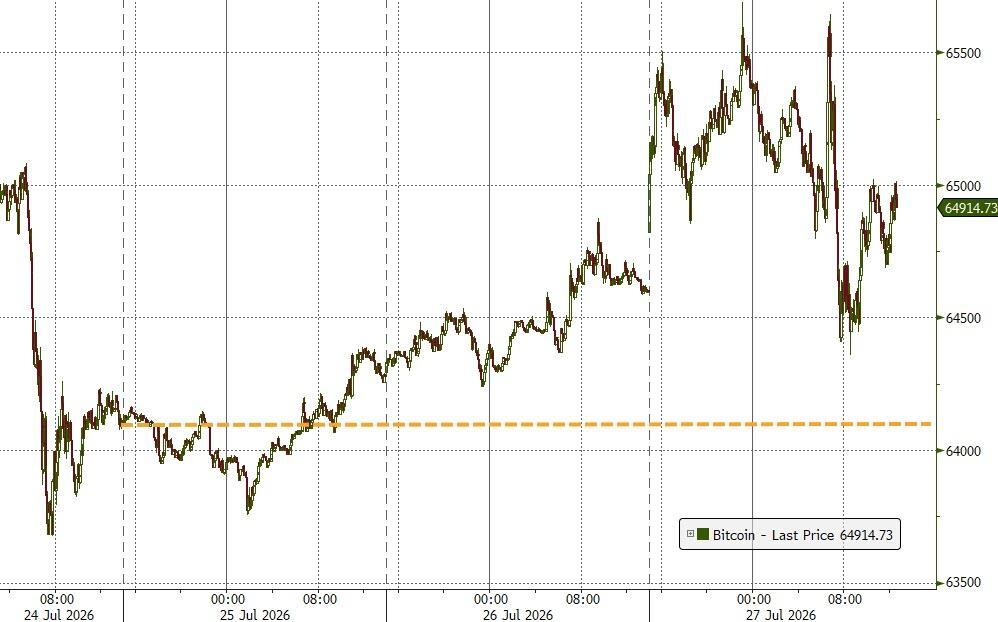
$S&P 500 Index (.SPX.US)$Nearly flat,Nasdaq Composite Index (.IXIC.US)fell approximately 0.16%, while the Dow Jones Industrial Average rose about 0.49%. Pressure on technology stocks left markets particularly vulnerable ahead of$Microsoft (MSFT.US)$、$Amazon (AMZN.US)$, Meta, and Apple’s earnings week. The yield on the 10-year U.S. Treasury note declined by 3 basis points to 4.64%, while gold rose 0.7% to USD 4,082.87 per ounce,$Bitcoin (BTC.CC)$edging up modestly by 0.6%.
U.S. stocks diverged on Monday, with semiconductor shares leading a decline in the technology sector that offset the boost from a sharp drop in oil prices. Market sentiment remained cautious ahead of a busy earnings season this week.
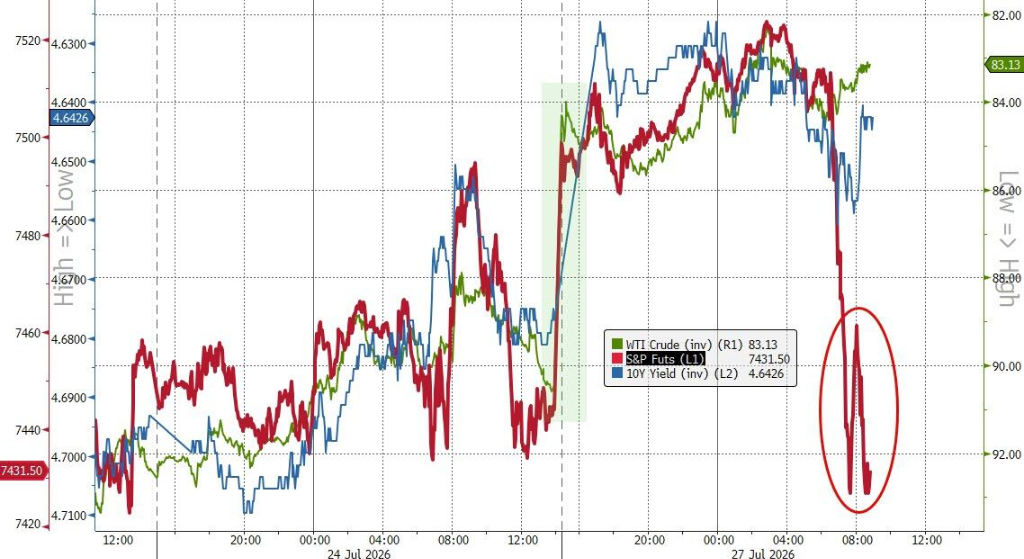
Trump stated he had paused airstrikes on Iran to leave room for negotiations, prompting a sharp decline in oil prices. WTI crude fell more than 8% in a single day, marking its largest one-day drop in nearly two months. However, losses in the semiconductor sector dragged the Nasdaq into negative territory.
 The S&P 500 ended virtually flat, while the Nasdaq Composite declined by approximately 0.16%, and the Dow Jones Industrial Average rose about 0.49%. Pressure on tech stocks left markets particularly vulnerable as they approached an earnings-heavy week featuring Microsoft, Amazon, Meta, and Apple.
The yield on the 10-year U.S. Treasury note fell by 3 basis points to 4.64%, gold rose 0.7% to $4,082.87 per ounce, and Bitcoin edged up 0.6%.
Oil prices plunged, and the TACO logic worked once again.
WTI crude dropped approximately 8.2% on Monday to around $81.96 per barrel, its steepest one-day decline in nearly two months, while Brent crude also fell to around $89 per barrel.
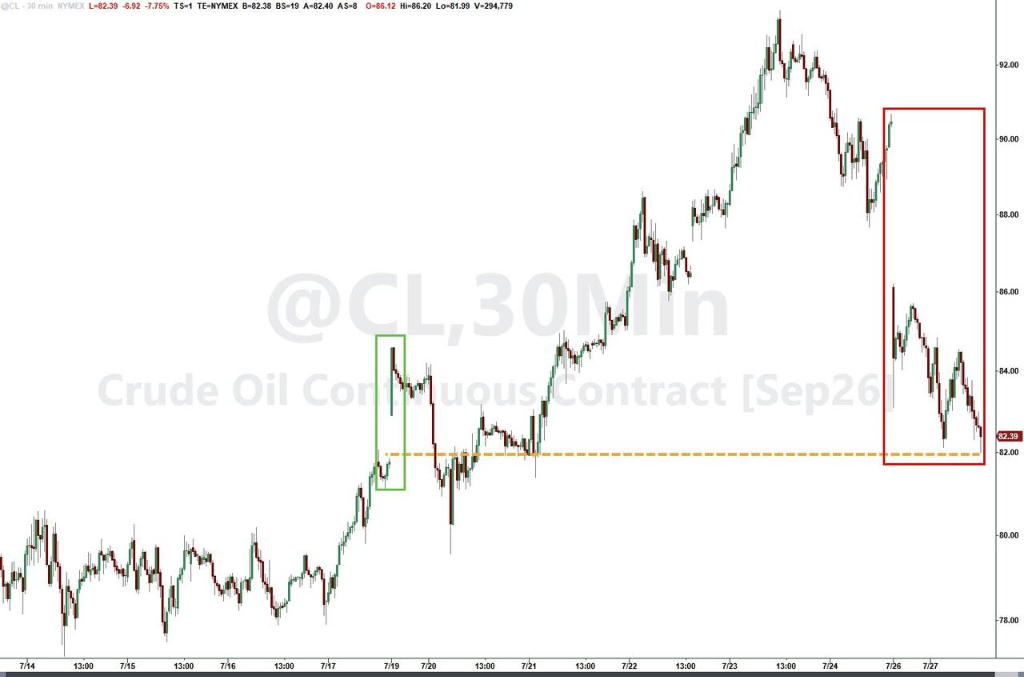
According to Axios, as cited by Xinhua News Agency, he had decided to suspend U.S. strikes on Iran to give diplomacy another chance. He also emphasized that if diplomatic efforts fail, he might order the resumption of military action against Iran.
Meanwhile, Iran signaled restraint in retaliating and initiated consultations via Oman regarding the Strait of Hormuz. Additionally, the Caspian Pipeline Consortium’s export terminal on Russia’s Black Sea coast resumed oil loading operations after being disrupted earlier when shipowners avoided the facility following Ukrainian drone attacks, which had temporarily hindered Kazakh crude exports.
Rich Privorotsky of Goldman Sachs characterized this pattern as follows: The Trump administration’s policy framework exhibits strong reflexivity—whenever energy prices surge sharply or financial assets experience significant sell-offs, it triggers a de-escalatory response. He wrote:
“That is precisely why the market has largely ignored the conflict from the outset—and why it will continue to do so.”
Bart Melek, Global Head of Commodity Strategy at TD Securities, noted that investors are unwinding long positions—concerned that inventories could fall to critically low levels—while simultaneously establishing short positions more aggressively, betting that a full-scale war can be avoided. He stated:
High oil prices carry significant political costs, and reported shortages of missile interceptors have further complicated efforts to de-escalate the situation.
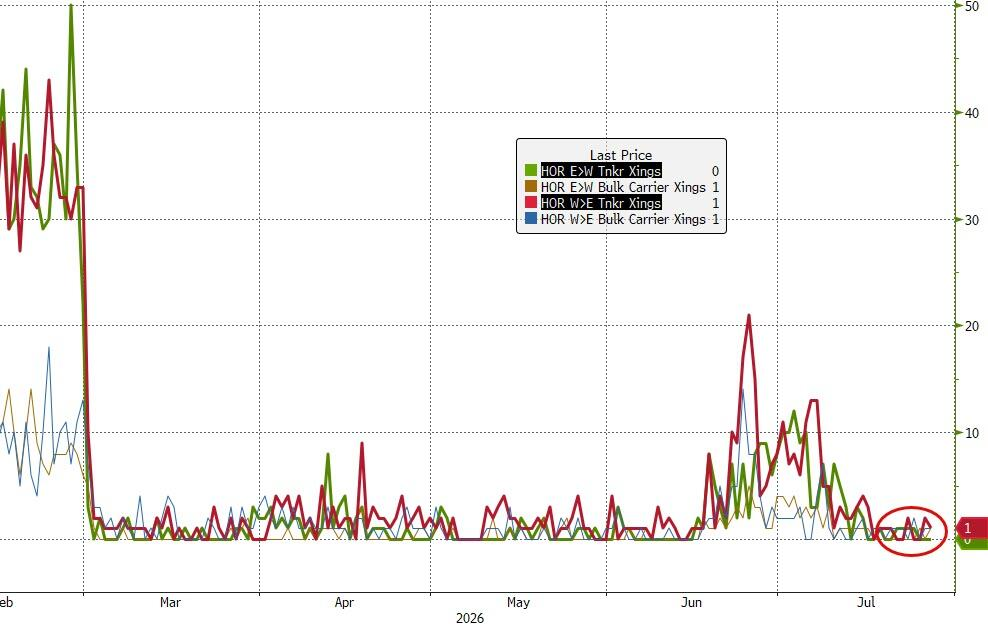
According to Kpler data, maritime traffic through the Strait of Hormuz was sparse on Sunday, with only eight commodity vessels transiting—mostly small refined product tankers and dry bulk carriers.
Chip stocks plunge: Disruptions in China’s supply chain become evident
U.S. equities diverged on Monday, with the S&P 500 nearly flat, the Nasdaq Composite down approximately 0.16%, and the Dow Jones Industrial Average rising about 0.49%.
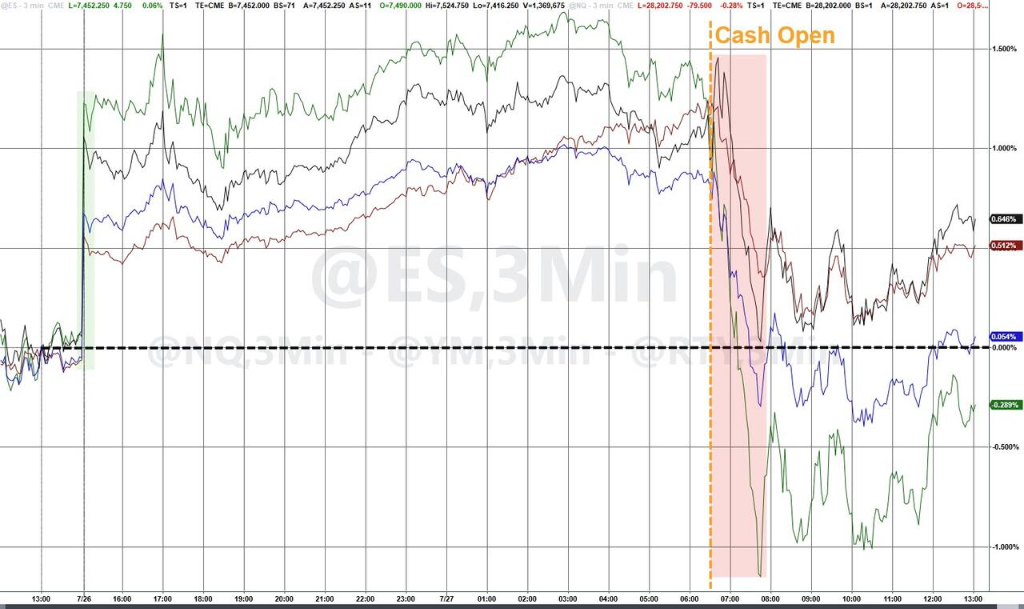
Oil prices fell sharply, and although U.S. equity indices opened higher, a steep decline in the semiconductor sector prevented technology stocks from benefiting, making it the day’s largest market drag.
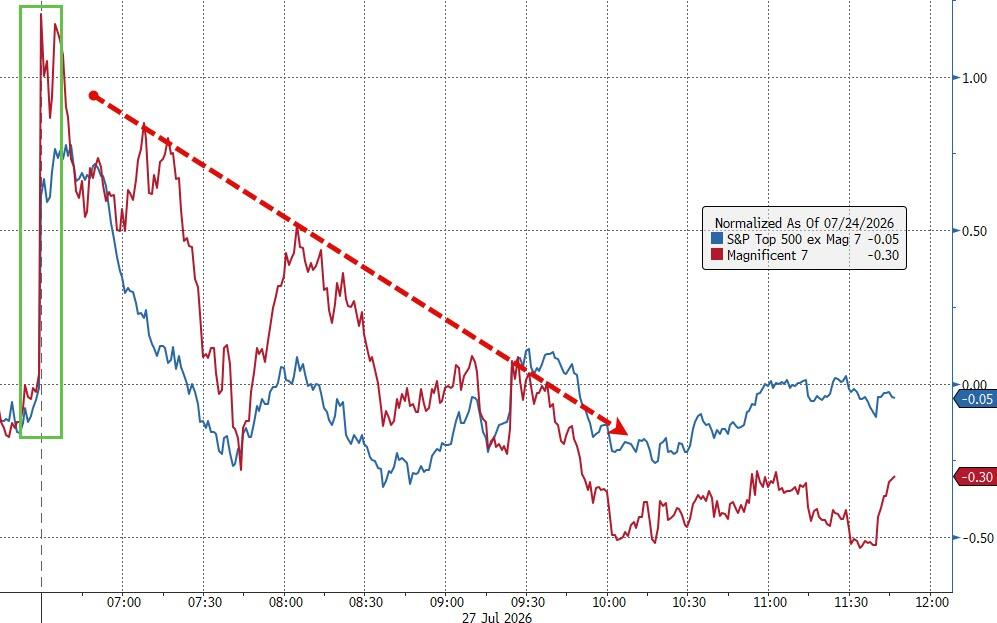
Both the Mag 7 and the S&P 493 erased all their earlier gains, with the Mag 7 performing slightly worse.
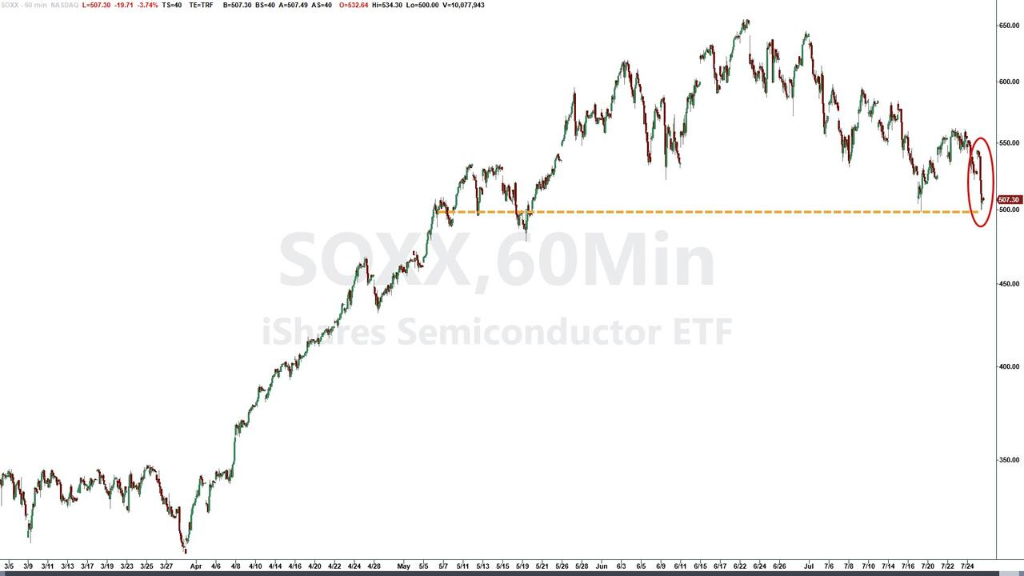
$PHLX Semiconductor Index (.SOX.US)$continued its recent decline, now down approximately 20% from its record closing high reached on June 22.
Changxin Technology, a memory chip manufacturer, surged 466% on its debut trading day, becoming the largest A-share company by market capitalization in China. Market participants widely interpret this as a signal that China is accelerating its path toward self-sufficiency in DRAM production.
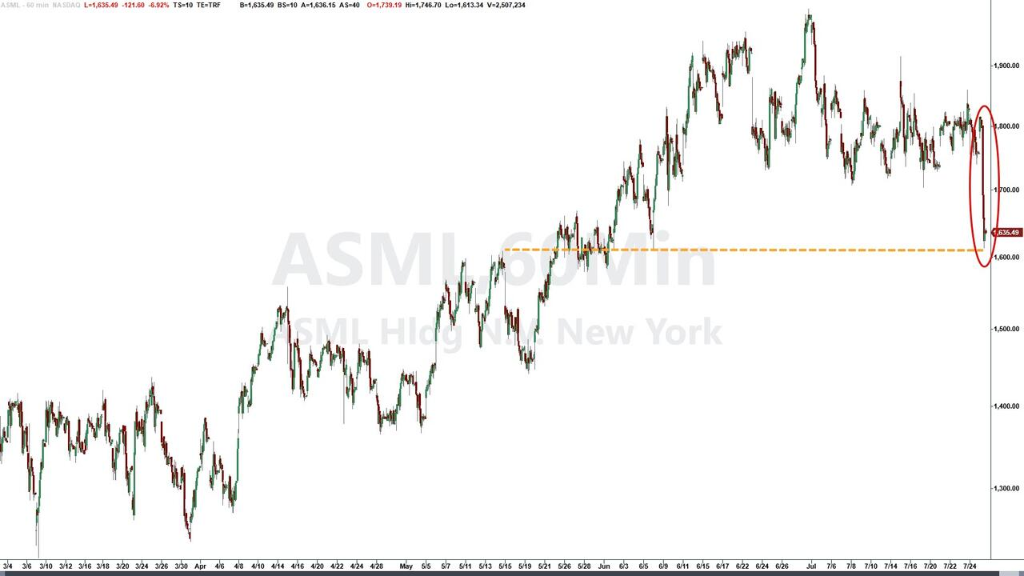
ASML Holding’s shares tumbled 5.8% on Monday.
Michael Ball of Bloomberg also noted thatNVIDIA (NVDA.US)the latest infrastructure agreements—including a partnership with SK Group exceeding USD 500 billion and reports of up to USD 250 billion earmarked to assist OpenAI in leasing computing power—have reignited market concerns about the cash flow logic underpinning AI-related capital expenditures and raised additional worries regarding supplier financing risks.
Chris Hussey of Goldman Sachs stated:
The S&P 500’s recent two-month period of stagnation stems more from market doubts over the sustainability of AI infrastructure investment than from concerns about oil prices, interest rates, or any other macroeconomic factors.
Data show that on the day in question, the S&P 500 rose 0.8% excluding AI-related stocks, significantly outperforming the index as a whole.
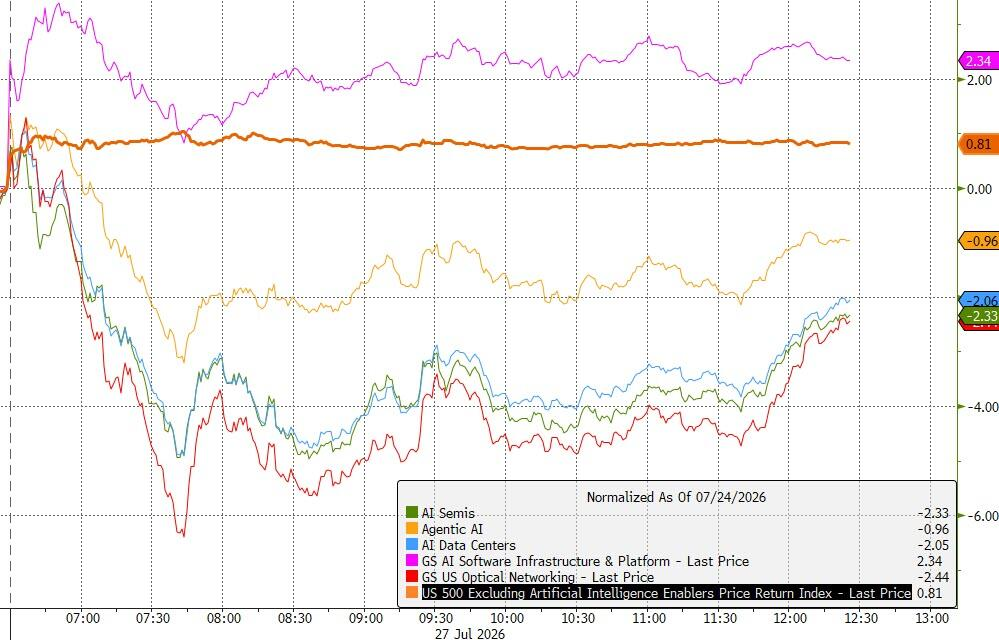
Approximately 34% of the S&P 500’s total market capitalization will report earnings this week, including Microsoft, Meta, Amazon, and Apple. Market participants are closely watching these hyperscale cloud providers for their latest commentary on capital expenditure plans.
Chris Larkin of Morgan Stanley stated:
Geopolitical tensions and oil prices may be the biggest sources of uncertainty this week, but even strong earnings from the Mag 7 may not convince the market—particularly if doubts about the scale of AI spending persist.
JPMorgan’s team led by Andrew Tyler indicated that its tactical positioning indicator points to “significant upside potential” for the S&P 500, while simultaneously highlighting crowded semiconductor positions and the Iran conflict as key risks.
The team said it maintains a “tactically bullish” stance, expecting U.S. equities to benefit from declining bond yields, a weaker dollar, and robust corporate earnings.
The Federal Reserve faces unusually high uncertainty.
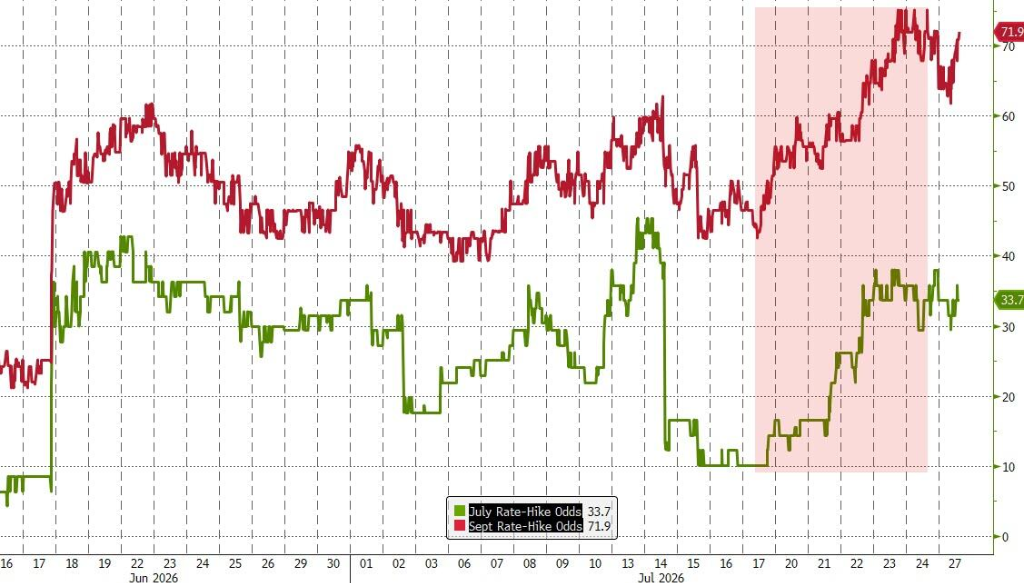
This week’s Federal Reserve policy meeting is another key market variable. Interest rate futures currently imply a roughly 34% to 38% probability of a 25-basis-point rate hike this week—a level of uncertainty that is unusually high on the eve of an FOMC decision.
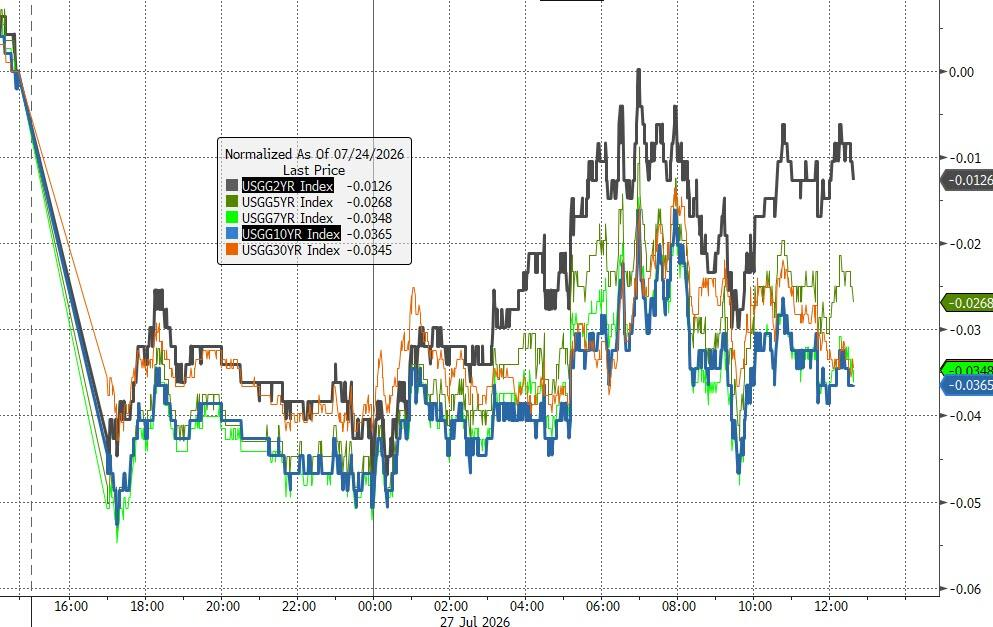
Bond markets showed relatively muted performance on Monday, with short-end U.S. Treasury yields underperforming long-end yields, continuing the flattening trend in the yield curve. Demand was strong at the 2-year note auction, while the 5-year note auction was only modest, with weak indirect bid demand.
Bloomberg’s Sebastian Boyd highlighted a notable contradiction: on one hand, the Fed’s communication tone has turned markedly hawkish, with Lorie Logan and Beth Hammack successively issuing warnings about further rate hikes, and Governor Chris Waller stating that risks in the U.S. have 'tilted decisively' toward inflation.
On the other hand, short-term inflation expectations have fallen to their lowest level in over a year, and long-term inflation expectations have also declined significantly in recent months. Multiple benign inflation indicators suggest that, despite elevated oil prices, the previously feared second-round inflationary effects have not yet materialized.
Performance of Other Major Asset Classes
The dollar closed flat, rebounding from earlier-session weakness.
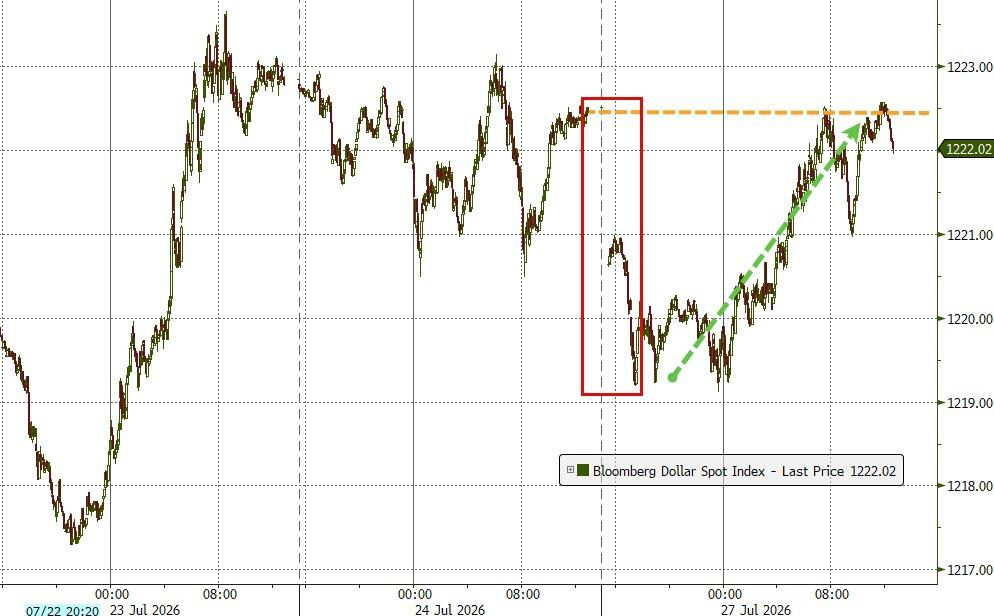
Gold rallied intraday but gave back gains, failing to hold above $4,100.
Bitcoin experienced wide intraday swings and ultimately rose 0.34% compared to Sunday’s close.
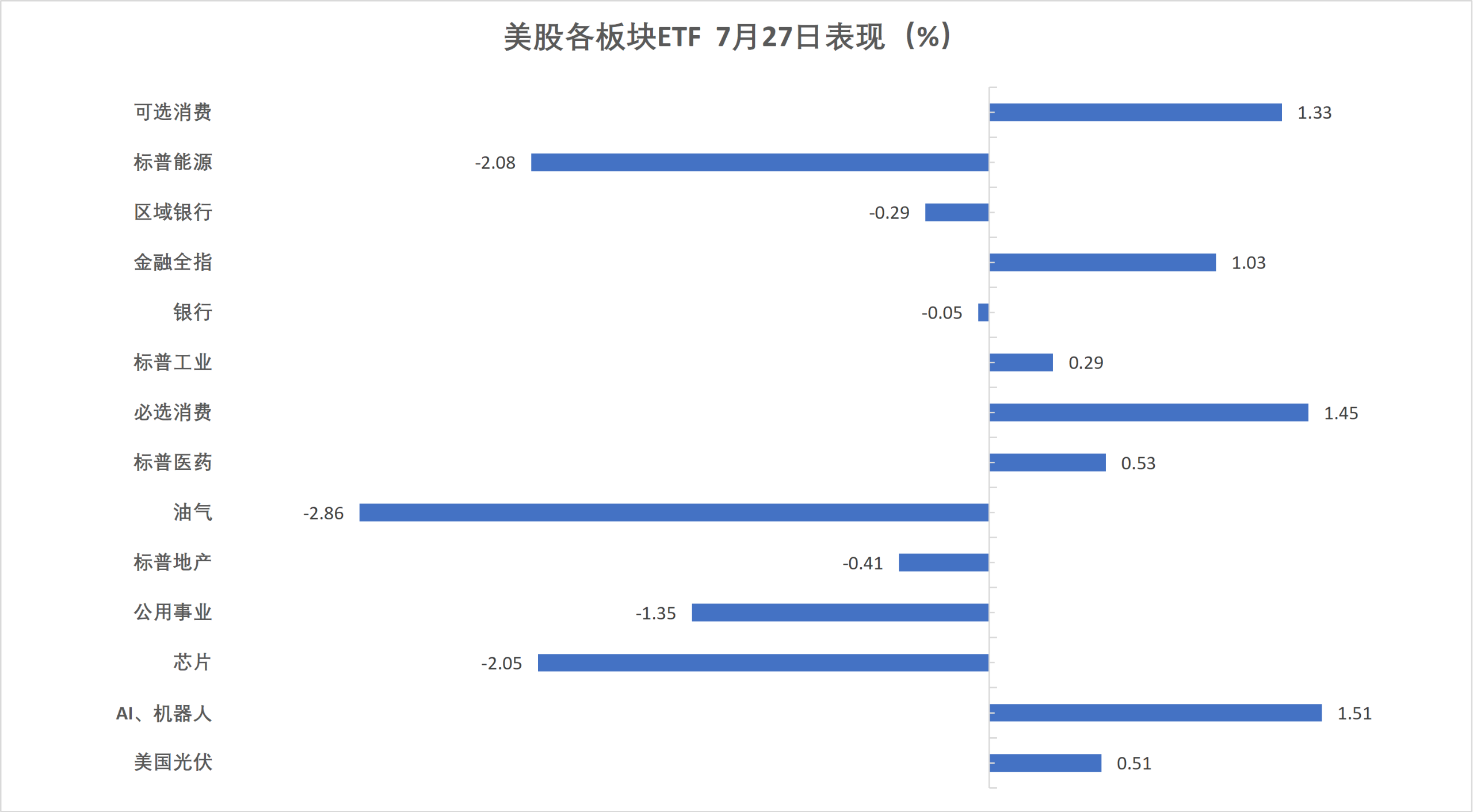
U.S. equities diverged sharply on Monday. The Dow Jones Industrial Average and small-cap stocks gained, while the S&P 500 ended essentially flat (with non-AI sectors outperforming the broader index), and the Nasdaq and semiconductor sectors led losses. Traditional, consumer, and healthcare sectors advanced.
U.S. equity benchmark indices:
The S&P 500 rose 1.20 points, or 0.02%, closing at 7,413.18.
The Dow Jones Industrial Average gained 262.83 points, or 0.51%, closing at 52,210.08.
The Nasdaq Composite closed down 43.742 points, or 0.18%, at 24,932.081.$NASDAQ-100 Index (.NDX.US)$It closed down 89.131 points, or 0.32%, at 28,039.211.
$Russell 2000 Index (.RUT.US)$closed up 0.62% at 2,948.035.
The CBOE Volatility Index (VIX) closed up 0.48% at 18.67, having held steady near 17.50 during U.S. pre-market hours before rising sharply, reaching a session high of 19.93 at 22:43.
U.S. stock sector ETFs:
U.S. sector ETFs ended mixed, with the semiconductor ETF falling 2.25%, the energy sector ETF down 2.11%, and technology, global tech, and banking ETFs declining by up to 0.9%.
Mag 7:
The Wind U.S. Tech Mag 7 Index fell 0.33%.
NVIDIA fell 4.99%,$Tesla (TSLA.US)$ended down 1.22%, Amazon declined 0.31%, Meta dropped 0.22%, Apple rose 1.17%, Microsoft gained 1.94%, and Google A advanced 2.13%.
Semiconductor stocks:
The Philadelphia Semiconductor Index closed down 264.005 points, or 2.23%, at 11,554.88.
$Taiwan Semiconductor (TSM.US)$ADRs declined 1.03%, and AMD fell 5.17%.
U.S.-listed Chinese stocks:
The Nasdaq Golden Dragon China Index rose 2.51% to close at 6,257.87 points, approaching its 50-day moving average.
Among actively traded Chinese ADRs,$Baozun Inc. (BZUN.US)$gained 12.8%, Xiaomi rose 9%,$EHang (EH.US)$up 7.5%,$Daqo New Energy (DQ.US)$Up 4.2%,$NetEase (NTES.US)$up 3.5%,$PDD Holdings (PDD.US)$, Tencent,$Alibaba (BABA.US)$rose over 2%.
Other stocks:
$Circle(CRCL.US)$up 5.28%.
Optical communications and storage sectors led the decline,SanDisk (SNDK.US)down more than 11%,$Kioxia ADR (KXIAY.US)$、$SK Hynix (SKHY.US)$down over 7%,$Lumentum (LITE.US)$fell more than 6%,$Western Digital (WDC.US)$、$Seagate Technology (STX.US)$Down more than 4%,$Coherent (COHR.US)$、$Ciena(CIEN.US)$down more than 3%,Micron Technology (MU.US)、$Marvell Technology (MRVL.US)$、Corning (GLW.US) and down more than 2%. Among them, $SK Hynix (SKHY.US)$ fell below its U.S. IPO offering price, $Kioxia ADR (KXIAY.US)$ having retreated more than 57% from its late-June peak, SanDisk more than 45%, and Marvell Technology more than 42% from their June highs.
AI application software stocks continued to strengthen,$Shopify(SHOP.US)$Up more than 11%,$Palantir (PLTR.US)$rose 7%,$Salesforce (CRM.US)$、$ServiceNow(NOW.US)$increased by more than 6%,$Adobe (ADBE.US)$、$Applovin (APP.US)$climbing over 5%.
Other news
[CME Group Launches Single-Stock Futures, Allowing Investors to Trade 23 Hours a Day$SpaceX (SPCX.US)$, Micron Technology, and other stocks]
United StatesCME Group (CME.US)On July 27, CME Group launched cash-settled single-stock futures based on 55 U.S. equities, along with micro contracts based on 22 stocks, marking the exchange’s entry into a market designed to enable leveraged long and short trading around the clock. These contracts trade on CME’s Globex platform from Sunday evening through Friday afternoon, with one hour of daily maintenance downtime, allowing investors to react to earnings reports and other market-moving events outside regular U.S. equity market hours.
[Amazon Enters Satellite Communications Race: Plans to Deploy 5,000 Satellites]
Amazon plans to launch a constellation of more than 5,000 satellites to provide mobile communication services to consumers worldwide. The company stated on Monday (July 27) that it has filed an application with the U.S. Federal Communications Commission (FCC), seeking approval to deploy the constellation by 2028. Amazon said the system will offer voice calls, text messaging, data services, and emergency communications.
[NVIDIA Unites Industry Players to Form 'Open Secure AI Alliance']
On Monday local time, NVIDIA announced the formation of the Open Secure AI Alliance (OSAA), partnering with Adobe,$Dell Technologies (DELL.US)$、$CrowdStrike(CRWD.US)$Hugging Face, and other technology companies to jointly develop and share AI safety and cybersecurity tools, aiming to build a more robust AI security ecosystem through open models.
[Microsoft Launches Its First Cybersecurity Model]
Microsoft unveiled its first cybersecurity model, MAI-Cyber-1-Flash, along with an agent-based security system called “Project Perception,” on Monday. Microsoft CEO Nadella stated, “MAI-Cyber-1-Flash is our first cybersecurity model built from the ground up to identify the most challenging vulnerabilities in complex codebases. When used in conjunction with MDASH (Microsoft’s Multi-model Agent-based Security Scanning Platform), it delivers world-class performance at half the cost of leading models.”
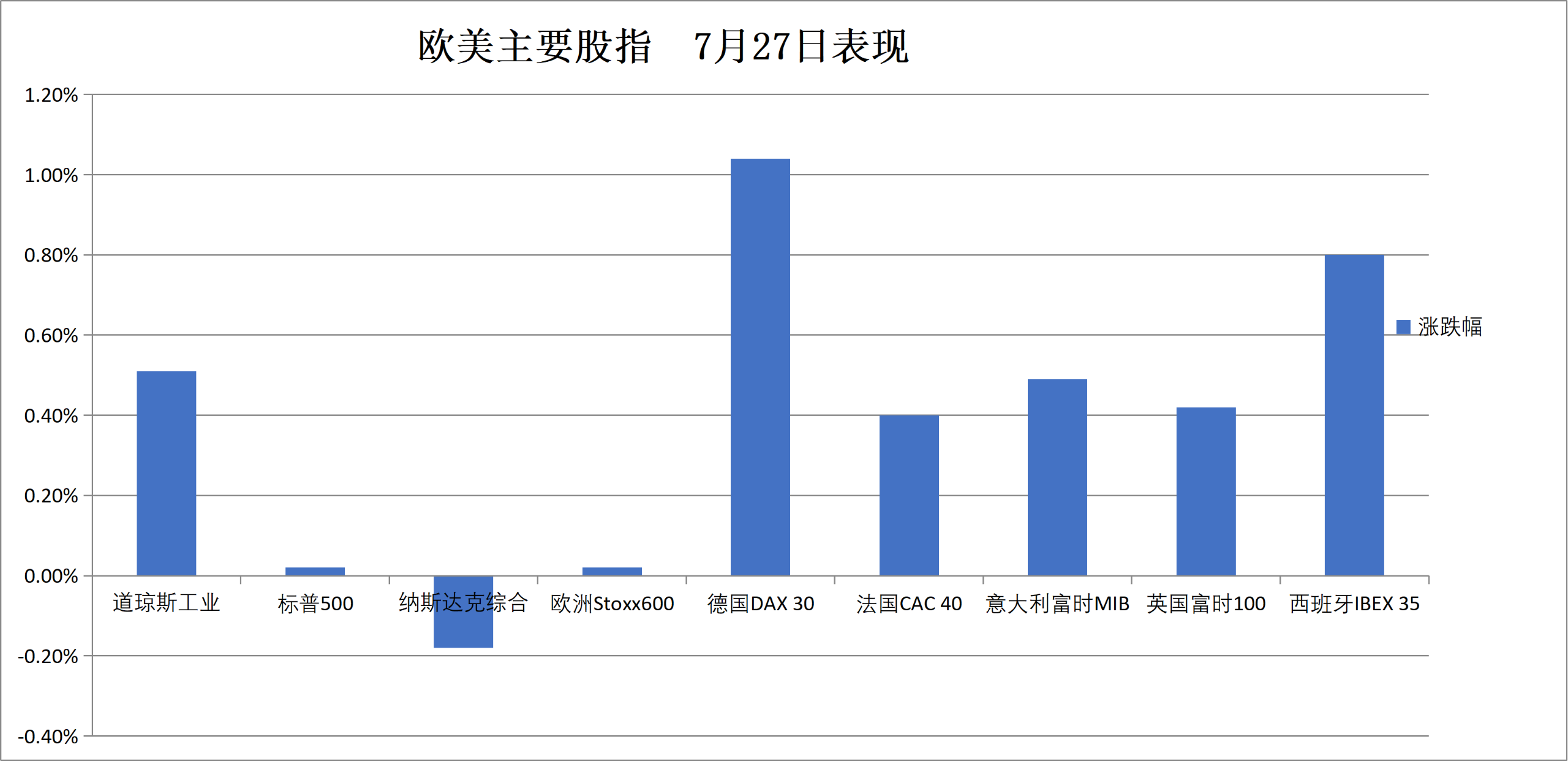
European stock markets closed largely flat,$ASML Holding (ASML.US)$with BE Semiconductor and ASM among the worst performers. Germany’s stock market rose 1%, while Denmark’s index declined by more than 0.8%. BE Semiconductor, ASML Holding, and ASM each fell by at least 7%.
Pan-European Equities:
The STOXX Europe 600 Index closed up 0.02%.
The EURO STOXX 50 Index gained 0.02% to close at 6,282.21 points, though it has been steadily retreating since 20:00.
National stock indices:
Germany’s DAX 30 Index rose 1.04% to close at 25,361.03 points.
France’s CAC 40 Index advanced 0.40% to close at 8,406.06 points.
$FTSE 100 Index (.FTSE.GB)$It rose 0.42% to close at 10,781.75 points. The FTSE 250 Index gained 0.41%, and the FTSE 350 Index advanced 0.42%.
Sector and individual stock performance:
Among eurozone blue-chip stocks, Germany's SAP rose 7.90%, Wolters Kluwer climbed 7.85%, and Adyen gained 4.34%,$Ferrari (RACE.US)$up 4.29% to rank fourth, while Prosus rose 2.98%.
Among all constituents of the STOXX Europe 600 Index, Evolution Group rose 6.71%, Sopra Steria Group gained 6.39%, Capgemini Consulting increased by 5.42%, joining SAP and Wolters Kluwer as top performers.
Want to select stocks or get a stock diagnosis? Curious about the opportunities and risks in your portfolio? For all your investment questions,Just ask Futubull AI!

Editor/Liam