
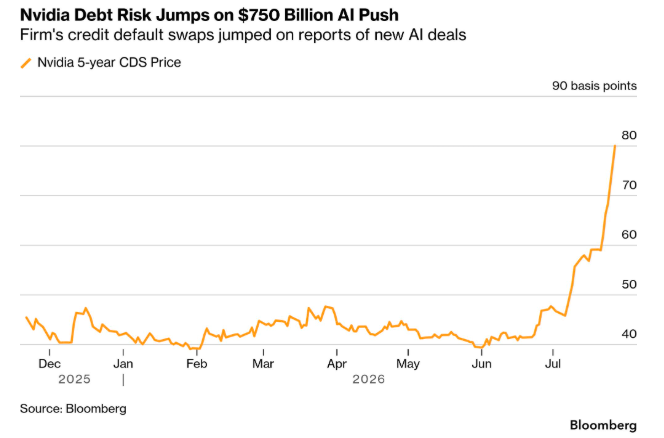
NVIDIA's five-year CDS recorded its largest intraday single-day increase on record, Oracle was downgraded by S&P to BBB- with its CDS widening to 215 basis points, and Alphabet reported negative free cash flow for the first time since going public—the credit market confidence crisis triggered by AI-related 'circular financing' is now spreading from NVIDIA across the entire hyperscale cloud service provider sector. Bond market stress has already spilled over into equities, with South Korea’s KOSPI plunging nearly 8% in a single day.
The bond market is casting a vote of no confidence in the unchecked expansion of AI infrastructure.
The financing frenzy for AI infrastructure is triggering ripple effects across credit markets. On Monday, data from ICE Data Services showed that NVIDIA’s five-year credit default swap (CDS) recorded its largest single-day intraday gain on record, Oracle was downgraded by S&P Global, and Alphabet reported negative free cash flow for the first time—signaling that credit market alarms, initially centered on NVIDIA, have now spread to the entire hyperscalers group.
 Manish Kabra, Head of U.S. Equity Strategy at Société Générale, stated bluntly: “For hyperscale computing companies, it’s CDS—not EPS (earnings per share)—that matters now.”
The immediate catalyst for this volatility stems from a series of massive financing guarantee transactions NVIDIA is advancing. According to sources familiar with the matter, NVIDIA is negotiating with OpenAI to provide approximately $250 billion in financing guarantees to help OpenAI secure computing capacity for a 10-gigawatt data center project in Ohio. Simultaneously, NVIDIA is also discussing providing financing for OpenAI’s $350 billion chip procurement initiative. Combined with its previously announced partnership with SK Group exceeding $500 billion, NVIDIA’s potential exposure to AI infrastructure deals now exceeds $750 billion.
The core market concern lies in the circular nature of these transactions: NVIDIA provides financing or guarantees to customers who, in turn, purchase NVIDIA’s chips. Gary Tan, portfolio manager at Allspring Global Investments, noted, “An increasing amount of capital is being used to fund future AI customers and infrastructure deployments.” If AI demand falls short of expectations, this model could significantly amplify losses across the entire chain.
NVIDIA’s stock fell 4.99% that day, reducing its market capitalization to $4.75 trillion and ceding its position as the world’s most valuable company to Apple. Apple rose more than 1% on the day, reaching a market cap of $4.95 trillion—the first time since April 2025 that it has reclaimed the top spot. The market has taken note that Apple maintains a cautious stance on AI capital expenditures, preferring to lease computing capacity rather than build its own infrastructure—a strategy increasingly favored by investors.
CDS Alarms: Spreading from NVIDIA Across the Sector
$NVIDIA (NVDA.US)$ The five-year CDS rose intraday by approximately 14 basis points, peaking at around 82 basis points per annum—the largest intraday increase since the contract began actively trading last November. According to ICE Data Services, this implies an annual cost of approximately $82,000 to purchase five-year default protection on $10 million of NVIDIA debt.
However, this turmoil in credit markets extends far beyond NVIDIA alone.
According to LSEG data, $Oracle (ORCL.US)$ 、 $SpaceX (SPCX.US)$ 、 $Alphabet-C (GOOG.US)$ 、 $Amazon (AMZN.US)$ 、 $Meta Platforms (META.US)$ 、 $Broadcom (AVGO.US)$ CDS prices have recently surged to record highs. Oracle’s five-year CDS was quoted at 215 basis points on Monday, significantly higher than the 144 basis points seen at the beginning of the year—meaning it would cost $215,000 annually to insure $10 million of debt against default.
Oracle’s situation is particularly dire. Last month, the company announced plans to invest $70 billion in data center construction over the coming year, prompting S&P Global Ratings to downgrade its credit rating to BBB—just one notch above junk status—citing 'uncertainty around its profitability path amid massive AI investments.'
Alphabet’s position is also drawing attention. Its credit default swap (CDS) spread surged to a record high of 67 basis points on Monday, following the company’s disclosure that its free cash flow turned negative in the second quarter—the first time this has occurred since its initial public offering more than two decades ago.
John Aylward, Chief Investment Officer at credit manager Sona Asset Management, stated bluntly: 'Credit markets struggle with uncertainty, and the pace and cost of AI financing are highly unpredictable—this is triggering a serious crisis of confidence.'
Financing Costs Near Junk Levels: Meta’s Data Center Sounds Alarm Bells
Behind the surge in CDS spreads lies the bond market’s substantive repricing of AI infrastructure financing.
The clearest example comes from Meta. The cost of its latest financing for a $12 billion data center in Texas has risen sharply, approaching levels typical of junk-rated bonds. John Aylward noted that this debt 'is priced in line with current B- rated bonds... It’s quite a startling situation, but that’s the world we live in today.'
The message from this pricing signal is clear: investors are demanding higher risk premiums to absorb AI infrastructure debt, no longer treating it as standard investment-grade corporate debt.
David Brown, Co-Head of Global Investment Grade at Neuberger Berman, articulated the market’s central concern: 'The biggest question is whether this level of capital expenditure will become permanently elevated and when we might see a turning point back to positive free cash flow. We won’t have answers in the near term, which explains the recent underperformance.'
Brown further warned: 'This could become a problem given the enormous amount of financing still pending across the industry.'
George Catrambone, Head of Americas Fixed Income at DWS Group, pointed out that buying CDS has become a tool for investors to hedge against credit downgrades and market volatility: 'Hedging is becoming increasingly common, especially after seeing these capital expenditure figures post earnings. Massive amounts of debt have been issued, yet there’s little evidence so far of corresponding revenue growth. The market is applying greater scrutiny.'
Guarantee Chains: Google Ties Itself to Anthropic, Accumulating Systemic Risk
This financing game is not exclusive to NVIDIA. Tech peers are deeply engaging in AI supply chain financing using a similar logic.
Google has agreed to guarantee lease payments for Anthropic across five data center locations, helping the OpenAI rival secure loans equivalent to approximately USD 35 billion. This arrangement mirrors NVIDIA’s logic of providing guarantees for OpenAI: large tech firms leverage their own creditworthiness to help AI companies—lacking investment-grade ratings—access low-cost financing, while these AI firms, in turn, consume the cloud services, chips, or computing power offered by these tech giants.
Sal Naro, Chief Investment Officer at Coherence Credit Strategies, describes this model as “financial alchemy”: “Opaque, off-balance-sheet transactions driven by intercorporate relationships—this kind of ‘financial alchemy’ is concerning and could lead to credit rating downgrades.”
Billy Leung, Investment Strategist at Global X Management, noted, “NVIDIA providing further guarantees for OpenAI’s additional data center debt will deepen an already scrutinized vendor-financing model. This reflects both the funding pressures inherent in AI infrastructure build-outs and serves as a signal of demand.”
NVIDIA CEO Jensen Huang has consistently held a different view. In January this year, commenting on NVIDIA’s investment in CoreWeave, he stated, “This represents only a very small portion of the capital they will ultimately need to raise. To call this circular financing is simply absurd.” He believes such investments not only boost NVIDIA’s own business but also generate investment returns.
Credit Market Stress Spills Over into Equities: CDS Replaces EPS as the New Watch Window
Turbulence in credit markets has begun spilling over into equity markets, changing how analysts assess hyperscale cloud providers.
Manish Kabra, Head of U.S. Equity Strategy at Société Générale, stated, “For hyperscale compute companies, it’s now about CDS—not EPS (earnings per share). AI-related capital expenditures continue to outpace cash generation, pushing free cash flow for tech conglomerates toward cyclical lows.”
This assessment has already manifested directly in the markets. On Monday, the Philadelphia Semiconductor Index fell 2.23%, NVIDIA dropped nearly 5%, AMD declined by approximately 5%, and ASML Holding lost more than 5%. The reaction in South Korea was even more severe: SK Hynix plunged as much as 11.1% intraday on Tuesday, Samsung Electronics fell 9.5%, and the KOSPI Composite Index dropped close to 8% at one point, prompting the Korea Exchange to activate its SIDECAR mechanism to halt algorithmic selling. SK Hynix’s U.S.-listed shares closed at USD 143.02, falling below its IPO price of USD 149.
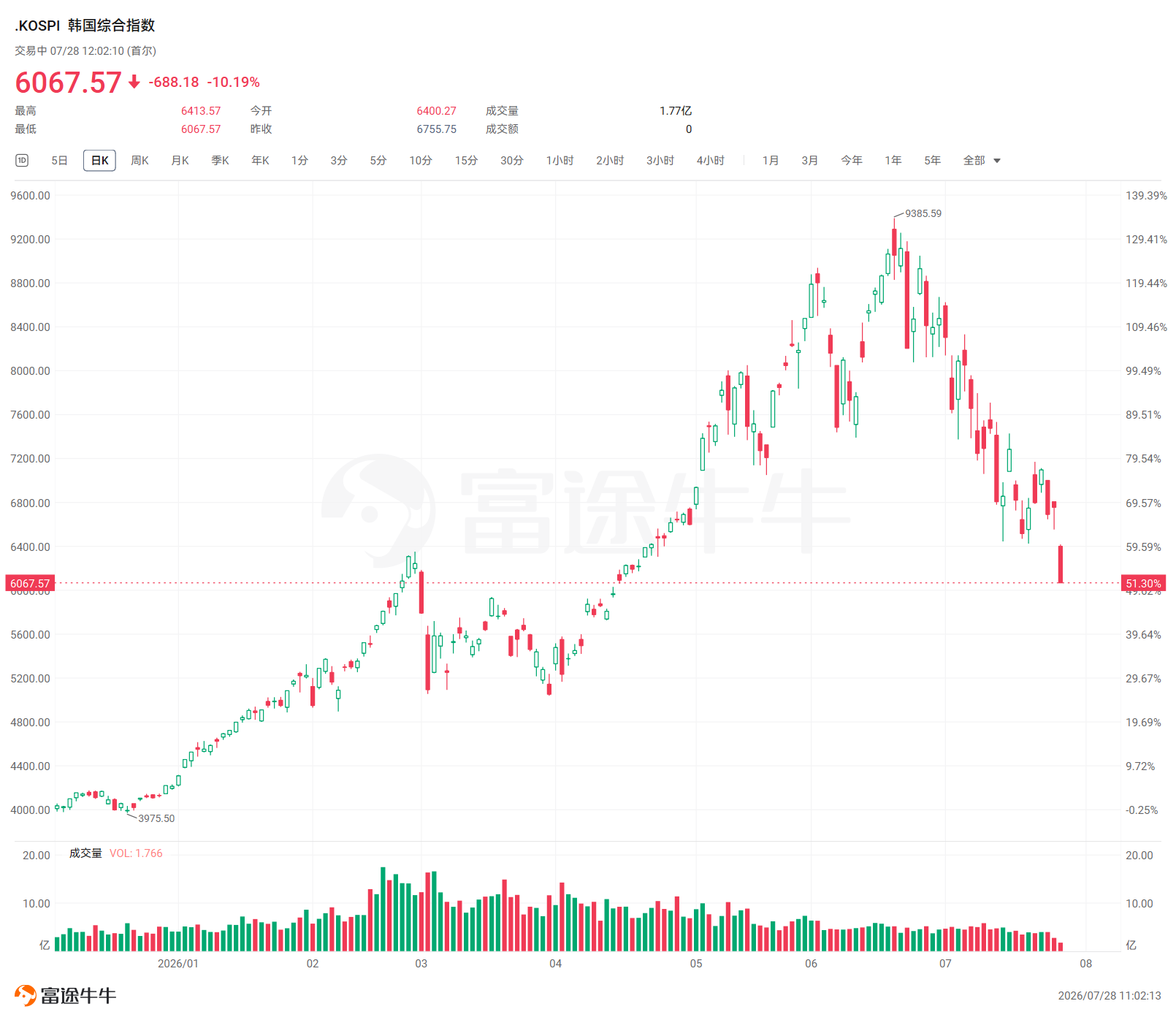
According to Reuters, Han Ji-young, an analyst at Korean brokerage Kiwoom Securities, noted that the current sell-off has been driven by multiple factors: financing risks associated with AI infrastructure, the impact of low-cost Chinese open-source AI models (such as Kimi K3) on expectations for computing power demand, and competitive concerns triggered by the listing of Chinese memory chipmaker CXMT.
At present, the sustainability of AI-related capital expenditures remains the market’s biggest uncertainty. The repricing in bond markets is erecting a financing ceiling—one that is becoming increasingly difficult to ignore—for the ongoing AI infrastructure boom.
Editor/KOKO