
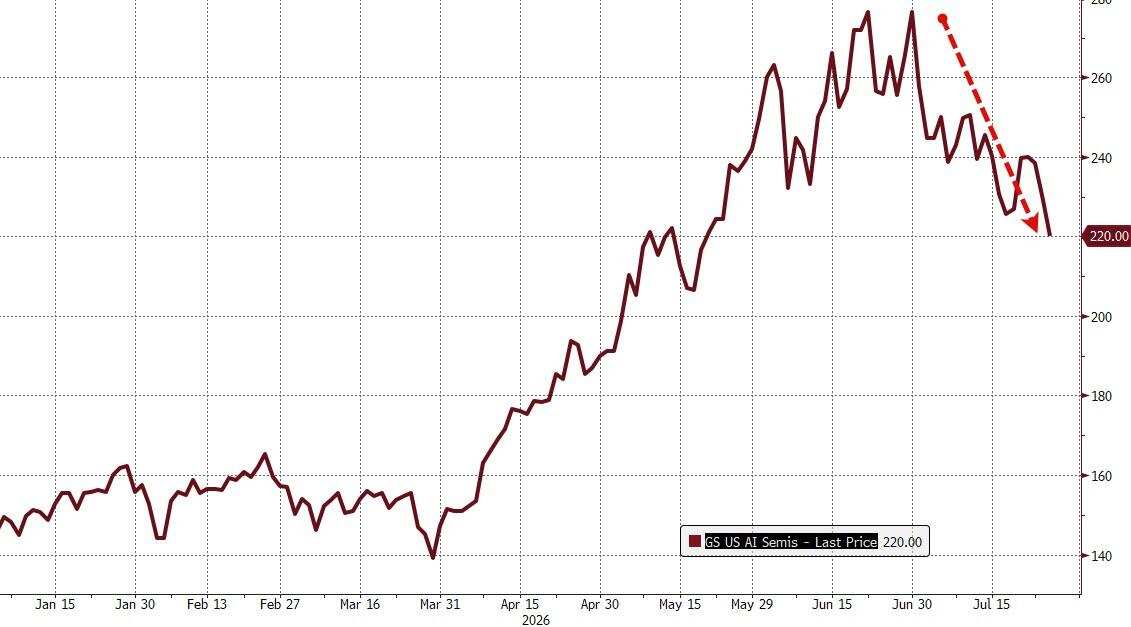
① On Monday this week, U.S. equity investors were clearly caught off guard by an unexpected "chip storm"; ② although major indices appeared relatively stable, the Philadelphia Semiconductor Index plunged nearly 5% overnight before closing down 2.23%. The index continued its decline today, dropping nearly 6% at the open.
This Monday, U.S. equity investors were clearly caught off guard by an unexpected “chip storm.” Although major market indices appeared relatively stable, $PHLX Semiconductor Index (.SOX.US)$ It plunged nearly 5% overnight before closing down 2.23%. The Philadelphia Semiconductor Index continued its decline today, dropping nearly 6% at the open.
As of now, among popular chip stocks, $Micron Technology (MU.US)$ Fell by more than 10%, $SanDisk (SNDK.US)$ fell more than 14%, $SK hynix (SKHY.US)$ dropped nearly 10%,$Advanced Micro Devices (AMD.US)$ declined nearly 9%, $Intel (INTC.US)$ fell nearly 8%, $Taiwan Semiconductor (TSM.US)$ dropped nearly 4%, $NVIDIA (NVDA.US)$ dropped more than 1%.
 In response, Goldman Sachs trader John Flood noted that during Monday’s market volatility—once again driven by sharp declines in momentum stocks—his trading desk received a surge of client inquiries regarding the latest market conditions…
The Goldman Sachs partner distilled the factors driving the market on that day as follows:
On Wednesday, the Federal Reserve will hold a 'live' FOMC meeting (with no preset policy direction and a 35% probability of a rate hike), coupled with $Meta Platforms (META.US)$ and$Microsoft (MSFT.US)$will release its earnings report after the market close on Wednesday, followed by $Apple (AAPL.US)$ and$Amazon (AMZN.US)$Earnings reports will be released on Thursday, and a confluence of events has left the market broadly lacking in risk appetite.
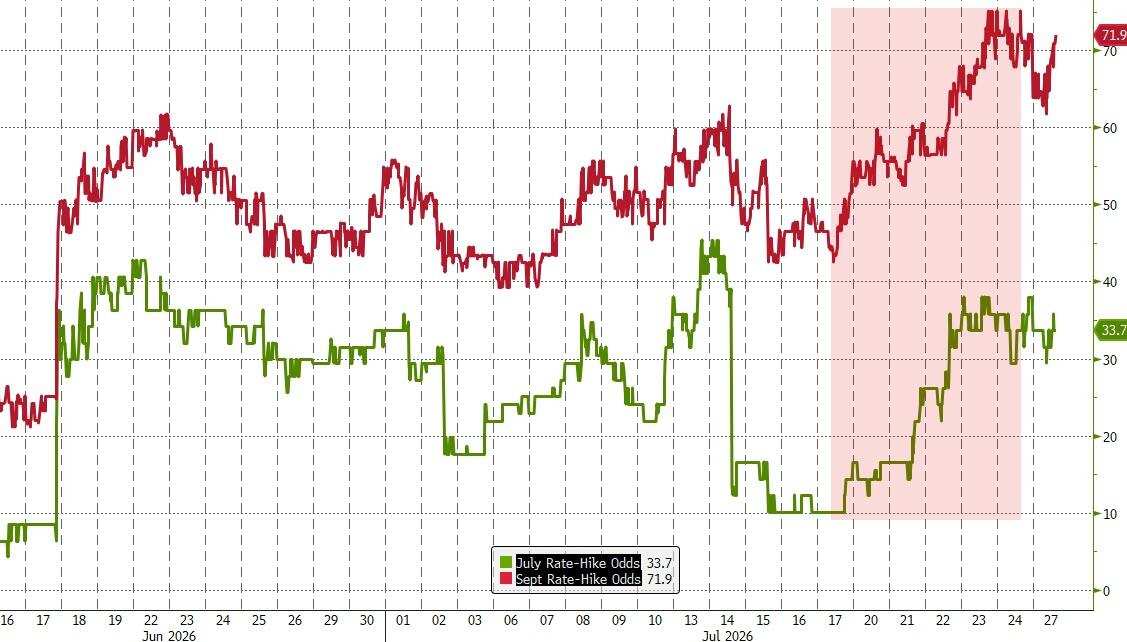
Hedge funds are selectively reducing single-stock exposure (selling once again), while long-only institutions (L/Os) are choosing to hold their positions and await further clarity.
Notably, a recent market rumor—that media reports claimed NVIDIA was in talks to provide a $250 billion financial guarantee for OpenAI’s planned data center project in Ohio, and might further finance OpenAI’s purchase of chips needed for the facility, potentially amounting to an additional $350 billion—did not receive a “positive” reception from traders.
Many industry insiders believe this could eventually be seen in hindsight as marking the peak of the AI-related financing frenzy.
Flood remarked that AI-related capital expenditures had previously served as a key catalyst propelling markets higher, but investors are now beginning to question whether credit risk remains the central concern here.
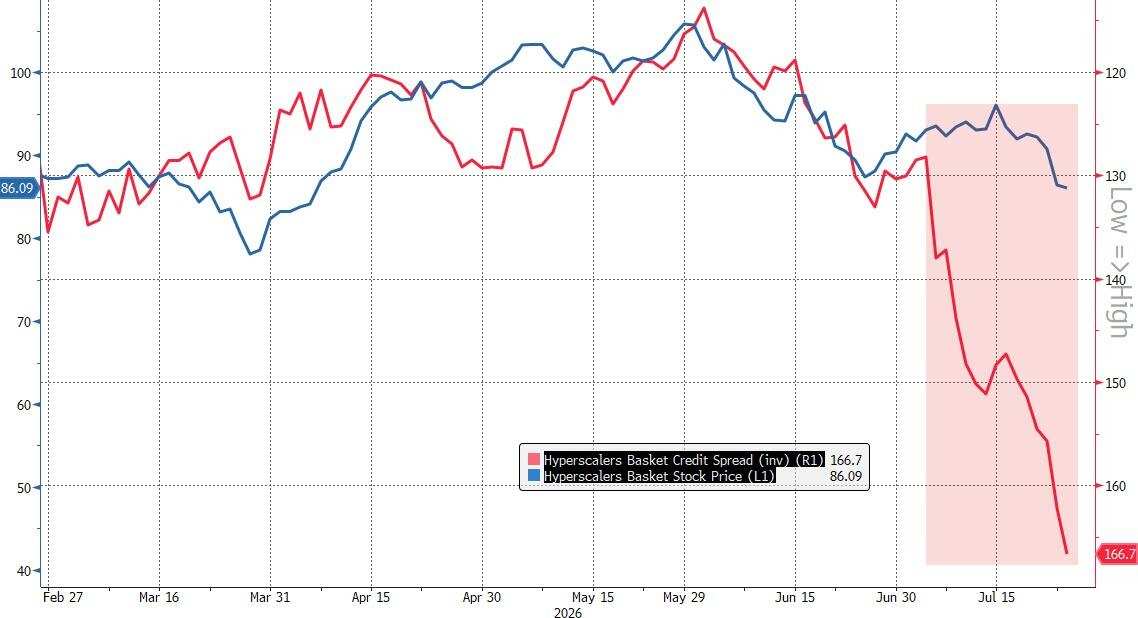
Notably, according to ICE Data Services, on Monday, the cost of five-year credit default swap (CDS) protection on NVIDIA debt rose by approximately 14 basis points intraday, peaking at around 82 basis points per annum—the largest intraday increase since the contract began actively trading last November.
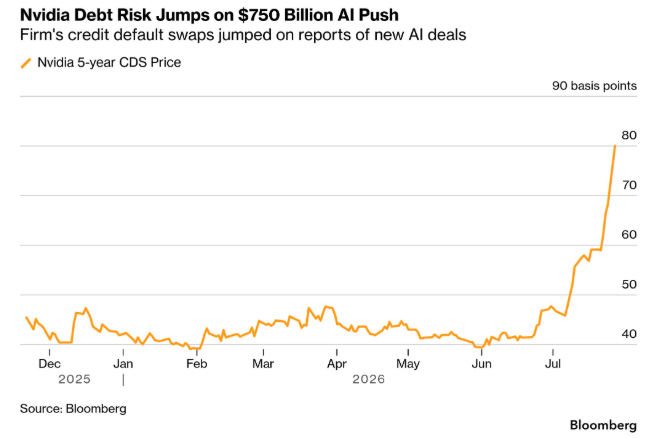
According to LSEG data, CDS spreads related to$Oracle (ORCL.US)$、$SpaceX (SPCX.US)$、 $Alphabet-C (GOOG.US)$ 、 $Amazon (AMZN.US)$ 、 $Meta Platforms (META.US)$ 、$Broadcom (AVGO.US)$have all risen to record highs in recent days. This underscores growing concerns over the massive spending by large technology firms on data centers, chips, and computer memory.
Meanwhile, on the news front, Chinese memory chipmaker ChangXin Technology ($CXMT Corporation (688825.SH)$) saw a strong debut on its listing day, introducing a new variable into the global memory chip sector. ASML Holding, the leading lithography equipment manufacturer, also declined on Monday amid industry rumors.
Domestically developed open-source models are also disrupting the global AI pricing structure. High-performance open-source models such as Kimi K3 are undergoing rapid iteration, significantly narrowing the technological gap with foreign closed-source models and eroding the technical moats of Western AI firms.
The widespread adoption of open-source models has forced major overseas AI companies into subsidy-driven price wars, compressing their profit margins and leading to continuous downward revisions in revenue and valuation expectations. Downstream AI enterprises face mounting profitability pressures, which in turn suppress demand for upstream computing power and chips, further exacerbating uncertainty around AI-related capital expenditures.
These three dynamics are interlinked and form a self-reinforcing cycle: the disruption caused by open-source models weighs on downstream AI profitability, amplifies NVIDIA’s contingent debt risks, and—combined with the peak of the industry cycle driven by domestic memory substitution—triggers a collective valuation reset across the global AI semiconductor sector.
Flood noted that$NASDAQ 100 Index (.NDX.US)$the current forward price-to-earnings ratio stands at approximately 21.8x, representing a discount of nearly 10% compared to its 10-year average forward P/E ratio of about 23.6x—marking the lowest valuation level since the start of the current AI boom cycle in early 2023.
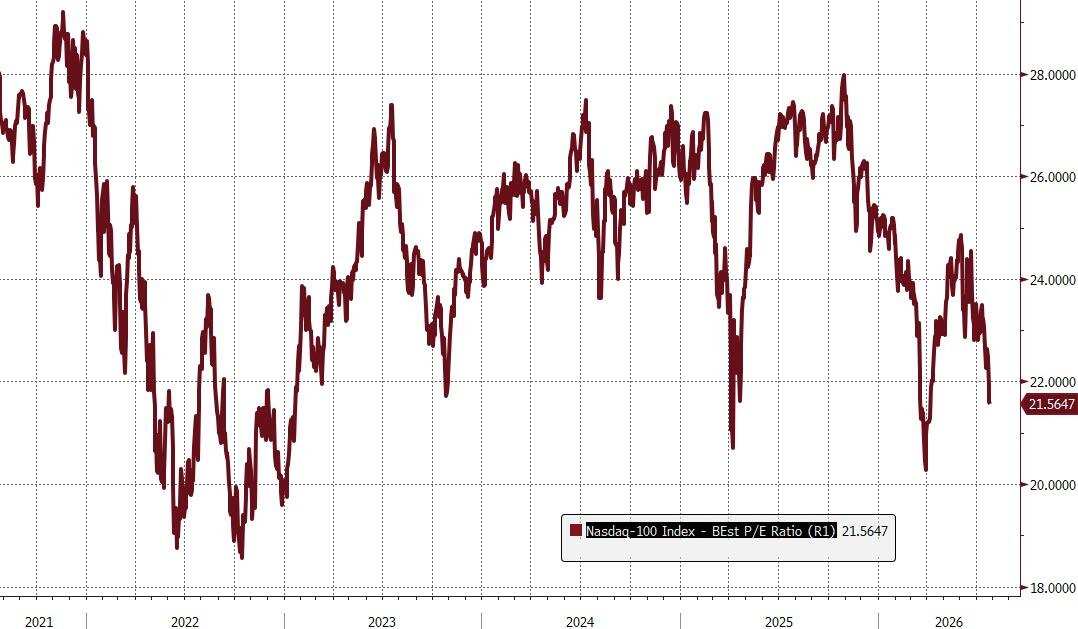
Flood stated that semiconductor companies continue to report robust earnings, yet their stock performance has been underwhelming—typically exhibiting a pattern of 'beating expectations but subsequently pulling back.' This dynamic has fueled market anxiety ahead of another pivotal earnings week.
On the geopolitical front, headlines concerning Iran remain frustrating and confusing—Trump remarked that negotiations must either move forward rapidly or not at all.
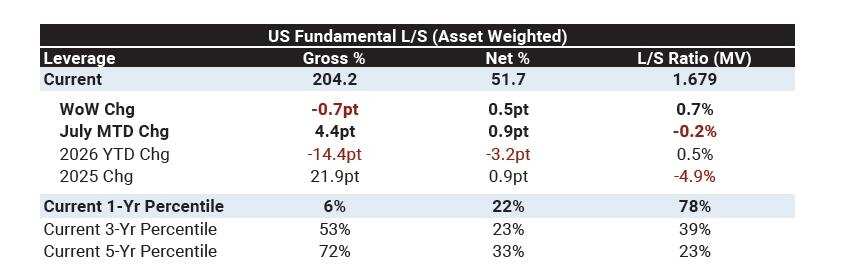
By the way, Flood pointed out that Goldman Sachs’ prime brokerage data shows hedge funds have significantly reduced both risk exposure and leverage, with positioning becoming notably less crowded.
What lies ahead?
Flood believes that individual stock volatility in the U.S. market may remain elevated in the near term. However, as companies continue to deliver solid earnings, major U.S. equity indices could stabilize and trend upward. Moreover, the Federal Reserve may refrain from raising rates on Wednesday—despite markets already pricing in a rate hike and fully factoring in the possibility of a September increase.
So, what exactly is unsettling the market right now? Flood has taken note of$S&P 500 Index (.SPX.US)$An unusually wide divergence has emerged between the implied volatilities of index constituents and the index itself...
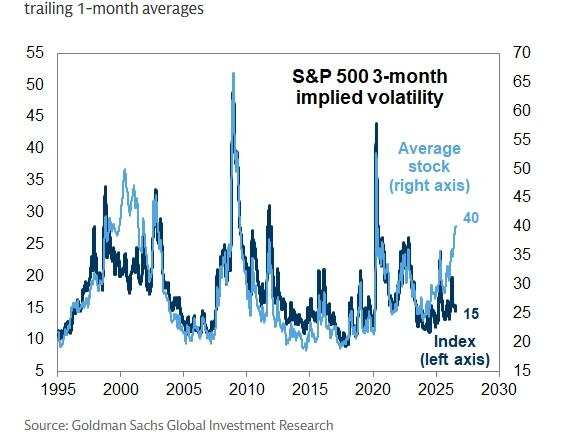
Flood is currently concerned that interest rate volatility will further amplify upward pressure on equity volatility. U.S. Treasury yields surged sharply over the past week, with the 10-year real yield now reaching its highest level since 2023, and the 30-year real yield approaching 3%—a level that, over recent decades, has only been breached briefly during the extreme turbulence of the global financial crisis.
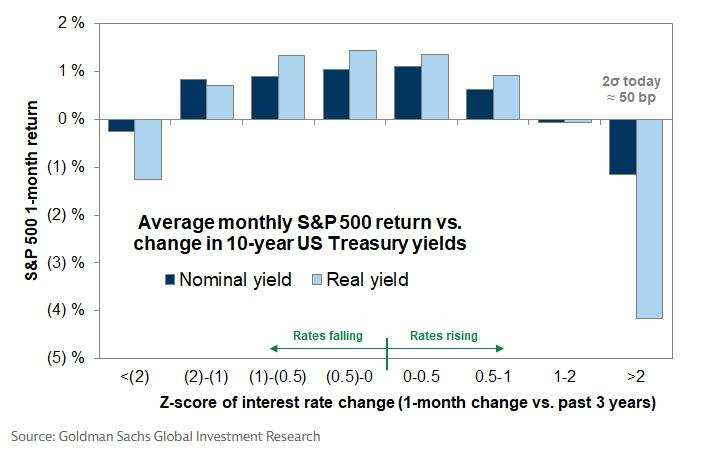
Flood noted that historical evidence suggests U.S. equities typically struggle when interest rates rise by more than two standard deviations within a specific period.
To date, this two-standard-deviation threshold corresponds to a roughly 50-basis-point increase in the 10-year yield over a single month—suggesting that if the nominal 10-year U.S. Treasury yield were to surge toward approximately 5% in the near term, or if the 10-year real yield were to rise to around 2.7%, U.S. equity markets would face heightened downside pressure.
 Want to select stocks or get a stock diagnosis? Curious about the opportunities and risks in your portfolio? For all your investment questions,Just ask Futubull AI!

Editor/rice