
The surge in NVIDIA's credit default swaps (CDS) triggered a sharp market sell-off—not driven by fears of an AI bubble, but by concerns over a hidden cycle of circular financing: as chipmakers began extending credit support to customers purchasing their own chips, AI growth has become increasingly reliant on the same chain of credit. The market is no longer focused on computing power, but on who will bear the risk of holding the last position in this chain.
On July 27, a data point flashed red on Wall Street traders’ screens:$NVIDIA (NVDA.US)$The five-year credit default swap (CDS) spread surged by 14 basis points in a single day, reaching 82 basis points—the largest one-day increase since the contract began trading in November 2025.
On the same day,$NVIDIA (NVDA.US)$Its stock price plummeted by 5%, wiping out approximately $250 billion in market capitalization.$Apple (AAPL.US)$Seizing the opportunity, [it] overtook [its rival] to reclaim the title of the world’s most valuable company with a market cap of $4.93 trillion.
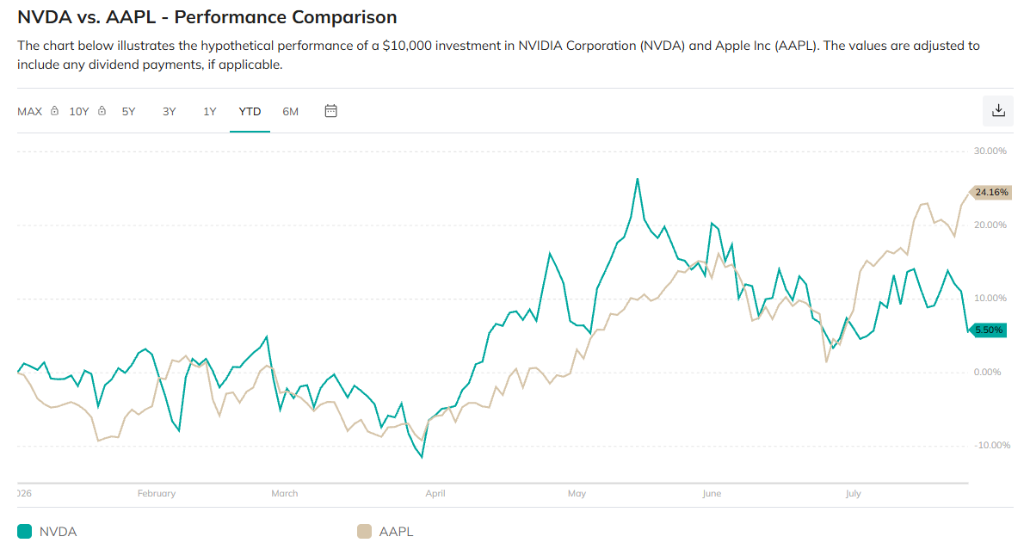
 What triggered this sell-off was precisely$NVIDIA (NVDA.US)$its own announcement of 'good news': a partnership with South Korea’s SK Group worth over $500 billion for AI infrastructure development, and ongoing discussions to provide up to $250 billion in financing guarantees to OpenAI to help it lease SoftBank’s 10-gigawatt hyperscale data center under development in Ohio. The combined value of these two deals exceeds $750 billion—roughly 3.5 times NVIDIA’s projected fiscal year 2026 revenue.
The market isn’t against AI. It’s asking a more fundamental question: Why would a chipmaker use its own credit to guarantee its customers’ purchases of its own chips?
The real sharpness of this sell-off doesn’t lie in whether 'there is demand for AI'—there is. Hyperscalers already hold $1.45 trillion in committed contracts, and the imbalance between surging demand and constrained supply remains unchanged.
The problem lies elsewhere: when NVIDIA simultaneously acts as chip supplier, equity investor, and debt guarantor, every dollar invested in AI circulates within the same closed loop. The credit market has voiced the most basic question on everyone’s behalf—if OpenAI fails to develop a product capable of generating repayment, who will ultimately bear the burden? Will it be NVIDIA as guarantor, SoftBank as lender, or the bank that bought this debt from you?
This is not panic over an AI bubble. It is a repricing of financing structures. When Societe Generale analysts say, 'Now watch CDS, not EPS,' they mean this: the AI narrative is shifting from revenue growth to credit risk. From this moment onward, the protagonist is no longer compute power—it’s the balance sheet.
How exactly does this 'circular financing' work?
Let’s first unpack this closed loop.
First layer:$NVIDIA (NVDA.US)$Providing a $250 billion financing guarantee to OpenAI. OpenAI currently lacks an investment-grade credit rating—it is still burning cash. With NVIDIA as guarantor, lenders are willing to provide low-cost financing for this data center project.
Layer Two: This project, developed by SB Energy—a subsidiary of SoftBank—is being built in Piketon, Ohio, with a planned capacity of 10 gigawatts, sufficient to power 8 million U.S. households. Total investment is expected to exceed $500 billion. Based on prior industry estimates regarding the share of GPU costs in hyperscale AI data centers, GPU procurement alone could amount to hundreds of billions of dollars.
Layer Three: NVIDIA is also separately negotiating a chip procurement financing deal with OpenAI worth up to $350 billion. Combined with $250 billion in guarantees, NVIDIA’s exposure to this single client could reach $600 billion—compared to NVIDIA’s own annual revenue of just $216 billion.
After going full circle, the path of money looks like this:$NVIDIA (NVDA.US)$Guarantee → SoftBank builds data centers → OpenAI leases computing power → OpenAI uses NVIDIA-guaranteed financing to purchase NVIDIA chips → NVIDIA recognizes revenue and orders → goes on to guarantee even more projects.
This is what the market refers to as a 'circular financing' loop.
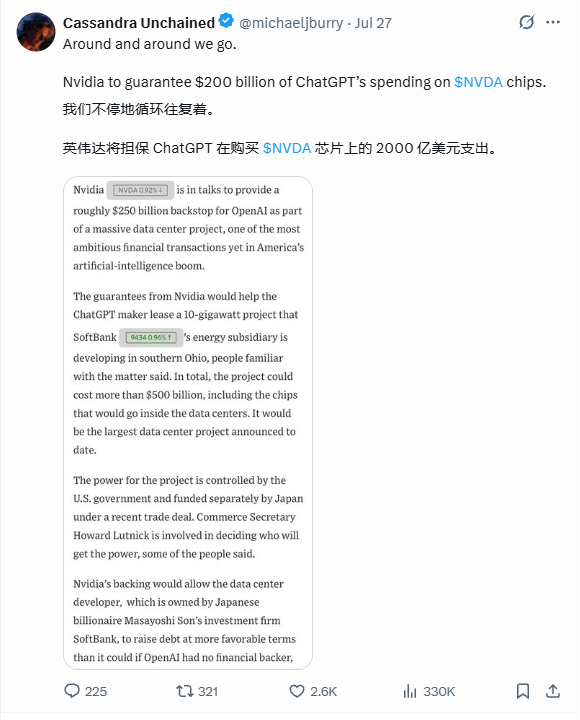
Michael Burry, famed for shorting subprime mortgages, posted just one sentence on X: 'Round and round it goes. NVIDIA is guaranteeing the $200 billion that ChatGPT will spend on NVIDIA chips.'
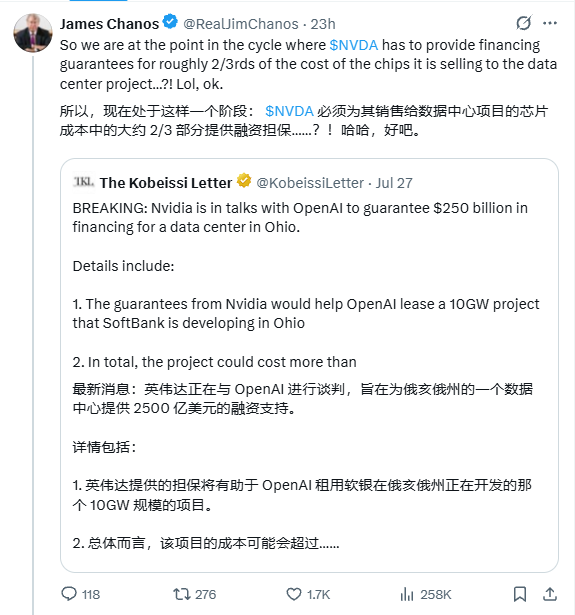
Noted short-seller Jim Chanos put it more bluntly: "Have we really reached the point in this cycle where NVIDIA has to provide financing guarantees covering two-thirds of the cost for the chips it sells to data centers?! Lol, sure thing."
Aleksandar Tomic, Associate Dean at Boston College, compared this to the 1999 internet bubble, when companies bought each other’s products to create an illusion of booming demand. 'OpenAI is essentially using NVIDIA’s money to buy NVIDIA’s chips, rather than funding its expansion with revenue generated from customers.'
Jensen Huang responded bluntly. Back in January, when discussing NVIDIA’s investment in CoreWeave, he stated: 'This is only a small fraction of the total capital they will ultimately need to raise. Calling this circular is absurd.' He emphasized that investments in companies like OpenAI and Anthropic not only advance the industry but also generate returns.
The problem is that the market is already repricing this 'absurdity.'
The credit markets have flashed red across the board.
The surge in CDS is not an isolated event. It is the loudest alarm among a series of warnings.
$NVIDIA (NVDA.US)$The single-day increase of 14 basis points in NVIDIA’s CDS spread is not only the largest in the contract’s history, but more importantly—during the same period, Taiwan Semiconductor’s CDS rose by merely 0.02 basis points, and ASML’s even narrowed slightly. NVIDIA stands alone as the sole 'island' amid this wave of credit turbulence.
But this does not mean other companies are safe. Zooming out:
$Oracle (ORCL.US)$NVIDIA’s CDS spread has surged to 203 basis points—not just risen, but skyrocketed. It stood at only 144 basis points at the beginning of the year and hit an all-time intraday high on July 21. The trigger was S&P downgrading its credit rating from BBB+ to BBB−, leaving it just one step away from junk status. The core reason: AI-related capital expenditures have vastly exceeded market expectations, resulting in persistently negative free cash flow.
Even excluding Oracle, an extreme outlier,$Meta Platforms (META.US)$(65 basis points),$Amazon (AMZN.US)$(58 basis points),$Alphabet-A (GOOGL.US)$(48 basis points),$Microsoft (MSFT.US)$(42 basis points), with CDS averaging around 49 basis points—the highest level since 2018 and double what it was at the beginning of 2025.
This is not a credit issue confined to a single company. It reflects a sector-wide repricing of credit risk.
The driving force behind this trend is the scale of bond issuance. Since 2026,$Amazon (AMZN.US)$、$Alphabet-C (GOOG.US)$、$NVIDIA (NVDA.US)$、$Meta Platforms (META.US)$、$Oracle (ORCL.US)$、$SpaceX (SPCX.US)$companies have collectively issued $182 billion in investment-grade bonds—a 1,300% year-over-year increase, accounting for approximately 15% of total U.S. corporate bond issuance.
This is not a normal pace of financing. It reflects the debt acceleration caused by compressing trillion-dollar capital expenditures into a 12-month window. According to Morgan Stanley, the aggregate leverage ratio of hyperscale cloud providers has surged from 0.9x to 1.8x in just two quarters.
Moody's statistics are even more striking: lease-related off-balance-sheet commitments from just five major tech companies amount to $662 billion. A Nikkei investigation shows that total off-balance-sheet obligations of leading hyperscale cloud providers stand at approximately $1.65 trillion—eight times higher than four years ago.
Masayoshi Son’s bet: a $40 billion bridge loan
In this story, SoftBank plays a role that cannot be ignored.
SoftBank’s cumulative investment in OpenAI has exceeded $60 billion, including a $40 billion bridge loan—one of the largest bridge financings in Asian history, maturing in March 2027. S&P has downgraded its credit outlook from stable to negative, stating, "The company’s AI investments primarily involve startups and private firms, exposing it to significant AI innovation risk and intense competition. OpenAI is among its weakest credit-quality investments."
More subtle signals come from cooling financing conditions. SoftBank initially planned to borrow $10 billion using its OpenAI stake as collateral; the amount was later reduced to $6 billion, and ultimately—the talks collapsed. Lenders struggled to value a private company that is not publicly listed and lacks market-based pricing.
Markets are awaiting OpenAI’s IPO—which has been filed confidentially, with Goldman Sachs and Morgan Stanley as lead underwriters—to price this layer of risk. Until then, repayment of SoftBank’s $40 billion bridge loan hinges on what valuation OpenAI can achieve and how much trust the market is still willing to extend to AI.
The first phase of the Ohio data center is scheduled to come online in 2028. NVIDIA’s $250 billion guarantee will take several years to translate from paper commitments into actual risk exposure. But credit markets never wait for delivery—they price risk in advance.
It’s not a bubble—it’s a problem with the financing structure.
NVIDIA is not Enron.
Over the past 12 months, it generated $96.6 billion in free cash flow and held over $13 billion in cash on its balance sheet as of the end of April. Its AA credit rating faces virtually no near-term concerns. Its $25 billion bond issuance in June attracted $85 billion in orders—more than three times oversubscribed.
AI demand is not fabricated out of thin air. Hyperscale cloud providers currently hold contract backlogs amounting to $1.45 trillion. AWS CEO Matt Garman stated, "Current AI infrastructure investment is anything but speculative"—not as a rebuttal to skeptics, but because the orders are genuinely there.
The core issue is that real demand is being amplified through an opaque financing structure.
When NVIDIA simultaneously acts as a chip supplier, equity investor, and debt guarantor, the market cannot disentangle the interests across these three roles. A company using its own credit to guarantee its customer’s purchases—this would raise suspicions of 'alchemy' in any industry at any point in the cycle. Sal Naro, Chief Investment Officer at Coherence Credit Strategies, used precisely that term: 'Opaque financial structures, off-balance-sheet transactions, and complex interrelationships among affiliated entities may foster ‘financial alchemy,’ ultimately leading to credit rating downgrades.'
Credit markets do not bet on whether corporate revenues will rise; they bet on whether there is a buffer in case they fall. At this critical juncture, as AI transitions from the infrastructure build-out phase to commercial monetization, the depth of that buffer hinges on a more fundamental question:
If the commercial returns from products like OpenAI’s ChatGPT, Anthropic’s Claude, Mistral, and xAI ultimately fail to justify the $1.4 trillion in spending commitments—as Viram Shah, CEO of Vested Finance, pointed out, noting OpenAI’s current spending commitments stand at approximately $1.4 trillion against roughly $13 billion in revenue—this unfavorable return profile unsettles the market. In such a scenario, every layer of guarantee, every bridge loan, and every CDS contract would be triggered simultaneously within the same time window.
This is not a question about a bubble. It is a question about concentration risk.
History offers two reference points. Cisco’s story in 2000 was one of ‘absent demand’—fiber optic networks were built out across the internet, but traffic volumes never materialized as expected. AI will not replay this script because compute demand is real.
The subprime crisis in 2007 was about ‘risk being dispersed, yet no one knew where it ultimately resided’—CDOs fragmented MBSs and shattered risk visibility. Today’s AI financing dilemma follows a similar logic: NVIDIA provides guarantees → SoftBank builds data centers → OpenAI leases compute capacity → OpenAI uses NVIDIA-backed capital to purchase chips. Risk appears distributed across four entities, yet each link is tethered to the same credit chain. If any single link breaks, all four dominoes fall together.
Who profits, who bears the risk, and who repays when repayment becomes impossible
At this point, it is worthwhile to flatten the ledger and examine exactly what each party gains and what each party shoulders within this loop.
NVIDIA: earns GPU gross margins and control over the ecosystem; bears guarantee exposure and credit spreads. Its $25 billion bond issuance in June carried a 50-basis-point credit spread—because it borrowed at AA-rated rates while guaranteeing OpenAI, which lacks any credit rating whatsoever.
SoftBank: earns potential equity upside upon OpenAI’s IPO; bears a $40 billion bridge loan and S&P’s negative outlook. Masayoshi Son is betting that this high-stakes gamble can be converted into hard cash before March 2027.
OpenAI: It earns from the market’s anticipation of AGI that does not yet exist. What it shoulders is a structural deficit—$1.4 trillion in spending commitments against $13 billion in revenue—and a deferred debt problem.
Banks: They earn underwriting fees and interest rate spreads. What they shoulder is the risk that if this wave of confidence reverses, the $182 billion in AI-related debt may find no buyers in the short term.
Apple: It shoulders nothing. Hence, it has become the world’s most valuable company.
Apple’s capital expenditures have declined consistently over the past three quarters. Jay Woods, Chief Market Strategist at Free Capital Markets, stated: "Apple was previously criticized for insufficient AI investment, but in hindsight, it has successfully avoided the capital expenditure trap." This isn’t to say Apple isn’t pursuing AI—its slow progress on Apple Intelligence is evident—but rather that the market is voting with its feet: a light-asset AI strategy currently commands greater trust.
Three monitoring points
First, whether NVIDIA’s CDS will breach the 100-basis-point mark. At 82 basis points, the level itself isn’t alarming—the typical crisis threshold for investment-grade companies’ CDS usually exceeds 200 basis points. However, velocity matters more than absolute levels. From November to July, NVIDIA’s CDS spread widened from 35 to 82 basis points. If this pace continues, it won’t take long to cross the psychological threshold. At that point, NVIDIA’s cost of issuing debt will rise, its ability to provide guarantees will weaken, and the very notion of ‘cyclical’ financing will come into question.
Second, the IPO window for OpenAI. If OpenAI completes its initial public offering within the year, SoftBank’s $40 billion bridge loan will gain a clear exit route, dispersing the foundational risk across the broad equity market. If the IPO is delayed—given already unfavorable market sentiment—the pressure will propagate backward along the guarantee chain. The first casualty won’t be NVIDIA’s balance sheet, but market confidence itself.
Third, whether Seoul can stem the bleeding. On July 27, SK Hynix’s ADR fell 7.47% to $143.02, marking a cumulative decline of over 38% from its June peak. On the day of the market circuit breaker (July 13), the Bank of Korea issued a report reassuring markets, citing three reasons: 'tight AI infrastructure demand,' 'this isn’t a conventional inventory cycle,' and 'difficulty ramping up HBM capacity.' These arguments are logically sound. But credit markets don’t operate on rationale—they hinge on who is willing to take the last position.
In 1873, British financial writer Walter Bagehot left behind a statement that, more than a century later, appears on nearly every credit default swap prospectus:
“In times of prosperity, everyone can borrow money (trust is universal). The real question is, when the era arrives in which debts cannot be repaid, who will actually pay?”
The boom phase of AI is reaching an inflection point. From now on, the main focus will no longer be computing power—it will be the balance sheet.
Editor/melody