
Global semiconductor stocks suffered a "Black Tuesday"—doubts over the returns on AI capital expenditures, concerns about NVIDIA's over $750 billion "circular financing" casting a shadow over credit markets, and renewed competitive fears triggered by the listing of China's DRAM leader ChangXin Memory Technologies combined to ignite a wave of panic selling that spread from Wall Street to Asia-Pacific markets.
What was once an AI-fueled rally is now turning into a fundamental reckoning: 'The money has been spent—where are the returns?'
Cracks in the AI capital expenditure bubble are piercing chip valuations in the most violent manner.
 Global chip stocks faced massive sell-offs on Tuesday, as mounting doubts over the returns on AI-related capital spending, concerns about NVIDIA’s 'circular financing' model, and rising competition from Chinese memory chipmakers converged to trigger a 'Black Tuesday' that spread from Wall Street to Asia-Pacific markets.
South Korean equities were hit first and hardest.$Korea Composite Index (.KOSPI.KR)$It plunged nearly 11%, marking its steepest single-day drop since 1998, triggering the market’s eighth circuit breaker this year after falling more than 8% intraday.$SK Hynix (000660.KR)$Shares tumbled more than 14%; Samsung Electronics dropped over 13%. Japanese markets faced similar pressure,$Nikkei 225 (.N225.JP)$closing down nearly 4%,$Kioxia Holdings (285A.JP)$and fell more than 18%,$Tokyo Electron (8035.JP)$and$Nikon (7731.JP)$all declined by more than 10%.
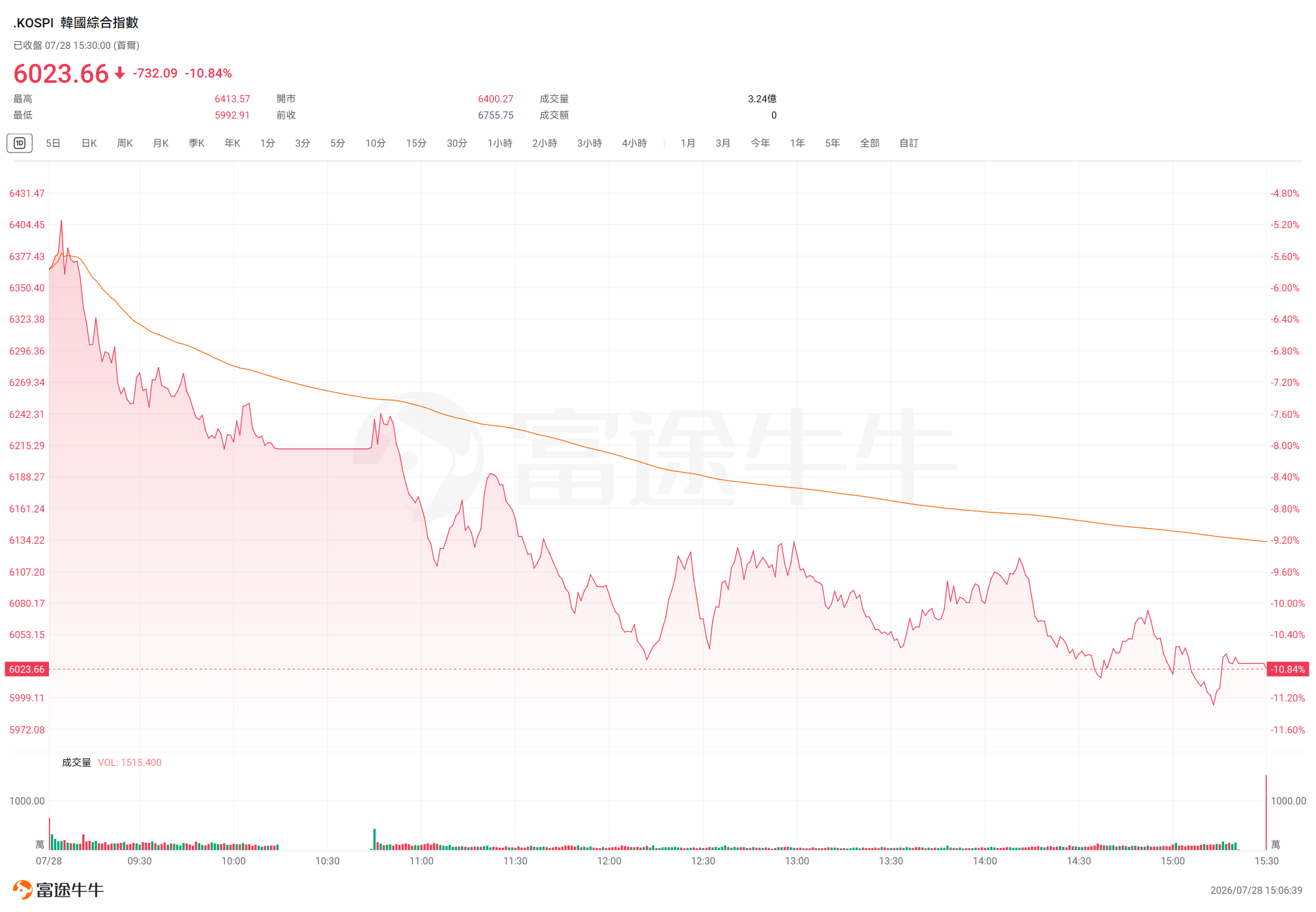
The immediate catalyst for this sell-off is the market’s rapidly eroding patience regarding whether tech giants’ AI-related capital spending will ultimately deliver returns.$Alphabet-A (GOOGL.US)$The stock price fell by more than 7% following the announcement of its highest-ever quarterly profit last week, and the resulting market shock has yet to subside. Meanwhile,$NVIDIA (NVDA.US)$The "circular financing" model underpinning AI infrastructure deals exceeding $750 billion in scale has drawn scrutiny from credit markets, compounded by the listing of China’s DRAM leader Changxin Technology, which has prompted a reassessment of the competitive landscape. These overlapping headwinds have weighed heavily on semiconductor stocks.
AI spending concerns continue to fester, with earnings season amplifying market stress
The root cause of this selloff lies in eroding market confidence that massive AI investments will generate reasonable returns.
Last week,$Alphabet-A (GOOGL.US)$It revised its full-year 2026 capital expenditure forecast upward to between $195 billion and $205 billion, triggering investor concerns.$PHLX Semiconductor Index (.SOX.US)$The stock then declined for three consecutive days, closing lower again on Monday in U.S. markets,$Advanced Micro Devices (AMD.US)$、$NVIDIA (NVDA.US)$all ranked among$S&P 500 Index (.SPX.US)$the top decliners.
$Alphabet-A (GOOGL.US)$、$Microsoft (MSFT.US)$、$Meta Platforms (META.US)$and$Amazon (AMZN.US)$The combined capital expenditures of the four tech giants are expected to reach $700 billion this year, with Wall Street forecasting that figure could surpass $1 trillion by 2027. Investors are increasingly uncertain about when—and how—these investments will translate into tangible profits.
Kyle Rodda, senior analyst at Capital.com, stated bluntly in a report: "These companies embody the core pressure point in current market sentiment—the excessive capital expenditures by AI firms, which investors fear will erode returns."
This week’s dense cluster of risk events has further amplified the market’s skittish reaction.
$Microsoft (MSFT.US)$、$Meta Platforms (META.US)$、$Apple (AAPL.US)$、$Amazon (AMZN.US)$Earnings reports will be released in succession, and the Federal Reserve, Bank of Japan, and Bank of England will also announce their interest rate decisions,$S&P 500 Index (.SPX.US)$with over 170 companies in the index reporting earnings this week. Chris Larkin of E*Trade from Morgan Stanley noted, "Even if the Mag 7 deliver strong earnings, the market may not respond favorably, especially as questions persist about the level of AI-related spending."
Dilin Wu, strategist at Pepperstone Group Ltd., summarized: "The bar is now extremely high—beating expectations no longer guarantees a stock price increase. We’ve repeatedly seen this play out. Some of today’s selling may reflect traders proactively reducing positions ahead of earnings announcements."
"Circular financing" concerns drive NVIDIA CDS to record highs
Another key catalyst behind this market selloff is$NVIDIA (NVDA.US)$Concerns over 'circular financing' triggered by the unprecedented-scale AI infrastructure exchange.
According to sources familiar with the matter, NVIDIA is in talks with OpenAI to provide approximately $250 billion in financing guarantees to secure data center computing capacity, while also discussing financing for OpenAI’s $350 billion chip procurement project. Combined with its previously announced partnership with SK Group exceeding $500 billion, NVIDIA’s potential exposure to AI infrastructure transactions now exceeds $750 billion.
At the heart of market concerns is the inherently "circular" nature of this model—NVIDIA provides financing or guarantees to customers who, in turn, purchase NVIDIA chips. If AI demand falls short of expectations, losses across the entire chain could be magnified. Gary Tan, portfolio manager at Allspring Global Investments, stated, "An increasing amount of capital is being used to fund future AI customers and infrastructure deployment."
These concerns first erupted in the credit markets.
According to ICE Data Services, NVIDIA’s five-year credit default swap (CDS) widened by approximately 14 basis points intraday to around 82 basis points—the largest intraday move since the contract became actively traded last November. CDS spreads for Oracle, Alphabet, Amazon, Meta, and Broadcom also hit record highs.
Manish Kabra, U.S. equity strategy head at Société Générale, stated bluntly: "For hyperscale computing companies, you now watch CDS—not EPS. AI-related capital expenditures continue to outpace cash generation, pushing tech giants’ free cash flow to cyclical lows."
NVIDIA CEO Jensen Huang disagrees with the characterization of these arrangements as "circular financing." In January, he remarked, "Calling this circular financing is simply absurd." He believes these investments not only support NVIDIA’s own business but also generate returns. However, his comments have clearly failed to reassure the credit markets thus far.
AI-related debt issuance is flooding the market, and bond investors are voting against expansion.
Credit markets are also sounding alarms.
In the first half of this year, U.S. investment-grade corporate bond issuance exceeded $1.2 trillion, reaching its highest level since 2021, with hyperscale cloud providers accounting for approximately $200 billion. Lukasz Labedzki, a fixed income analyst at Franklin Templeton Institute, noted that this surge in supply, combined with the U.S. government’s substantial borrowing needs, is creating dual pressures on the market.
Spreads on AI-related bonds have widened significantly in recent weeks. According to Bloomberg data, the spread on 10-year AI-related debt stands at approximately 121 basis points, notably higher than the roughly 80 basis points for high-grade corporate bonds overall. The yield on 30-year U.S. Treasuries has remained above 5% for multiple consecutive weeks—the longest such stretch since 2007.
$Oracle (ORCL.US)$Its situation is particularly dire. After announcing a $70 billion investment in data center construction over the next year, the company had its credit rating downgraded by S&P Global to BBB—just one notch above junk status—and Moody's similarly revised its rating outlook to negative.$Alphabet-A (GOOGL.US)$Free cash flow turned negative last quarter for the first time in over two decades since its listing, and its CDS spread surged to a record high of 67 basis points.
$Meta Platforms (META.US)$The latest financing cost for a $12 billion data center project in Texas has approached levels typical of junk-rated bonds. John Aylward, Chief Investment Officer at Sona Asset Management, stated that the debt 'is priced in line with current B- rated bonds... This is a rather astonishing situation.'
David Brown, Co-Head of Global Investment Grade at Neuberger Berman, articulated the market’s central concern: 'The biggest uncertainty is whether this level of capital expenditure will become permanently elevated and when we might see a turning point back to positive free cash flow. We won’t have answers in the near term, which explains the current underperformance.'
Listing of China’s DRAM leader reignites concerns over competitive dynamics
Another catalyst for the recent chip stock sell-off stems from shifts in the competitive landscape of China’s memory chip market.
China's largest DRAM chipmaker$CXMT Corporation (688825.SH)$Listed on the Shanghai Stock Exchange’s STAR Market on Monday, its share price surged more than 465% on the first trading day, pushing its market capitalization above RMB 3.28 trillion and making it the most valuable company on China’s A-share market. The IPO raised approximately RMB 57.9 billion (around USD 8.6 billion), marking Asia’s largest IPO this year.
Global investors have thus begun reassessing the competitive outlook for the DRAM industry over the coming years. Market concerns center on the possibility that, with ChangXin Technology’s completion of a large-scale financing round, its capacity expansion and R&D capabilities will significantly improve, potentially accelerating the onset of intensified competition in traditional DRAM businesses and thereby compressing industry profit margins.
According to Reuters, Han Ji-young, an analyst at South Korea’s Kiwoom Securities, noted that this wave of selling has been driven by multiple factors, including financing risks associated with AI infrastructure, the impact of low-cost open-source AI models from China on expected compute demand, and competitive concerns triggered by ChangXin Technology’s listing.
However, most analysts believe the market reaction reflects some degree of overinterpretation. Currently, ChangXin Technology’s products are primarily focused on conventional DRAM segments such as DDR4 and DDR5, whereas$Micron Technology (MU.US)$、$SK hynix (SKHY.US)$and$Samsung Electronics (005930.KR)$its fastest-growing profits come from AI memory products like HBM. Bernstein analyst Mark Li noted that the sector’s recent pullback presents a strategic entry opportunity, forecasting that global memory chip market revenue could exceed USD 1.3 trillion by 2027–2028.
This Week’s Crucial Test: Earnings Reports and Central Bank Decisions
Markets have characterized this week as a concentrated stress test.
$Microsoft (MSFT.US)$、$Meta Platforms (META.US)$、$Amazon (AMZN.US)$and$Apple (AAPL.US)$will report their quarterly earnings on Wednesday and Thursday this week, respectively. Over 170 companies in the S&P 500 are scheduled to release results this week. Meanwhile, the Federal Reserve, the Bank of Japan, and the Bank of England will all announce interest rate decisions. In Asia, SK Hynix and Samsung will be among the first to report.
There is only one key focus for earnings reports: whether AI-related investments can be validated. Citing UBS Global Wealth Management, Bloomberg reported, “Limited visibility on capital expenditures beyond 2027, combined with heightened investor demands for spending discipline, could continue to dampen risk appetite.”
Monetary policy also carries unexpected variables. According to Bloomberg, Citadel Securities expects the Federal Reserve to deliver a surprise rate hike this week. In a report, Frank Flight, Head of Macro Strategy, wrote that a 25-basis-point rate increase on Wednesday would bolster Chair Kevin Warsh’s credibility on inflation control and signal that policymakers no longer rely on providing ample advance notice for every policy move. Traders currently price in about a one-third probability of a Fed rate hike this week. Flight stated, “The market may once again be underestimating the extent of the Fed’s hawkish pivot.”
Chris Larkin of E*Trade from Morgan Stanley summarized the current situation: “This is a week full of potential surprises—both positive and negative. Geopolitics and oil prices could be the biggest wild cards, but even if the Mag 7 deliver strong earnings, markets might not respond favorably, especially as doubts persist over the scale of AI-related spending.”
Editor/melody