
Some traders remain committed to large European interest rate curve positions, despite having suffered significant losses along the way. Although U.S. strikes against Iran disrupted this trade, traders continue to bet that the 30-year swap rate will rise more than the 10-year swap rate.
Despite repeated deviations from expectations this year in trades betting on the long-end of the European sovereign yield curve, traders remain committed to one of Europe’s most popular interest rate wagers. They are betting that 30-year swap rates will rise more than 10-year swap rates—a position disrupted by U.S. military action against Iran. This implies that the so-called 10s/30s European government bond yield/swap curve steepening strategy remains one of institutional investors’ most favored trade themes, as hedge funds and asset managers anticipate that long-term rates must rise to stimulate demand for government debt.
Zhitong Finance notes that trades betting on a steeper euro yield curve—specifically, that 30-year swap rates would increase more than their 10-year counterparts—were severely hit as U.S. attacks on Iran significantly disrupted inflation expectations. The trade regained momentum during the lull in Middle Eastern hostilities in May and June, and demand for this thematic position has remained robust since then. However, renewed U.S.-Iran military strikes in July pushed oil prices back above $100 per barrel last week and compressed the spread.
 One of Europe’s most crowded interest rate trades—the euro 10s/30s swap curve steepening—has faced repeated shocks this year from U.S.-Iran tensions, rebounding oil prices, and shifting rate hike expectations from the European Central Bank (ECB) and the Federal Reserve. Yet institutional investors appear not to have retreated en masse. The core rationale behind the trade lies in the structural shift driven by the Netherlands’ €1.6 trillion pension system transitioning to defined-contribution schemes, expanding European sovereign debt supply, and structurally weaker demand for long-dated bonds—all of which are expected to push 30-year yields persistently higher relative to 10-year yields.
Following the outbreak of the U.S.-Iran conflict, inflation risks initially pushed up front-end rates, erasing approximately 60% of the prior steepening, leaving the 10-year to 30-year yield spread at only about 8 basis points. However, a positive carry of roughly 7 basis points per annum, potential front-end yield declines driven by a possible ceasefire, and structural long-end market dynamics continue to make this trade a 'low-beta hopeful position' for hedge funds. The real risk lies in the fact that the European Central Bank is still priced in for around 42 basis points of rate hikes by year-end, and geopolitical tensions—implied volatilitymay continue to drive repeated flattening of the curve. Thus, this trade resembles a bet on de-escalation of hostilities and long-term supply-demand repricing rather than a one-way, certainty-based arbitrage.
Iranian conflict shatters consensus on the curve: front-end inflation trades reverse Europe’s 'King of Steepeners'
“The unwinding of euro curve steepening trades in March was quite painful for many market participants,” said Julian Baker, Co-Head of Linear Rates Trading for Europe, Middle East, and Africa at JPMorgan. He added, however, that the so-called 10s/30s curve steepening trade remains highly popular among the bank’s institutional clients.
Globally, swap curve steepening trades have gained favor as hedge funds and other asset management firms bet that long-term government bond yields must rise more rapidly to incentivize the market to absorb ever-expanding sovereign debt issuance.
In Europe, this trade has been largely successful since late 2024 and has become one of the most crowded positions in the market. In 2025, investors further reinforced this classic bet following Dutch pension reforms that shifted the country’s €1.6 trillion ($1.8 trillion) pension system toward defined-contribution plans. The market interprets this change as supportive of a steeper yield curve, as it redirects demand toward higher-risk assets.
The Dutch pension system’s transition from defined-benefit to defined-contribution structures reduces mechanical demand for ultra-long bonds and long-dated swaps while increasing allocations to riskier assets. Combined with persistently growing European sovereign debt supply, long-term rates must offer higher risk premiums to attract capital. Therefore, despite recent losses, the trade’s underlying structural logic—rising long-end supply coupled with structurally weaker buyer demand—remains intact.
Indeed, market dynamics last year reflected this view: the 10s/30s swap spread widened by more than 50 basis points—the second-largest increase on record since 2009. After the U.S.-Iran geopolitical conflict erupted in late February, markets priced in higher short-term rates to counter inflationary pressures, wiping out 60% of the prior steepening. As hopes for a durable ceasefire grew, the curve partially recovered, but flattened again this month, leaving the spread depressed at around 8 basis points.
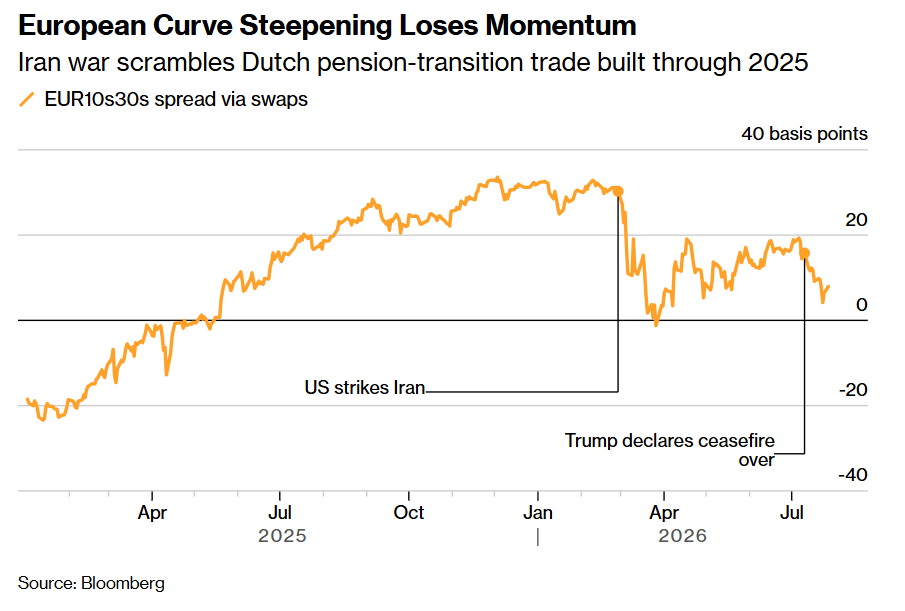
As shown in the chart above, the momentum behind the steepening of the European yield/interest rate curve has weakened significantly—the Iran conflict has disrupted Dutch pension de-risking trades that had been building throughout 2025.
However, according to a long-standing indicator tracked by European banking giant Barclays, the escalation of U.S.-Iran tensions earlier this month did not trigger a new wave of large-scale market position unwinding, leading only to some modest deleveraging. This suggests that, despite the possibility of further rate hikes by the European Central Bank (ECB), many investors still expect short-dated government bonds to continue outperforming longer-dated ones.
The ECB decided last week against implementing back-to-back rate hikes, but policymakers have signaled their readiness to hike again soon. Markets currently price in an additional 42 basis points of tightening by year-end.
Ceasefire as a strong buy signal? Positive carry supports the ‘low-beta hope trade,’ but volatility remains the biggest enemy.
If U.S.-Iran tensions credibly ease, a decline in oil prices and reduced rate hike expectations could initially push down short-end yields, resulting in a ‘bull steepening’—the primary rationale institutional investors cite for maintaining this trade. Meanwhile, the positive carry of approximately 7 basis points per year on 10s–30s steepener positions enhances holding tolerance. However, the ECB may still deliver further rate hikes, and long-end positions remain highly sensitive to implied volatility. Thus, while entry levels are now cheaper, this remains a highly path-dependent trade reliant on the confluence of geopolitical developments, monetary policy shifts, and pension fund flows.
Rohan Khanna, Managing Director at Barclays, wrote in a research report last week that although the European yield curve is currently dominated by front-end yield movements, the steepener trade offers investors a ‘low-beta hope trade.’
‘Given the extent of monetary tightening already priced into markets, front-end yields should fall if credible de-escalation occurs, driving a bull steepening of the yield curve,’ Khanna stated. He added that, despite the painful trading experience so far this year, ‘based on our conversations, this remains the preferred way for market participants to express confidence once they believe the war risk has passed.’
Although recent flattening in spreads has created attractive entry levels, other seasoned market participants remain less convinced, given that sharp and unpredictable volatility could once again disrupt the yield curve.
‘Given the high sensitivity of long-end steepener trades to implied volatility, we remain cautious about establishing such positions,’ wrote Citigroup’s senior fixed-income strategists Andrea Appedu and Jamie Sear, among others.
Strategists at ABN AMRO had previously projected that the steepening of the European yield curve would peak in the second half of 2026, as Dutch pension funds reduce their holdings of long-dated bonds and cut demand for long-end interest rate swaps. Both long-term capital and fast-money players like CTA strategies had heavily crowded into this classic rates trade, but geopolitical conflict has prevented this expectation from materializing.
Baker noted that investors remain drawn to the effects stemming from the Dutch pension system transformation, while the 10- to 30-year curve steepening trade still offers approximately 7 basis points of positive carry per year.
“There’s both a macro rationale and a market structure rationale here, along with a positive carry trend, making this a trade that large institutional clients are very willing to participate in,” he added in the interview.
Carry (holding return or carry return) typically refers to the expected profit or loss generated solely by the passage of time, interest receipts and payments, funding costs, and the position 'rolling down' the forward curve, under the assumption that market prices and the yield curve remain largely unchanged. Positive carry means that even if investors have not yet seen their core directional view materialize, maintaining the position itself continues to generate returns.
In a 10- to 30-year curve steepening trade, investors typically implement a DV01-neutral position by receiving the 10-year fixed rate and paying the 30-year fixed rate, betting on a widening of the spread between 30-year and 10-year yields. The approximately 7 basis points of annual positive carry implies that, assuming the curve remains broadly unchanged, the position would theoretically generate about 7 basis points of return over time. However, positive carry serves only as a buffer for holding the position—it is not a guaranteed return. If the curve flattens in the opposite direction or volatility spikes sharply, capital losses could still far exceed this carry component.
Editor/Deng