
Boosted by a sharp decline in oil prices, U.S. Treasuries are poised for their best consecutive rally in a month. The core reason for the drop in oil prices is market optimism that negotiations between the United States and Iran will lead to the resumption of tanker shipments around the Arabian Peninsula.
Zhitong Finance APP learned that international crude oil benchmarks—Brent and WTI—have declined sharply in recent days, driven by market optimism over peace talks between the U.S. and Iran, which are expected to restore tanker traffic around the Arabian Peninsula. U.S. Treasury prices have also been significantly bolstered by cooling oil prices and inflation expectations, potentially marking their longest winning streak in a month. For equities, short-term market sentiment may see a technical rebound in risk appetite, jointly fueled by falling oil prices and declining 10-year U.S. Treasury yields, though this is insufficient to confirm a broad-based global equity bull market.
The yield on the 10-year U.S. Treasury note—often dubbed the 'global anchor for asset pricing'—has fallen for three consecutive days and extended its decline during pre-market trading in the U.S. on Tuesday, dropping by 3 basis points to 4.62%. The premium it commands over the two-year Treasury yield, which is most sensitive to Federal Reserve monetary policy, has narrowed to its lowest level in nearly four weeks.
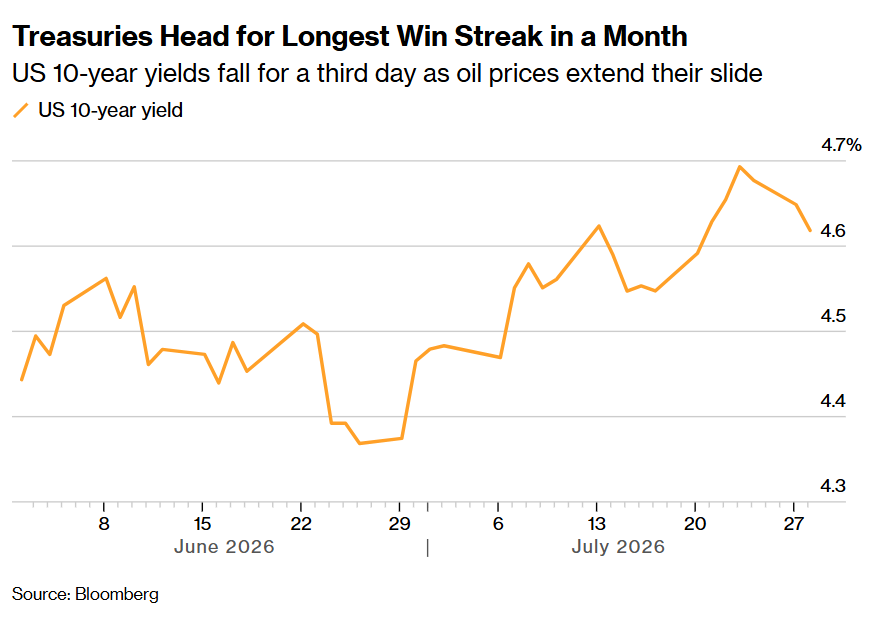
 As illustrated above, U.S. Treasuries are heading toward their longest winning streak in a month—with the 10-year yield falling for the third straight day amid continued declines in international oil prices.
Improving U.S.-Iran negotiations are rapidly compressing the geopolitical risk premium embedded in crude oil prices and driving sustained gains in long-end U.S. Treasuries through lower energy inflation expectations. Brent crude has retreated from above $100 per barrel last week to around $86, while the 10-year Treasury yield has dropped to approximately 4.62%. However, the simultaneous narrowing of the spread between the 10-year and two-year yields suggests this dynamic more closely resembles a 'bull flattener'—driven by falling long-end inflation premiums and heightened safe-haven demand—rather than a market-wide bet that the Federal Reserve is poised to re-enter a monetary easing cycle.
Notably, interest rate futures still imply a nearly 40% probability of a 25-basis-point rate hike by the Fed this week, while economists’ baseline forecasts generally anticipate that the Fed will hold rates steady for the remainder of the year. This further underscores that the bond market is merely unwinding some of its prior 'runaway oil price' pricing, rather than signaling full confidence that monetary tightening risks have been eliminated.
As the risk-free rate anchor in the denominator of discounted cash flow (DCF) equity valuation models, persistently elevated 10-year Treasury yields would not necessarily terminate the AI-driven super bull market but could trigger a temporary pullback and potentially shift the rally from a 'valuation-expansion-driven bull market' toward an 'earnings-verification-driven bull market.' Rising yields would significantly compress valuations for high-duration assets such as high-P/E semiconductors, AI software, unprofitable AI infrastructure firms, hydrogen fuel cells, quantum computing, and space technology. However, for established tech leaders with locked-in orders, pricing power, buyback capacity, and strong cash flows, the impact would largely manifest as short-term volatility rather than a fundamental breakdown in their business logic.
Retreating oil prices lift long-end Treasuries; U.S. bonds post best winning streak in a month
Latest trading data show that improving prospects for U.S.-Iran negotiations are swiftly eroding the geopolitical risk premium in crude oil prices and driving consecutive gains in 10-year and longer-dated U.S. Treasuries via lower energy inflation expectations. Brent crude has fallen from above $100 per barrel last week to around $86, while the 10-year Treasury yield has declined to approximately 4.62%.
‘The recent optimistic performance of 10-year and longer-dated U.S. Treasuries indicates that investors remain unwilling to fully eliminate risk premiums tied to potential renewed inflationary pressures or to rule out the possibility that major central banks may ultimately need to maintain restrictive monetary policy for an extended period,’ said Evelyn Gomez-Lecchi, multi-asset strategist at Mizuho International.
Forward rate agreements linked to the Federal Open Market Committee (FOMC) meeting date indicate a greater-than-one-third probability—approaching 40%—that the Federal Reserve will raise rates by 25 basis points on Wednesday, Eastern Time.
‘This is highly unusual,’ said Laura Cooper, Senior Macro Credit Strategist at Nuveen Administration Ltd., in a media interview. ‘Looking back over the past decade or so, Federal Reserve FOMC members have typically provided ample advance communication about their potential monetary policy actions. Investors now have to contend with a new monetary policy regime under Waller, where the Fed no longer offers forward guidance.’
She indicated that the Fed might ‘remain on hold for now,’ but she still ‘leans toward the view that there is no need to resume rate hikes this year.’
Later-released U.S. ADP employment data may offer clearer insights into the labor market outlook. There are currently no economist forecasts available for the four-week average through July 11; the prior period surprised with an increase of 16,500 jobs. The Conference Board’s U.S. Consumer Confidence Index is expected to show a rise from 91.2 in June to 92.4 in July. The U.S. Treasury will auction $44 billion of new seven-year notes, and investors should closely monitor market absorption and indicators of demand strength for this issuance.
During pre-market trading in the U.S. on Tuesday, Brent crude oil prices fell by 2.3% to $86.28 per barrel; the benchmark had briefly risen above $100 per barrel last week, reaching its highest level in two months.
Global equity markets have entered a phase of ‘discount rate correction and earnings quality verification.’
At the level of financial market trading and pricing, the 10-year U.S. Treasury yield—undisputedly the ‘global anchor for asset pricing’—if it continues to rise over the coming period driven by stronger inflation expectations and larger-scale fiscal stimulus-induced ‘term premium’ factors, and approaches the psychologically significant 5% threshold, would directly elevate the risk-free rate component in discounted cash flow (DCF) valuation models for risk assets. This could potentially compress or even trigger a collapse in valuations across unprofitable high-profile tech and growth stocks, AI-compute-related momentum stocks, high-yield corporate bonds, and cryptocurrency assets. Moreover, if the 10-year yield continues rising alongside persistent inflation rather than improved economic growth, corporate profit margins would face additional pressure from elevated energy costs, wages, and financing expenses.
Theoretically, the 10-year U.S. Treasury yield corresponds to the risk-free rate (r) in the denominator of the DCF valuation model widely used in equity markets. If other variables—particularly cash flow expectations in the numerator—remain largely unchanged (e.g., during earnings season lulls when positive catalysts are absent), then a higher or persistently elevated denominator would place downward pressure on valuations of risk assets currently trading at historical highs, such as AI-linked technology stocks, high-yield corporate bonds, and cryptocurrencies.
For global equity markets, concurrent declines in oil prices and long-end government bond yields are, in principle, favorable for high-valuation technology stocks with long duration profiles that rely heavily on the discounting of distant future cash flows. Sustained declines in oil prices also significantly alleviate corporate cost pressures and boost real household income, while lower risk-free rates increase the present value of firms’ future cash flows. Consequently, short-term market dynamics may witness a technically driven acceleration in risk appetite fueled by falling oil prices and declining Treasury yields, though this alone is insufficient to confirm a broad-based return to a bull market in global equities.
Technology leaders with strong free cash flow generation, high monetization of AI initiatives, and no reliance on external financing will outperform compute-focused projects dependent on forward-looking demand, high leverage, or customer financing for growth. Discretionary consumer, industrial, transportation sectors, and certain rate-sensitive assets may benefit from lower energy costs, whereas oil producers and high-beta semiconductors continue to face downward revisions to earnings expectations. Ultimately, what determines whether the current market rebound evolves into a new uptrend is not merely Brent crude breaching a specific price level, but whether the Fed pauses rate hikes and whether major AI capital spenders—such as Microsoft, Meta, and Amazon—can simultaneously demonstrate improvements in revenue growth, capital efficiency, and free cash flow recovery.
Editor/Deng