
After years of lagging behind in the smart home market, Apple is preparing to make a strong entry into the sector with new devices and software.
Mark Gurman, an Apple product leaker known for repeatedly and accurately revealing details about iPhone updates in advance, posted on Tuesday that $Apple (AAPL.US)$ Apple is preparing to make a major push into the global smart home market centered around Siri AI. This signals that Apple Inc. (AAPL.US), after lagging behind other consumer electronics companies in the smart home space for years, is now gearing up for a significant entry into this sector with new on-device hardware and an AI-powered software ecosystem. The company’s stock has recently risen against the broader market downturn in AI computing-related equities, as Apple aims to launch a notable new offensive.
Citing sources familiar with the matter, Gurman wrote that the company plans to kick off this wave of smart home product launches with a new smart home hub centered around its upgraded Siri AI assistant. The sources also indicated that Apple is preparing to unveil a new set-top box for television and an upgraded HomePod mini smart speaker. These individuals requested anonymity because the plans have not yet been publicly disclosed.
 All three devices are nearing their release phase. Apple plans to launch the new Apple TV and HomePod mini this fall, followed by the home hub device between October of this year and early next year.
According to Gurman, Apple intends to introduce a Siri AI-powered home hub featuring a roughly 7-inch display, alongside concurrent updates to the Apple TV and HomePod mini, with future expansion planned into home security cameras and robotic endpoints equipped with mechanical arms. The strategic significance of this initiative far exceeds merely adding another smart speaker: features such as facial recognition, access to personal calendars and information, FaceTime calling, control of door locks and household appliances, multi-room communication, and security monitoring would elevate Siri AI into an always-on home operating system and ambient computing interface.
This move will position Apple—the maker of the iPhone smartphone—as a more direct and formidable competitor to Amazon and Google, a subsidiary of Alphabet, in a market rapidly being reshaped by artificial intelligence. Apple’s new home hub device will compete head-to-head with Amazon’s Echo Show and Google’s Nest Hub product lines.
As of midday on July 28, Apple’s share price briefly climbed to approximately $340, pushing its market capitalization above the $5 trillion milestone for the first time. Meanwhile, NVIDIA’s market cap retreated to about $4.74 trillion, and the iShares Semiconductor ETF—the bellwether for AI computing beta strategies in U.S. equities—fell by as much as 4.6% on the same day. This stark contrast suggests that Apple’s smart home strategy precisely aligns with the current market’s willingness to pay a premium: while the AI infrastructure segment faces renewed scrutiny over capital expenditures, financing arrangements, and ultimate return expectations, Apple is demonstrating to investors a path to AI monetization grounded in strong cash flows, existing hardware bases, user data, and ecosystem distribution capabilities.
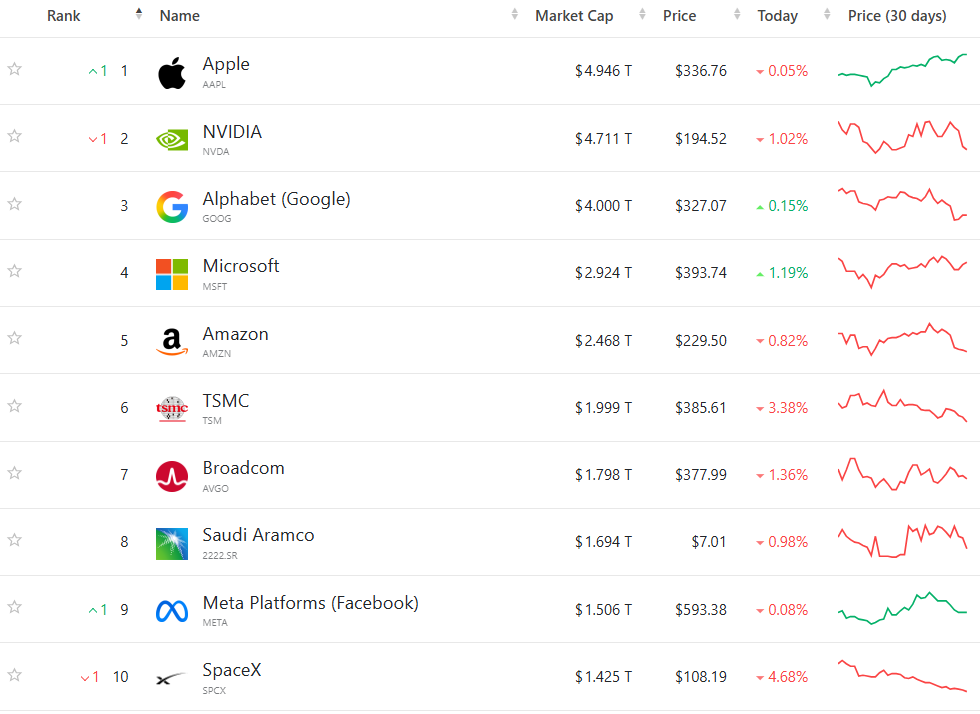
In other words, the Siri AI home hub adds a new long-term growth option to Apple’s portfolio, which has recently hit record highs despite adverse market conditions, reinforcing investor confidence that Apple has not only avoided missing the AI megatrend but may in fact be positioned to capture significant value from on-device AI applications.
The semiconductor sector faced concentrated selling pressure due to concerns over AI infrastructure financing risks, returns on capital expenditures, and competitive pressures from China. In contrast, Apple reclaimed the title of the world’s most valuable company through its relatively asset-light AI approach, consistent profitability, and robust hardware ecosystem. This shift underscores a change in market sentiment—from rewarding massive capital outlays toward valuing free cash flow, user access points, service revenue, AI commercialization efficiency, and the ability to monetize continuously through an established hardware install base, service infrastructure, and user stickiness.
Siri AI Aims to Seize the Home Hub
Apple is not merely refreshing product lines like Apple TV and HomePod mini; rather, it seeks to redefine the human-computer interaction entry point within the home environment by positioning Siri AI as the operational core and the smart home hub as its hardware vehicle.
A roughly 7-inch display, facial recognition, distance sensing, personalized calendar and notes, FaceTime, home security, device control, and multi-room intercom capabilities will transform the new device from a traditional smart speaker into an 'ambient AI terminal' capable of recognizing household members, accessing personal information, and proactively adapting its interface. The wall-mounted J491 model, the desktop J490 version, and a future 9-inch robotic variant equipped with a mechanical arm illustrate Apple’s vision—not of a single breakout product, but of a network of AI-enabled home nodes spanning multiple rooms and interconnected devices.
Strategically, Apple is elevating Siri AI from an iPhone feature to a unified intelligence layer spanning iOS, tvOS, watchOS, and home hardware: user data, device control, security, and content services can all operate under a single identity framework. Its true competitors are no longer limited to Amazon’s Echo Show and Google’s Nest Hub, but also include Amazon Ring—representing the home security entry point—and future platforms for robotics and embodied AI. Apple officially unveiled its next-generation Siri AI and the Apple Intelligence software framework in June 2026, providing the software foundation for the reported home hardware roadmap; however, specific product plans still originate from anonymous sources and have not been formally confirmed by Apple.
From Selling Hardware to Managing Household Data: Apple Seeks a Second Ecosystem Loop in the Post-iPhone Era
To date, Apple has failed to turn its home products into a significant revenue stream. Its HomePod smart speaker was first launched in 2018, and the Apple TV set-top box made its debut nearly two decades ago—both have seen relatively limited sales. The majority of revenue from Apple’s Wearables, Home, and Accessories segment comes from AirPods and Apple Watch.
Apple’s new home hub will feature a roughly 7-inch square display, designed to serve as the centerpiece of the company’s renewed push into smart homes. The device will run a new operating system built on Apple TV’s tvOS. Its interface appears to blend elements of tvOS, watchOS, and iOS, featuring an icon grid, widgets, and apps.
The device supports FaceTime video calling, home security monitoring, and an internal communication system for households with multiple Apple home devices. Users can manage and control smart appliances such as speakers and door locks, view photos, access calendars, and play music. According to informed sources, the device will also include customizable watch faces similar to those on the Apple Watch.
Its signature feature is facial recognition, enabling the home hub to identify who is viewing the screen, gauge their distance from the device, and dynamically personalize the interface in real time. The device can adjust the size and type of information displayed for easier viewing and show personalized content—such as calendars, notes, and other user-specific data—based on who is standing in front of it.
Gurman emphasized in the article that representatives from Apple, headquartered in Cupertino, California, declined to comment on all information disclosed by sources familiar with the matter.
The product is designed to fully leverage Siri AI—a significant upgrade to the voice assistant that can access users’ personal information and enable precise voice-based control of applications. Apple also plans to introduce a companion interface on the iPhone to help users set up and manage the home hub.
Apple will release two versions. The first, internally codenamed J490, features a display mounted on a hemispherical base resembling a HomePod mini cut in half. The second version, codenamed J491, is designed to attach to walls using a new magnetic mounting system. Apple envisions users deploying multiple units of this device throughout their homes.
The internal codenames for the new Apple TV and HomePod mini are J265 and B525, respectively. They resemble the current models in appearance but will feature faster processors to support Siri AI. Apple recently raised the prices of these two devices to $199 and $129, respectively.
Since 2024, Apple has been advancing the launch of these three new home devices. At the time, Apple originally planned to introduce a comprehensively redesigned version of Siri. Due to engineering and quality issues, the assistant was delayed, later rebranded as Siri AI, and is now scheduled for release this fall alongside iOS 27 and other new operating systems.
Following its initial delay in 2024, Apple had aimed to release this new hardware in spring 2025. The planned launch date was subsequently pushed back to fall 2025 and then further delayed to spring 2026. The primary challenge lies in the fact that these devices cannot be launched without the software and AI capabilities they are designed around. Although unlikely, it remains theoretically possible that these products could face another postponement.
These first three Siri AI-powered home products serve as a prelude to at least two additional new devices. The first is a higher-end home hub with robotic functionality. Its robotic arm enables the display to move and interact with users—for example, capturing more people or objects during FaceTime calls. This more advanced device features a 9-inch display.
Apple also plans to launch an advanced indoor security camera, codenamed J450, along with a related ecosystem to compete with Amazon’s Ring.
Behind the Plunge in Chip Stocks and Apple’s Record High: Markets Shift from 'AI Compute Frenzy' to 'Cash Flow and Ecosystem Rent'
Apple’s plan to aggressively penetrate the global smart home market with Siri AI at its core has further fueled its recent stock price surge despite broader market headwinds. While this latest initiative has indeed added momentum to Apple’s share price, whether Apple can consistently outperform NVIDIA and the semiconductor sector ultimately hinges on its ability to demonstrate that, in the AI era, the most valuable asset is not merely manufacturing compute power—but controlling the entry point through which billions of users access that power daily.
The core insight behind 'NVIDIA’s sharp sell-off and Apple reclaiming the top spot' is not that markets are rejecting demand for AI compute, but rather that they are beginning to distinguish between the capital risks inherent in AI infrastructure and the monetization quality of AI application gateways. NVIDIA has reportedly been considering providing financing guarantees of up to approximately $250 billion for a 10-gigawatt data center project involving OpenAI, and is separately discussing GPU procurement financing of up to roughly $350 billion. These reports triggered a 4% to 5% decline in NVIDIA’s share price, as investors grew concerned that chip suppliers are shifting from high-margin equipment sales toward customer financing, leasing guarantees, and potential credit risk.
Apple, by contrast, does not need to replicate the balance sheet expansion typical of hyperscale cloud providers: in its most recently reported quarter, Apple generated $111.2 billion in revenue (up 17% year-over-year), earnings per share rose by 22%, operating cash flow exceeded $28 billion, and services revenue hit a new all-time high. Capital is thus rotating away from 'who deploys the most GPUs and data centers' toward 'who owns end users, distribution channels, and verifiable cash flows.'
However, investor confidence in Apple does not mean its valuation can expand indefinitely without delivery. Apple currently trades at a price-to-earnings ratio of approximately 41x, and its $5 trillion market capitalization already incorporates optimistic assumptions—namely, the successful rollout of Siri AI, sustained hardware upgrade cycles, and continued growth in services. Only if the smart home initiative delivers a stable Siri AI launch, timely hardware releases, user willingness to deploy terminals across multiple rooms, and subsequent conversion into recurring revenue from iCloud, security, media, and other subscriptions will it evolve from a 'narrative catalyst' into a 'profitability catalyst.'
Editor/Deng