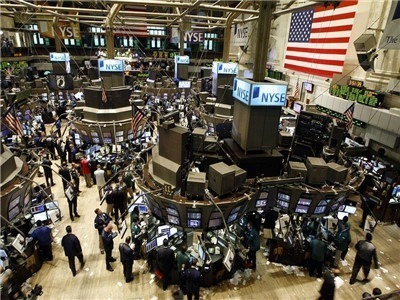
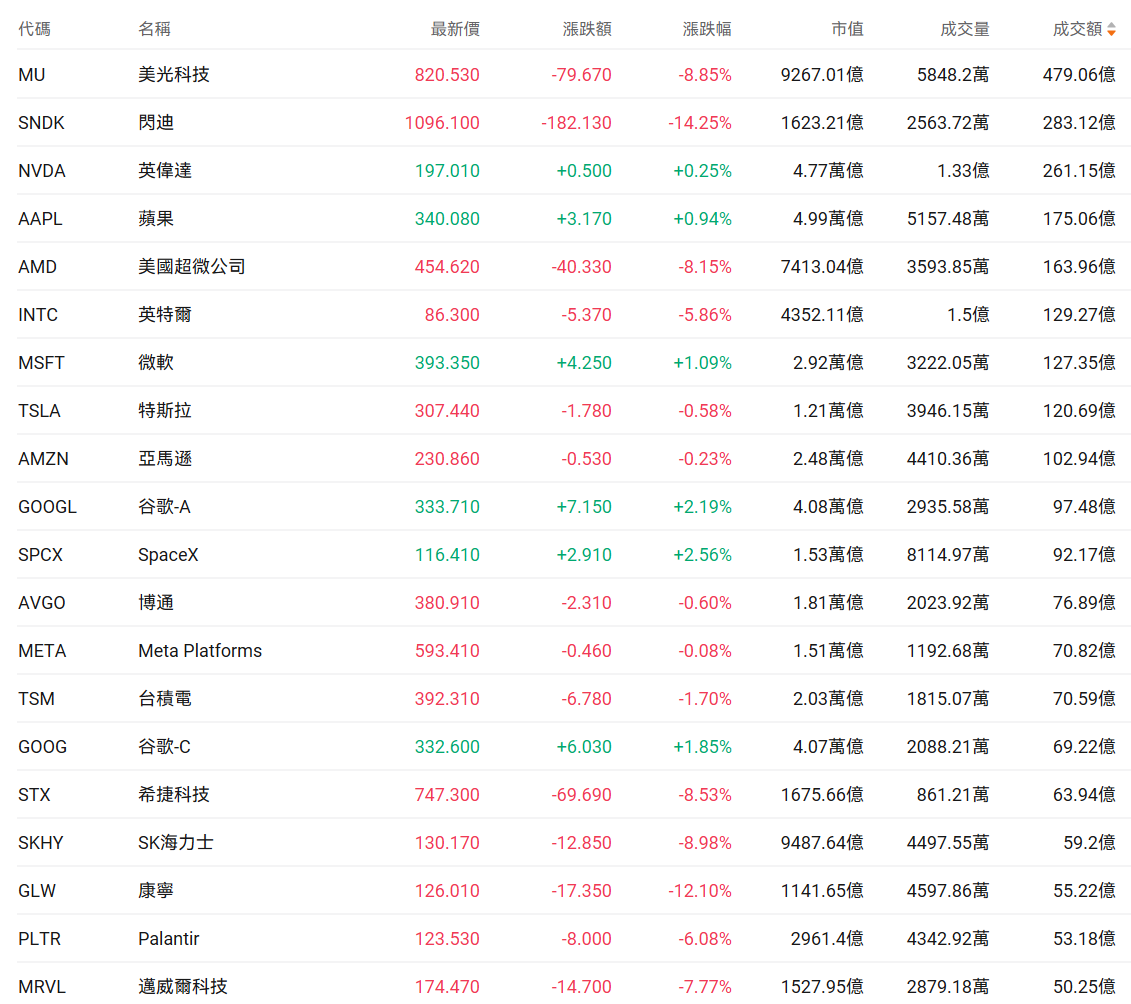
Top U.S. stock by trading volume on Tuesday$Micron Technology (MU.US)$Closed down 8.85%, with trading volume reaching USD 47.906 billion.
U.S. semiconductor stocks, including Micron Technology, broadly declined on Tuesday, following weak trends in Asian and European markets.
This move followed a wave of massive selling in Asian markets. In South Korea,$SK hynix (SKHY.US)$closed down 14.65%,$Samsung Electronics (005930.KR)$fell by more than 13%. Other AI-related stocks also faced heavy sell-offs,$Samsung SDI (006400.KR)$dropped 11.37%,$LG Innotek (011070.KR)$declined 16.29%, and Seoul Semiconductor fell 8.78%,$LG Chem (051910.KR)$closed down 7.5% at the end of the trading session.
 Japanese chip stocks also declined on Tuesday. Tokyo Electron closed down 10.96%,$Advantest (6857.JP)$fell more than 10%, and SoftBank dropped 4.43%. A Japanese computer memory manufacturer$Kioxia Holdings (285A.JP)$plummeted by over 18%.
2nd place$SanDisk (SNDK.US)$closed down 14.25%, with trading volume reaching $28.312 billion.
The stock has now declined for three consecutive trading days, with each day’s loss exceeding 10%, resulting in a cumulative drop of nearly 32%.
SanDisk’s share price has now fallen by more than half from its June peak. The stock closed at $2,335 on June 25. Fueled by AI-driven demand tightening the supply of memory chips, the stock surged dramatically in 2026, gaining over 850% through June.
In the first half of 2026, capital poured heavily into the memory chip sector. However, investor sentiment has turned cautious in recent weeks, triggering successive sell-offs in the memory segment and weakening the broader semiconductor market.
3rd place$NVIDIA (NVDA.US)$rose 0.25%, with trading volume reaching $26.115 billion.
On July 27 local time, NVIDIA announced it has agreed to invest approximately $5 billion in Safe Superintelligence, an artificial intelligence startup founded by former OpenAI chief scientist Ilya Sutskever.
NVIDIA (NVDA.O) CEO Jensen Huang stated that open-weight artificial intelligence models are crucial for advancing the AI industry, which is still in its early stages of development. Following a meeting with U.S. lawmakers in Washington on Tuesday, Huang emphasized that open-weight models are essential to ensuring AI is deployed safely and reliably across the economy. In brief remarks to reporters, Huang said, “For American industry, we need open weights to ensure security, and we need open weights to guarantee safety. It is also vital for maintaining the dynamism of the entire industry.”
4th place $Apple (AAPL.US)$ Rose 0.94%, with trading volume of $17.506 billion.
Apple’s intraday market capitalization surpassed $5 trillion for the first time on Tuesday, a day after overtaking NVIDIA to become the world’s most valuable publicly traded company.
The iPhone maker, which is set to report quarterly earnings on Thursday, has seen its stock rise 25% this year, outperforming other major technology peers. The stock briefly touched an intraday high of $342.89 on Tuesday before retreating slightly.
Although Alphabet,$Amazon (AMZN.US)$, Meta, and$Microsoft (MSFT.US)$and other hyperscale enterprises have allocated hundreds of billions of dollars in capital expenditures this year toward artificial intelligence infrastructure, Apple has maintained relatively low capital spending and relies on Google’s cloud infrastructure and AI technology.
Last year, Apple lagged behind its trillion-dollar peers in market valuation as investors worried the company was missing out on the AI boom by tightly controlling investments and delaying the long-anticipated launch of an upgraded Siri—now scheduled for release this fall alongside new iPhone hardware. Recently, however, the narrative has shifted amid concerns that aggressive spenders are taking on debt and generating negative cash flow without a clear path to substantial returns.
Apple is relaunching its smart home strategy centered on an upgraded Siri AI, challenging Amazon (AMZN.US) and Google. New products include a first-of-its-kind home hub featuring a roughly 7-inch screen and dynamic facial recognition–enabled interaction, along with a new Apple TV and HomePod mini slated for release this fall. Although the rollout has been affected by software delays, Apple has already outlined plans for more advanced offerings, including robotics devices and security cameras, aiming to systematically reshape its home ecosystem.
5th place $Advanced Micro Devices (AMD.US)$ Fell 8.15%, with trading volume of $16.396 billion.
Although Advanced Micro Devices announced on Monday that it had$Core Scientific (CORZ.US)$signed an agreement with a partner for up to 2.5 gigawatts of AI data center capacity, AMD’s shares still declined sharply on Tuesday, weighed down by weakness across the broader semiconductor sector.
This decline primarily reflects the broader 'bleeding' effect across the AI hardware sector. Multiple factors contributed, including Michael Burry—the investor who inspired 'The Big Short'—taking short positions against semiconductor stocks, growing market skepticism about the sustainability of AI financing models, and heightened risk aversion ahead of the Federal Reserve meeting.$PHLX Semiconductor Index (.SOX.US)$On Monday, NVIDIA fell 2.23%, while Advanced Micro Devices dropped 5.17%. As capital flows visibly shifted toward software and application layers, investors questioned the sustainability of large-scale capital expenditures, placing significant pressure on pure-play hardware stocks.
Rank 6 $Intel (INTC.US)$ fell 5.86%, with trading volume reaching USD 12.927 billion.
U.S. semiconductor stocks broadly declined on Tuesday.
8th Place $Tesla (TSLA.US)$ fell 0.58%, with trading volume reaching USD 12.069 billion.
ContourGlobal, a prominent industrial project developer, stated that a leading company in electric vehicles, AI, autonomous driving, and robotics $Tesla (TSLA.US)$ has entered into a major long-term agreement to purchase power generated by a large-scale solar and battery storage project in Arizona, USA, backed by private equity giant KKR & Co.
This latest power purchase agreement is unusual for Tesla, which already operates a network of battery storage and solar assets, and underscores how the company increasingly needs to secure additional power purchase agreements amid tightening electricity markets in the U.S., driven by surging data center demand fueled by massive AI inference workloads.
According to a statement, the company will sell 90% of the Sterling project’s output to Tesla. The facility, scheduled to begin operations in 2028, will feature 509 megawatts (MW) of peak solar generation capacity and a 360 MW battery energy storage system capable of discharging for four hours. Financial terms were not disclosed.
9th place$Amazon (AMZN.US)$ fell 0.23%, with trading volume reaching USD 10.294 billion.
Amazon has significantly adjusted its AI strategy, downgrading several Nova flagship models—including Premier, Omni, Reel, and Canvas—to 'Keep the Lights On' (KTLO) status, meaning they will no longer receive dedicated research and development resources. Concurrently, the company has laid off some employees from its AGI division and shut down the AGI Lab. Amazon is now shifting its strategic focus to its internal frontier model team, concentrating engineering resources and computing power to accelerate development of a new generation of flagship foundation models, expected to debut this fall, marking a shift from a multi-pronged approach to a focused breakthrough strategy.
Rank 10 $Alphabet-A (GOOGL.US)$ rose 2.19%, with trading volume reaching USD 9.748 billion.
On Tuesday, reports emerged that Google has committed to providing up to USD 44 billion in guarantees to backstop data center leasing projects. The company plans to promote its in-house AI chips through financial instruments while managing the size of its on-balance-sheet assets.
Rank 11$SpaceX (SPCX.US)$Closed up 2.56%, with trading volume of USD 9.217 billion.
Musk stated that Grok 4.6 will be released around August 7. It will be a 1.5T model, featuring significant improvements in SFT and RL. Grok 4.7, a 2.1T model, will follow several weeks later and will outperform 4.6 across all dimensions—albeit with slightly slower inference speed but better overall performance.
Ranking 16th $Seagate Technology (STX.US)$ Closed down 8.53%, with trading volume of USD 6.394 billion.
Seagate Technology reported fourth-quarter revenue of USD 3.629 billion after the U.S. market close on Tuesday, exceeding the market consensus estimate of USD 3.485 billion. The company forecasts first-quarter revenue between USD 4.0 billion and USD 4.2 billion, above the market expectation of USD 3.749 billion.
Ranked 17th$SK Hynix (000660.KR)$Closed down 8.98%, with trading volume of USD 5.92 billion.
The stock continued to decline on Tuesday following its post-IPO drop on Monday.
On Tuesday morning (July 28) local time in South Korea, the KOSPI index plunged 11% intraday, with SK Hynix falling over 14% and Samsung Electronics dropping more than 13%. Notably, SK Hynix (SKHY.US), which had just completed its U.S. IPO, had already signaled risk ahead: its American Depositary Receipts (ADRs) closed the previous trading day at USD 143.02, officially breaking below the IPO price of USD 149. This AI memory stock, once heavily favored by global capital, quickly fell into post-listing underperformance, serving as an early warning signal for the ongoing semiconductor sell-off in the Korean equity market.
As a core supplier of NVIDIA’s high-bandwidth memory (HBM) chips, SK Hynix is one of the companies most directly benefiting from the current global AI infrastructure investment boom, exhibiting substantial earnings elasticity. Consequently, its share price is highly sensitive to marginal shifts in sector sentiment—any hint of change regarding AI demand or supply dynamics can trigger significant capital inflows or outflows.
Ranked 18th$Corning (GLW.US)$Closed down 12.10%, with trading volume of USD 5.522 billion.
Corning's stock price fell sharply on Tuesday, primarily due to the company's revenue guidance for the next quarter falling short of market expectations, which raised investor concerns about its growth outlook.
Although Corning reported quarterly revenue and earnings per share that both exceeded expectations, and demand for optical fiber driven by AI data center construction remained strong, the company’s projected core revenue range of $4.9 billion to $5.0 billion was below Wall Street’s consensus expectation of $5.0 billion. This slight shortfall was amplified as a negative signal against the backdrop of recent market caution toward AI hardware stocks, dragging down the entire optical communications sector. Additionally, Corning’s share price had already risen significantly on the back of AI-related enthusiasm, building up substantial profit-taking pressure, which further exacerbated the post-earnings decline.
Want to select stocks or get a stock diagnosis? Curious about the opportunities and risks in your portfolio? For all your investment questions,Just ask Futubull AI!

Editor/Liam