
During the earnings call, management committed to sequentially improving both quarterly revenue and gross margin through fiscal year 2027. Nearline capacity has been secured through 2028, with some customers already booking capacity for 2029. Gross margin guidance for the September quarter is approximately 57%, with operating margin around 50%, and incremental gross margins well above 60%. HAMR Mosaic 4 is ramping up rapidly, and Mosaic 5 is scheduled to begin qualification by the end of 2027. The CEO explicitly stated that customers are purchasing additional capacity at prices above contractual rates.
Amid a broad sell-off in semiconductor stocks, Seagate Technology’s management offered reassurance during its earnings call: demand is not only holding firm, but customers are proactively locking in orders through 2029.
On July 28, Eastern Time, $Seagate Technology (STX.US)$ the company delivered an earnings report that exceeded expectations: quarterly revenue rose nearly 50% above forecasts, and gross margin surged past 50%.
 During the subsequent earnings call, management explicitly stated that fiscal year 2027 growth will outpace that of fiscal year 2026, with sequential quarterly increases in both revenue and profitability throughout the year. Nearline enterprise (EB) demand is already locked in through calendar year 2028, and customer willingness to extend planning into 2029 continues to strengthen. The CEO bluntly remarked, 'Customers are bidding up prices to secure additional capacity.' Against a backdrop of widespread declines across the semiconductor sector, Seagate’s comments provided direct supply-side validation of sustained storage demand.
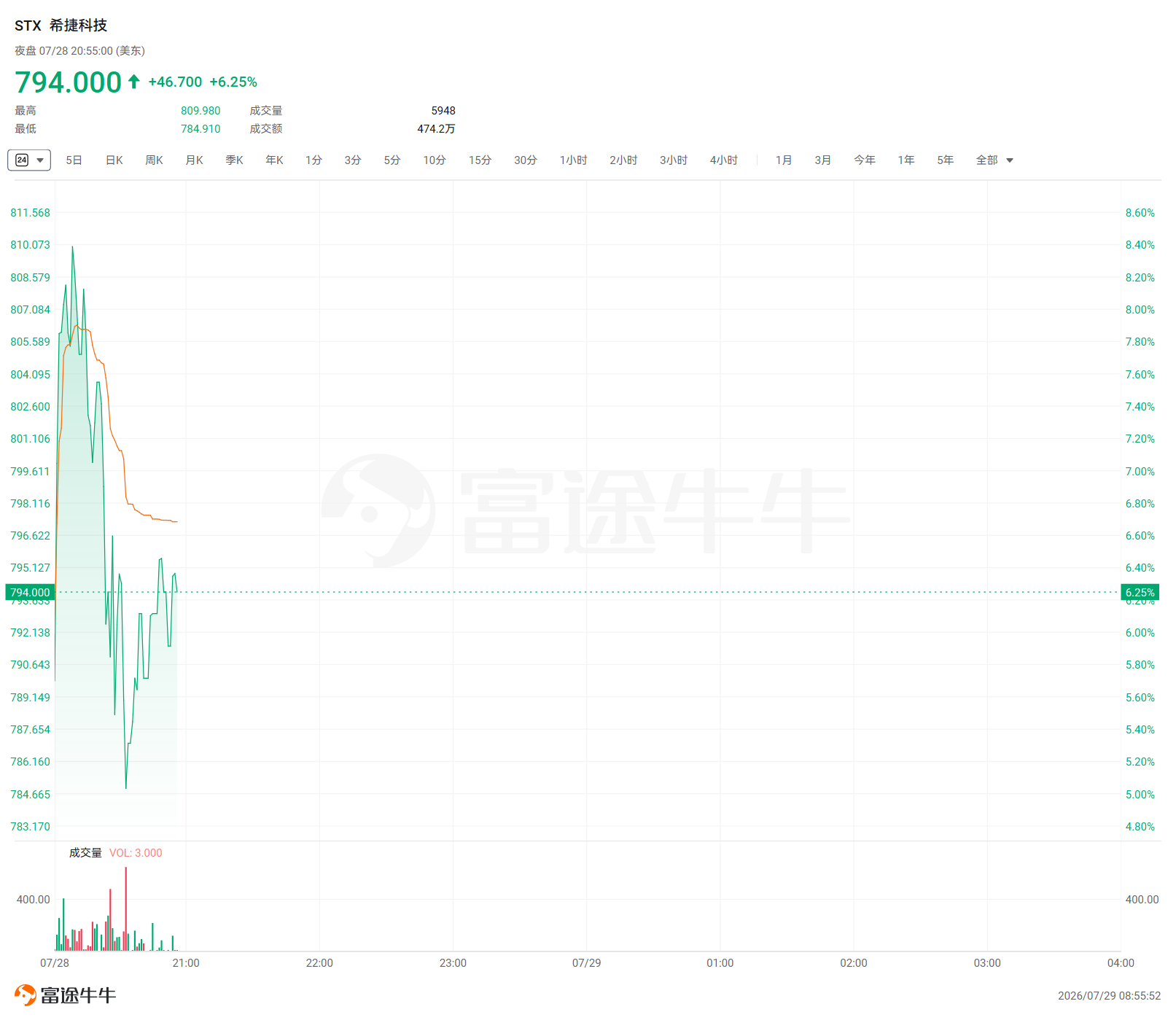
On the day of the U.S. market close, $PHLX Semiconductor Index (.SOX.US)$ fell 4.59%, $Roundhill Memory ETF (DRAM.US)$ 、 Micron Technology (MU.US) dropped nearly 9%, leaving the entire storage sector in turmoil. Seagate Technology also declined 8.53% during regular trading hours, but after releasing its earnings report and holding its earnings call, the company’s stock reversed sharply in after-hours trading, surging as much as 10%. It is currently up more than 6% in extended-hours trading.
How long can this growth last? Management offers a clear commitment.
CEO Dave Mosley opened the call by stating: 'We expect our revenue growth in fiscal year 2027 to exceed our performance in fiscal year 2026.'—a year in which Seagate achieved 34% full-year revenue growth.
CFO Gianluca Romano went further: 'We have clearly indicated that we will deliver sequential quarterly revenue growth and gross margin expansion throughout fiscal year 2027.' This is not a vague optimistic outlook, but a commitment to be fulfilled quarter by quarter.
The core rationale underpinning this outlook is that Seagate’s nearline hard drive capacity is already largely committed through long-term agreements (LTAs) extending into calendar year 2028. Moreover, the planning horizon continues to expand—Mosley revealed, 'We are not seeing customers shorten their planning cycles; many are actively extending their plans into 2029 and beyond. We believe this reflects their growing confidence in their long-term infrastructure needs.'
How much higher can gross margins go? 'Incremental gross margins are well above 60%.'
Gross margin this quarter has already reached 52.7%, with the September-quarter guidance implying a gross margin of approximately 57% and an operating margin of around 50%.
Analyst Aaron Rakers pressed on the sustainability of gross margins. Romano responded, "Our pricing strategy has been in place for 12 to 13 quarters, and the direction hasn’t changed." Three key drivers underpin this: continued execution of our pricing strategy, an ongoing shift in product mix toward higher-capacity nearline hard drives, and cost improvements stemming from the transition to HAMR technology.
Mosley added further clarity on the earnings elasticity from the HAMR transition: when shifting production from 3TB per drive to 4TB per drive, factories require a brief production pause for the transition, during which yields ramp up. "When we exceed our plans, cost performance typically comes in better than expected—that’s the source of the profit elasticity," he said.
Romano gave a clear signal regarding incremental gross margins: "Our incremental gross margin is well above 60%... The trend is clearly toward stronger gross margins, and our guidance for the September quarter is already close to that level."
Pricing: Customers are paying premiums above contract prices to secure capacity.
Pricing was the most intensively questioned topic by analysts during the earnings call.
Morgan Stanley analyst Erik Woodring noted that Seagate Technology’s price per exabyte (EB) rose approximately 10% year-over-year in the June quarter, and the implied pricing growth in the September quarter guidance could approach or even exceed 20% year-over-year. He asked whether this trend is sustainable.
Romano offered a straightforward explanation: "The supply-demand gap is now slightly wider than it was a few quarters ago. We have some additional capacity, which we’re pricing at very attractive levels."
Mosley revealed a key detail: Seagate’s contracts are typically locked in for one year, but once product yields improve, additional capacity becomes available for the market—"Customers are usually willing to pay above the contracted price to secure this extra capacity. That’s why you see this stepwise price increase," he explained.
An early HAMR customer had previously benefited from preferential pricing. Romano stated explicitly, "The volume sold at preferential prices in the June quarter was already minimal, and there will be none in the September quarter"—a factor contributing to further sequential pricing improvement in September. However, he emphasized that the primary driver remains robust overall demand, with customers actively competing for additional capacity.
HAMR Technology Roadmap: Mosaic 4 scaling up, Mosaic 5 progressing as planned
On the technical front, Mosley confirmed that all HAMR-related milestones are progressing on schedule.
Specific progress is as follows:
Mosaic 3: Certification has been completed with all major cloud customers and the product is now in volume production environments.
Mosaic 4 (supporting up to 44TB per drive): Volume ramp-up is accelerating with the world’s two largest CSPs. Romano disclosed that Mosaic 4 began shipping in the March quarter, achieved a 'solid ramp' by the June quarter—making a 'significant contribution' to financial performance—and will see further increases in the September quarter.
Mosaic 5 (5TB+ per platter): Certification and initial shipments are expected to begin by the end of 2027.
HAMR adoption: HAMR-based drives now account for 40% of nearline exabyte shipments, with a target to increase this share to 50% by the end of 2026.
Romano explained why the company must continue investing in manufacturing tools even as overall unit shipments remain flat: over the past year, the number of heads and platters per drive has increased by 15% to 20%, while total unit shipments have barely changed. As products transition from 3TB/platter to 4TB and 5TB, manufacturing process flows have become more complex and require longer tool occupancy time—this is the core rationale driving capital investment.
Mosley added: 'The increase in factory complexity isn’t just about the number of heads and platters—it’s about the product transition itself. Newer products spend more time on tools and sometimes require multiple passes through the same tool.'
AI demand: KV caching and physical AI—the two new drivers—are 'still in early stages.'
During the earnings call, management expressed cautious optimism regarding new storage demand driven by AI but repeatedly emphasized that it is 'still in the early stages.'
Mosley explained the relationship between KV Cache and hard disk storage: in agentic AI applications, systems need to retain large amounts of 'context' for each user. As the number of users grows and interactions become more complex, this contextual data expands significantly. 'You don’t want to recompute this context every time—that’s what’s driving storage demand,' he said. A white paper jointly published by Seagate and SK hynix shows that tiering KV Cache data across memory, SSDs, and hard drives can reduce repeated GPU calls during compute-intensive phases, thereby freeing up GPUs for more revenue-generating workloads.
Regarding Physical AI, Mosley expressed even greater enthusiasm—but also acknowledged it is a longer-term prospect. 'People focus on robots as the end product, but I believe this is fundamentally a data problem. These robots have sensors, and the data flows back to a local cloud or a larger cloud infrastructure,' he noted. He believes the vast amounts of unstructured video data generated by Physical AI will become a significant driver of hard drive storage demand. 'But even before we get to Physical AI, enterprise application trends themselves are already highly favorable for us.'
Financial Discipline: Debt Reduction and Accelerated Share Buybacks
By the end of fiscal year 2026, Seagate’s net debt leverage ratio had declined to 0.4x. An additional $1.2 billion in debt will be repaid in the September quarter—of which $1.0 billion in high-yield senior notes was already settled in July, with the remaining convertible debt due for repayment in September. Romano stated that total debt outstanding is expected to fall to approximately $2.4 billion by the end of the September quarter.
Additionally, 'We are executing a higher-scale share repurchase this quarter and will continue to do so over the next several quarters,' Romano added. He also mentioned that there remains one higher-interest bond that is planned to be addressed within the next one to two quarters.
Below is the full transcript of the earnings call:
Seagate Fiscal Year 2026 Fourth Quarter and Full-Year Earnings Conference Call Transcript
Meeting Date: July 28, 2026 Company Name: Seagate Meeting Type: Fiscal Year 2026 Fourth Quarter Earnings Conference Call
I. Opening Remarks
Operator: Welcome to Seagate Technology’s Fiscal Year 2026 Fourth Quarter and Full-Year Earnings Conference Call. All participants are in listen-only mode. Following today’s presentation, there will be a question-and-answer session. This call is being recorded. I will now turn the conference over to Shanye Hudson, Senior Vice President of Investor Relations. Please go ahead.
Shanye Hudson, Senior Vice President of Investor Relations:
Good day, everyone, and welcome to today’s conference call. Joining me are Dave Mosley, Chairman and Chief Executive Officer of Seagate Technology, and Gianluca Romano, Chief Financial Officer. We have posted our press release and detailed supplementary information for the fourth quarter and full year of fiscal year 2026 in the investor section of our company website.
During today’s call, we will reference both GAAP and non-GAAP financial measures. A reconciliation of non-GAAP to GAAP measures is provided in the earnings press release and Form 8-K filed on our website. For certain forward-looking non-GAAP measures, we have not provided reconciliations because material items that may impact these measures are outside our control and cannot be reasonably predicted; therefore, without unreasonable effort, we are unable to provide a reconciliation to the corresponding GAAP measures.
Before we begin, please note that today’s conference call contains forward-looking statements reflecting management’s current views and assumptions as of today, based on available information. These statements should not be relied upon as representing our views at any subsequent time. Actual results may differ materially from those expressed or implied in these forward-looking statements due to risks and uncertainties associated with our business. For further information regarding risks, uncertainties, and other factors that could affect our future business performance, please refer to today’s press release, our filings with the SEC (including our most recent Annual Report on Form 10-K and Quarterly Reports on Form 10-Q), and the supplementary materials posted in the investor section of our website.
Following our prepared remarks, we will open the call for questions. To ensure all analysts have an opportunity to participate, we ask that each analyst ask one primary question before rejoining the queue. I will now turn the call over to Dave.
II. Management Remarks
Dave Mosley, Chairman and Chief Executive Officer
Thank you, Shanye, and good day, everyone. Seagate closed an outstanding fiscal year 2026 with strong performance. Our June-quarter revenue and non-GAAP earnings per share both exceeded expectations, and we achieved our 13th consecutive quarter of non-GAAP gross margin expansion.
This quarter, our free cash flow margin reached 31%, generating over $1.1 billion—the strongest quarterly performance in more than a decade.
Our exceptional financial performance in fiscal year 2026 was driven by the three structural growth pillars I outlined last quarter: sustainable market demand, a differentiated technology roadmap, and disciplined operational execution.
First, sustainable market demand. As our results demonstrate, demand for high-capacity storage remains strong and continues to grow. Driven by robust cloud customer demand for data storage solutions and the widespread adoption of AI-enhanced applications, we achieved 34% revenue growth in the current fiscal year. Given this momentum and our improved visibility into demand, we expect revenue growth in fiscal year 2027 to exceed that of fiscal year 2026.
Second, we are advancing a differentiated technology roadmap centered on our Mosaic platform based on HAMR technology. HAMR enables us to increase areal density, allowing more data to be stored on each disk platter. This allows us to scale exabyte shipments in a highly capital-efficient manner to meet growing demand while capturing greater value per drive. By the end of this fiscal year, HAMR-based products accounted for approximately 40% of our nearline exabyte shipments. We will continue investing in HAMR capabilities to support our mid-20% exabyte growth target while further enhancing profitability and capital efficiency.
Third, translating demand strength and technological advancement into profit growth. In fiscal year 2026, we expanded non-GAAP gross margin by 10 percentage points, grew non-GAAP earnings per share by over 90%, and generated a record $3.1 billion in free cash flow. Looking ahead to fiscal year 2027, we anticipate sequential quarterly improvement in both margins and cash generation throughout the year.
Our confidence stems from the scale, quality, and duration of commitments from data center customers against a backdrop of persistently strong demand. Data center demand currently accounts for approximately 90% of our exabyte shipments. Under existing long-term supply agreements, the vast majority of our nearline exabytes have already been allocated through 2028. Importantly, we have not observed customers shortening their planning horizons. On the contrary, as strategic partnerships deepen, many customers are actively seeking to extend their planning cycles into 2029 and beyond—a trend we view as reflecting growing customer confidence in their long-term infrastructure needs.
These collaborations further reinforce our conviction regarding the durability of demand, while also providing customers with greater supply assurance and supporting critical technology transitions. We continue to adhere to our principle of securing customer orders before initiating hard drive production, with contracts explicitly defining product configurations and pricing terms covering all of fiscal year 2027. We remain committed to a value-based pricing strategy, balancing stronger demand conditions with our objective of delivering sustainable, long-term profitable growth.
Cloud customers remain the primary driver of nearline demand, with nearline exabyte shipments achieving sequential quarterly growth for three consecutive years and showing no signs of deceleration—further accelerated now by the proliferation of AI, which is amplifying demand from traditional data-intensive applications such as video. We continue to benefit from cloud infrastructure deployments that generate strong demand for scalable, cost-effective, and highly reliable storage.
At the same time, we believe storage demand will remain durable throughout the investment cycle for two key reasons: first, new data continues to be generated continuously within existing cloud and enterprise infrastructure; and second, customers are increasingly retaining and reusing data beyond its original purpose as its value extends further. AI is reinforcing these trends and clearly demonstrating that data is not only growing but compounding.
As AI evolves from model training to inference and onward to agentic applications, more data is being generated and retained to preserve historical context, meet compliance requirements, and enable feature reuse. With data center environments growing larger and more complex, customers must balance performance, power consumption, and cost across distributed infrastructure. Cloud service providers have long addressed these challenges through tiered storage architectures—combining high-performance memory and SSDs with high-capacity hard disk drives—to optimize performance and economics at scale.
Our recent white paper co-published with SK Hynix highlights the importance of storage for inference and agentic AI workloads and directly underscores the value of hard disk drive storage. These workloads rely on persistent context across user interactions, and KV cache (Key-Value Cache) is a critical mechanism for efficiently retaining and reusing that context. As user counts grow and interactions become longer and more complex, KV cache sizes can expand significantly.
Our research shows that by extending KV cache data across a three-tier architecture comprising memory, SSDs, and hard disk drives, enterprises can retain more context and avoid recomputing already-generated data. This not only directly drives demand for hard disk drive storage but also reduces GPU utilization during the most compute-intensive phases of applications, thereby freeing up GPU resources for higher-value workloads.
Moreover, we are witnessing the application of tiered storage architectures extending from large-scale cloud data centers to enterprise deployments. As enterprises increasingly need to operate across public cloud, private cloud, and on-premises environments, they must manage ever-growing volumes of structured and unstructured data while confronting the same performance, cost, and energy-efficiency trade-offs that hyperscale cloud service providers have addressed for years. We are already seeing this expanding demand within our own business.
In the June quarter, enterprise nearline revenue grew for the fifth consecutive quarter, and our collaborations with emerging cloud (Neocloud) operators and leading model developers have become increasingly frequent. As these providers scale their data management needs, they are beginning to adopt modern tiered storage architectures built upon hard disk drives (HDDs) to deliver trusted, high-capacity storage foundations.
Looking ahead, we believe physical AI applications—such as robotics and autonomous vehicles—will drive the next phase of exponential growth in data creation and retention at the edge. These applications rely on world models trained on millions of hours of historical and synthetic video content to understand and reliably interact with the physical world.
Collectively, these trends underscore a structural transformation in storage demand: applications across cloud and enterprise environments are creating, retaining, and reusing data at unprecedented scale, driving broader adoption of high-capacity storage within modern tiered architectures and creating sustained growth opportunities for Seagate.
Our technology roadmap plays a central role in enabling Seagate to capture opportunities arising from growing storage demand. Increasing areal density remains our North Star objective. We believe that boosting the data capacity per disk is the fastest and most capital-efficient path to supporting long-term exabyte-scale growth while maintaining relatively stable HDD unit shipments. Our deep expertise in materials science, precision manufacturing, advanced photonics, and nanoscale wafer production has enabled us to pioneer HAMR technology and the Mosaic platform, delivering continuous improvements in both per-disk and per-drive storage density.
We continue to push the boundaries of innovation—an achievement exemplified last quarter by our vertically integrated laser manufacturing capability, which achieved volume production of tens of millions of edge-emitting lasers. This milestone demonstrates the scale, maturity, and supply chain resilience of our Mosaic platform. These innovations enhance total cost of ownership (TCO) for our customers while expanding our exabyte output and improving operational and supply chain efficiency.
By the end of fiscal year 2026, we successfully completed the ramp-up plan for HAMR-based products as scheduled. Mosaic 3 products have been certified and deployed in production environments across all major cloud customers. The second-generation Mosaic 4 platform, supporting up to 44TB per drive, is currently ramping with two of the world’s largest CSP customers, and certifications with other customers are underway. We expect that by the end of 2026, 50% of HAMR exabytes shipped will be based on the Mosaic 4 platform, marking our next ramp-up milestone.
Looking further ahead, our Mosaic 5 platform (5TB+ per disk) remains on track for customer qualification and volume shipment by the end of 2027.
In summary, Seagate delivered comprehensively throughout fiscal year 2026, advancing each quarter on the momentum of the prior one, and we anticipate this trajectory to continue into fiscal year 2027. The ongoing expansion in data creation, retention, and utilization continues to elevate the strategic importance of hard disk drive storage within modern data architectures. Our strong demand outlook, differentiated technology strategy, and disciplined operational execution together form a solid foundation for Seagate to capitalize on significant opportunities ahead and create long-term value for stakeholders.
Finally, I would like to thank our global team for another year of outstanding execution, and express my gratitude to our customers, suppliers, partners, and shareholders for their continued support and trust in the company. Now, I’ll turn it over to Gianluca.
Gianluca Romano, Executive Vice President and Chief Financial Officer
Thank you, Dave. We concluded fiscal year 2026 with a strong June quarter, delivering double-digit sequential growth in both revenue and profit, driven by disciplined operational execution and expansion in both revenue and gross margin across every end market we serve.
Revenue for the June quarter was $3.6 billion, up 17% sequentially and 48% year-over-year, exceeding the high end of our guidance range. We achieved record highs in gross margin, operating margin, and earnings per share.
Non-GAAP gross margin was 52.7%, an increase of 570 basis points sequentially;
Non-GAAP operating margin increased by 710 basis points sequentially to 44.6%;
Non-GAAP earnings per share were $5.71, up 39% sequentially and 121% year-over-year, significantly surpassing the high end of our guidance range.
As Dave mentioned earlier, we generated over $1.1 billion in free cash flow, marking our strongest quarterly performance in more than a decade.
Sustained strong demand from data centers continued to outpace overall company growth. In the June quarter, we shipped 218 exabytes, up 34% year-over-year, with data centers accounting for 89% of total shipments. Data center exabyte shipments reached 195 exabytes, up 11% sequentially and 43% year-over-year; data center revenue was $2.9 billion, up 17% sequentially and 57% year-over-year. Global cloud customers accounted for the vast majority of data center revenue and exabyte demand.
Meanwhile, demand trends in the enterprise OEM data center market also continued to strengthen, reflecting broader customer adoption and increasing storage requirements across a wider range of workloads—many of which Dave previously outlined. In the June quarter, we achieved robust double-digit year-over-year growth in both revenue and exabyte shipments in the enterprise OEM market.
To support long-term demand growth, we are continuing to expand deployment of HAMR technology across our product portfolio. Our objective is to shift an increasing portion of our capacity toward HAMR-based products—initially serving cloud customers and gradually extending to enterprise deployments over time. During this transition, we are making targeted investments in the additional tools and technologies required to manufacture HAMR products. These investments enable us to maintain relatively stable hard drive unit shipments even as customers migrate to higher-capacity drives and manufacturing cycles lengthen. We believe these initiatives will position us to deliver mid-20% nearline growth over the next several years.
Outside of data centers, revenue from the edge IoT market amounted to $697 million, representing 19% of total revenue, up 14% sequentially and 20% year-over-year, partly due to persistently tight supply conditions and rising NAND prices.
Regarding other items on the income statement: Non-GAAP gross profit increased significantly to $1.9 billion, up 31% sequentially and more than doubling year-over-year. Non-GAAP gross margin expanded from 47% in the prior quarter to 52.7%, reflecting the continued execution of our long-term pricing strategy and an improved product mix. Supported by strong demand, we expect these favorable trends to continue.
Non-GAAP operating expenses were $293 million, or 8% of revenue, demonstrating our disciplined approach to cost management. Non-GAAP operating profit rose 39% sequentially to $1.6 billion, or 44.6% of revenue, highlighting the scalability of our financial model as well as ongoing areal density innovations, supply discipline, and effective pricing strategy execution.
In the June quarter, Other Income and Expense (OI&E) was $58 million; we expect OI&E to further decline to approximately $45 million in the September quarter, reflecting the benefit of lower interest expense as we continue to repay debt.
Non-GAAP net income increased to $1.3 billion, resulting in non-GAAP earnings per share of $5.71, based on a tax provision of $242 million and a diluted share count of approximately 231 million shares (including the net impact of the 2028 convertible notes).
Cash flow and balance sheet highlights: Capital expenditures for the June quarter were $187 million, representing 4.7% of revenue for fiscal year 2026. Looking ahead, we anticipate capital expenditures for fiscal year 2027 to remain within our target range of 4% to 6% of revenue.
Free cash flow expanded to $1.1 billion, up 17% sequentially. Supported by sustained demand, operational efficiency gains, and disciplined capital spending, we expect further improvement in cash generation throughout fiscal year 2027.
In the June quarter, we returned approximately $283 million to shareholders through dividends and share repurchases.
Strengthening the balance sheet was a key strategic priority for fiscal year 2026, and we have delivered on this commitment. At fiscal year-end, we held $1.7 billion in cash and cash equivalents, with total liquidity—including undrawn revolving credit facilities—reaching $3.0 billion. As of the end of fiscal year 2026, total debt stood at approximately $3.6 billion, down $1.4 billion year-over-year, including $300 million repaid during the June quarter.
Our net leverage ratio has improved to 0.4x, based on adjusted EBITDA of $1.7 billion for the June quarter (up 37% sequentially and 142% year-over-year).
In the September quarter, we will repay an additional $1.2 billion of debt: $1 billion of high-yield senior notes was prepaid in July, and the remaining balance of convertible notes is scheduled for repayment in September.
September quarter outlook: Visibility from our Build-to-Order (BTO) model further reinforces our confidence in sustained demand for high-capacity nearline hard drives, a trend increasingly amplified by the accelerating adoption of AI. We expect continued revenue and profitability expansion in the September quarter.
Revenue guidance: $4.1 billion, plus or minus $100 million, representing 36% year-over-year growth at the midpoint;
Non-GAAP operating expenses: approximately $300 million;
Non-GAAP operating margin: expected to be approximately 50%, based on the midpoint of revenue guidance;
Non-GAAP earnings per share: $7.30, plus or minus $0.20, based on an estimated tax rate of approximately 16% and non-GAAP diluted shares outstanding of 231 million (including an estimated dilutive impact of approximately 2 million shares from the 2028 convertible notes).
Our strong financial performance and forward-looking outlook fully demonstrate our ability to deliver profitable growth, expand margins, and generate significant cash flow. We are confident in achieving sequential quarterly revenue growth and margin expansion throughout fiscal year 2027, while creating long-term value for our customers and shareholders.
Operator, please open the Q&A session.
III. Question-and-Answer Session
Question 1: Aaron Rakers, Wells Fargo
Question: Thank you for the opportunity to ask a question, and congratulations on your outstanding performance. I’d like to dive deeper into gross margin. Based on your guidance, it appears that next quarter’s gross margin will reach the mid-57% range. Is this the guidance you are providing? Additionally, during the transition from Mosaic 3 to Mosaic 4, the annualized cost per terabyte is declining by approximately mid-teens percent. Is this trend sustainable? How should we model this over the long term?
Dave Mosley: Regarding product transitions, when we upgrade our products, we need to temporarily halt production lines, which involves yield considerations. When our execution exceeds plan expectations, it creates additional room for cost optimization—this addresses the second part of your question.
Gianluca Romano: Gross margin in Q4 of fiscal year 2026 was already very strong, delivering robust sequential improvement, and our guidance indicates further enhancement next quarter. Our pricing strategy, established roughly 12 to 13 quarters ago, has been consistently implemented without directional changes, though it varies slightly each quarter. Continued optimization of our product mix has helped—we are seeing an increasing share of high-capacity nearline products, with nearline exabytes growing significantly again this quarter. All aspects align with the strategic direction we have maintained over multiple quarters. As Dave mentioned, the transition from 3TB to 4TB per drive has also provided an additional boost to profitability.
Question 2: Ben Reitzes, Melius
Question: Thank you for taking my question. I’d like to discuss two longer-term demand drivers. First, how much is KV caching currently contributing to utilization at the hard disk drive layer? Is it already showing early signs of impact? And when might it meaningfully affect exabyte demand? Second, when do you expect physical AI to become a material driver of exabyte demand?
Dave Mosley: Both are still in very early stages. We highlighted KV caching specifically because we are observing an increasing number of agent workflows. The key word here is 'context'—when deploying these agents, they need rich context covering business rules, problem scenarios, and so on, and users don’t want to recompute this context every time. This is precisely what drives storage demand, though it remains in a very nascent phase.
We’re quite excited about physical AI. People often focus on end products like robots or autonomous vehicles themselves, but I actually view this more fundamentally as a data proposition. These robots are equipped with sensors that form sensor networks, and the learning data they generate flows back to local clouds or larger-scale cloud infrastructures. So when I refer to physical AI, I’m really thinking about data—the processing of that data, the insights derived from it, and how much of it needs to be stored long-term to maintain contextual continuity.
Physical AI scenarios primarily generate unstructured data such as video, unlike the structured data (e.g., spreadsheets or forms) of the past. Machines repeatedly learn from this unstructured data, and users don’t want to reload it into memory layers each time—which represents a tremendous opportunity for us.
Question 3: Erik Woodring, Morgan Stanley
Q: Thank you for the question, and congratulations on the strong results and guidance. Gianluca, in prior quarters you have consistently and firmly stated that year-over-year pricing per exabyte would remain in the mid-to-high single-digit percentage range. In the June quarter, pricing per exabyte has already achieved a 10% year-over-year increase, and the implied year-over-year pricing growth embedded in your September quarter guidance appears to be close to—or even exceed—20%. Could you please provide an update on the latest pricing dynamics and explain why we should not expect the September quarter’s pricing trend to persist or even accelerate further, especially given ongoing supply-demand imbalances, robust customer demand, and the delivery of higher value to customers?
Gianluca Romano: Our strategy has not changed, but the supply-demand gap has indeed widened compared to several quarters ago. In Q4 of fiscal year 2026, our shipments increased slightly, and the September quarter may also see a modest amount of additional capacity coming online, which we are pricing at very attractive levels. This is not a shift in strategy but rather capturing additional pricing benefits through strong execution in a period of exceptionally robust demand. Of course, each quarter presents different dynamics, and we will need to monitor pricing trends over the coming quarters. However, we have clearly stated our expectation that revenue will improve each quarter, with gross margins and overall profitability rising sequentially—and pricing is one component of this sequential improvement.
Question 4: Asiya Merchant, Citigroup
Q: Excellent results—thank you for taking my question. Regarding exabyte CAGR, you have reaffirmed a target in the mid-20% range, yet actual performance has significantly exceeded that. I note you mentioned some investment plans. Could you help us understand whether exabyte growth above 30% can be sustained into fiscal year 2027, particularly as you transition to second-generation HAMR and ramp Mosaic 5 further?
Dave Mosley: We are not actually increasing the number of drive enclosures; instead, we are continuously working to enhance the heads and disks inside each enclosure to achieve higher technological capability and greater exabyte output. The ultimate CAGR depends on the pace and success of this process. During product transitions, factories experience some degree of efficiency loss, but over the long term—moving from 3TB to 4TB and then to 5TB—we can produce significantly more exabytes.
To date, what you’ve seen is primarily the transition to 3TB. We are currently ramping 4TB, and 5TB is coming soon. Our ramp pace depends on end-customer demand and customer qualification programs—because from wafer start to final shipment, we require a lead time of three to four quarters. Additionally, yield improvements contribute a modest amount of extra exabyte capacity, and our team has performed exceptionally well in this area. These dynamic factors collectively shape our outlook for the next few years—which is precisely why we’ve provided a target of ‘mid-20%’ CAGR. While there is potential to exceed this target, it will still require substantial technological breakthroughs.
Question 5: C.J. Muse, Cantor Fitzgerald
Q: Thank you for the question. Regarding pricing, could you please distinguish between price changes for like-for-like products versus price uplift driven by new products? Additionally, how should we interpret the drivers behind the implied year-over-year pricing increase of over 20% in the September guidance, as well as trends expected in the December quarter and beyond, particularly in light of existing contracts expiring and being renegotiated?
Dave Mosley: As outlined in our prepared remarks, we strive to maintain predictability for at least the next 12 months—the timeframe for which our factories have visibility and during which we finalize exact configurations and pricing with customers. There are some interesting dynamics as contracts roll over across different customers.
First, product qualification makes like-for-like comparisons difficult, as our product iteration cycle is very rapid—a benefit to both us and our customers, who achieve superior total cost of ownership (TCO) when building data centers. Second, other architectural factors also influence how quickly or slowly customers can absorb these products, making the situation quite complex.
From a temporal perspective, in addition to the pricing locked within a given annual cycle, we can also see room for execution improvement approximately two to three quarters ahead—not in the current quarter, but somewhat later. At that time, we will have more exabytes available, and the market’s strong demand for these exabytes typically means customers are willing to pay a premium above contract prices. This is why we observe a stepwise increase in pricing. It reflects customer confidence in demand—they are effectively voting with their actions every day by signing agreements at prices even higher than existing contracts.
Gianluca Romano: Regarding the new orders and long-term agreements we are currently negotiating, the trend remains consistent with the past. We continue to see robust demand, which naturally provides room to further advance our pricing strategy. Each quarter varies based on the number of contracts, shipment volumes across different customers, incremental shipments, and their associated pricing—but the direction is clear. We have operated this way for over three years, and currently, both supply-demand tightness and pricing dynamics are particularly strong. Moreover, we are already moving forward in the same direction for the next two to three quarters.
Question 6: Tom O'Malley, Barclays
Question: Thank you for taking my question—it has two parts. Previously, you indicated that by June 2027, 70% of nearline products would utilize HAMR technology. How is progress toward that target? Additionally, I noted your remarks specifically highlighted strategic investments in additional tools, technologies, and manufacturing capabilities—could you elaborate on the focus of these investments to support achieving the HAMR mix target?
Dave Mosley: HAMR deployment continues to proceed smoothly and aligns broadly with our expectations from several years ago. Over time, we have indeed extracted slightly more value from PMR than initially anticipated, but overall, I believe the trajectory remains largely consistent, and everything is trending positively.
Regarding investments, the tools we are investing in are primarily dedicated to head and disk manufacturing, enabling the transition from 3TB to 4TB and then to 5TB technologies. I am very pleased with the team’s execution in this area and remain optimistic that HAMR will ultimately dominate our product portfolio. We are continuously deepening our understanding of these tools, which are central to areal density development, and I believe the long-term potential for areal density improvements may be even more favorable than I envisioned a few years ago.
Gianluca Romano: On HAMR exabyte mix, we have actually just achieved our first milestone—by June, 40% of nearline exabytes shipped came from HAMR drives—so we are progressing according to plan, and we expect to meet future targets on schedule.
Regarding new investments, there is a significant difference between components and complete hard drives. For example, over the past year, the number of disks and heads inside drive enclosures may have increased by 15% to 20%, while unit shipments of hard drives remained nearly flat. This is a natural outcome of the ongoing evolution toward nearline specifications and drives with 10 to 20 head-disk assemblies. This pattern has held true over the past 10 to 20 years; thus, even with flat unit shipments, we must continually scale up head and disk supply over time—it is a normal part of the business.
Dave Mosley (supplementing): I’d like to add one point, as many people don’t fully appreciate this yet: what’s driving increased factory complexity isn’t just the number of drives, heads, or disks—it’s the product transitions themselves. Newer products, such as the shift from 4TB to 5TB, require longer dwell times on tools and sometimes multiple passes through the same process step. This rising factory complexity is a primary driver behind our substantial investments.
Question 7: Mark Newman, Bernstein
Q: Thank you for the question, and congratulations on another strong performance. I’d like to focus on technology and cost-related issues. Could you provide an update on HAMR shipment progress—previously guided to reach 40% by the end of fiscal year 2026 and 50% by calendar year-end 2026? Are you currently on track? Regarding Mosaic 4, you mentioned it is ramping with global CSPs; last quarter its contribution to revenue was still modest—will it become more significant in the September quarter? Additionally, given the Mosaic 4 ramp, can we expect an acceleration in cost reductions?
Dave Mosley: All the metrics you mentioned are progressing according to plan. Regarding Mosaic 4, it was actually already quite substantial last quarter, and the current ramp is going very smoothly. We are managing the Mosaic 4 ramp pace somewhat deliberately, partly due to certification cycles and the fact that other customers are completing allocations of the previous generation while simultaneously moving through certification, which introduces some complexity into the supply chain. However, market acceptance of Mosaic 4 has been strong, and it will continue ramping throughout this fiscal year.
Gianluca Romano: To add to that: we began shipping Mosaic 4 in the March quarter, when volumes were quite low. We achieved a solid ramp in the June quarter, making it a meaningful contributor to this quarter’s financial performance, and its contribution will be even more pronounced in the September quarter. Meanwhile, our entire team is already focused on the next step—achieving volume production of 5TB per platter and 50TB per drive in the next calendar year.
Question 8: Wamsi Mohan, Bank of America
Q: In your exabyte outlook for fiscal years 2027 and 2028, how much has already been locked in via BTO (build-to-order) arrangements, and how much remains outside long-term agreements? Additionally, part of the pricing improvement in the September quarter stems from the expiration of introductory HAMR customer contracts that offered preferential pricing. Can this pricing momentum be sustained at that level for the remainder of the fiscal year? You’ve indicated that both revenue and margins will improve each quarter—could you provide some indication of the magnitude?
Dave Mosley: On the second point, different customers are at different stages of their contracts, and renegotiations will occur at various points in time. I believe our visibility across fiscal year 2027 remains relatively clear. At the same time, as we continue ramping new products—focusing on yield optimization and scrap reduction—we are freeing up additional capacity. Given the extremely strong exabyte demand, we intend to allocate this incremental capacity to customers demonstrating clear demand intent and capture corresponding market pricing.
Gianluca Romano: Regarding that specific customer—the volume shipped at preferential pricing in the June quarter was actually very small, and there will be none in the September quarter. So while this does have a modest positive impact on September pricing, it is not the primary driver. The main driver of pricing improvement in the September quarter is robust overall demand, with customers actively seeking additional incremental shipments.
Question 9: Joseph Cardoso, JPMorgan
Q: When you say ‘not increasing the number of drive enclosures,’ does this also encompass the nearline allocations you’re already seeing for 2028 and planning extending into 2029? What is your pricing visibility for those years?
Dave Mosley: As your question touches on, following the last downturn cycle, we established a strategy to maintain stable unit shipments of hard drives, and we remain committed to that path. However, within each drive, the number of critical components—such as heads and disks—is increasing, which is placing some pressure on our internal head and disk wafer fabs. These fabs, which are under our direct control, are undergoing active technological transitions.
The core story lies in the increasing complexity of manufacturing processes and the associated production challenges—from 3TB to 4TB and now to 5TB, the process roadmap has become progressively more complex, placing significant pressure on internal component manufacturing. However, given our position on the technology curve, we believe this is the optimal path to deliver more exabytes to the market, which is the fundamental reason we remain committed to this strategy.
Question 10: Karl Ackerman, BNP Paribas
Q: Dave, you mentioned advancing Mosaic certification among hyperscale cloud service providers, but Seagate’s exposure to emerging cloud and foundational model companies is also growing. Could you break down the demand contributions from traditional hyperscale cloud, emerging cloud, and on-premises deployments in your outlook for the September quarter?
Dave Mosley: Two years ago, I would have said that emerging cloud was primarily compute-focused. However, we are now seeing that even some of the largest emerging cloud operators require substantial data storage. They may have previously sourced this data from traditional hyperscalers, but now certain emerging cloud providers indicate a need to deploy storage instances locally, close to their operations. I don’t necessarily view this as competitive with hyperscale clouds—the use cases vary significantly, especially for application-specific training workloads, where there is a strong rationale for keeping several exabytes nearby.
We are having the very conversations you described with these customers. Everyone recognizes the efficiency of hyperscale cloud architectures and wants to achieve a similar level of efficiency. In some cases, we are engaging in deep system-level discussions; in others, we are focused solely on the hard drives themselves. Since these customers intend to operate this equipment over the long term, they also want to stay at the forefront of technological transitions—even though this can sometimes be challenging due to differences in feature sets. For customers requiring support, the certification landscape is quite complex.
Question 11: Amit Daryanani, Evercore
Q: Dave, looking ahead to long-term agreements and exabyte demand in 2028 and 2029, can all demand be fully met through areal density improvements alone? How secure is the upstream supply chain, particularly for specialized components? Gianluca, when will you reach an 80% gross margin?
Dave Mosley: On the supply chain front, we maintain close coordination with supply partners who have weathered significant challenges, ensuring all parties move forward in lockstep—a carefully orchestrated approach that is absolutely critical. We cannot afford fragmented, independent investments across the ecosystem, as that would drive costs in the wrong direction.
Regarding confidence in long-term demand, I am highly confident. Many market participants are still working to understand what these emerging applications mean for the storage layer. Whether it’s video-centric applications that were already sizable in the pre-AI era or today’s AI-enabled applications, both continue to drive strong demand for storage. Forecasts for some of these new applications remain challenging, and while optimism abounds, the existing data sphere—i.e., the data residing within cloud service providers—is growing rapidly regardless. I don’t believe areal density improvements alone can meet all demand, but advances in areal density are indeed robust, enabling better business planning across the ecosystem—and that’s one reason we can communicate effectively over longer time horizons.
Gianluca Romano: On gross margin, our incremental gross margin has been very strong over multiple recent quarters, and our overall gross margin continues to improve sequentially. We have not set a specific numerical target; instead, we aim to keep enhancing margins in line with business performance. We already know that each remaining quarter of this fiscal year will deliver sequential improvement. Where we ultimately land will become clear in due course, but we are not targeting any particular number.
Question 12: Steven Fox, Fox Advisors
Question: I’d like to understand the issue of free cash flow. Following a decade-high level, what are the key drivers for further improving free cash flow margins from a manufacturing perspective? Areal density improvements, measured in percentage terms, are expected to narrow incrementally, and multiple passes through the same equipment will become more capital-intensive—how do these factors impact free cash flow? Additionally, please remind us of your target debt level and when you plan to begin share repurchases.
Dave Mosley: We remain committed to our capital model—allocating 4% to 6% of revenue to capital expenditures. We are procuring modern tools, and even within the framework of 5% of revenue for CapEx, we are refreshing our equipment and performing well. These investments will all translate into higher areal density, which is precisely what excites us most.
From an operating expense standpoint, we do not anticipate needing significant increases in OpEx—our teams are delivering strong results across multiple innovation fronts, whether in mechanical engineering, quantum devices, lasers, or other cutting-edge areas. We believe the team is well-resourced and producing solid outcomes. Therefore, continued areal density improvements do not rely on substantially higher capital spending; ultimately, this will translate into what we refer to as sustained growth in free cash flow.
Regarding debt, our debt balance stood at $3.6 billion at the end of fiscal year 2026, a significant reduction from approximately $5.0 billion at the beginning of the fiscal year.
Gianluca Romano: We will further reduce debt this quarter. In fact, we completed a significant step in July, and we expect debt to decline to approximately $2.4 billion by the end of the September quarter. Additionally, there remains one higher-interest note that I hope to address in the near future—potentially in the next quarter or the one after. Meanwhile, our share repurchase activity this quarter has already exceeded that of the prior quarter, and we intend to maintain elevated repurchase levels over the coming quarters.
Question 13: Vijay Rakesh, Mizuho
Question: From the perspective of nearline hard drive attach rates with GPUs, how has this ratio changed compared to last year amid the adoption of AI and KV caching? Additionally, is gross margin expected to exceed 60%? Could you provide insight into the incremental gross margin contribution of Mosaic 4 compared to its predecessor?
Dave Mosley: On attach rates, I know many are trying to model this—it’s certainly worth exploring—but ultimately it depends heavily on specific applications. Different workloads vary significantly in their context requirements: some demand large context windows, while others do not. The scale of demand driven by agent-based AI and KV caching will largely hinge on which applications achieve widespread adoption. We are still working to incorporate these dynamics into our models, and as we look toward 2029, 2030, and beyond, close collaboration with customers and continuous tracking of application trends will be essential. We are quite optimistic about this trajectory—and this outlook does not yet include contributions from physical AI, which falls more under the enterprise application discussion I mentioned earlier.
Gianluca Romano: Last quarter, our gross margin was already approaching 53%, and our guidance for the September quarter indicates further improvement. Our incremental gross margin is already well above the 60% level you referenced. While I won’t provide specific forward guidance, the clear trend is toward consistently strengthening gross margins. Based on the guidance we’ve already provided for the September quarter, we are not far from reaching that level.
Question 14: Ananda Baruah, Loop Capital
Question: Dave, what are the primary application types currently driving demand? How will these core application types evolve in the coming years before we enter the era of physical AI?
Dave Mosley: I’ve been in this industry for a long time. When it comes to structured data—such as traditional form-filling or ERP systems—even though the volume of such data is already substantial, I believe its impact on storage demand is relatively limited.
What will truly drive a significant increase in processing demand is the emergence of massive volumes of unstructured data—video data, multi-source sensor data, or even text-based data that originates from highly diverse and heterogeneous sources. These applications require extensive computational power, and users do not want to repeat these computations. This trend is not only unfolding among hyperscale cloud service providers but is also spreading within enterprises and at the edge. These dynamics are already highly favorable to us even before we reach the era of physical AI.
IV. Closing Remarks
Dave Mosley:
Thank you, Gary, and thank you to all participants for joining us today. Fiscal year 2026 was an outstanding year for Seagate Technology, fully reflecting the strong execution capabilities of our global team and our deep collaboration with customers. As we enter fiscal year 2027, we are well positioned to seize the significant opportunities ahead. We will continue to focus on advancing our technology roadmap, achieving profitable revenue growth, and creating long-term value for all stakeholders. We look forward to updating you on our progress throughout the upcoming quarters.
Operator: This conference call has now concluded. Thank you for participating in today’s presentation. You may now disconnect.