In the early hours of July 30 Beijing time, the Federal Reserve will announce its July interest rate decision.
Mainstream market institutions expect rates to remain unchanged, but the probability of a July rate hike implied by OIS (Overnight Index Swaps) has surged from 12% a week ago to 38%, while expectations for a September hike have risen to 82%.
Holding rates steady is already the consensus—why is the market becoming even more nervous?
 The answer is: the Federal Reserve is shifting from a 'data-dependent' stance to a 'risk-preventive' approach.
Views from Goldman Sachs, CICC, and Citadel Securities indicate that uncertainty surrounding the current policy path has reached extreme levels.
Consensus ends here: the FOMC is fracturing internally.
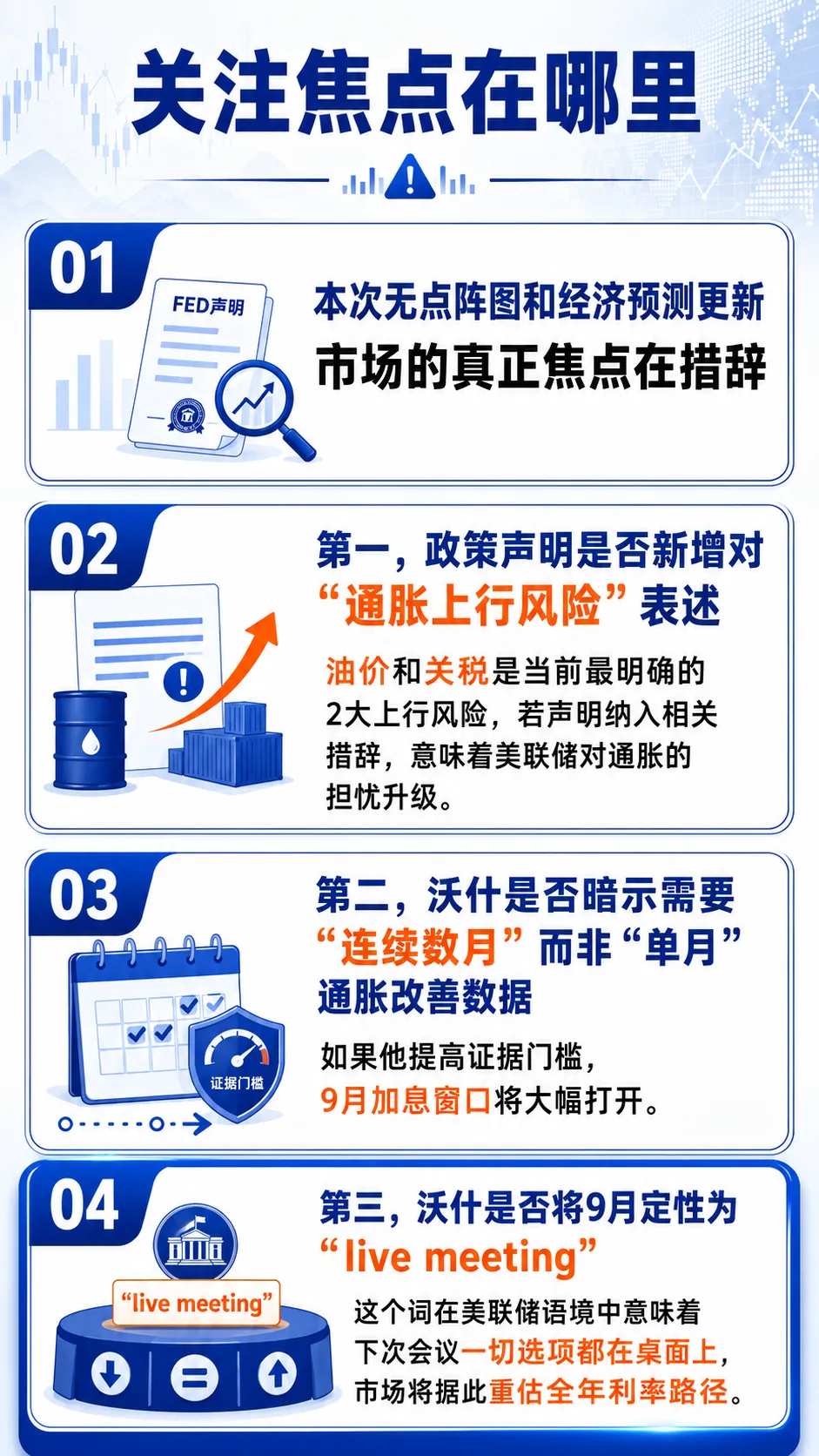
The Federal Open Market Committee (FOMC), the Fed's interest rate-setting body, is currently experiencing significant internal division.
Dallas Fed President Lorie Logan has publicly called for a rate hike, and Natixis forecasts she is 'almost certain to cast a dissenting vote.' Harker and Kashkari may also join the opposition camp.
On the other side, officials such as Waller and Cook favor a wait-and-see approach amid the cooling June CPI (Consumer Price Index). Former Fed Governor Kevin Warsh has explicitly abandoned forward guidance, and market attention has shifted from 'guessing the Chair’s stance' to 'counting dissents'—more than two dissenting votes would send an extremely hawkish signal.
The number of dissenting votes carries more signaling power than the decision itself.
Oil prices were merely the trigger; the real concern is the broadening of inflation.
Brent crude was the most visible catalyst for this round of rate hikes.
Since July 7, oil prices surged, briefly approaching USD 100 per barrel. Prices later retreated after Trump called off a military strike on Iran, but the geopolitical risk premium has not dissipated.
What truly unsettles the Federal Reserve is the broadening of inflation. In May, the PCE (Personal Consumption Expenditures price index—the Fed’s preferred inflation gauge) rose 4.1% year-over-year, core PCE stood at 3.4%, and long-term inflation expectations were at 3.3%.
The yield on the 30-year U.S. Treasury note hit 5.17%, a nearly two-decade high. New tariffs combined with expanded AI investment are transmitting inflationary pressures from energy costs to broader input costs. With PCE still above 4% and 30-year Treasury yields at a two-decade peak, the broadening of inflation is the real issue.
What does Wall Street think?
The divergence among institutions regarding this meeting is unusually pronounced—rare since Waller took office.
Goldman Sachs considers the uncertainty surrounding this meeting 'unusually high.' The statement may acknowledge the upside inflation risks posed by geopolitical conflicts, and at least one voting member is expected to dissent. However, a majority of voting members are unlikely to support a rate hike—representing the mainstream cautious stance.
CICC judges that the probability of a rate hike in July is low, but the meeting will likely adopt a 'hawkish pause.'
Citadel Securities holds the most aggressive view, directly forecasting a 25-basis-point rate hike this week, arguing that a surprise hike would reinforce Waller’s commitment to 'restoring price stability.'
Goldman Sachs is cautious, CICC expects a hawkish pause, and Citadel anticipates a surprise rate hike—diverging views among institutions have amplified market uncertainty, making the market's pricing anchor more fragile.
What does the market fear most?
This week$Microsoft (MSFT.US)$、$Meta Platforms (META.US)$、$Apple (AAPL.US)$、$Amazon (AMZN.US)$will see successive earnings releases, forming a 'super week' alongside the FOMC meeting.
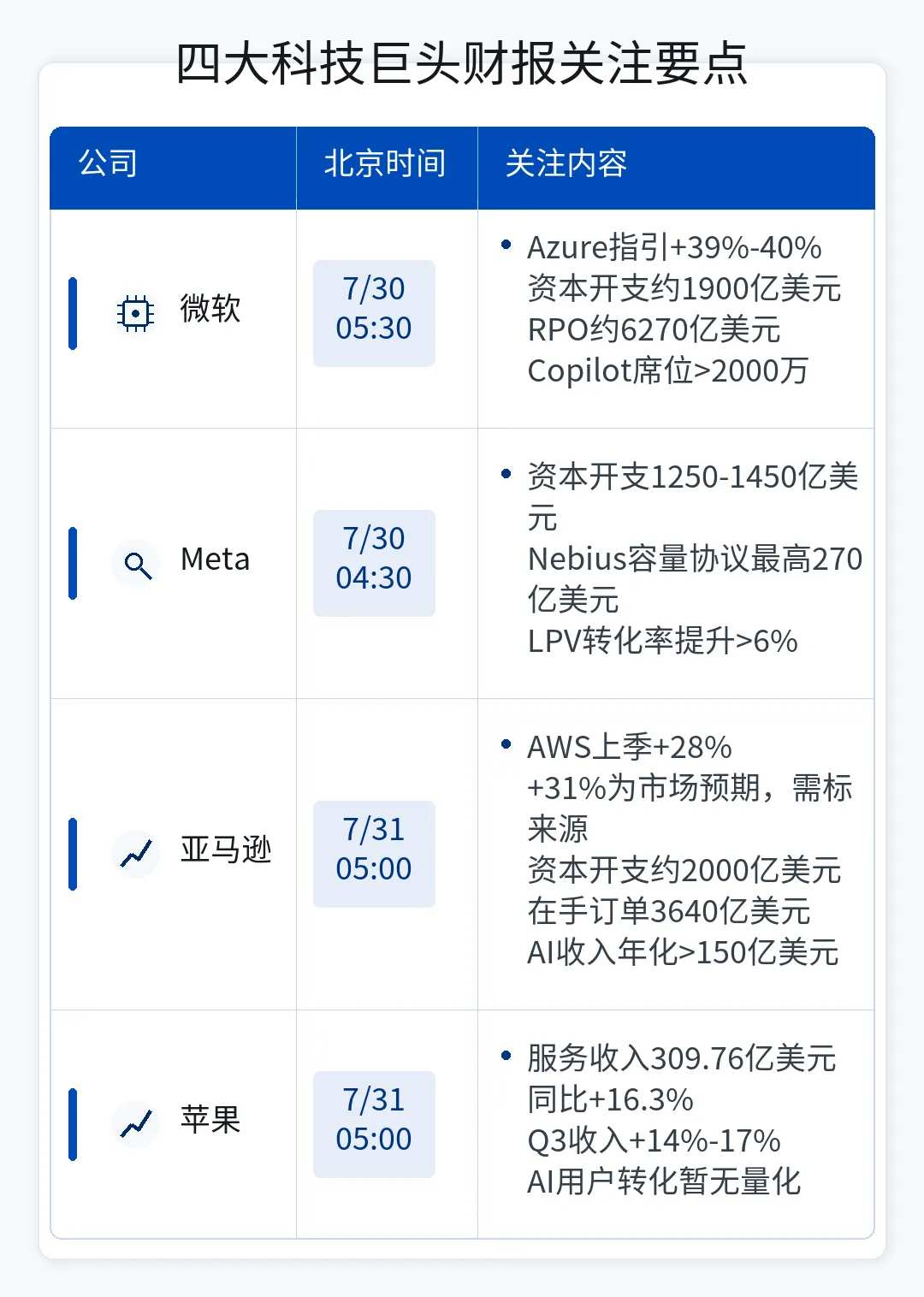
Alphabet already dropped the first bomb last week: cloud revenue grew by 82% and profits hit a record high, but its full-year capital expenditure guidance was raised to $195–205 billion, sending its share price down by more than 7%.
The combined capital expenditures of the four tech giants are projected to reach approximately $700 billion by 2026. The market is no longer satisfied with the 'AI narrative'—it demands tangible financial commitments.
If the Federal Reserve raises the evidentiary threshold for inflation and tech giants fail to demonstrate that AI investments are generating cash flows, 'higher-for-longer rates and tech earnings realization' will dominate global asset pricing in the next phase.
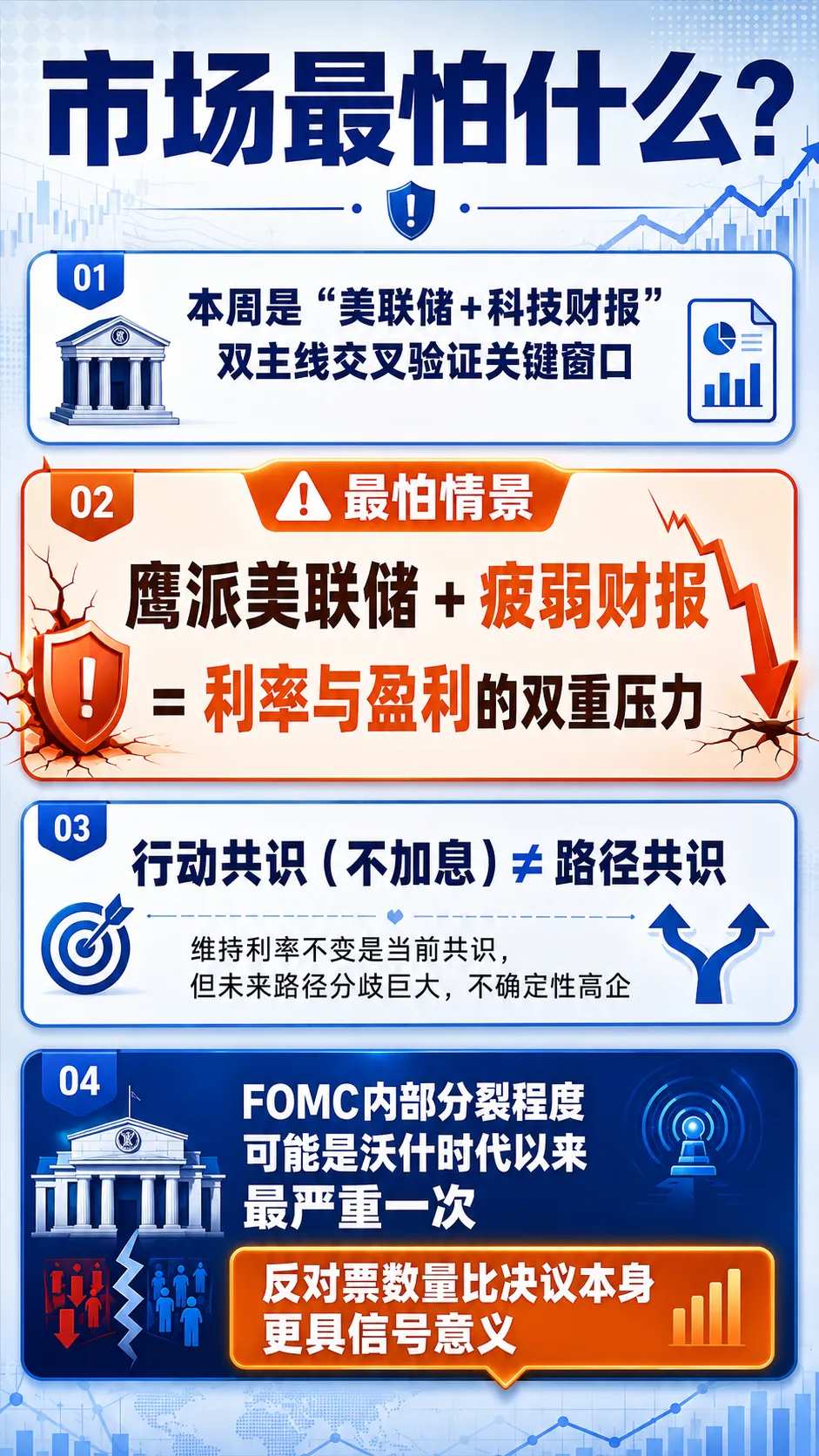
The root of market anxiety is not whether the Fed hikes rates in July, but rather that—following the disappearance of forward guidance—the Fed is shifting from a 'data-dependent' stance to a 'risk-preventive' approach.
Editor/melody