The most dangerous illusion in the U.S. equity market is mistaking a forced liquidation during crowded selling for the end of an industry’s fundamental logic.
As of the time of writing,$Korea Composite Index (.KOSPI.KR)$fell nearly 8%,$SK Hynix (000660.KR)$and falling nearly 13%.$PHLX Semiconductor Index (.SOX.US)$dropped another 4.49% on Tuesday, marking a cumulative decline of over 6.5% across two trading days and a drop of nearly 25% from its peak.
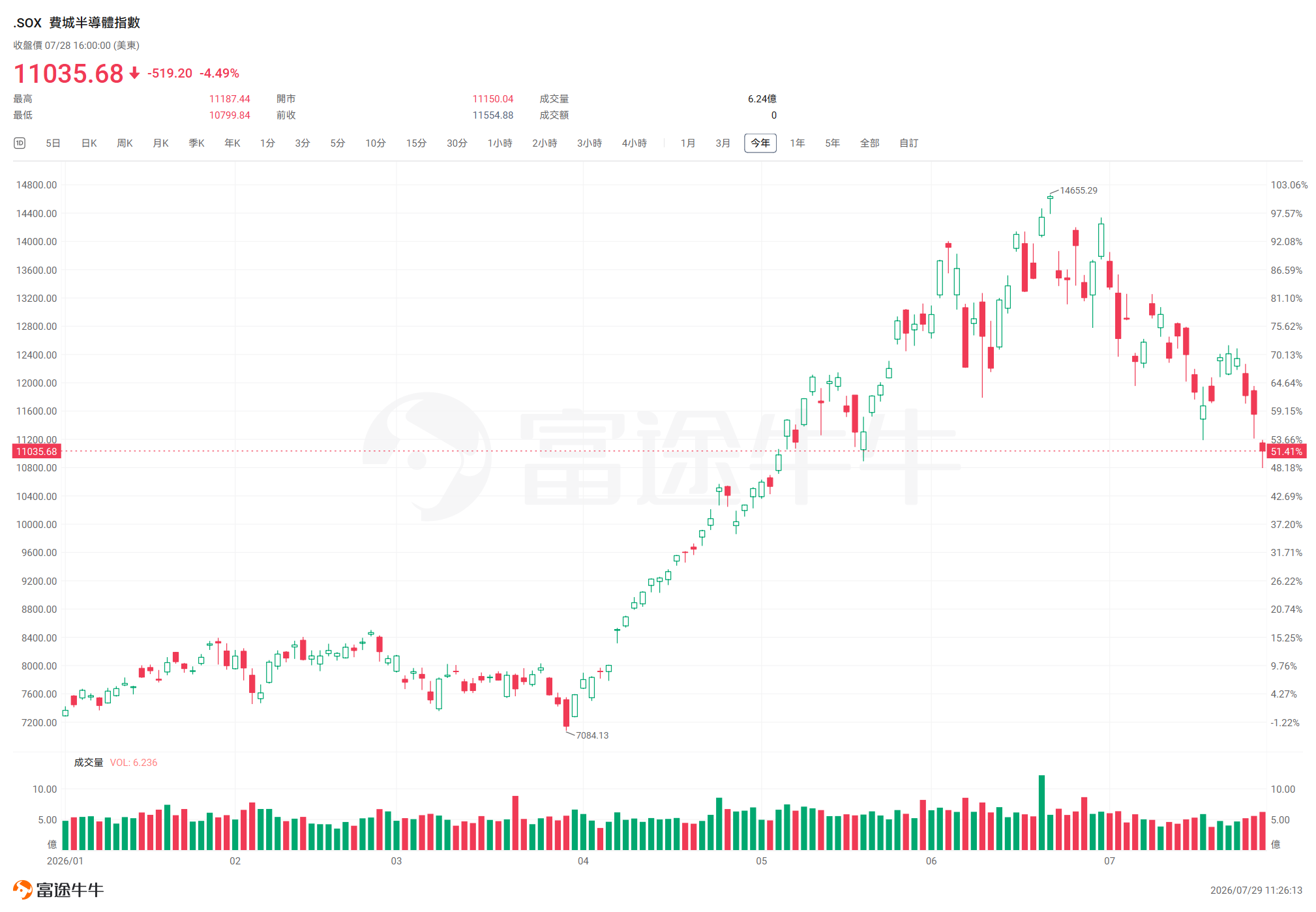
The declines in individual stocks are even more striking:$Micron Technology (MU.US)$from USD 1,255 down to around USD 820, representing a drawdown of approximately 35%;$Intel (INTC.US)$from USD 142 down to USD 86, a decline of nearly 40%;$SK hynix (SKHY.US)$nearly halved from its recent high.
 For investors holding semiconductor assets, this is no longer an ordinary technical pullback but a daily ordeal that quickens the pulse every time they open their accounts.
Yet precisely during moments when market sentiment is extremely amplified, we must strip away the panic reflected in price action and discern the true flow of capital.
What’s collapsing is the most crowded trade.
Tuesday$S&P 500 Index (.SPX.US)$rose 0.21%, with small-cap, financial, and healthcare sectors all closing higher,$CBOE Volatility S&P 500 Index (.VIX.US)$Instead, it pulled back, and high-yield bonds did not experience any sell-off.
$Apple (AAPL.US)$It touched $342.89 during the session, surpassing a $5 trillion market capitalization for the first time and reclaiming the title of the world’s most valuable company from NVIDIA.
This indicates a highly intense portfolio rotation is underway beneath the surface. Capital is not fleeing the market but is instead exiting the most crowded positions of recent months—AI hardware, memory chips, and Korean tech stocks—and moving into traditional sectors and consumer leaders with lighter positioning and less valuation pressure.
This is neither a liquidity-driven financial crisis like in 2008, nor a broad-based market selloff triggered by the pandemic outbreak in 2020, nor a full-blown recession caused by inventory reversals in smartphones and PCs during the 2022 rate-hiking cycle.
The current market dynamics resemble more of a 'crowding correction' driven by excessive concentration of positions and overly rapid short-term gains. The listing of ChangXin Memory Technologies (CXMT) happened to serve as the spark that ignited prevailing market pessimism.
Why Did ChangXin Become the Catalyst?
$CXMT Corporation (688825.SH)$Priced at RMB 8.66 per share, it opened on its debut day at RMB 49.50 and closed at RMB 49, surging 466% above the offering price, giving it a market capitalization of nearly USD 488 billion—surpassing Intel.
A DRAM manufacturer founded only in 2016 has, within a decade, entered public markets with a valuation approaching that of global semiconductor giants. What this truly disrupts is not just a few memory stocks but the entire industry’s long-standing 'scarcity premium' based on constrained supply.
Previously, the market largely viewed ChangXin Memory Technologies as a competitor still requiring years to catch up. Post-listing, however, the narrative has shifted. Its massive market capitalization implies stronger fundraising capacity, faster capacity expansion, greater talent attraction, and an enhanced ability to sustain losses and navigate technological iterations over a longer horizon.
This does not mean CXMT will replace Micron Technology, Samsung, or SK Hynix tomorrow, nor does it imply that domestic equipment, once deployed, will immediately achieve global leadership in yield, cost, and advanced process nodes. Significant technological and certification barriers still exist between standard DRAM, server memory, and HBM.
But capital markets have already begun pricing in another concern: if ChangXin Memory receives sustained financing, could global DRAM supply grow faster over the next few years than previously anticipated?
What cyclical stocks fear most has never been weak sales today, but rather the market starting to believe that tomorrow will bring a new competitor—one unconcerned with short-term returns and capable of continuous capacity expansion.
ChangXin Memory closed its second trading day at RMB 47, down about 4% from its debut. On Wednesday, as of this writing, it was up nearly 5%. It is still too early to determine whether the first-day valuation reflected an IPO-driven liquidity-fueled rally or a signal that global capital is preparing for a long-term revaluation of Chinese memory assets. The stock needs several more trading days to allow the market to gradually disentangle sentiment, liquidity, and underlying industrial value.
More importantly, even if the share price stabilizes in the short term, it will not immediately validate the company’s capacity, yield rates, and costs over the next three years.
What ChangXin has altered is long-term expectations.
SK Hynix reports earnings below expectations
Just as market panic peaked,$SK hynix (SKHY.US)$the company released its second-quarter earnings report. It reported revenue of KRW 79.32 trillion, up 257% year-over-year, and operating profit of KRW 60.54 trillion, surging 557% year-over-year, resulting in an operating margin of approximately 76%.
Although revenue and operating profit fell short of market expectations by roughly 5%, this can hardly be considered a poor earnings report.
DRAM and NAND prices continue to rise. In Q2, DRAM average selling prices (ASPs) increased by approximately 30% quarter-over-quarter, while NAND ASPs rose by about 55%. The company expects DRAM shipments to grow roughly 10% quarter-over-quarter in Q3, with NAND shipments increasing by about 3%. It has already signed long-term supply agreements with around ten key customers. Mass shipments of HBM4 have also commenced and will scale up further in the second half of the year. These figures do not support the notion that AI memory demand has collapsed.
The real issue is that SK Hynix’s previous trading was no longer about whether the company would grow, but rather that its stock price had to keep rising, profits had to continually reach new highs, and every earnings report had to significantly exceed expectations—with its HBM advantage remaining unchallenged for the long term.
When the market has already priced in all positive news, even a still-strong—but not extraordinarily strong—earnings report can become a reason to sell.
Moreover, the sharp decline in the Korean market occurred before SK Hynix officially released its earnings report.
Therefore, this earnings report was not the cause of the plunge on that day, but rather new evidence the market received after the plunge had already happened.
Its message is clear: memory demand has not collapsed, but valuations, positioning, and expectations all need to cool down.
Market scrutiny focuses on the speed of returns.
This is precisely what the 'AI Audit Year' is truly auditing.
The market does not doubt whether AI has a future, but rather how long it will take for today’s massive capital investments to translate into tomorrow’s profits and free cash flow.
The AI supply chain must build data centers, GPU clusters, power systems, optical communications networks, and storage infrastructure before revenues are fully realized.
Upstream equipment and chip companies receive orders first, but productivity gains for cloud providers, model developers, and end users take longer to materialize in financial statements.
Thus, the market has begun repeatedly asking: How much further will capital expenditures increase? Will new depreciation first weigh down profits? When will AI revenue cover financing costs? And how much free cash flow will each dollar invested by cloud providers ultimately generate?
Therefore, growth in token usage remains important, but one cannot focus solely on tokens. If unit prices continue to decline and much of the usage stems from free traffic or subsidies, usage volume will not automatically translate into profit.
What truly warrants monitoring is the entire value chain: whether usage can generate revenue, whether revenue can cover inference costs, whether data center utilization can improve, and whether gross margins and free cash flow can keep pace with capital expenditures.
For semiconductor investors, the real warning signs are not a single-day 10% drop, but rather cloud providers cutting AI capex, cancellations of long-term HBM orders, falling contract prices for DRAM and NAND, persistently rising inventories, and new capacity additions significantly outpacing demand.
As long as these metrics do not deteriorate simultaneously, the AI investment theme cannot be prematurely written off.
However, whenever stock prices have risen too quickly and positioning has become excessively crowded, the market demands stronger evidence.
Over the next two years, neither bulls nor bears will likely produce a definitive answer all at once; instead, they will have to resubmit their cases each earnings season. Heightened volatility is not unexpected—it is the market’s way of pricing the time lag between capital spending and commercial returns.
Only by looking back at history can we discern the true nature of this current downturn.
Historically, sharp declines in U.S. equities have never had just one cause.
The 2020 pandemic-induced crash resulted from a sudden economic standstill, which simultaneously disrupted corporate cash flows and financial liquidity, triggering broad-based asset sell-offs.
The 2022 tech bear market stemmed from the Federal Reserve’s rapid interest rate hikes combined with an inventory cycle reversal in PCs, smartphones, and consumer electronics—leading the market to compress valuations and revise earnings expectations downward.
The semiconductor sector's adjustment in the fourth quarter of 2018 coincided with trade tensions, interest rate hikes, and excess memory inventory, causing industry orders and macroeconomic demand to weaken simultaneously.
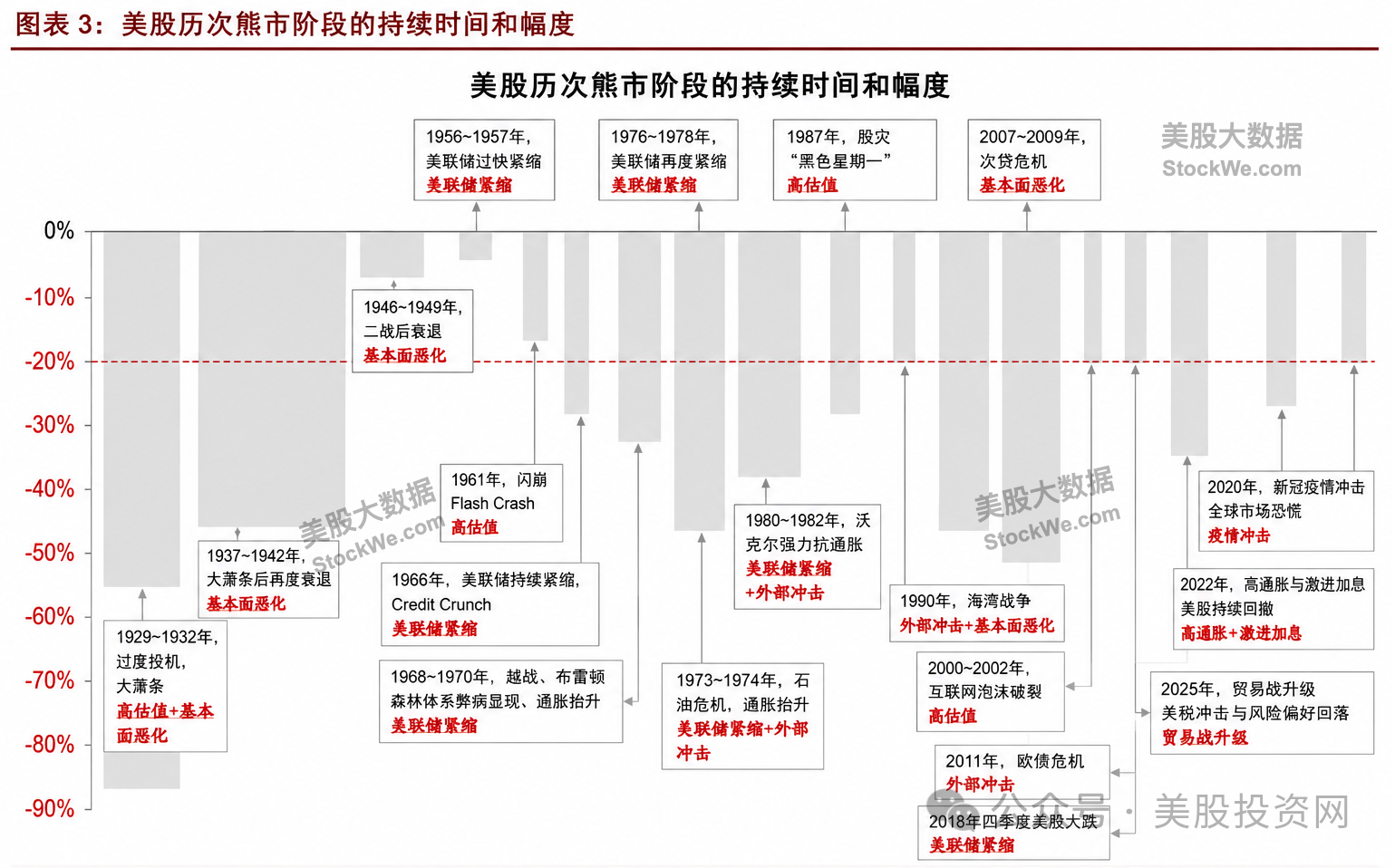
This time, the situation more closely resembles structural deleveraging: credit markets have not deteriorated in tandem, while banks, healthcare, and some small- and mid-cap stocks have even risen—indicating that capital is not exiting across the board but is instead rotating out of the most crowded AI hardware positions.
However, compared with typical technology corrections, this episode involves an additional layer of real industrial change: ChangXin Memory Technologies has transformed domestic memory supply from a distant expectation into a tangible variable that capital markets are now willing to finance continuously.
Therefore, excessive pessimism is unwarranted at this stage, yet it would also be premature to declare the correction over. Most of the deleveraging may already be complete, but no one can confirm that the final phase has concluded.
The issue is not whether the AI investment thesis has changed, but rather to what valuation level the market must adjust before it is willing to pay again for future growth.
What constitutes an oversold mispricing versus genuine deterioration?
Markets often err in the short term, but not every decline qualifies as an oversold mispricing.
In 2018, NVIDIA’s stock fell by more than half from its peak due to the collapse in cryptocurrency-related demand and inventory adjustments. However, its data center business, CUDA ecosystem, and direction in accelerated computing remained intact. Once inventories were cleared, the company’s long-term growth trajectory resumed driving its share price.
In 2022, Meta’s stock一度 dropped by approximately 77%. At the time, slowing ad revenue, metaverse investments, and cost overruns were real challenges—but Facebook, Instagram, and WhatsApp still retained their user bases, advertising cash flows, and competitive moats. After implementing cost discipline, the market reassessed the company’s intrinsic value.
Conversely, some stocks experience significant declines not because the market is wrong, but because their competitiveness is genuinely eroding—due to outdated products, loss of market share, deteriorating returns on capital, or persistent misallocation of resources by management. Such declines cannot be justified as ‘cheap’ merely by referencing how far they remain below historical highs.
Genuine mispricing typically exhibits several common characteristics:
Industry demand continues to grow, the company’s order book shows no significant deterioration, competitive moats remain intact, and profits and cash flows are resilient enough to weather economic cycles—the only issue being that the stock price has been temporarily depressed excessively by positioning, liquidity constraints, and sentiment.
Even great companies can experience sharp declines. Market opportunities often lie in the period when 'the stock price is broken, but the company is not.' However, this requires first distinguishing truly great companies from those that merely saw high share prices in the past.
What to do next
This week, we must first await the FOMC decision. The Federal Reserve will announce its interest rate decision at 2:00 PM ET on Wednesday, followed by a press conference by Warsh at 2:30 PM ET.
If the Fed holds rates steady, interest rate risk will be temporarily resolved, potentially acting as a catalyst for stabilization in highly volatile technology stocks;
If the Fed raises rates, markets will revise upward their expectations for the future path of interest rates, possibly triggering another round of volatility for AI hardware and other high-valuation assets.
Regardless of the outcome, however, the medium-term market direction will ultimately hinge not on a single meeting, but on whether earnings expectations continue to decline.
The most important task now is not to guess the bottom, but to clearly distinguish between two scenarios.
The first scenario is a rapid stock price rebound that pushes valuations back to elevated levels, even though orders, profits, and earnings expectations have not improved. Such a rally resembles sentiment-driven recovery; it is advisable to reduce leverage and trim positions added during the rally, rather than going fully invested again based solely on a single day of strong gains.
The second scenario is that share prices continue to decline, yet company orders remain intact, clients’ capital expenditures have not been reduced, industry demand continues to grow, and credit markets have not deteriorated.
Such a decline is more likely to involve indiscriminate selling, allowing investors to gradually build positions around companies that are genuinely competitive, profitable, and generate strong cash flows.
The rationale for buying should not merely be that 'the stock has already fallen by 30% or more,' but rather that 'even if share prices remain volatile, this company’s profitability will continue to grow over the next three years.' No one can precisely time the absolute market bottom.
One could initiate a small position once valuation enters a reasonable range, add another tranche after FOMC-related risks subside, and reserve the largest allocation for when prices stabilize and fundamentals are reaffirmed.
Holding cash is not bearish—it is preserving optionality. If a single high-volatility semiconductor stock already constitutes 60% of a portfolio, that is no longer typical concentrated exposure but a directional bet.
Whether you can withstand a further 20% decline should be answered before buying—not forced upon you by the market after the drop. No one knows how long the panic will last.
Yet at least three things are clear now: AI demand has not been disproven by a single earnings report, the competitive landscape in memory storage is indeed shifting, and the most crowded positions still require time to unwind.
Precisely in times like these, avoid rushing to declare the endgame on behalf of the market. First examine orders, then profits;
first assess cash flow, then valuation;
first distinguish whether the company itself has deteriorated—or only its share price has.
True opportunity never comes when all stocks fall together, but when great companies are temporarily mispriced due to panic—and you happen to still have cash on hand.
Editor/melody