$Microsoft (MSFT.US)$ and$Meta Platforms (META.US)$ With earnings reports imminent, the market is growing increasingly impatient with the two tech giants’ massive investments in artificial intelligence (AI) and the resulting continued erosion of their cash reserves.
Both companies are scheduled to report results after U.S. markets close on Wednesday. Although external expectations remain for sustained rapid growth, that is not Wall Street’s primary focus. Last week, Alphabet Inc. ( $Alphabet-A (GOOGL.US)$ ) delivered better-than-expected results across multiple metrics, yet its stock posted its steepest single-day decline in over a year, as the Google parent company reported negative free cash flow for the first time since going public, while its capital expenditures surged sharply.
Microsoft and Meta, along with Alphabet and$Amazon (AMZN.US)$, belong to the group making the largest AI investments. However, the market considers Microsoft and Meta less dominant in industry leadership compared to Alphabet, which could lead to more stringent scrutiny of their earnings reports.
 “If Alphabet can’t convince investors that its spending is delivering value, then it will be even harder for Microsoft and Meta to make that case,” said Tim Ghriskey, Senior Portfolio Strategist at Ingalls & Snyder, which manages approximately $11 billion in assets and holds positions in both Meta and Microsoft. “Both companies still have work to do to reassure the market.”
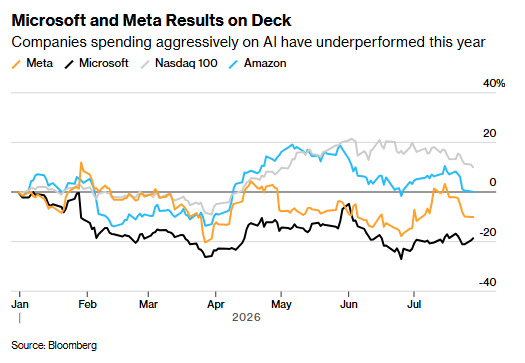
Microsoft’s stock has declined 19% year-to-date, ranking among the worst-performing 20 constituents of the Nasdaq 100 Index—which is heavily weighted toward technology stocks—while the index itself has gained 10% so far in 2026. Meta’s shares have fallen 10% over the same period, while Amazon (scheduled to report earnings after U.S. market hours on Thursday) has remained roughly flat.
Focus on Microsoft’s Cloud Business
Microsoft’s capital expenditures for the fourth quarter of its current fiscal year—including finance leases—are expected to exceed $42 billion, driving total spending for fiscal year 2026 to a record $146.6 billion, nearly double the $24.2 billion spent in the same period last year.
Against this backdrop, Microsoft's spending outlook for fiscal year 2027 will be one of the key focal points of this earnings report. Analysts expect this figure to exceed $230 billion, while adjustedFree cash flowis expected to decline from $62.3 billion in fiscal year 2026 to $32 billion.
As with Alphabet, investors will closely monitor Microsoft’s cloud business for signs that spending is translating into growth. Revenue from its Azure segment is expected to rise by nearly 40% this quarter. However, despite Alphabet’s cloud revenue surging more than 80%—beating expectations—it failed to generate enthusiasm in the market.
“For Microsoft, I think the situation is even less clear,” said Paul Meeks, Head of Technology Research at Freedom Capital Markets. “Google appears to be taking market share from all its competitors.”
Analysts expect Microsoft’s total revenue to grow by 15% and net profit to rise by 16%. Both metrics are projected to maintain double-digit percentage growth over the next three fiscal years.
Setting aside capital expenditures, this growth corresponds to a relatively reasonable valuation. Microsoft’s current share price trades at less than 20 times its expected earnings for the next 12 months, below its 10-year average of 27 times and also below the Nasdaq 100 Index’s multiple of 21.4 times.
Meta Faces More Questions
Although Meta Platforms’ stock is valued even more cheaply than Microsoft’s—at less than 15 times forward earnings—the parent company of Facebook faces a less clear path to demonstrating to investors that its AI investments will yield adequate returns. The market expects Meta’s capital expenditures to reach $135.6 billion in 2026 and climb further to over $175 billion in 2027.
To raise funds, Meta has already begun issuing bonds and is reportedly considering raising tens of billions of dollars through equity issuance. This is expected to have a significant impact on Meta’s cash position. Analysts forecast free cash flow will fall below $10 billion this year, far lower than the $460 billion projected for 2025, and could turn negative in 2027 before returning to positive territory in 2028.
“If you’re looking for stable cash flow, Meta Platforms is not the right investment,” said Grzeski of Ingalls & Snyder. “Their future is promising, but the near termreturn on investmentis quite challenging, and holding this stock requires considerable conviction.”
In terms of revenue, institutions project Meta will grow by 26% this year, with growth rates slowing progressively over the following three years. Net profit is expected to increase by 40% in 2026 but only by 6.5% in 2027.
Among all companies heavily investing in AI, Meta stands out—it lacks a cloud infrastructure business that could rent out computing power externally. However, the company is reportedly planning such a move and has already held discussions with AI firm Anthropic regarding compute capacity leasing.
Matt Stucky, Chief Equity Portfolio Manager at Northwestern Mutual Wealth Management, which holds Meta shares, stated that these moves highlight both the company’s potential and the market’s fickle sentiment toward the stock.
“When the stock price rises, people think it’s the best business in the world; but when it falls, the market suddenly believes management is struggling,” he said. “If execution is successful, there is room to revise earnings expectations upward—but you must be fully prepared for volatility.”
Editor/Deng