
① Cloud providers are bearing massive capital expenditures, yet their stock prices and free cash flow are under pressure, with risks potentially spilling over to chip and equipment companies; ② Low-cost models from China and the U.S. are rapidly closing the performance gap, prompting enterprise clients to accelerate their shift toward cheaper models and in-house training solutions; ③ Foundational models and tokens may gradually become commoditized, posing greater challenges to the profitability outlook of leading labs such as OpenAI and Anthropic.
Caixin Global, July 29 (Editor: Xia Junxiong) — Michael Cembalest, Chairman of Market and Investment Strategy at JPMorgan Asset Management, recently issued a cautionary note on the current AI-driven equity trade in U.S. markets.
The report notes that AI continues to drive capital spending, tech sector profits, and semiconductor stock gains, but clear divergence has emerged within the supply chain: companies selling chips and equipment remain robust, while hyperscale cloud providers—bearing heavy investment burdens and tasked with monetizing AI—are seeing mounting pressure on their stock prices and free cash flow.
 Meanwhile, next-generation low-cost models from China and the United States are swiftly narrowing the performance gap with OpenAI and Anthropic.
As model prices continue to decline and enterprises enhance their in-house training capabilities, foundational models and tokens could gradually become commoditized, potentially reshaping profit distribution across the AI industry.
The AI supply chain is exhibiting a divergence reminiscent of the late stage of the internet bubble.
Cembalest pointed out that the most concerning phase of a boom cycle is not when all companies weaken simultaneously, but when firms closest to end demand have already peaked, while upstream beneficiaries of capital expenditure continue to rise.
A similar phenomenon occurred during the late stage of the internet bubble between 1999 and 2000.
At that time, telecom service providers such as Verizon, AT&T, WorldCom, and Sprint weakened first, while equipment suppliers—including Cisco, Nokia, Nortel Networks, Qualcomm, and Motorola—continued to see rising stock prices. Taking Cisco and Verizon as examples, after Verizon’s stock price largely plateaued, Cisco still experienced a significant rally until the bubble finally burst.
The report argues that the current AI supply chain is displaying a similar structure.
Semiconductor and equipment companies such as NVIDIA, Micron, Broadcom, and Applied Materials sit at the 'back' of the AI supply chain, benefiting from sustained procurement by cloud computing firms, which has driven rapid growth in their stock prices and free cash flow. In contrast, hyperscale cloud providers—including Alphabet (Google’s parent company), Amazon, Microsoft, Meta, and Oracle—are positioned at the 'front,' bearing massive investments in data centers, chips, power infrastructure, and software. However, their stock performance has stagnated, and free cash flow has declined significantly.
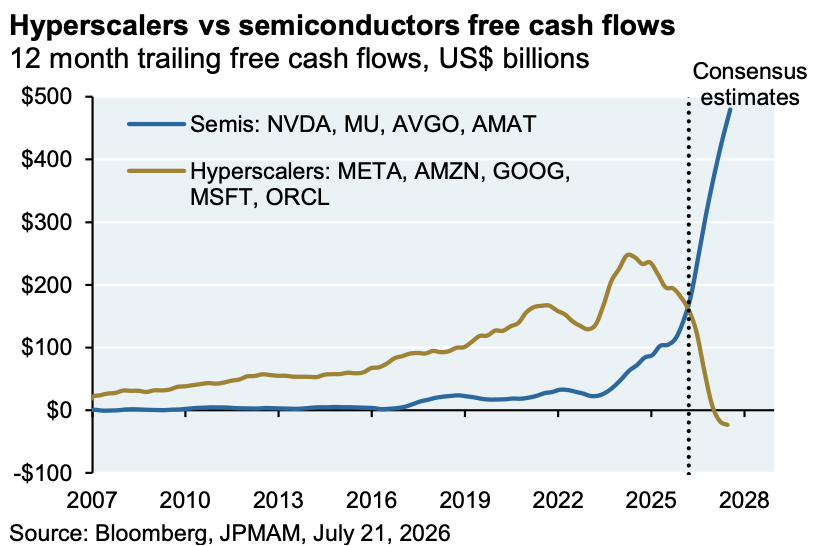
(Free cash flow trends across the AI supply chain have diverged markedly: semiconductor firms are benefiting, while cloud providers remain under persistent pressure.)
The current high growth of semiconductor companies fundamentally depends on continued capital expenditure expansion by downstream customers. If cloud providers fail to generate sufficient revenue and profits from AI services—leading to persistently declining returns on investment—demand for upstream chips and equipment could ultimately be affected.
In other words, risks associated with the AI investment cycle may first manifest in cloud providers’ cash flows before eventually transmitting to the semiconductor industry.
Who will pay for the ever-expanding AI investments?
The report also highlights a divergence in profitability between the technology sector and its key customers.
Historically, earnings growth among U.S. technology companies has generally aligned with that of industries such as finance, manufacturing, media, transportation, and healthcare—sectors that heavily procure technology hardware and software.
Recently, however, tech sector profits have continued to rise rapidly, while these highly technology-dependent customer industries have not seen commensurate improvements in profitability. This leads Cembalest to pose a critical question: if tech companies’ primary customers are not earning more, who will ultimately pay for AI hardware, software, and cloud computing services?
This question cuts to the heart of a core contradiction in AI commercialization.
Current AI-related capital expenditures are primarily concentrated in chips, servers, data centers, and model training. Ultimately, however, these investments must be recouped through enterprise customers achieving higher efficiency, lower costs, or new revenue streams. If AI only boosts profitability for infrastructure suppliers without improving end-users’ margins, the current pace of capital spending will be difficult to sustain over the long term.
Meanwhile, the market itself has already accumulated significant gains.
The report analyzed the performance of all consecutive four-year cycles of the S&P 500 Index since 1928 and found that the current cycle, starting from 2022, has already moved well into the top 10% of historical performances.
This does not necessarily mean that U.S. equities will peak immediately, but with valuations and cumulative returns already elevated, investors’ tolerance for delays in AI-driven profit realization may decline significantly.
AI Model Price War: Pressure Coming from Both the U.S. and China
In addition to capital expenditure risks, the foundational AI model market is also entering a new round of price competition.
The report notes that competitive pressure is coming not only from Chinese companies but also from U.S. firms such as Meta, SpaceXAI, and Thinking Machines.
Meta’s Muse Spark 1.1 and SpaceXAI’s Grok 4.5 are both closed models, with operating costs amounting to only a fraction of those for the Claude and GPT series, yet their overall performance gap remains relatively modest.
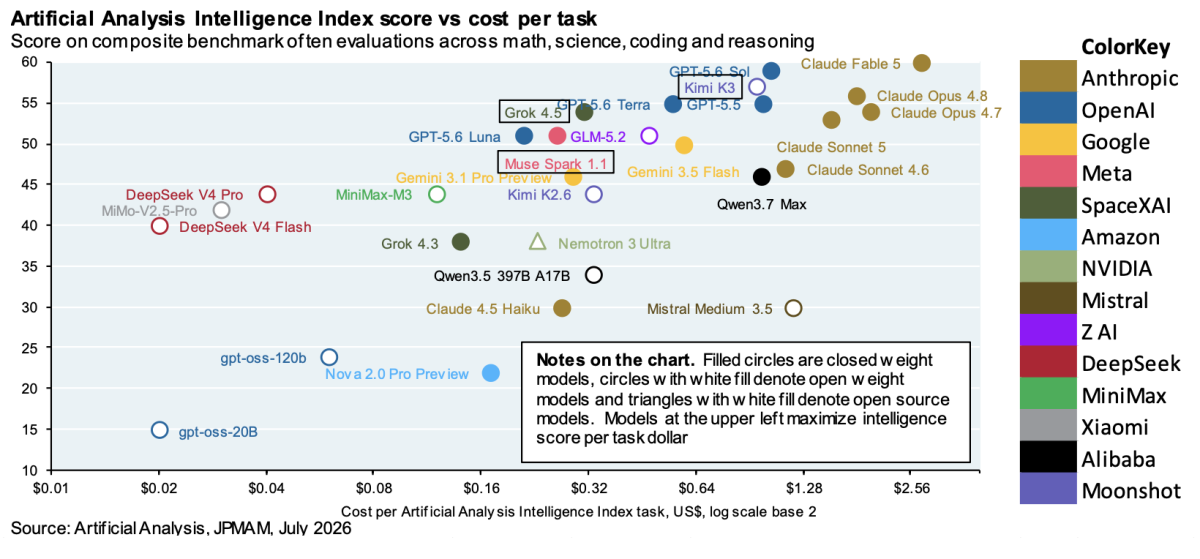
(Different AI models are showing clear divergence between performance and task cost, with low-cost models rapidly narrowing the gap with leading models.)
Although benchmark tests cannot fully reflect real-world model performance, enterprise clients have an incentive to migrate some workloads to cheaper platforms as long as lower-cost models can accomplish specific tasks—providing CFOs with a clear motivation to do so.
In fact, this trend has already begun.
According to OpenRouter data, since February 2026, the share of tokens consumed by U.S. enterprises using Chinese models has consistently exceeded 30%, recently peaking at 45%. Depending on the measurement methodology, Chinese models account for 30% to 60% of query volume and token usage on OpenRouter.
The price war is particularly detrimental to frontier AI labs, as the two leading AI companies—OpenAI and Anthropic—have yet to demonstrate that their business models can achieve stable profitability.
Citing estimates from Empirical Research, the report states that OpenAI’s operating losses could reach $60 billion in 2027 and widen to $85 billion in 2028. With continued massive investments required for model training and compute capacity, persistently declining model pricing will further delay the timeline to profitability.
Model competitiveness should be measured by 'cost per task.'
The report highlights Kimi K3, an open-weight model launched by Moonshot AI, as a key Chinese model under review. With 2.8 trillion parameters, it is currently the largest open-weight model available, compared to Anthropic’s Claude Opus 4.8, which has approximately 1.5 trillion parameters.
Kimi K3 charges $3 per million input tokens and $15 per million output tokens.
By comparison, Anthropic’s Claude Fable charges $10 and $50 per million tokens for input and output, respectively, while OpenAI’s Sol charges $10 and $45. If Kimi K3’s actual performance is comparable to these two models, its pricing represents a significant discount.
However, the report emphasizes that model economics should not be judged solely by token price per unit; rather, the total cost to complete a given task should be considered. Some lower-priced models may require more tokens to achieve similar results, yet even when evaluated on a 'cost per task' basis, Kimi K3 remains highly competitive.
This implies that U.S. frontier AI labs cannot rely solely on higher token efficiency to withstand the impact of low-cost models.
The report also notes that many recent innovations in areas such as sparse architectures, KV cache compression, quantization, and inference efficiency have originated in China. Consequently, the competitive advantage of Chinese models is extending beyond labor costs or pricing strategies to encompass model architecture and inference efficiency.
Inkling is driving enterprises to shift from purchasing models to self-training.
Open-weight models in the U.S. could similarly reshape the industry landscape. Inkling, launched by Thinking Machines in July, has 975 billion parameters but activates only about 41 billion parameters per query, resulting in actual operating costs lower than what its total scale would suggest.
Inkling can process text, images, and audio, supports a context window of up to 1 million tokens, and allows users to adjust inference intensity to balance accuracy, speed, and cost. The company has also introduced a lower-cost version, Inkling-Small, which is available on Hugging Face, with Databricks as the launch partner.
More importantly, Thinking Machines aims to encourage enterprises to use the Tinker API and their internal data to train their own open models, rather than relying entirely on general-purpose services offered by OpenAI and Anthropic. Bridgewater Associates disclosed that its news-filtering model, trained using Tinker, outperforms both Claude Opus 4.8 and GPT-5.5 in accuracy while being significantly more cost-effective.
This approach could shift the competitive focus for AI companies. In the future, enterprises may no longer need to continuously procure the most powerful and expensive general-purpose models; instead, they could opt for more affordable open models and customize them with their own data.
The business model of frontier labs—traditionally reliant on technological leadership and closed ecosystems to command premium pricing—could thus be weakened.
Editor/Deng