
South Korea pledged to take additional measures to stabilize the stock market and restrict retail investors from purchasing leveraged exchange-traded funds, following a sharp market decline that caused investors to lose billions of dollars.
Zhitong Finance APP has learned that the South Korean government has pledged to implement additional and more proactive measures to stabilize its stock market, which has recently experienced repeated circuit-breaker-triggered crashes, and to restrict retail investors' participation in leveraged exchange-traded funds (commonly known as leveraged ETFs). This unprecedented stock market plunge has already inflicted billions of dollars in losses on retail investors’ portfolios.
The South Korean government’s latest policy statement undoubtedly provides notable short-term relief and reduces tail risks for the global semiconductor equity sector. According to seasoned financial market analysts, the likelihood of direct government intervention in the equity market has risen significantly—particularly given the government’s explicit statement about 'establishing a legal basis enabling regulators to implement emergency market stabilization measures,' which reserves institutional space for future direct intervention. Meanwhile, South Korea’s Finance Minister has clearly stated that the government is actively studying market-stabilization measures.
 At the trading level, the South Korean government’s latest commitment appears to represent a comprehensive upgrade of its policy response function—from 'regulatory deleveraging' toward 'providing price and liquidity backstops when necessary.' If forced liquidations continue to create liquidity vacuums, repeatedly trigger market-wide circuit breakers, and begin impacting funding markets and financial institutions’ balance sheets, the government may deploy or reactivate a 'stock market stabilization fund' (or 'market equalization fund'), financed jointly by financial institutions to purchase KOSPI 200 index assets. South Korea has clear precedents: in 2020, it established a KRW 10.7 trillion stock market stabilization fund with plans to directly invest in the KOSPI 200 index; in 2024, regulators also indicated they could deploy a KRW 10 trillion production stability fund at any time.
However, currently implemented policies remain focused on restricting highly leveraged single-stock ETFs: raising cash requirements, capping portfolio exposure limits, halting new product launches, increasing trading costs, and introducing flexible leverage mechanisms—rather than using government funds to directly purchase equities.
The Philadelphia Semiconductor Index has declined approximately 25% from its June 22 peak, entering a technical bear market. On July 28, the U.S.-listed semiconductor ETF SMH fell about 3.6%, while Samsung Electronics and SK Hynix of South Korea plunged 13.4% and 14.7%, respectively. AI-related semiconductor stocks in both Asian and U.S. markets experienced another sharp sell-off on Wednesday. South Korea’s stock market triggered circuit breakers for two consecutive trading sessions; during Wednesday’s session, the benchmark KOSPI index tumbled more than 12% intraday, triggering the market-wide circuit breaker mechanism again and briefly falling below the 5,300-point mark—representing a cumulative decline of over 43% from its recent all-time high.
Repeated circuit breakers force regulatory emergency brakes: South Korea tightens rules on single-stock leveraged ETFs as debate over the 'casino-ization' of its stock market ignites a battle to defend market stability
Although the South Korean government has sent a strong signal that 'direct market rescue tools are now on the option list,' these measures remain policy options rather than confirmed actions at this stage. Confirmation of a 'stabilization fund-style intervention' would require official disclosure of the fund’s name, capital size, participating institutions, capital call arrangements, and the launch timeline for direct purchases of ETFs tracking Korea’s KOSPI benchmark index. Until such details emerge, the current stance should be characterized as 'prioritizing regulatory hemostasis, with fiscal and financial backstops on standby.'
Following an emergency market meeting chaired by Finance Minister Goo Yoon-cheol, the government issued a significant regulatory and policy-forward-looking statement late Wednesday evening, announcing a series of measures. All top-tier financial regulatory bodies in the country participated in the meeting.
In a recent statement, South Korea’s Ministry of Economy and Finance said: 'Participants unanimously agreed that excessive concentration of trading in leveraged ETF products linked to individual stocks has amplified market volatility and committed to taking swift and decisive countermeasures.' The statement also noted that all financial regulators plan to restrict retail investor access to leveraged ETFs, including imposing caps on the exposure of such products within an investor’s overall portfolio and raising transaction costs.
The statement added: 'Regulators will seek to establish a legal basis that permits authorities to implement emergency market stabilization measures, drawing on international precedents such as Hong Kong’s flexible leverage regime.' It also stated that Seoul will implement 'round-the-clock market surveillance' at the highest alert level.
Earlier this year, buoyed by optimism over demand for AI computing chips and memory chips, South Korea’s benchmark KOSPI index surged by 100%, making its stock market the best-performing globally. However, the market subsequently faced heavy selling pressure as deleveraging and unwinding of extremely crowded bullish positions—sparked by share price volatility in Samsung Electronics and SK Hynix—rippled across the broader market.
The KOSPI has plunged approximately 40% from its June peak. Disappointing earnings reported by SK Hynix on Wednesday raised doubts about the artificial intelligence investment boom and accelerated retail investor sell-offs, further exacerbating the downturn. This decline triggered a market-wide circuit breaker for the second consecutive trading day in South Korea.
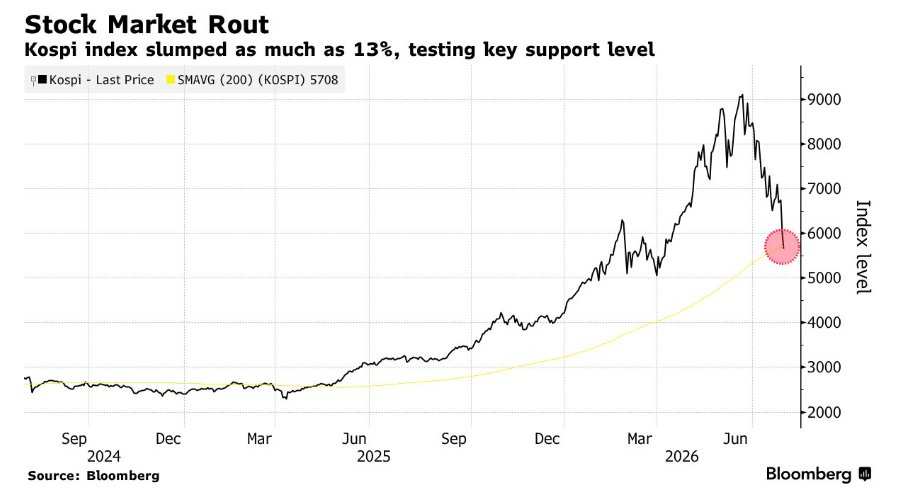
As shown in the chart above, South Korea’s stock market has recently experienced frequent sharp declines, with the KOSPI at one point plunging 13%, testing a key technical support level.
Following the announcement of the aforementioned measures by South Korea, the Korean won traded roughly flat against the U.S. dollar.
Most South Korean lawmakers generally believe that the single-stock leveraged ETFs launched domestically in May amplified market volatility. Because speculative trading has been concentrated in a handful of blue-chip stocks, the volatility of South Korea’s stock market has become significantly higher than that of comparable global markets.
Koo Yoon-cheol apologized during a parliamentary hearing on Wednesday and acknowledged that regulators should have conducted a more cautious evaluation before these products were introduced.
Wednesday’s hearing further escalated into criticism over the government’s handling of policy. Opposition lawmakers questioned why these products were approved at an unusually rapid pace despite widespread concerns expressed by the asset management industry, arguing that officials prioritized boosting share prices over maintaining market stability.
Lee Jong-woon, a lawmaker from the People Power Party, told Koo Yoon-cheol during the hearing: “This country has turned into a casino.” “These products should never have been allowed into the market from the outset. I consider this a policy failure.”
When pressed by opposition lawmakers on whether he would resign if the consequences of this policy worsened further, Koo Yoon-cheol responded that speculating about resignation would be irresponsible and emphasized that his current priority is stabilizing the market.
On Wednesday, the head of South Korea’s top financial regulatory body also issued a public apology over the escalating controversy surrounding single-stock leveraged ETFs.
Protests with funeral wreaths forced regulators to hit the emergency brakes: South Korea halts the leverage-driven 'death spiral'—will the global semiconductor and AI computing supply chain see a policy-driven liquidity counteroffensive?
Condolence wreaths placed in front of South Korea’s National Assembly have escalated a financial deleveraging event into a political and regulatory crisis: Samsung Electronics and SK Hynix together account for nearly half of the KOSPI’s market capitalization, while retail investors have heavily concentrated their bets through daily 2x single-stock leveraged ETFs. The decline in underlying stocks forced funds to reduce their derivatives exposure, triggering a positive feedback loop of 'falling stock prices → ETF rebalancing-driven selling → margin calls → further price declines.' In response, the South Korean government plans to cap individual investments in such products at no more than 20% of total investable assets, increase transaction costs and simulation-trading requirements, and raise the minimum cash threshold to KRW 30 million effective July 31. Previously, authorities had already suspended new product listings and advertising for these instruments and begun establishing a legal basis for emergency market-stabilization measures. While these actions do not equate to an official announcement of deploying a 'stabilization fund,' they signal that the policy reaction function has shifted from investor education to directly curbing incremental leverage and, if necessary, providing market backstop tools.
From a global market transmission perspective, this policy represents a significant structural market tailwind for the semiconductor and AI compute supply chain—not a direct boost to underlying industry demand. The KOSPI plunged 10.84% on July 28 and dropped as much as 12.6% intraday on July 29 before closing down 5.98%. SK Hynix, despite reporting record profits,一度 fell nearly 20%. The Philadelphia Semiconductor Index (SOX) had already corrected by 20% from its June 22 record high and neared another 6% decline on July 28. This indicates that South Korea is not an isolated epicenter but part of a broader unwinding of crowded AI trades, cross-market quantitative momentum strategies, and high-beta semiconductor positions globally.
Therefore, overall, restricting leveraged ETFs in South Korea could reduce the cross-market price contagion caused by end-of-day passive rebalancing of Samsung and Hynix positions to Taiwan Semiconductor, Micron, NVIDIA, and the Philadelphia Semiconductor Index, helping narrow liquidity discounts. However, it cannot automatically restore valuations of core global AI compute supply chain stocks, which remain near historical percentile highs.
For the global semiconductor sector and AI compute trading theme, the most disruptive wave of forced selling triggered by South Korea’s sharp deleveraging and the unwinding of extreme bullish positions may already be in its latter stages—not indicative of a full-blown balance sheet crisis across the Korean financial system. According to JPMorgan research, leveraged ETF assets under management have declined from approximately USD 50 billion to USD 17 billion, hedge fund deleveraging is roughly 90% complete, and foreign outflows have been highly concentrated in just two memory-weighted stocks.
Meanwhile, losses in the Korean market have been largely confined to a few AI-weighted stocks rather than reflecting a synchronized collapse across all sectors. Thus, the government’s current tightening of leverage rules may trigger only limited residual position reductions and, more importantly, likely diminish the marginal intensity of any future forced selling episodes. This could help shift global equity markets away from mechanical, indiscriminate liquidation of AI compute supply chain names and back toward pricing based on earnings, valuations, and industrial competitiveness tied to the AI compute theme.
The South Korean government’s latest market-stabilization commitment serves as a critical circuit breaker for the severely battered global semiconductor and AI compute supply chain. It can mitigate tail-end liquidity risks, ease forced selling pressures transmitted from leveraged ETFs to global chip stocks, and create conditions for an oversold rebound. However, it is not a sufficient condition for reigniting a full-fledged AI super-bull market. A policy bottom may have already formed, a positioning bottom is drawing near, but a fundamental bottom must ultimately be confirmed by robust free cash flows driven by cloud vendors’ capital expenditures, memory contract pricing, and tangible AI compute demand.
Editor/Deng