
‘The New Fed Wire’: This marks the first time since 2016 that three voting members of the FOMC cast dissenting votes aligned on the same policy stance. The statement indicated that one-quarter of voting members supported a 25-basis-point rate hike. It reiterated that the conflict in the Middle East has created significant economic uncertainty, inflation remains elevated—partly due to higher energy prices—and the economy continues to expand steadily, with the unemployment rate remaining largely unchanged.
As most market participants anticipated, the Federal Reserve remained on hold, but divisions within the committee over the timing of future rate hikes emerged as early as its second monetary policy meeting under Waller’s leadership.
On Wednesday, July 29, Eastern Time, the Federal Reserve announced after its Federal Open Market Committee (FOMC) meeting that the target range for the federal funds rate would remain unchanged at 3.50% to 3.75%. This marks the fifth consecutive FOMC meeting in 2026 without a rate change, following three straight rate cuts through the end of last year.
 The Fed’s decision aligned with the expectations of most market participants. As of Tuesday’s market close, CME Group’s FedWatch Tool indicated that futures markets priced in a nearly 70% probability of no rate hike this week and a slightly above 30% chance of a 25-basis-point increase. The probability of maintaining rates unchanged at the September meeting stood below 24%, and by December, the likelihood of unchanged rates fell below 9%, while the probability of at least two 25-basis-point hikes was approximately 58%.
The statement released this time closely mirrored the language from the June meeting. As before, it reiterated the Fed’s commitment to achieving price stability. It once again highlighted that geopolitical tensions in the Middle East have created significant economic uncertainty, inflation remains elevated—partly due to higher energy prices—and the economy continues to expand steadily with the unemployment rate essentially unchanged.
The statement repeated verbatim its previous assessment of inflation: “Inflation remains elevated relative to the Committee’s 2% objective, reflecting in part supply-side disruptions that have driven up prices in certain sectors, including energy.”
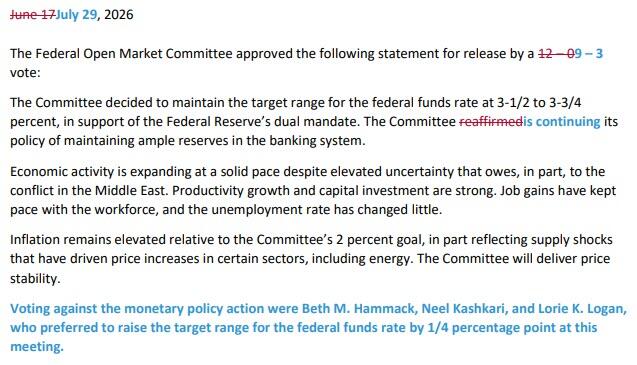
Compared to the previous meeting, the only major change in this statement concerned the voting outcome: of the 12 officials with voting rights on the FOMC this year, nine supported maintaining rates unchanged, while three dissented. Nick Timiraos, a journalist often dubbed the ‘Fed whisperer,’ noted that this marked the first time since 2016 that three voting members cast dissenting votes aligned on the same policy stance.
Prior to the release of the statement, Timiraos observed that if one or two committee members had voted against pausing rate hikes, it would have clearly signaled mounting hawkish pressure within the FOMC. Past Fed chairs could typically placate potential dissenters by incorporating more hawkish or dovish language into the statement or by signaling likely action at the next meeting. However, Waller has explicitly stated his intent to abandon such tools, potentially leaving him without sufficient means to keep internal disagreements beneath the surface.
The most notable change in this statement: one-quarter of FOMC voting members supported a 25-basis-point rate hike at this meeting.
According to the meeting statement, all three FOMC members who dissented on the interest rate decision were regional Federal Reserve Bank presidents.
They were Beth Hammack, President of the Federal Reserve Bank of Cleveland; Neel Kashkari, President of the Federal Reserve Bank of Minneapolis; and Lorie K. Logan, President of the Federal Reserve Bank of Dallas. The statement indicated that all three favored a 25-basis-point rate hike at this meeting.
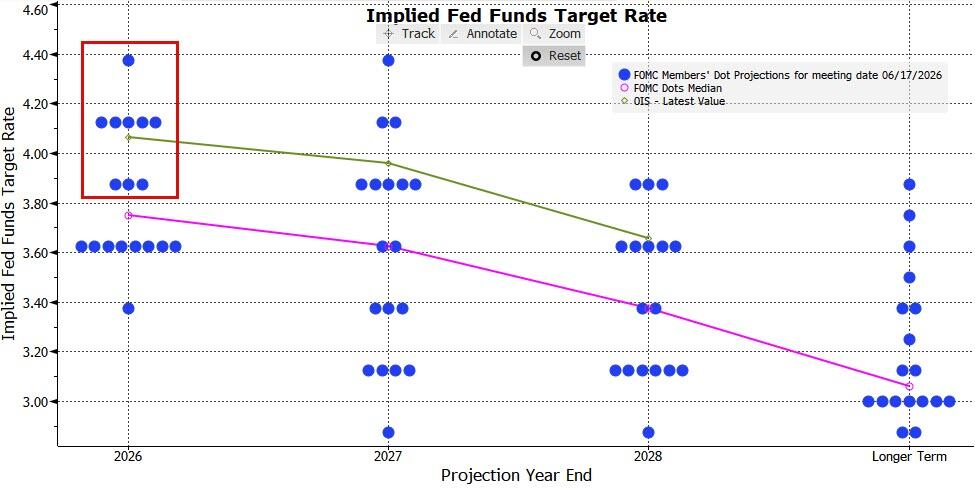
This implies that one-quarter of this year’s FOMC voting members favored raising interest rates at this meeting. The dot plot released after the previous meeting showed that, among the 18 Fed officials who submitted rate projections, nine anticipated at least one 25-basis-point rate hike this year, with six expecting at least two such hikes.
The voting outcome of this week’s FOMC meeting confirmed Warsh’s prediction—made both before and after he assumed the role of Fed Chair—that the Federal Reserve was experiencing an 'internal war.'
At the previous FOMC meeting, all voting members, including Warsh, agreed to keep the policy rate unchanged—a unanimous decision for the first time in nine months since the rate-setting decisions began.
However, as escalating tensions in the Middle East continue to push oil prices higher, fresh inflationary pressures are emerging, presenting new challenges for the Fed following its shift at the last meeting toward signaling a greater likelihood of rate hikes than cuts.
In an article published Monday, Timiraos noted that this week’s FOMC meeting serves as a concentrated test of Warsh’s entire policy strategy. If the Fed opts to hold rates steady, a critical question arises: Warsh has repeatedly emphasized over his first two months in office that the Fed will not tolerate inflation exceeding its target, but if it remains inactive without specifying any trigger conditions for action, markets will naturally question whether these tough statements carry any real teeth.
In the screenshot below, red text indicates content deleted from the previous FOMC statement, while green text shows additions made in this statement.
Editor/Stephen