
In the fourth fiscal quarter, Microsoft reported an 18% year-over-year increase in total revenue and a 23% rise in EPS—over 10% above analyst expectations. Azure surpassed $100 billion in annual revenue for the first time. Cloud-related remaining performance obligations (RPO) surged 84% year-over-year to $678 billion, roughly double the company’s full-year revenue. The quarter included $3.2 billion in revenue from its investment in Anthropic, and Microsoft 365 Copilot now has over 30 million paying users. Capital expenditures rose 70% year-over-year but came in 3.5% below expectations. Undrawn commitments for data center leases increased 67% sequentially to $329.1 billion.
$Microsoft (MSFT.US)$ The company delivered a quarterly performance that comprehensively exceeded Wall Street expectations, demonstrating the resilience of its core business profitability despite substantially higher investments in AI infrastructure.
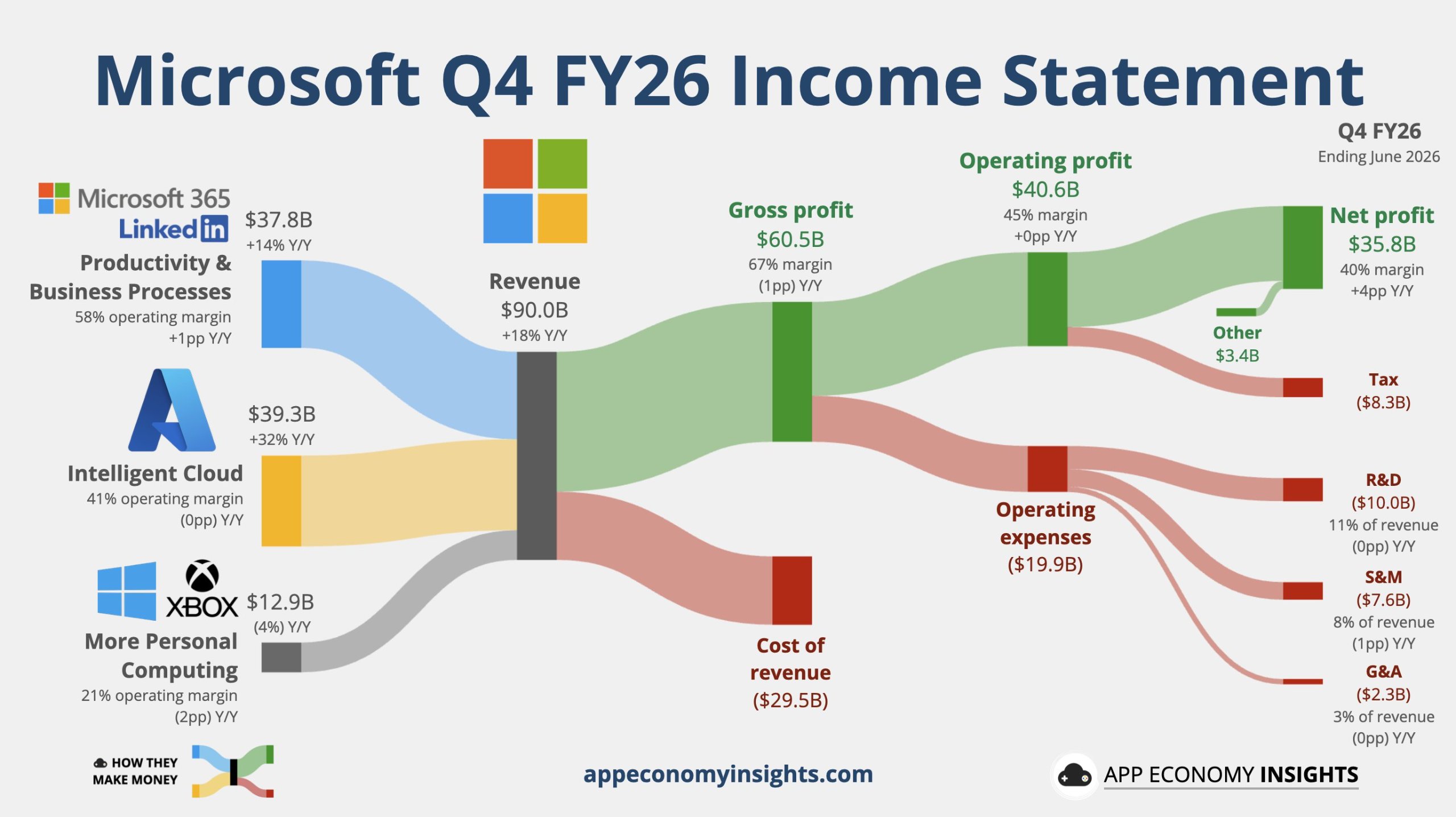
After U.S. markets closed on Wednesday, July 29 (Eastern Time), Microsoft reported that for its fourth fiscal quarter ended June 30, 2026, revenue rose 18% year-over-year to $90.007 billion—2.6% above analyst expectations—and non-GAAP adjusted earnings per share (EPS) increased 23% year-over-year to $4.74, surpassing consensus estimates by 11.5%. Operating income grew 18% to $40.6 billion, 4% above market forecasts, indicating that revenue growth was not entirely offset by AI infrastructure spending.
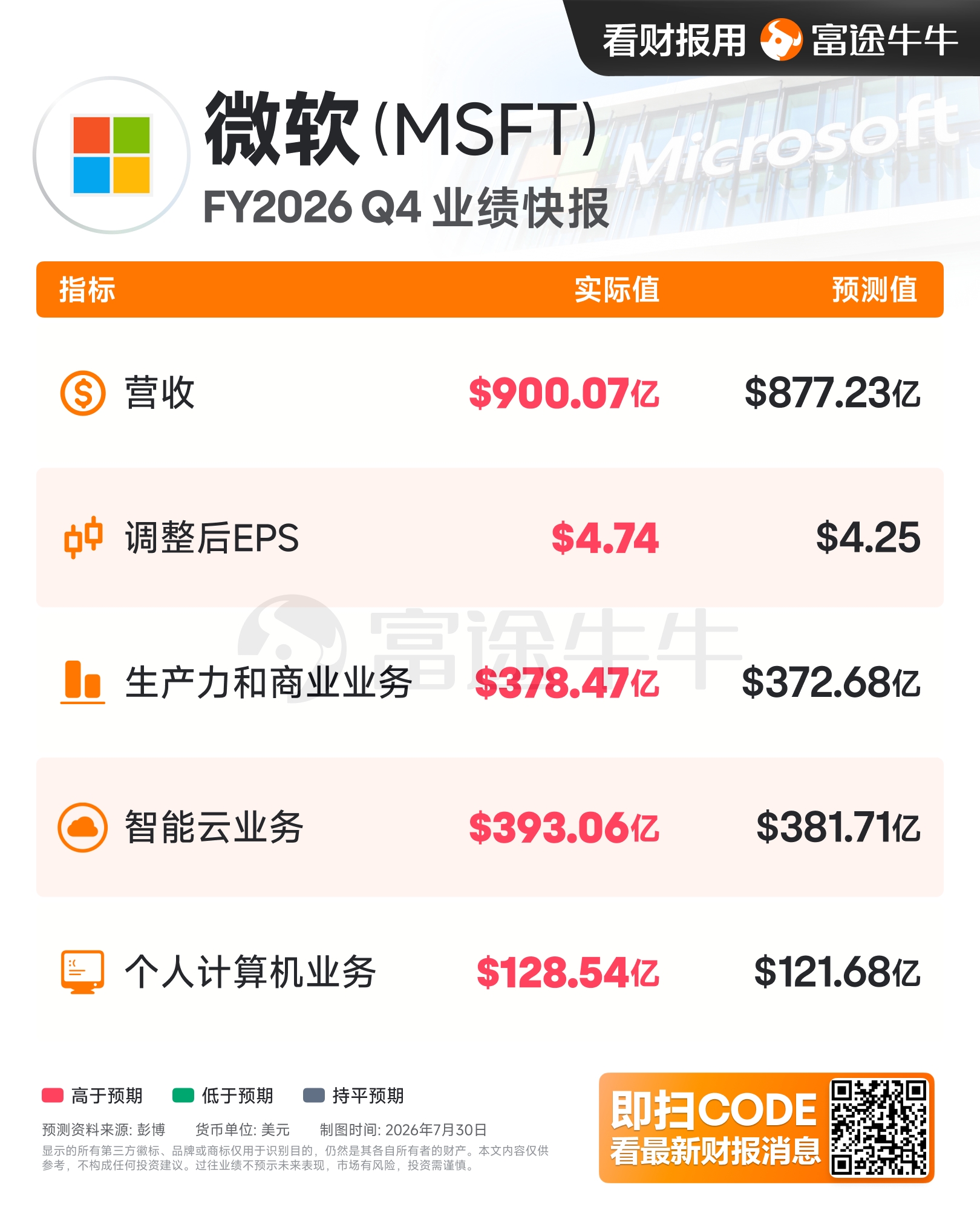
 Cloud performance—the segment most closely watched by investors—was even stronger. In the fourth quarter, Microsoft’s total cloud revenue rose 27% year-over-year to $59.3 billion, 1% above analyst expectations. Specifically, revenue from Azure and other cloud services grew 43%, significantly outpacing the market’s forecast of 39.6%. Revenue from the Intelligent Cloud segment reached $39.31 billion, approximately 3% above expectations.
Microsoft CEO Satya Nadella highlighted the company’s progress along the “cost-to-outcome curve,” ensuring that every customer can translate tokens into tangible business results. He cited two key milestones: first, Azure surpassed $100 billion in annual revenue for the full fiscal year 2026; second, Microsoft 365 Copilot now has more than 30 million paying users.
The financial report underscored that the AI arms race remains costly. Microsoft spent $35.8 billion on property and equipment in the fourth quarter—more than double the amount from the same period last year and approximately 1.6% above analyst expectations. However, total capital expenditures supporting customer demand for cloud and AI products rose 70% year-over-year to $41 billion, coming in 3.5% below expectations. Full-year 2026 capital expenditures are expected to broadly align with Microsoft’s previously disclosed guidance of approximately $190 billion.
The core significance of this earnings report lies in the fact that Microsoft’s massive AI investments are now translating into accelerated cloud growth. In recent quarters, investors had been most concerned whether tech giants like Microsoft, Google, and Amazon were spending too aggressively on AI data centers and chips, with returns appearing distant. This quarter’s significantly better-than-expected Azure growth provides an early answer: enterprise AI demand is already converting into cloud revenue.
Additionally, in a regulatory filing, Microsoft disclosed that it added over $130 billion in new data center lease commitments during the fourth fiscal quarter that have not yet commenced, bringing the total undrawn lease commitments to $329.1 billion—a 67.4% sequential increase—highlighting the continued acceleration of its AI compute capacity expansion.
Prior to the earnings release, Microsoft’s stock closed down approximately 0.7% on Wednesday. Following the announcement, shares surged in after-hours trading, briefly rising nearly 4.9% before giving back much of those gains. During the earnings call, Microsoft reaffirmed its full-year capital expenditure guidance without an upward revision—making it one of the first major tech companies not to raise its spending outlook—which triggered a further acceleration in share price, pushing after-hours gains to as high as 10%.
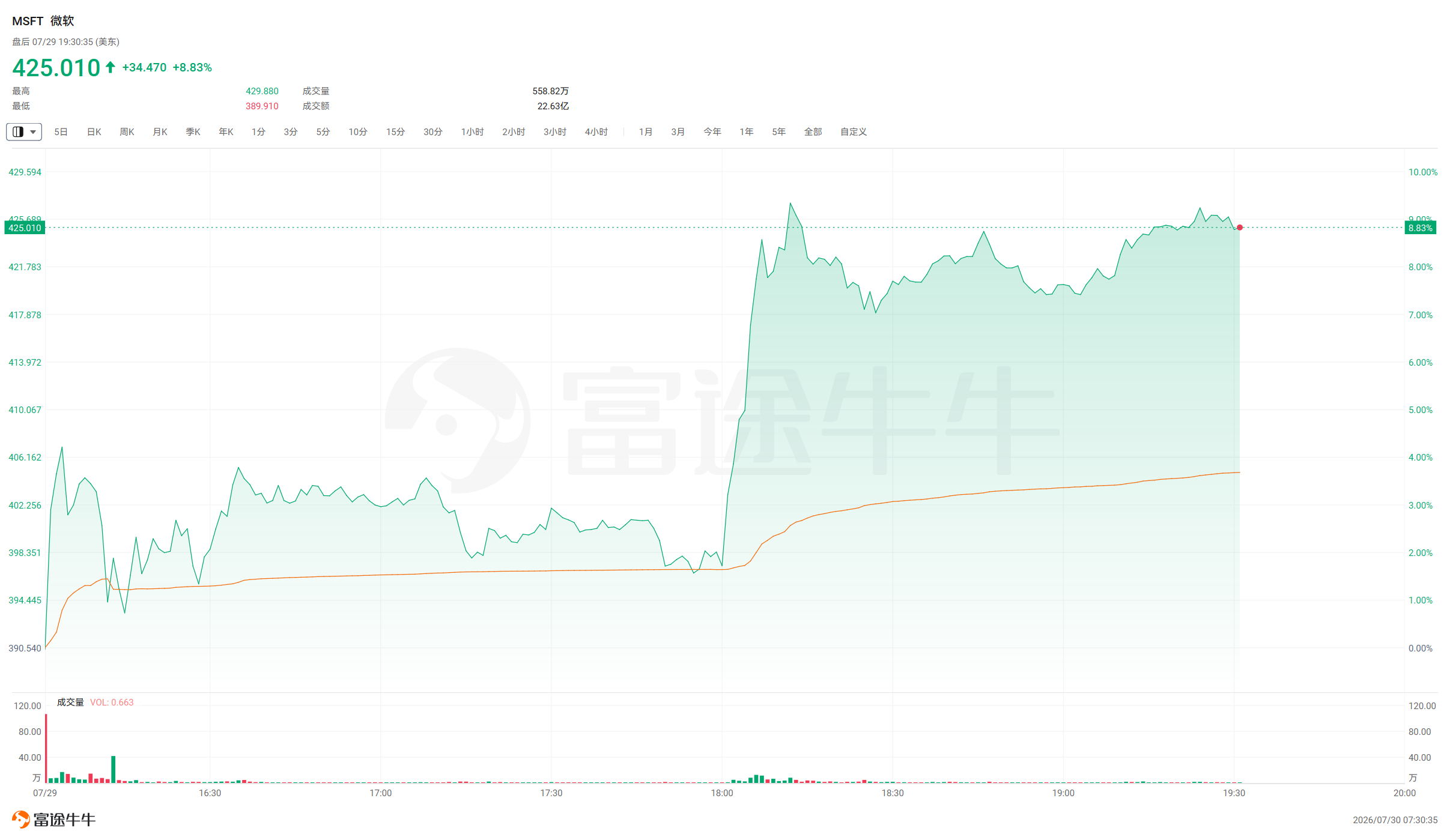
This volatile price action reflects the market’s ongoing balancing act between stronger-than-expected cloud growth and persistently high AI-related spending. Azure’s significant revenue beat signals robust demand for AI and cloud services. However, if capital expenditures continue to rise sharply, free cash flow and margins will remain under pressure. Conversely, if capital spending stabilizes while cloud revenue continues to surge, that would be the signal investors hope for: that the money is being well spent.
Analysts note that Microsoft’s current investment rationale has become clear: if Azure growth continues to accelerate and Copilot adoption keeps rising, the market will be more willing to accept high levels of AI-related capital expenditure. However, if cloud growth slows in the future while spending remains elevated, valuation pressures could intensify again.
Therefore, while this quarterly report reinforced Microsoft’s leadership in AI and cloud computing, it also shifted focus squarely onto the coming quarters: whether Microsoft can consistently demonstrate that every dollar spent on AI capital expenditure translates into meaningful cloud revenue, enterprise software revenue, and long-term contract growth.
Azure Emerges as the Standout Performer Last Quarter, Surpassing $100 Billion in Annual Revenue for the First Time
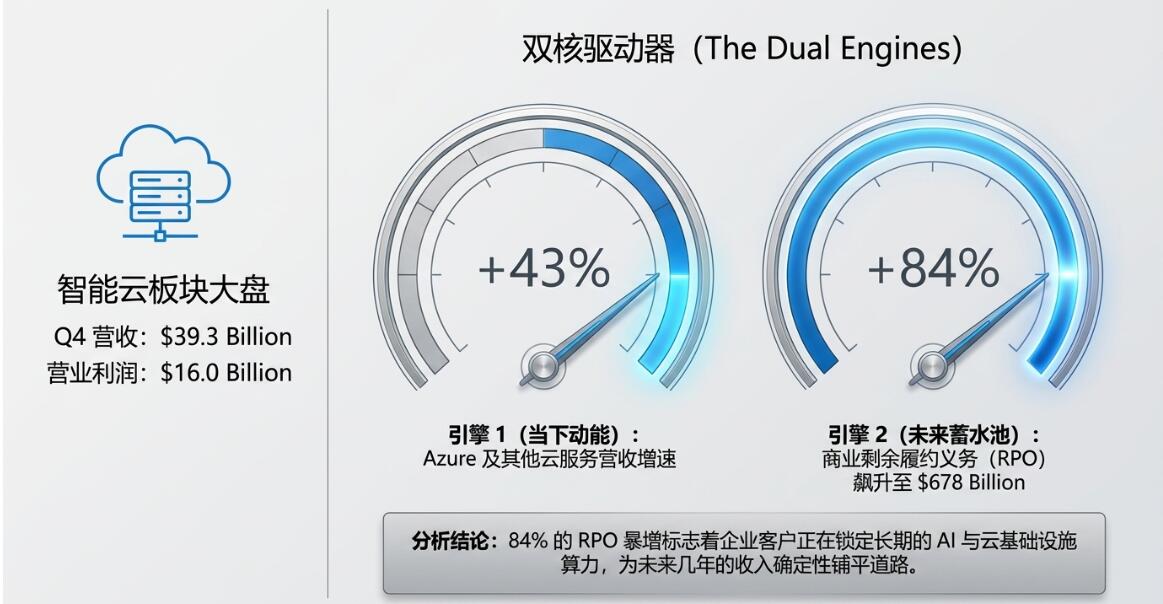
The most critical figure from Microsoft’s fourth fiscal quarter was a 43% year-over-year increase in Azure and other cloud services revenue on a constant-currency basis—surpassing analysts’ expectations of approximately 39.6%. Against a backdrop of intensifying competition among major cloud providers and market concerns about the realizability of AI-driven demand, this robust growth significantly bolstered investor confidence.
Revenue from the Intelligent Cloud segment reached $39.31 billion, exceeding the expected $38.17 billion and representing approximately 32% year-over-year growth. This segment—which includes Azure, server products, and enterprise services—is Microsoft’s most direct channel for monetizing its AI infrastructure.
Nadella disclosed that Azure’s full-year revenue surpassed $100 billion for the first time—a significant milestone. This indicates that Azure is no longer merely the growth engine behind Microsoft’s cloud transformation but has evolved into a core business of substantial scale within the company’s revenue structure, while still maintaining high growth rates.
From the market’s perspective, Azure’s better-than-expected growth directly alleviated investor concerns about the return on AI investments. Previously, market attention had already shifted from whether Microsoft possessed a leading edge in AI to whether its AI investments would generate sufficient revenue. This quarter’s earnings provided a largely positive answer.
Microsoft’s Total Cloud Revenue Grew 27% as Enterprise AI Demand Continued to Expand
In the fourth fiscal quarter, Microsoft’s total cloud revenue reached $59.3 billion, up 27% year-over-year and above the market expectation of $58.71 billion. Microsoft Cloud—which encompasses Azure, Microsoft 365 Commercial Cloud, Dynamics 365, and other cloud services—serves as a comprehensive indicator of Microsoft’s ability to commercialize AI and its broader cloud ecosystem.
Within this, Microsoft 365 Commercial Cloud revenue grew by 16%, demonstrating that Microsoft’s growth is not solely reliant on Azure infrastructure demand; its productivity software and enterprise collaboration ecosystem continue to expand steadily.
Notably, paid seats for Microsoft 365 Copilot have exceeded 30 million. Copilot is Microsoft’s flagship product embedding generative AI into core productivity applications such as Office, Teams, and Outlook. The growth in paid seats indicates rising enterprise adoption of AI-powered workplace assistants.
This also represents Microsoft’s key advantage over other AI companies: it not only provides foundational computing power and model access but also controls critical enterprise software entry points. Enterprise customers can deploy AI capabilities through existing Microsoft channels—including Microsoft 365, Azure, GitHub, and Dynamics—thereby accelerating the path from AI experimentation to commercial deployment.
Revenue, profit, and EPS all surpassed expectations, with AI investments yet to impair profitability.
Microsoft reported total revenue of $90.01 billion for its fourth fiscal quarter, an 18% year-over-year increase and above analysts’ consensus estimate of $87.72 billion. Adjusted earnings per share (EPS) came in at $4.74, significantly exceeding the expected $4.25, reflecting even stronger-than-anticipated profitability.
Operating income reached $40.6 billion, also surpassing market expectations of $39.02 billion. For a company heavily investing in AI data centers, GPUs, and cloud infrastructure, the ability to deliver substantially higher-than-expected operating profit underscores the resilience of Microsoft’s core business margins.
The filings also revealed that Microsoft’s investment in Anthropic contributed $3.2 billion in revenue during the fourth fiscal quarter. While this provided an incremental boost to quarterly results, investors should distinguish this one-time factor when assessing Microsoft’s sustainable profitability: on one hand, it enhanced reported revenue and profit for the period; on the other, the market remains more focused on whether Azure, Microsoft 365, and AI products can sustain organic growth.
Overall, this quarter’s earnings reflect Microsoft’s typical profile: massive and stable revenue from cloud and enterprise software, coupled with elevated capital expenditures driven by AI investments, yet the company maintains robust profitability.
AI-related capital expenditures continue to surge, with cash flow pressure emerging as the primary risk.
Data shows that Microsoft’s property and equipment expenditures totaled $35.8 billion in the fourth fiscal quarter, up approximately 110% year-over-year. Full-year spending on such items reached $115.95 billion, a nearly 80% increase from $64.55 billion in the prior fiscal year.
Including assets acquired through finance leases, Microsoft’s total capital expenditures for the fourth fiscal quarter amounted to $41 billion, slightly below analysts’ expectation of $42.5 billion. Based on Microsoft’s full-year capital expenditure guidance of approximately $190 billion, total spending would represent a 61% year-over-year increase; using the accounting-adjusted guidance figure of $175 billion, the increase would be 56%.
Differences across measurement bases may include statistical discrepancies such as those related to finance leases and purchases of property and equipment, but the trend remains consistent: Microsoft’s AI infrastructure investment continues to expand at a rapid pace.
These figures indicate that Microsoft is building data centers, procuring AI chips, and expanding its cloud computing infrastructure at an unprecedented scale. For Microsoft, these expenditures are essential to maintaining its leadership in AI; however, for investors, the key question is whether these investments will generate returns that are sufficiently high and timely.
Cash flow data reflect this tension. The company generated $55.44 billion in operating cash flow this quarter, up 30% year-over-year, remaining very robust. However, after deducting capital expenditures on property and equipment, free cash flow amounted to approximately $19.64 billion, down from roughly $25.57 billion in the same period last year. In other words, AI-related capital spending is compressing free cash flow.
This is one reason behind the post-market volatility in Microsoft’s share price: Azure’s growth exceeding expectations demonstrates that AI investments are beginning to monetize, yet capital expenditure remains substantial, and the market will continue to scrutinize 'AI return on investment' over the coming quarters.
Unfulfilled cloud orders amount to roughly twice annual revenue, providing visibility into future income
Microsoft Cloud’s commercial remaining performance obligations (RPO) surged 84% year-over-year to $678 billion. This metric represents the value of contracted revenue not yet recognized, covering long-term commitments for Azure, Microsoft 365, and other enterprise services.
The $678 billion figure is substantial—approximately double Microsoft’s projected fiscal year 2026 revenue of $331.84 billion. It signals that enterprise customers are entering into longer-term and larger-scale cloud and software contracts, offering high visibility into future revenue growth.
This also suggests that AI demand may have transitioned from early-stage experimentation to broader commercial deployment. Enterprise clients are no longer merely trialing Copilot or Azure AI services—they are locking in future usage through long-term cloud contracts and software subscriptions.
The strong RPO growth aligns with Copilot paid seats surpassing 30 million, confirming that Microsoft’s enterprise AI ecosystem is shifting from 'proof of concept' to 'budget implementation.' This is a critical signal for the market, as AI-driven valuations ultimately require support from real orders and sustained revenue streams.
Total unexecuted data center lease commitments increased by 67% quarter-over-quarter, indicating that AI infrastructure investment has entered a longer-term cycle
Beyond capital expenditures reported in its financial statements, Microsoft disclosed a particularly noteworthy figure in regulatory filings: in the fourth fiscal quarter, the company added over $130 billion in new data center lease commitments that have not yet commenced.
The filings show that Microsoft’s total uncommenced lease commitments reached $329.1 billion, up from $196.6 billion in the prior quarter. This implies approximately $132.5 billion in new commitments during the quarter—an increase of 67.4%—marking a historic leap in Microsoft’s data center leasing scale.
These future lease costs do not currently appear on the balance sheet and will only be recognized once the leases commence and Microsoft begins making payments. Microsoft stated that these leases are 'primarily' for data centers, with some contingent upon the fulfillment of specific contractual conditions.
Jonathan Neilson, Microsoft’s Head of Investor Relations, said this reflects the sustained strength of demand the company is observing, adding that these leases are intended to serve demand for 'many years' to come.
This data indicates that Microsoft’s investment in AI infrastructure is not merely a short-term increase in capital expenditures but has already evolved into long-term lease commitments. In other words, Microsoft is proactively securing resources to meet AI computing demand for the coming years.
For investors, this represents both a positive signal and a source of risk. The upside is clear: Microsoft evidently sees sufficiently robust enterprise AI and cloud demand. The risk lies in the possibility that if AI demand materializes more slowly than expected, these large-scale, long-term leases could exert pressure on profit margins and cash flow.
Editor/KOKO