
Qualcomm reported third-quarter results, with revenue declining 4% year-over-year to $9.95 billion and net income dropping 25% to $2 billion. The primary pressure stemmed from a nearly 300% year-over-year surge in memory chip prices, which drove smartphone chip revenue down sharply by 20% to $5.1 billion. The company’s fourth-quarter guidance fell below expectations, sending its after-hours share price down approximately 4%.
Qualcomm released its quarterly results, with its mobile chip business significantly pressured by a sharp rise in memory prices, leading to a 25% year-over-year decline in net profit.
After U.S. market hours on July 29 local time, Qualcomm reported third-quarter fiscal results, with revenue down 4% year-over-year to $9.95 billion—slightly above Wall Street expectations—but net profit for the quarter fell to $2 billion.
 For the current fourth fiscal quarter, the company expects adjusted earnings per share to range between $2.05 and $2.25, with revenue guidance of $9.7 billion to $10.5 billion.
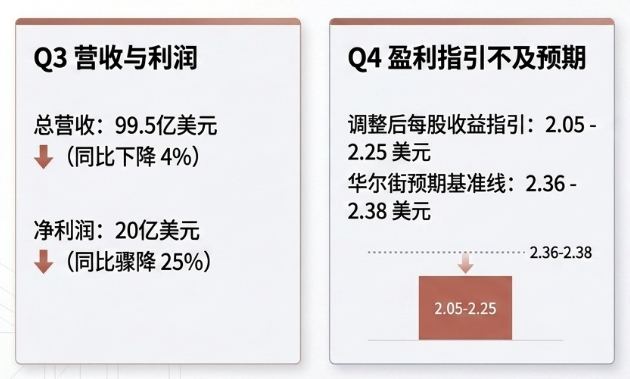
Even at the high end of the range, the adjusted earnings per share forecast remains below analysts’ prior expectations of $2.36 to $2.38, disappointing investors. Following the announcement, Qualcomm’s stock price dropped approximately 4% in after-hours trading.
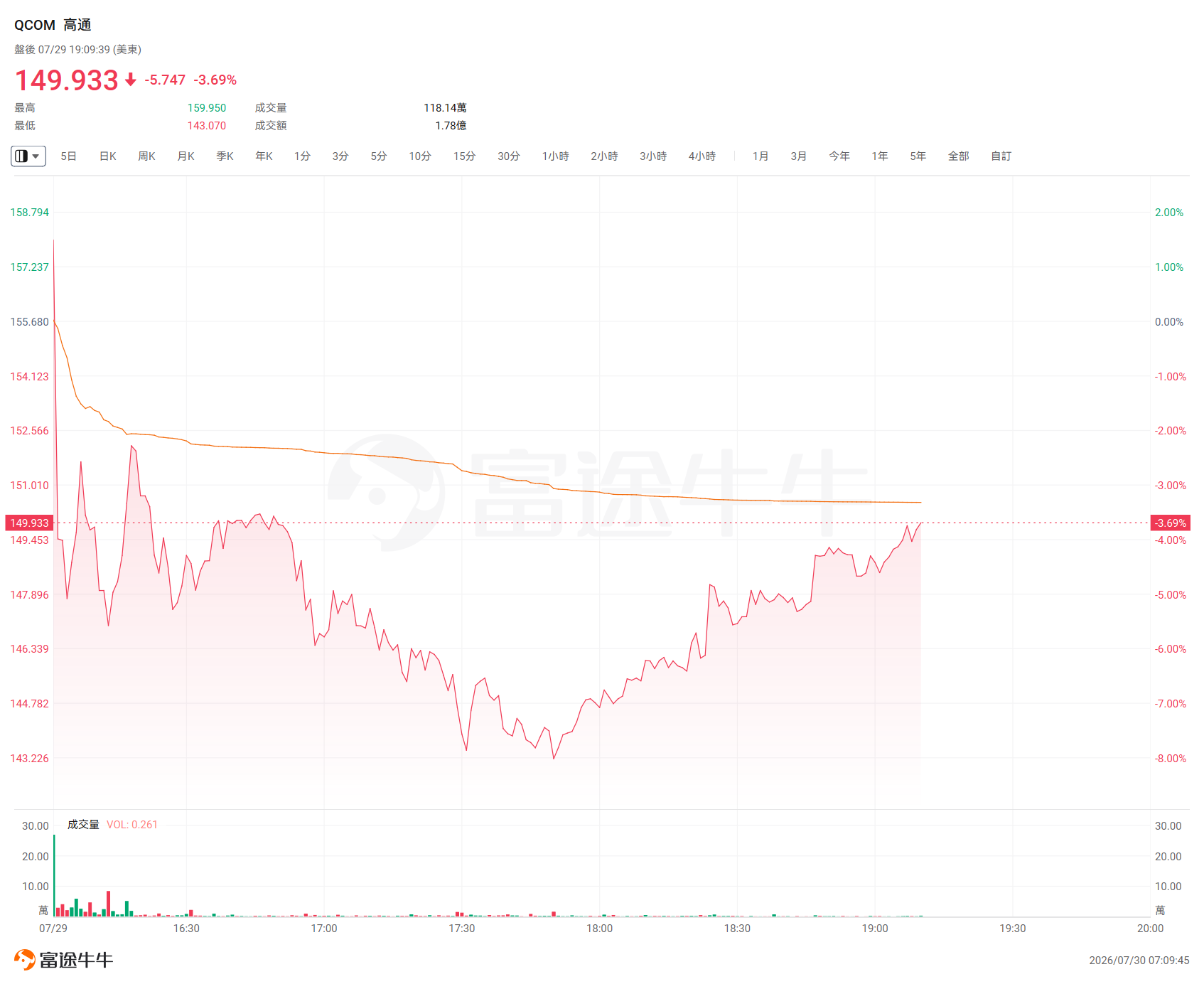
The company immediately announced it would implement a comprehensive price increase across its product portfolio effective September 1 to pass on persistently rising supply chain costs. Qualcomm CEO Cristiano Amon stated plainly:
“When costs go up, prices have to follow.”
He indicated that this round of price hikes is a short-term measure to address elevated supply costs and is expected to gradually improve the company’s gross margin over time.
Memory shortage hits smartphone business, core revenue plummets
The primary driver behind Qualcomm’s earnings pressure is the significant surge in global memory chip prices.
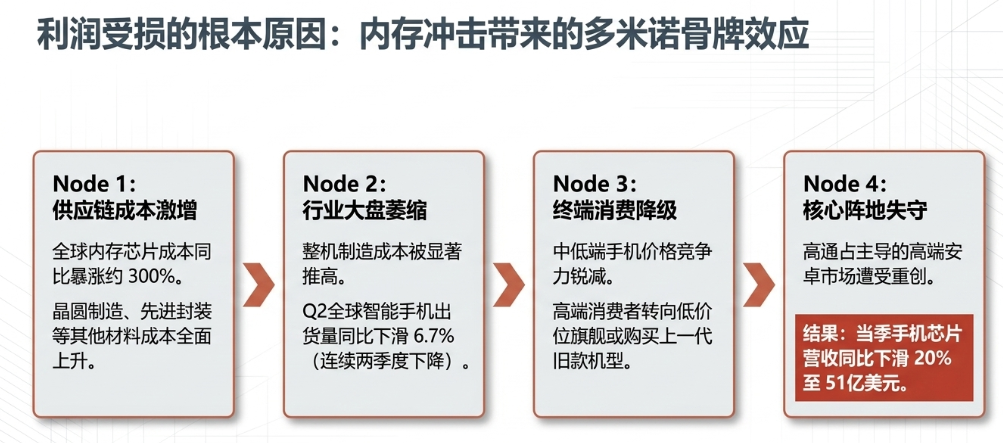
According to reports, memory chip costs rose approximately 300% year-over-year this quarter, substantially increasing the overall manufacturing cost of smartphones and dampening consumer demand.
Smartphone chip revenue for the quarter declined 20% year-over-year to $5.1 billion. Amon noted that rising memory prices have significantly eroded the price competitiveness of mid- to low-end smartphones. Even in the high-end Android smartphone segment—where Qualcomm holds a dominant position—consumers are increasingly shifting toward lower-priced flagship models or opting for previous-generation devices.
Amon stated:
Consumer preferences within the premium segment are shifting, with growing demand for more affordable options within the high-end category or outright selection of last year’s models—driven primarily by rising memory prices.
At the industry level, according to data from International Data Corporation (IDC), global smartphone shipments declined 6.7% year-over-year in the second quarter of this year, marking the second consecutive quarterly decline. Only Apple and Samsung reported growth against this trend.
The semiconductor industry as a whole is grappling with rising costs. In its earnings report, Qualcomm indicated widespread increases in input costs across wafer fabrication, packaging and testing, advanced packaging, memory, and other materials.
Firm pricing language; gross margin recovery expected in the second half
Facing cost pressures, Qualcomm has opted for proactive measures.
The company announced it will implement across-the-board price increases on its chip products effective September 1, covering all major product lines currently sold to smartphone manufacturers. Amon characterized this move as a "temporary, short-term measure" and emphasized that the company is actively optimizing its supply chain through multiple initiatives.
Qualcomm implemented a double-digit percentage price increase this time. In its earnings statement, the company stated that the move aims to "reflect higher costs in product pricing" and is expected to gradually improve gross margins over time.
Notably, Qualcomm also warned that Apple is accelerating its transition to in-house modem chips in iPhones—a shift progressing faster than previously anticipated.
Qualcomm expects revenue from Android-based smartphones to decline by approximately 20% year-over-year in fiscal year 2026, translating into an earnings-per-share loss of more than $1.50 and materially weighing on the company's long-term profitability.
Automotive and IoT Businesses Emerge as Growth Pillars
Amid weakness in its smartphone business, Qualcomm’s diversified strategy has provided critical support to its financial performance.
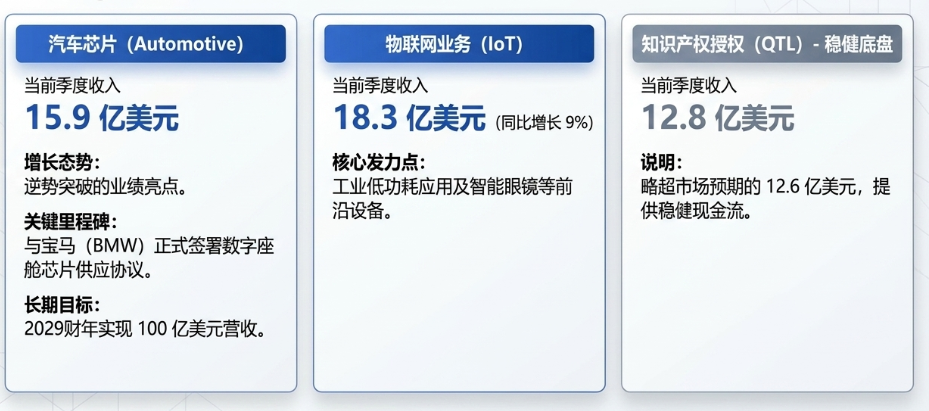
Revenue from its automotive chip business reached $1.59 billion this quarter, marking one of the highlights. In June, the company set a target of achieving $10 billion in automotive revenue by fiscal year 2029 and announced on Wednesday a digital cockpit chip supply agreement with BMW.
Revenue from its Internet of Things (IoT) business—which serves industrial low-power applications and devices such as smart glasses—rose 9% year-over-year to $1.83 billion. Additionally, Qualcomm’s Technology Licensing (QTL) segment reported quarterly revenue of $1.28 billion, slightly exceeding market expectations of $1.26 billion.
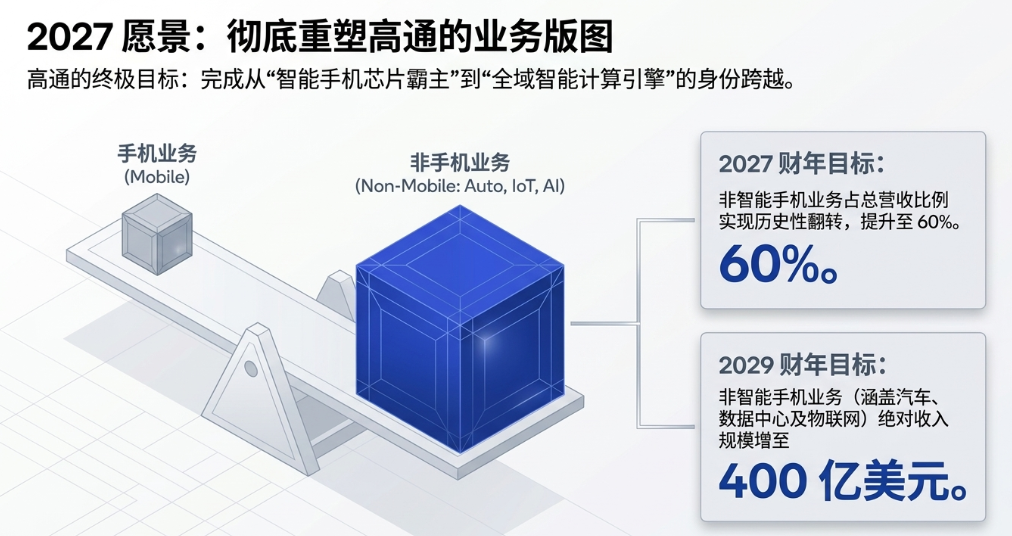
Amon stated that Qualcomm’s non-smartphone revenue—including automotive, data center, and IoT—is projected to grow to $40 billion by fiscal year 2029, with the company aiming to increase the share of non-handset revenue to 60% of total revenue by fiscal year 2027.
Betting on Data Centers Amid Intensifying AI Infrastructure Competition
Qualcomm is actively expanding into the AI data center infrastructure market to reduce its reliance on the smartphone business.
Amon reaffirmed the company’s goal of achieving $5 billion in data center revenue next year. In June, Qualcomm announced Meta as the first hyperscale technology customer for its AI data center processors.
On Wednesday, Qualcomm also announced the completion of its acquisition of Modular, an AI programming technology software company, and said it will officially launch its AI software platform at an industry conference in August.
However, Qualcomm's transition toward AI is far from smooth. NVIDIA’s meteoric rise—from a company valued at approximately $400 billion to a market behemoth now exceeding $4.6 trillion—has drawn numerous chipmakers, including Qualcomm and Arm, into this competitive arena.
Meanwhile, the substantial investments required for AI infrastructure are intensifying pressures across the entire electronics supply chain, which in turn is driving up consumer costs and placing smartphone chip suppliers like Qualcomm in a difficult position.
Editor/Stephen