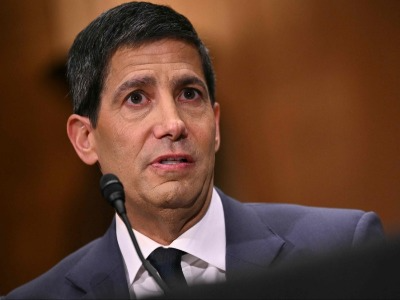
Federal Reserve Chair Waller stated that the 2% inflation target has 'no room for flexibility' and emphasized that the Fed will not deviate from its mandate due to market or external pressures such as military conflicts or tariff adjustments. Surging AI-related capital expenditures are driving up prices for memory and other components, and the timing and magnitude of these supply-side effects remain difficult to predict, increasing the complexity of monetary policy formulation. He downplayed forward guidance, urging markets to 'follow the data rather than fixate on the central bank.'
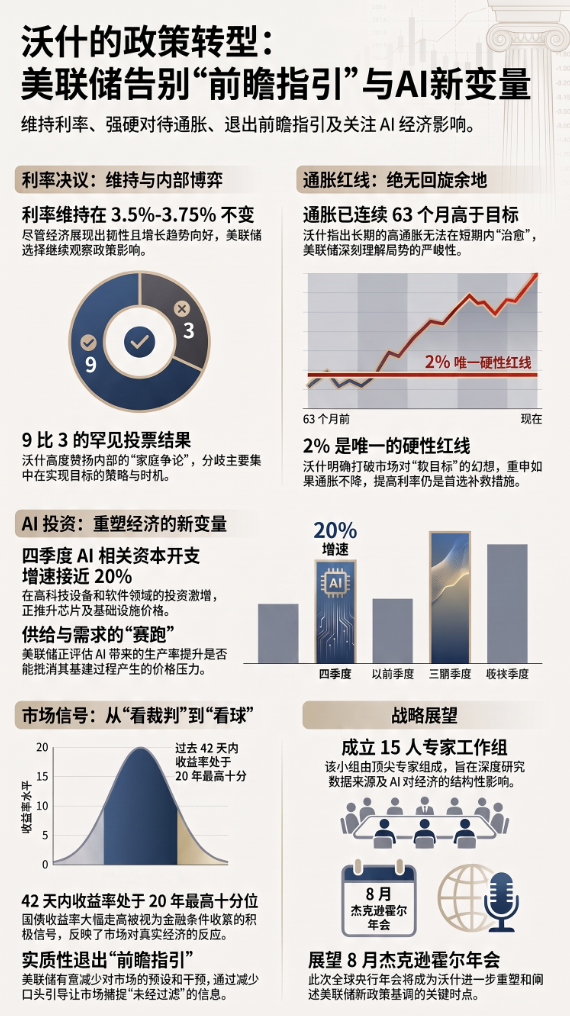
Federal Reserve Chair Waller viewed the rise in market interest rates as a signal that financial conditions have already tightened, reiterated that the 2% inflation target has 'no room for flexibility,' and announced a substantive exit from forward guidance, urging Wall Street to move away from reliance on central bank statements and 'capture genuine economic signals.'
The Federal Reserve voted 9–3 to keep the benchmark interest rate unchanged at 3.5%–3.75%. At the post-FOMC press conference, Chair Waller stated that the U.S. economy has shown resilience amid recent shocks, with a positive growth trajectory, employment growth broadly aligned with labor force expansion, and little change in the unemployment rate; however, inflation remains 'still too high' relative to the 2% policy target.
 On the issue of greatest market concern—the interest rate path—Waller offered no clear forward guidance. He emphasized that the Fed is deliberately reducing its pre-announcements and interventions in markets, seeking instead to obtain more 'direct and unfiltered' information from asset prices such as bonds and exchange rates.
At the same time, he repeatedly stressed that if inflation remains persistently elevated over the forecast horizon, further rate hikes 'are likely to be part of the solution.'
Waller also specifically noted that AI-related investments are driving up capital expenditures in the high-tech sector, but the ultimate impact of these investments on productivity, supply capacity, and inflation remains difficult to assess accurately. This implies that whether investment translates into productivity gains capable of alleviating price pressures remains a key variable in the Fed’s future policy evaluation.
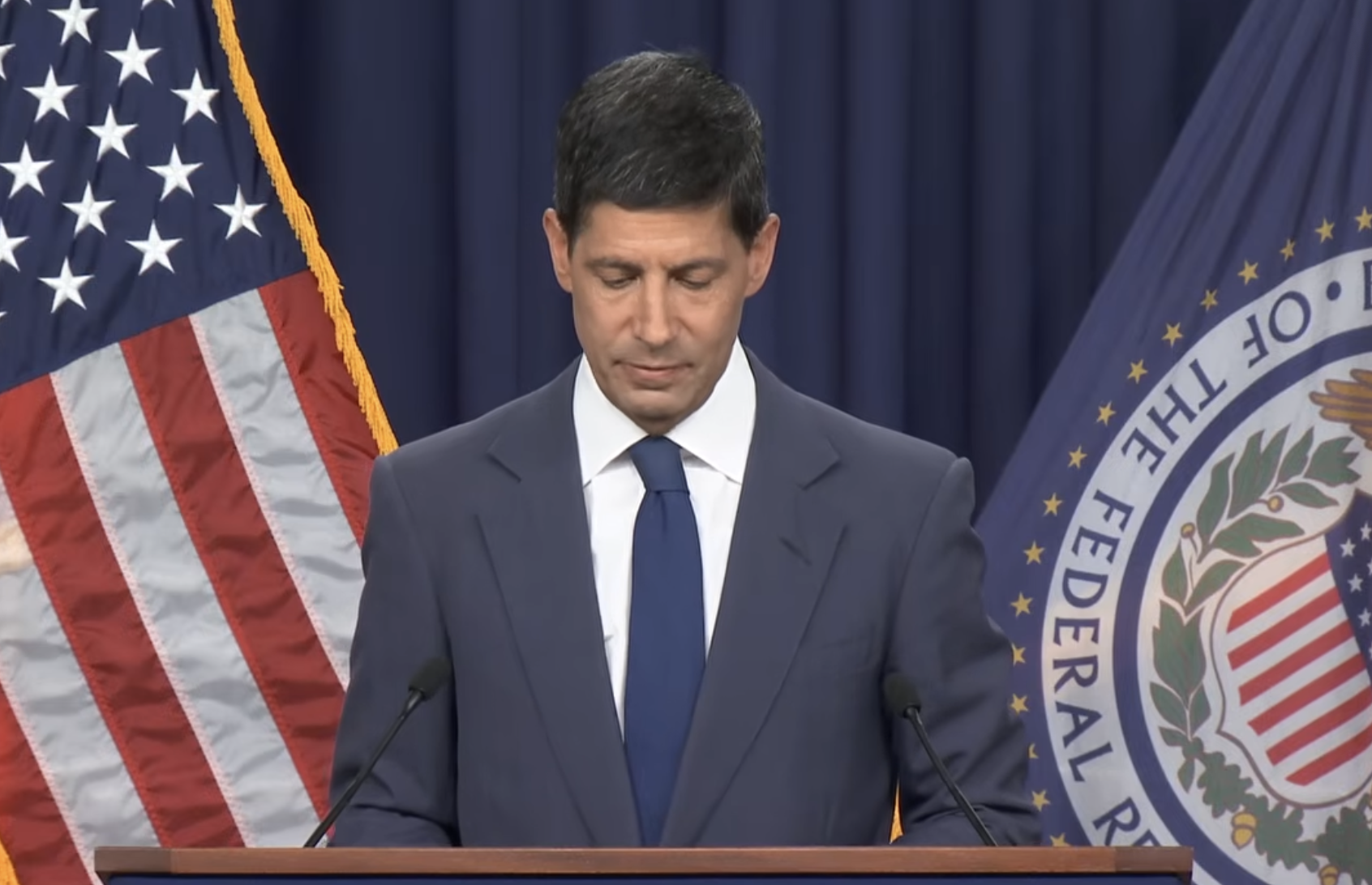
Inflation Bottom Line: No 'Soft Target'—2% Is the Only Red Line
Amid more than five years of elevated inflation, markets had speculated that the Fed might quietly tolerate inflation above 2%. Waller unequivocally dispelled this notion at the meeting, demonstrating a resolute stance on defeating inflation.
Waller stated clearly:
‘There is no soft inflation target, no implicit flexible target—none whatsoever during my tenure on this committee. There is only one target: 2%. None of my FOMC colleagues harbor any illusions about this.’
He acknowledged that the U.S. has endured '63 months' of inflation above target—a period marked by both patience and impatience—and that the Federal Reserve fully understands this situation cannot be resolved within nine weeks or by a single month of modest price declines.
In response to a question about what to do if inflation does not subside, Warsh gave a direct reply:
“If inflation remains too high and fails to recede, the best remedy is to raise interest rates.”
External Relations and Independence: Maintaining Resolve and Avoiding Interference
At the press conference, Warsh repeatedly emphasized that the Federal Reserve will not deviate from its mandate due to market pressures or external circumstances. He stated:
“The Federal Reserve will not waver. Our credibility depends on fulfilling our mandate and delivering on our responsibilities.”
When discussing the complex economic environment in recent years, Warsh identified pandemic-induced supply chain disruptions, military conflicts, energy supply interruptions, tariff adjustments, and a surge in AI-related investment as significant external shocks affecting the economy.
He noted that the Federal Reserve is not ignoring these developments but is actively assessing whether these shocks could further propagate and affect a broader range of prices.
However, he stressed that the Fed focuses on how these events transmit into inflation and economic activity—not on the events themselves—and that its policy decisions remain centered on achieving price stability and maximum employment.
AI Capital Expenditure Emerges as a Key Economic Variable: Growth Approaches 20% Over the Past Four Quarters
On macroeconomic hot topics, Warsh specifically highlighted the tangible impact of the AI boom on the real economy and prices—a subject rarely addressed in previous Federal Reserve meetings.
Wassh disclosed a set of core data:
“The latest data show that growth in the category of high-tech equipment and software related to artificial intelligence has been close to 20% over the past four quarters.”
Wassh noted that the surge in corporate capital expenditures has already pushed up prices for “memory and logic chips and related AI infrastructure.” The Federal Reserve is trying to determine whether these price increases represent merely sector-specific relative price changes or whether they will spill over into broader inflation.
“We take these shocks seriously. The Federal Reserve is studying the extent to which the effects of these shocks are broadening and how significantly they are influencing prices that have not yet been directly affected.”
On the supply-demand front, Wassh observed that the Fed has a relatively solid understanding of aggregate demand, but significant uncertainty remains regarding aggregate supply, productivity, and the structural changes driven by AI-related investment.
“We are inferring aggregate supply. We are making judgments about productivity. In a sense, there is a race between supply and demand—and the sharp increase in corporate capital spending on artificial intelligence makes this assessment even more difficult.”
He also warned that the AI investment boom will not automatically ease the Fed’s policy challenges. On one hand, gains in productivity and expansion in supply could help alleviate inflationary pressures; on the other hand, the construction of AI infrastructure itself may drive up prices in certain upstream sectors.
Shift in policy communication: De-emphasizing forward guidance and urging markets to “follow the data”
Wassh reiterated that the Federal Reserve is significantly scaling back—or even phasing out—the “forward guidance” it has commonly used over the past decade, no longer attempting to fine-tune market expectations through dot plots or verbal reassurances.
Wassh pointed out that over the past 42 days (the interval between two meetings), both nominal and real yields along the Treasury yield curve have risen sharply—by an amount ranking roughly in the top decile of moves seen over the past twenty years. He attributed this move to the Fed’s “stepping back”:
‘Market participants are learning to follow the ball, not the referee, and market prices will continue to respond in the direction and magnitude they deem appropriate. In my view, this is a positive development.’
In response to reporters’ concerns about whether the Federal Reserve might be losing control of the narrative, Walsh appeared “not particularly worried.” He stated candidly:
‘We’re trying to stay out of the way… What interests us is the reaction of financial markets.’
He believes that outside of crisis mode, the Federal Reserve should not tie its own hands but instead observe the direct, unfiltered market reactions to unfolding developments.
Rates unchanged, but Walsh says ‘this is not a pause’
Regarding the decision to hold rates steady, Walsh declined to characterize it as a “pause.” In his view, defining the policy stance solely by whether the federal funds rate has changed may overlook the adjustments already underway in financial markets. He said:
‘I would not describe our action today as akin to a pause. I would describe our action as a rigorous review of the economic situation.’
Walsh noted that over the past 42 days—the interval between two FOMC meetings—nominal and real interest rates across the entire U.S. Treasury yield curve have risen significantly, with these moves ranking roughly in the “top decile” over the past two decades.
‘Financial market prices did not pause during this intermeeting period—both nominal and real rates have risen.’
On the implications of rising market rates, Walsh did not equate them directly with a necessity for the Fed to raise rates further, but indicated that signals from bond markets show a degree of consistency with developments in the real economy.
Economic output remains robust, capital spending and productivity are strong, and the labor market is solid and stable. The bond market—the Treasury market—appears to be signaling the same. Even though we have done relatively little over the past 42 days, markets have done quite a lot.
Full Transcript of Federal Reserve Chair Waller’s Press Conference
Opening Remarks by Chair Waller
Good afternoon. This is my second time attending a Federal Open Market Committee (FOMC) meeting as Chair—it feels like time is flying. It may be premature to say this has become routine, but once again our discussions reflected a collegial and constructive atmosphere. I feel truly fortunate to work alongside such capable colleagues who are deeply committed to our mission and share my determination to enhance the Federal Reserve’s performance. As you know, the Committee voted 9 to 3 to maintain the target range for the federal funds rate at 3.5% to 3.75%.
The Committee continues its policy of providing ample reserves to the banking system. Despite recent shocks, the economy has demonstrated notable resilience, with favorable underlying trends and solid growth. Employment growth has kept pace with labor force growth, and the unemployment rate has changed little. Inflation remains elevated relative to the Committee’s 2% objective.
The Committee is resolute. You’ve heard this before, but we will achieve price stability. As always, the policy statement states facts only. It avoids forecasts, a choice we consider especially prudent in the current environment of uncertainty. However, uncertainty does not imply a lack of clarity. For some households, businesses, and market professionals, five years of high inflation have fostered a persistent misconception—that somehow the Federal Reserve’s implicit inflation target is higher than 2%.
Let me reiterate: there is no soft inflation target, no implicit flexible target—none whatsoever under this Committee’s watch. There is only one target: 2%. None of my FOMC colleagues harbor any illusions about this. We have turned a new page. We understand that above-target inflation persisting for more than five years cannot be cured in nine weeks or by a single month of modest price declines. The Federal Reserve will not waver. Our credibility depends on fulfilling our mandate and delivering on our responsibilities. The American people rightly expect nothing less, as the nation’s prosperity depends on it. To those of you in the press room who are regulars, today’s assessment may sound familiar.
Yet our discussions, our policy, and our strategy exhibit no inertia whatsoever. Two developments in the economy merit emphasis. The first is a very pronounced shift since our last meeting 42 days ago: nominal and real yields across the entire Treasury yield curve have risen sharply. Indeed, the increase in market rates between these two FOMC meetings ranks among the most significant of the past two decades—roughly in the top decile.
But if the Committee did not change the policy rate, what happened during the intermeeting period? Market attention focused squarely on actual data and real economic developments. Prices reacted in real time to incoming information, and the reduced use of forward guidance may have been a contributing factor. Market participants are learning to follow the ball, not the referee—and market prices will continue to adjust in the direction and magnitude they deem appropriate.
In my view, this is a welcome development—and it is only the beginning. After all, a central bank need not always be, nor everywhere be, the center of attention. I understand the Committee’s desire for rolling forecasts and commentary, but from our perspective, we need to observe markets’ direct, unfiltered reactions to unfolding developments. Of course, I want to emphasize that the Committee’s decisions remain critically important. When necessary and appropriate, we will act without hesitation. The second economic development—mentioned in my Congressional oversight hearing this month but worth repeating—is the striking strength in business investment. The surge in high-tech capital expenditures is particularly noteworthy. Yet this does not necessarily make the Federal Reserve’s job easier. In categories related to artificial intelligence—specifically high-tech equipment and software—the latest data show annualized growth of nearly 20% over the past four quarters. This supports healthy momentum in manufacturing output. More broadly, capital spending is laying the groundwork for future growth. Nevertheless, the precise timing and magnitude of supply-side effects remain difficult to predict.
FOMC meetings produce policy decisions, but equally important is candid discussion of the most significant overarching issues. This is also a priority in the Federal Reserve’s new chapter. At our meeting, vigorous discussions centered on four questions, which I will enumerate one by one. First, we devoted considerable time to discussing how high inflation over the past five years has shaped the current policy landscape. To borrow an old saying: is the past truly past? Second, my colleagues and I considered recent economic shocks: pandemic-induced supply chain strains, military conflicts, energy supply disruptions, sharply higher tariff rates, and yes, the surge in investment related to artificial intelligence. These shocks have diverse origins—do they also differ in their effects on output and employment? Third, we discussed price increases associated with these shocks. For example, the corporate capital expenditure boom is pushing up prices for memory and logic chips and related AI infrastructure. Do these developments signal broader inflation dynamics, or are we merely paying attention because they’re under the spotlight? Finally, we discussed monetary policy tools and strategies. If, as the Fed has long held, interest rate policy should be its primary monetary tool, then how much accommodation have we derived from our balance sheet toward achieving price stability? Our work at the Federal Reserve is progressing. We are asking the right questions. In this critical period, we fully appreciate the importance of arriving at the right answers. Of course, you all come with your own questions as well.
Q&A Session
Questioner 1: Let’s begin with questions now. We’ll start with Steve. Thank you for answering our questions, Mr. Chair. Okay. You’ve been in office for several months—or nine weeks, however long it’s been—and have observed markets operating without forward guidance. I’d like to know what signals you’re receiving from markets regarding where policy should stand?
Waller: Yes, so formally speaking, it’s been 8 weeks and 4 days—but I’m not counting. The market is sending signals… Steve, what I’ve really been trying to do—and I think you and your colleagues understand this—is to obtain unfiltered market information, direct inputs from buyers and sellers transacting in Treasury prices and the U.S. dollar’s foreign exchange value, and then make our own judgment about what that means for our mandate. How are we doing on inflation? How are we doing on employment? We try not to interfere with those market signals, which is partly why our language has been more restrained and why we’ve stepped back from forward guidance. So markets are reacting to events—and I’d say, over the past 42 days since our last meeting, their reactions have been much more direct. That’s a good thing. As I mentioned in my prepared remarks, we’ve seen significant tightening not only in nominal rates but also in real rates. We’re observing it. We’re trying to stay out of the way, because while many of you may be interested in our reaction function, we’re interested in the financial markets’ reactions.
Questioner 1: I understand, Mr. Chair. Let me follow up—if the market is speaking to you, what is it saying? If real rates are higher, does that imply the federal funds rate should be raised? Waller: Yes. So, interpreting markets isn’t easy. Like market professionals, we central bankers find these factors overdetermined. But let me offer some preliminary thoughts. First, as stated in the FOMC statement released at 2 p.m., economic output is solid, capital spending and productivity are strong, and the labor market remains robust and stable. The bond market—the Treasury market—appears to be conveying much the same message. If I were to parse the signals from the Treasury market, I couldn’t do it perfectly. But the bond market is saying many of the same things, which is why we’re seeing tightening in both nominal and real rates—even though, over the past 42 days, we haven’t done much, yet the market has done quite a lot.
Questioner 1: I understand, Mr. Chair. Let me follow up—if the market is speaking to you, what is it saying? If real rates are higher, does that imply the federal funds rate should be raised? Waller: Yes. So, interpreting markets isn’t easy. We central bankers, like market professionals, find these factors overdetermined. But let me offer some preliminary thoughts. First, as stated in the FOMC statement released at 2 p.m., economic output is solid, capital spending and productivity are strong, and the labor market remains robust and stable. The bond market—the Treasury market—appears to be conveying much the same message. If I were to parse the signals from the Treasury market, I couldn’t do it perfectly. But the bond market is saying many of the same things, which is why we’re seeing tightening in both nominal and real rates—even though, over the past 42 days, we haven’t done much, yet the market has done quite a lot.
Questioner 2: Claire Jones, Financial Times. You seem to have gotten the internal debate you wanted at this meeting. We saw—indeed, we observed three dissenting votes. Could you describe the arguments put forward by those who dissented? And please tell us why you weren’t persuaded by them at this stage. Thank you. Well, I suppose I shouldn’t give you their strongest arguments. I’ll give you some others.
Waller: You’re absolutely right. I asked for a good family debate—and I got one. That was the point; it was by design. I come to this meeting, and to this press conference, energized by what transpired over the past two days. Most of our discussion focused on the big questions critical to implementing monetary policy. We didn’t shy away from them. We weren’t afraid of them. There was far more interaction among my colleagues. This was a genuine family debate. My view—which you’ve heard before—is that this is a better way to formulate sound policy. It’s our North Star.
So, I hear a great deal of consensus. We have the authority, the tools, and the mandate to achieve price stability. There’s no retreat from our responsibilities. The decisions we made in the room enjoyed overwhelming support. But Claire, I’d also like to leave you with another impression. There was no inertia in that discussion. It was an active, vigorous conversation about everything we could do—and might want to do—in the future. You accurately noted today’s disagreement on one decision. But I think that doesn’t fully capture the essence of the discussion. The path to central banking heaven requires us to fulfill our mandate. Today, that means achieving price stability. I won’t measure that path by 42 days or any single meeting. After that meeting, I’m even more confident this is the right team to defeat high inflation.
To what extent was the decision not to act in July driven by June’s softer CPI data? In two words: not much. Not much at all. I’d like to believe the Committee shares my view that the historic problem with data dependence lies in both the data and the dependence itself. We don’t rely on any single data point as cover, excuse, or validation. What concerns me—and what I believe concerns the Committee—is the trend in the data. Certainly, we’ve received some encouraging inflation readings. I recall saying at our meeting 42 days ago something like 'inflation has run above target for 63 months.' I didn’t say 64—though the final count might be close. So we’ll be watching inflation data closely in the period ahead. But I don’t want to leave you with the wrong impression that we’re holding our breath. I’ve already convened a working group to re-examine the private and public data we use in our decision-making. That group is actively engaged. I’ll be reconnecting with them in the coming weeks, but I won’t say we’re overly reliant on any single data point—including the one from a few weeks ago that surprised some people.
Questioner 3: Chair Waller, thank you. I’m Neil Irwin from Axios—thank you for taking our questions. The federal funds rate is currently about 75 basis points below the two-year Treasury yield. This suggests markets expect you’ll eventually have to tighten significantly—about 100 basis points below most Taylor rule estimates. You’re fulfilling your employment mandate. Inflation remains elevated. Why shouldn’t rates be higher right now? Neil, your question contains a lot.
Wash: So interest rates are higher now than they were 42 days ago. The market has made its judgment—because we have partially stepped back from efforts to influence that judgment, nominal rates across the entire Treasury yield curve have risen. That doesn’t mean we’re taking orders from the market, but we are observing it. Therefore, it’s a misunderstanding to say the market hasn’t reacted simply because we took no action today.
The market is reacting in real time. In the period ahead, we have important decisions to make regarding the policy rate. During this time, I believe the market also has many decisions to make. Let me put it this way: the importance of monetary policy lies not just in what we say, or even solely in what we do. The true significance of monetary policy is how it affects the real economy, and the prices we observe in financial markets are one of many channels through which this occurs. We will continue monitoring this market information and watching how it responds to incoming developments, which will help inform our decisions when we meet again in seven or eight weeks.
How would you characterize the situation over the past few days, where you and the other eight members favored holding rates steady? Was that driven by strong conviction, or was it a tense standoff? Was the decision between holding steady and tightening a close call?
Wash: Well, as you know, the vote was 9 to 3. To my ear, the broader discussions over the past few days showed considerable consensus on the four key questions I initially raised about what’s truly happening in the economy, whether there have been shocks, the scope and effectiveness of our tools, and the implications for prices and output.
I heard a lot of common ground on the issues themselves. Were there differences in emphasis in the answers? Certainly. So might people reach different conclusions? Absolutely. But my own judgment is that this is a time for vigilant thinking—not vigilant waiting. I believe the vote reflected a unified stance.
Questioner 4: Thank you. Colby Smith, The New York Times. You mentioned that reviewing the Fed’s policy tools is one component of a three-pronged strategy to tackle inflation. I’m curious how you assess the effectiveness of these tools.
Wash: If inflation remains too high and fails to subside, the best remedy is to raise interest rates. That’s precisely what the discussion over the past two days has been about: if inflation stays elevated throughout the forecast horizon, interest rates will likely be part of the solution.
But I wouldn’t say it’s an isolated measure. I tried in my remarks today to reiterate a point I made several weeks ago to the oversight committee. I believe there’s a misconception among some—including certain participants in financial markets, households, and businesses—that central bankers like me, having stated a 2% inflation target, might actually be more tolerant of somewhat higher inflation. In economics, we refer to this as ‘revealed preference.’ So, is there reason for people to believe our inflation target is actually higher?
What I’ve heard over the past two days—and indeed over the past eight and a half weeks—is a clear ‘no.’ We will achieve the 2% inflation target, which the Committee defines as price stability. Thus, even without the specific tools you mentioned, one way to ensure we meet our goal is to anchor expectations firmly around the correct number. I believe we’ve made some progress on this front—though I’m not saying the job is done. It bears repeating. Ultimately, Colby, our business is about performance. We will be judged by our actions, and that’s exactly what we intend to deliver. Clarifying inflation expectations is part of it; equally important is demonstrating accountability—taking ownership rather than shifting blame.
Questioner 4: And our policy tools, as you mentioned, constitute the third equally critical component. Given that the statement once again notes that a significant portion of above-target inflation stems from supply shocks, does that diminish the effectiveness of rate hikes? Let me start with the premise of your question.
Wash: It’s as if you’ve been listening in on our discussions over the past day and a half. A significant part of our focus has been on trying to understand and identify the underlying inflationary dynamics within these shocks.
We take these shocks seriously. A series of shocks have been affecting this economy, and we are not turning a blind eye or dismissing them as unimportant. Instead, we are trying to understand to what extent the effects of these shocks are broadening and how significantly they are influencing prices that have not yet been directly affected. Our objective is to achieve more broadly based growth and more limited, better-controlled inflation.
I first acknowledge that these shocks have made policy work during this period more difficult, but this is also one of the key questions we are asking ourselves—and there are differing views among those in the room. I believe that over the coming months, we will refine this perspective and make better judgments. We will also let market prices help inform us.
Questioner 5: Thank you, Mr. Chair. Edward Lawrence from Fox Business. I’d like to delve a bit deeper. Specifically, in your view, what is the rationale for pausing (rate hikes) today? So, I would not characterize our action today as a pause. Rather, I would describe it as a rigorous review of the economic situation. I would describe it as an examination of significant challenges and as a reflection on our own homework, with the aim of resolving these issues over the period ahead. If you insist on calling this a pause, I would say financial market prices would suggest otherwise. Financial market prices did not pause during this intermeeting period. They moved in one direction in response to inflation data and in another direction in response to strong economic growth, with both nominal and real rates rising. Did the Federal Reserve change the policy rate today?
Wash: No, but I think that’s just the beginning of the story, not the end. If I may, I’d actually like to ask—not about forward guidance, but about looking ahead. Traditionally, Federal Reserve Chairs have used the Jackson Hole symposium to reset monetary policy. How do you view the speech you’ll deliver in August? Right now, I see it as a blank slate.
I haven’t yet begun discussing the content of that speech with the excellent team here. I think your description of history is accurate—at least from my first tenure at the Fed up until fairly recently. It has often served as a tone-setting speech, mostly signaling what might happen in the fall. I haven’t made any judgments on this yet, but such judgments will need to be made—perhaps, if possible, in the crisp mountain air of Jackson, Wyoming.
I’d also like to frame the bigger questions. There’s a tendency—especially as meetings and press conferences become more frequent—to become short-sighted and get caught up in whether you raised rates by a quarter of a percentage point or took that specific action.
Ultimately, whether we achieve price stability depends on decisions we make over six-, seven-, or eight-week cycles. But those decisions are even more consequential. What are the big questions? What exactly is happening with productivity? What is happening with demographics? What is happening to the global economy amid these shocks? I haven’t yet decided whether this will be a big-picture speech or a more traditional setup for all our actions from September through December.
Let me tell you one other thing I’ll do before Jackson Hole. I’m engaging with those working groups. My first principle in forming these groups was to bring together the world’s best subject-matter experts—particularly ensuring they interact with people who may hold opposing views. Over the next few weeks, I’ll be following up. I’ve given them time to thoughtfully develop their agendas, debates, timelines, and readiness plans. I’ll do some of that follow-up, which may influence—more or less—what I end up saying in Jackson Hole.
Questioner 6: Nick Timmerose from The Wall Street Journal. Chair Wash, I’d like to follow up on Colby’s question regarding policy transmission. You’ve stated there is no cruel trade-off between price stability and maximum employment. Rate hikes reduce inflation by cooling demand, which typically manifests in the labor market. If that’s not the channel you’re relying on…
Wash: What is it? Yes. Let me go back to first principles, Nick. I don’t believe any part of our mandate is inherently at odds with another part. I don’t view price stability and maximum employment as a binary choice. Some policymakers in past generations believed there was a strict trade-off. That is not my judgment. In fact, my judgment is that if we fulfill our mandate, we will achieve both objectives simultaneously—we will have price stability and maximum employment. Indeed, if you wanted to inflict the greatest damage on the labor market, you would subject it to a period of high and volatile inflation that leaves employers and businesses disoriented. So I consider both parts of our mandate equally important. There are no legislative orphans here.
I talk most often about price stability because, as a nation and as policymakers, we have generally done quite well on maximum employment, but significantly worse on prices. That’s why we describe inflation as 'elevated,' and it’s also the central focus when we discuss monetary policy transmission mechanisms. I believe different tools operate through different transmission channels. Interest rates work through lending channels, credit channels, and perhaps confidence and foreign exchange channels as well. The balance sheet may operate through other channels, such as signaling and portfolio rebalancing. We fully account for all these tools when formulating policy. But if it were implied that we would somehow...
Fine-tune aggregate demand to catch up with supply—that is not how I think. I don’t believe we are good at fine-tuning. We aim to broadly align aggregate supply and demand. But truly, sitting here today at this press conference, I believe we have a reasonable understanding of what aggregate demand looks like in this economy. We are inferring aggregate supply. We are making judgments about productivity. In a sense, there is a race between supply and demand, and the surge in business capital expenditures related to artificial intelligence has made this calculation more difficult. But over the coming period, we will strive to make that assessment.
Questioner 6: If I may ask, where exactly does today’s disagreement lie? Is it about inflation forecasts, or more about risks and strategy?
Wash: Yes, so I’ll let the dissenters speak for themselves. From what I’ve heard over the past two days, there is overwhelming consensus on goals, mandates, and commitments. I haven’t heard anyone pull back. The judgment about how best to achieve price stability—that’s probably the question we’re trying to answer. What’s the best move? What’s the best strategy? What’s the best way to implement it? The second question being asked is: When do we need to make those harder decisions? When do those choices need to be made? As I told one of your colleagues, I’m reassured that markets during the intermeeting period aren’t reacting to us—they aren’t reacting to the dot plot or our speeches. They seem to be responding more than ever to real-time developments. So they’re assessing for themselves how restrictive the Treasury yield curve should be. I view that as a positive development. We don’t endorse any specific market move, but I would also say we watch them with great interest.
Questioner 7: Janelle Marty from Bloomberg, following up on that question. There is greater uncertainty in the market about what action the Fed will take at this meeting. To some extent, you might consider that exactly what you’d want to see. But my question is: Is there a scenario in which, if markets priced in something with high certainty that contradicts your intentions, you would prefer not to surprise them?
Wash: What risk do you see associated with that? Yes, that’s a good question. Surprises are not part of our objective function. Surprises are not the problem we’re trying to solve. We have a clear North Star. What we’re solving for is how to make the best possible decision. Almost everything else should serve that goal. By not feeding the market, not pre-announcing our decisions, and not offering hints or leanings, my colleagues and I have found that during the intermeeting period, we receive insights from highly skilled economists within financial markets—not merely echoes or affirmations of what we’ve told them, but their own independent judgments, albeit imperfect. So surprises are not the goal. At the same time, I would say we are not entering this meeting feeling constrained by every option摆在我们面前.
Questioner 7: So some of your colleagues continue discussing how they view policy decisions. If you don’t provide your reaction function or your thought process, how concerned are you that you’re losing control of the narrative? Well, not very concerned. That’s the short answer to that question.
Wash: When some observers of the Fed say, 'We don’t want your forecasts; we don’t want your dot plot—we just want your reaction function,' part of me thinks, 'What we really want is your forecast. What we really want is your dot plot regarding your reaction function.'
Let me correct a possibly misconceived external perception—whether real or not. Any central bank official, particularly one operating in a labor market that is roughly in equilibrium, tends to lean toward tightening policy when seeing underlying inflation rise. Similarly, when achieving the other side of the mandate and observing underlying inflation decline, they tend to favor easing policy.
This is my reaction function, and I suspect it won’t deter people from continuing to probe for more, because the reality is that for a long time—since the 2008 crisis—many countries have been operating in crisis mode. We deliberately provided abundant information, attempting to offer strong reassurance, clearly articulating what we intended to do, and delivering explicit forward guidance, as if we were tying our own hands.
In crisis mode, this approach strikes me as highly prudent policy. However, under more benign conditions, I believe it warrants re-examination. Market participants—including investors, analysts, and journalists—have grown accustomed to absorbing all this information. Therefore, I take seriously the notion that withdrawing forward guidance would require some transitional period. Reform is never easy. Yet our broad-based judgment will help us make better decisions and thus fulfill our mandate.
Questioner 8: Thank you. When you refer to the 2% inflation target, which specific measure are you relying on?
Warsh: Yes, so I’ll give two answers. First, let me provide the official, standard response. Every January, the Federal Reserve issues a statement on its goals and strategies. In that strategy document—I believe dated this past January—it specifies the personal consumption expenditures (PCE) inflation measure as the target metric. There it is. I’ve had enough… so that’s our number. We stick to it.
Who knows what we might say about our strategy after next January. I suspect the working group may offer some additions. But I would caution that some version of the Lucas critique—or perhaps Goodhart’s Law—should remind us that when we designate a particular inflation measure (or any other metric) as our target, and explicitly state that it aligns with our objectives, we may inadvertently render it a less effective indicator or target.
Overall, if you stood before me and said, 'I adhere strictly to the strategy document—we will achieve exactly 2% inflation, not a basis point more or less,' I would respond that, to achieve that goal, I am monitoring a broader set of inflation data than just PCE. So, without fully revealing my hand…
I’m trying, like my colleagues, to understand the broad, pervasive price changes occurring in the economy. This isn’t a perfect science. I may have mentioned 42 days ago that I have a working group tasked with this issue, and we’re running a data project aimed at distinguishing signal from noise. So if you take away one message from me: yes, I care about what the PCE data shows; I care about CPI and the contributions of all other indicators—but my perspective is broader than that, even though our mandate is quite narrow.
Questioner 9: Michael McKee from Bloomberg Television. I’m somewhat puzzled by some of the things you’ve said today—perhaps you could clarify. You’ve repeatedly stated that your job is to lower prices, stabilize prices, and meet your target—and that you will achieve it. Yet markets say you haven’t gotten there yet, as evidenced by their rate hikes, while all you’ve done today is talk about it. And committee members before you have certainly talked as well. So the American public might reasonably ask: what are you waiting for?
Warsh: Believe it or not, today’s press conference wasn’t the sum total of what I did today. Over the past two days—and indeed the past two weeks—we’ve spent considerable time reviewing our monetary policy strategy, evaluating our tools, deeply considering the data sources we currently have and those we aspire to possess, and reflecting carefully on the period ahead. Among these issues, some will be addressed with greater clarity in due course—though certainly not with certainty.
Thus, the decision we made today—the discussion we had in that room—was, in my view, about as far from inertia as one could imagine: a point estimate chosen at a specific moment between two alternatives. You’ve heard the outcome. But I want to emphasize that the discussion was far more vigorous, and our thinking about how best to achieve that objective is evolving. Over the coming months, I anticipate significantly more progress on this front.
If I may… if I may steal a follow-up question. Yes, I won’t let you… If you don’t mind my stealing a follow-up question—okay—how does the outside world view what you’re doing? Let me reiterate once again: what we do is not just about what we say or even solely about what we do. We deliver results. So if I look at the Treasury yield curve, if I look at the U.S. dollar, if I look at many indicators within financial markets, I believe they broadly signal that this Committee truly has credibility and resolve to fulfill its mandate—and that, like me, market participants believe we will succeed. But I don’t want to leave you with the wrong impression. We don’t have a magic wand. This isn’t something we can accomplish in days or weeks, but we will fulfill the responsibilities Congress has entrusted to us, and today’s meeting—as well as the preparation leading up to it—represents an important step toward that goal.
Questioner 9: I’d also like to follow up on the working group. Could you clarify what vetting process you applied to the individuals you appointed to the working group, particularly given that Marc Andreessen made a substantial political contribution of $25 million over the past year to support candidates opposing stricter AI regulation? How can the public be confident that the committee he co-chairs will provide an independent assessment of AI’s economic impact, rather than…
Waller: “…align with the interests of the AI industry.” Yes, so I selected 15 outstanding subject-matter experts to address the five most critical questions—questions where, if we get the answers right, we’ll be better off; and if we get them wrong, we’ll be in trouble.
The reassurance I can offer you and your audience is this: we are the decision-makers—the Chair and members of the Federal Reserve Board and the FOMC. We will be the consumers of the outputs generated by these five separate committees. Our judgments will draw upon these external groups, but will absolutely not be dictated by them.
My philosophy in establishing these working groups was to select individuals who are exceptionally talented, deeply knowledgeable, and bring diverse viewpoints within each committee—so they can have robust internal debates.
This is not outsourcing to unknown or unvetted individuals. It is about testing whether new ideas can catalyze broader, better, and more informed discussions within the room. I am very confident we will achieve exactly that.
I am highly impressed by the qualifications of these 15 individuals. Full disclosure: I’ve known nearly all of them for a long time, and I believe they will offer their best possible perspectives on this issue. But ultimately, these are decisions we will make ourselves, and we remain accountable to our oversight bodies and to the mission Congress has assigned us.
Questioner 10: Hello, this is Anne Sophia from Reuters. Great to see you again. I’d appreciate some clarification as well. You’ve repeatedly stated your zero tolerance for inflation, yet we’ve consistently seen inflation above target for five years—including during your tenure so far. Of course, you don’t have a magic wand, but you haven’t taken action. You just hinted slightly at your reaction function, saying that if underlying inflation rises, you’d lean toward tightening policy. That’s precisely what we’ve been observing in recent inflation data. So could you explain what you mean by ‘zero tolerance for inflation’ and what you intend to do about it? Certainly. So I hear you clearly.
Waller: What I’m hearing broadly—from households and businesses alike—is impatience: ‘Just act already.’ That’s not an excuse; it’s a fact. This FOMC, this Board, has been operating for eight and a half weeks. But the patience—or rather, impatience—felt by households and businesses has lasted 63 months. We are now in charge. We will achieve our objective. We are laser-focused on ensuring we succeed. But I want to dispel any notion—yours or anyone else’s—that we can wave a magic wand to make it happen.
Yet the discussions over the past two days have left me more confident than I was eight and a half weeks ago. This team at the FOMC, the support we receive from Board staff, and the new challenges we’re confronting—we must solve these. As we work through them and grow wiser on these issues, we will fulfill our mission. You don’t have to take my word for it. If you look broadly at market prices, they certainly don’t suggest everything is clear-cut—but they are functioning in concert, keeping us vigilant, and they have tightened financial conditions over this intermeeting period, which gives us…
Questioner 10: ……This gives us some reassurance that we have the capacity and tools to achieve our objectives. So, how does your interpretation—or rather, I suppose, your confidence in your ability to assess the market and extract signals from that assessment—affect your decision-making and thinking as you head into the September meeting, when markets are pricing in a near-100% probability of a rate hike (as they currently perceive it)? So we won’t be……
Warsh: ……constrained by market pricing. We will not be bound by it, nor will we simply mimic market behavior. But I do believe it is useful and important to understand that markets can be a very valuable source of information—not a decisive one, not a perfect one. However, if we are aiming for a soft landing and achieving 2% inflation, it would be counterproductive to muddy such a highly useful information source by issuing our own forecasts or providing rolling commentary that blurs the signal.
I can assure you that we would have less information and less ability to successfully land the economy and achieve price stability if we did so. We are simply trying to ensure that this information source remains as direct and unfiltered as possible. This does not exclude other data sources, opinions, or surveys. But if you hear from me that we want to secure better access to information, I believe we are achieving that over a relatively short timeframe.
Questioner 11: We’ll now take the final question from Brian Chung. Hello, Chair Warsh. Brian Chung from NBC News. You’ve said previously that you would be willing to hold press conferences whenever there is news to announce. Today, rates remain unchanged, and there’s no forward guidance for average households. May I ask, what is the news today?
Warsh: Well, clearly, the fact that I’m holding a press conference itself constitutes news. Let me see if I can clarify this. My predecessors and the Federal Reserve committed to holding press conferences this year through year-end. I am honoring that commitment to hold press conferences this year—which may be news to those of you here, though perhaps not particularly exciting.
For viewers and readers at home, what I can assure you is this: the Federal Reserve is attentive to this matter, and I feel more confident today—about the Board’s and the Committee’s ability to meet our goals—than I did on my first day in office. And I was already quite confident when I arrived. I’ve been encouraged by the warm welcome I’ve received. Undoubtedly, some of your commentary today will refer to a divided Fed. Well, that is not what I’ve experienced over the past few days—and certainly not in recent days. What I’ve encountered is a group of professionals with diverse perspectives, viewpoints, and judgments, all eager to roll up their sleeves, engage in robust internal debate, and reform how the Fed makes policy—with enthusiasm, openness, and intellectual curiosity. That gives us a better chance of fulfilling the mandate Congress has entrusted to us. So I’d like to leave you with the optimism of a new central bank leader: we remain as committed as ever to achieving our objectives, and I give you my assurance that we will succeed. Thank you very much.
Editor/Stephen