
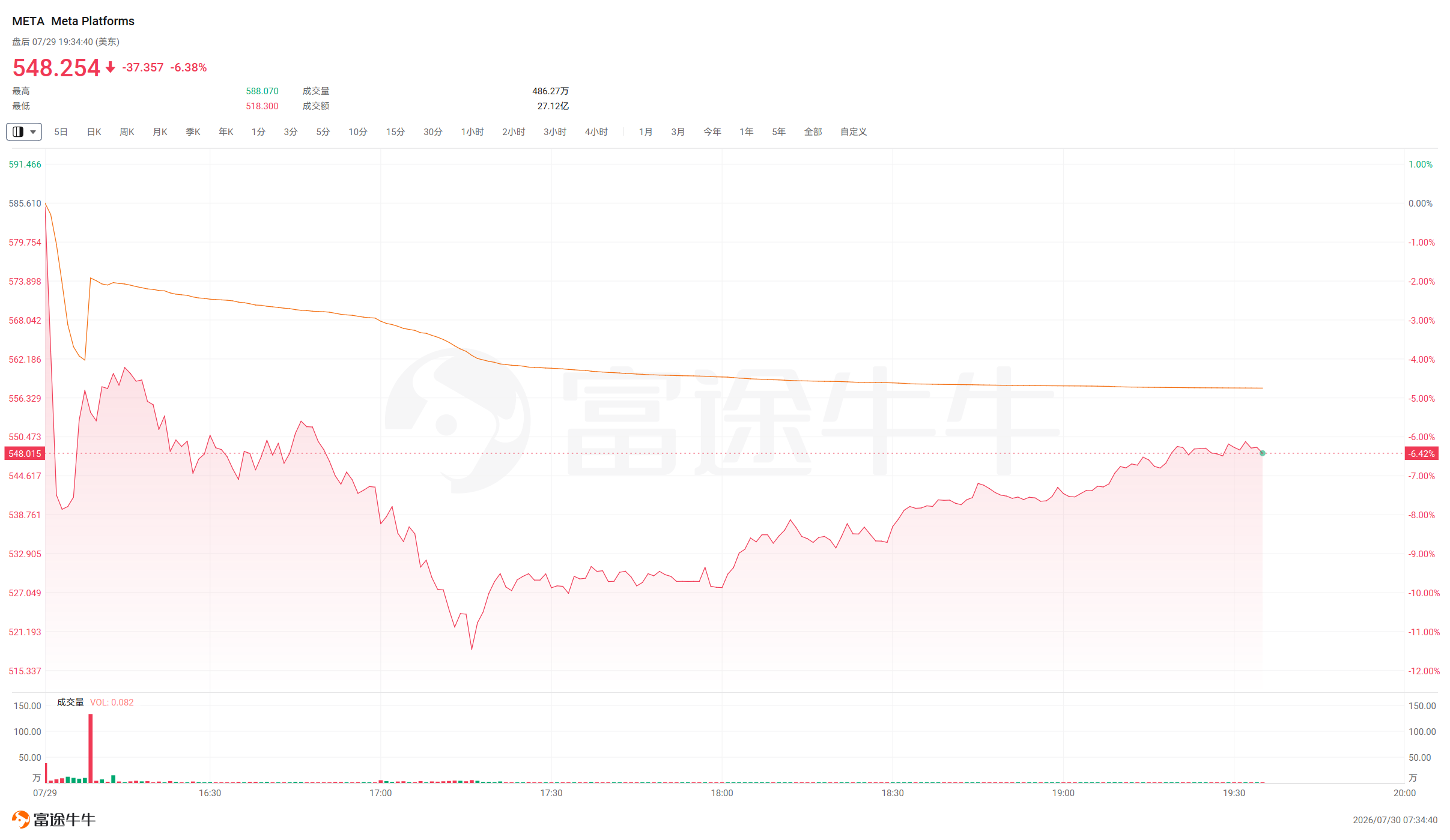
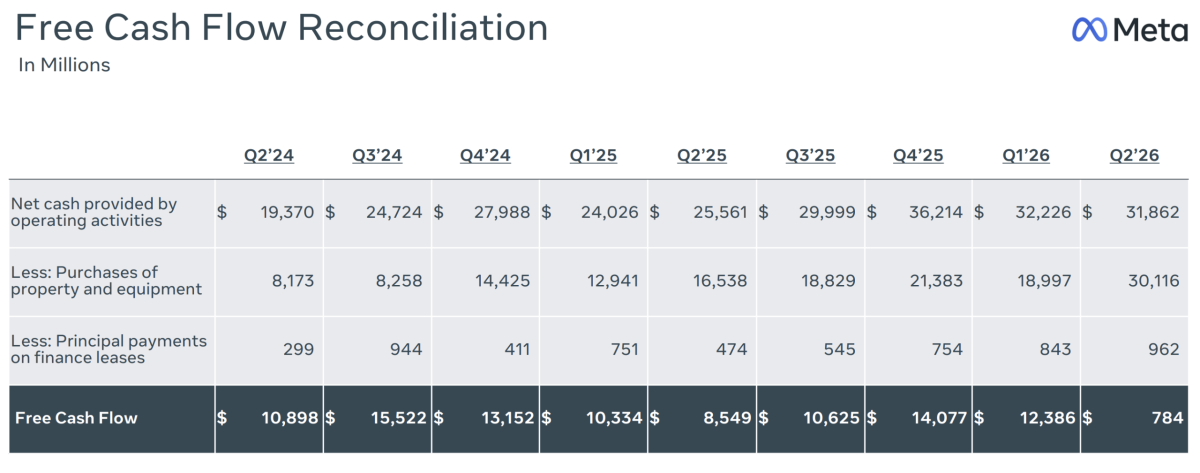
Meta reported second-quarter revenue of $60.8 billion, up 28%, slightly above the market expectation of $60.3 billion. Its third-quarter guidance midpoint of $62.5 billion fell short of the market consensus of $63.2 billion. The company also narrowed and raised the lower end of its full-year capital expenditure guidance range, revising it from $125 billion to $145 billion to $130 billion to $145 billion.Free cash flow$784 million, dropping to a near four-year low. Meta's after-hours share price一度 fell more than 10% on disappointing guidance and higher-than-expected AI-related capital expenditures.
Although revenue in the second quarter continued to grow at a near-30% pace, Meta has still failed to alleviate market concerns about the long payback period for its massive AI investments.
On July 29 local time, $Meta Platforms (META.US)$ released its second-quarter earnings for fiscal year 2026, reporting revenue of $60.8 billion, an increase of 28% year-over-year, slightly above the market expectation of $60.3 billion. However, the company’s revenue guidance for the third quarter was only in the range of $61 billion to $64 billion, with a midpoint of $62.5 billion, below analysts’ average expectation of $63.2 billion, disappointing the market.
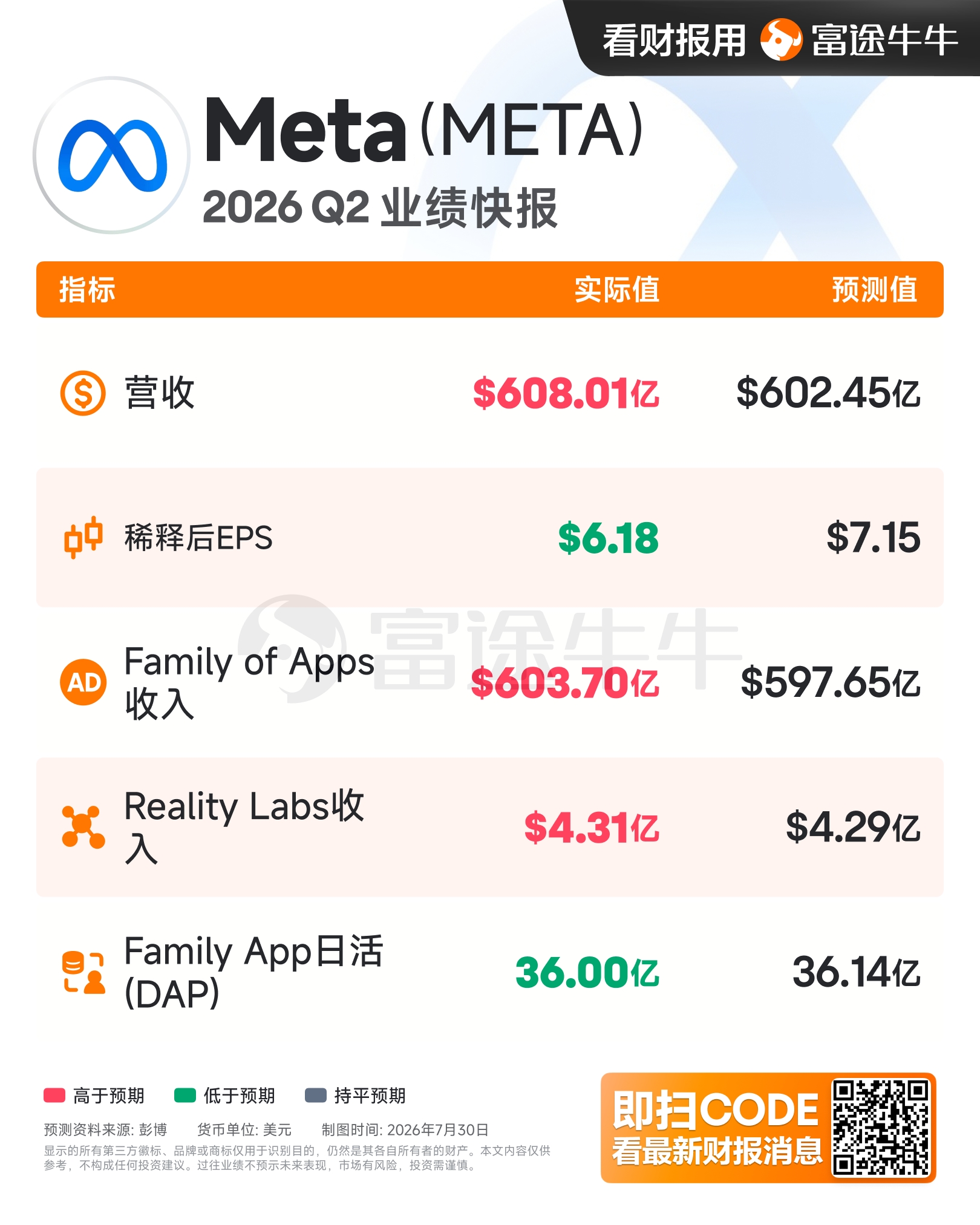
 Meanwhile, the company narrowed and raised the lower end of its full-year capital expenditure guidance range, revising it from the previous $125–145 billion to $130–145 billion, signaling that investment in AI infrastructure will remain elevated.
Following the weaker-than-expected earnings guidance and higher AI-related capital spending, Meta’s after-hours share price dropped by more than 10% at one point.
Revenue growth remains robust, but profits are being eroded by costs
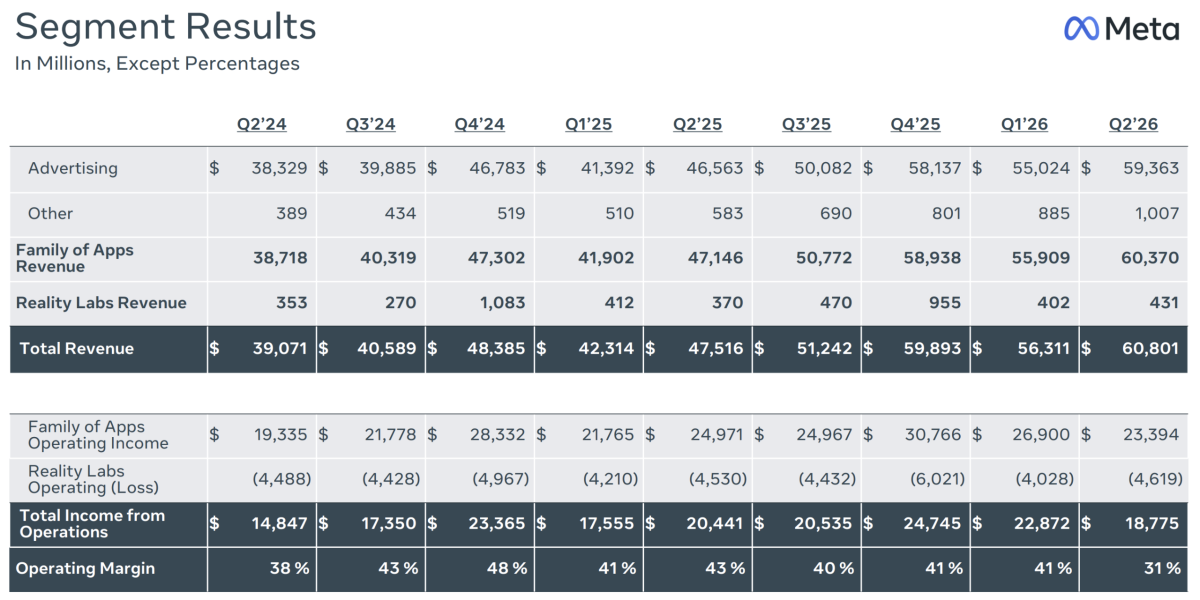
The earnings report showed that Meta’s Q2 revenue reached $60.801 billion, an increase of 28% year-over-year (or 27% on a constant-currency basis). Advertising remained the core driver of growth: ad impressions rose 14% year-over-year, and average ad prices increased by 12%, driving advertising revenue to $59.363 billion, up 27% year-over-year.
Mark Zuckerberg, Meta’s founder and CEO, stated:
“AI is accelerating our core business, powering next-generation products, and unlocking entirely new enterprise-level commercial opportunities—and we are already seeing tangible results.”
However, profit performance stood in stark contrast to revenue growth.
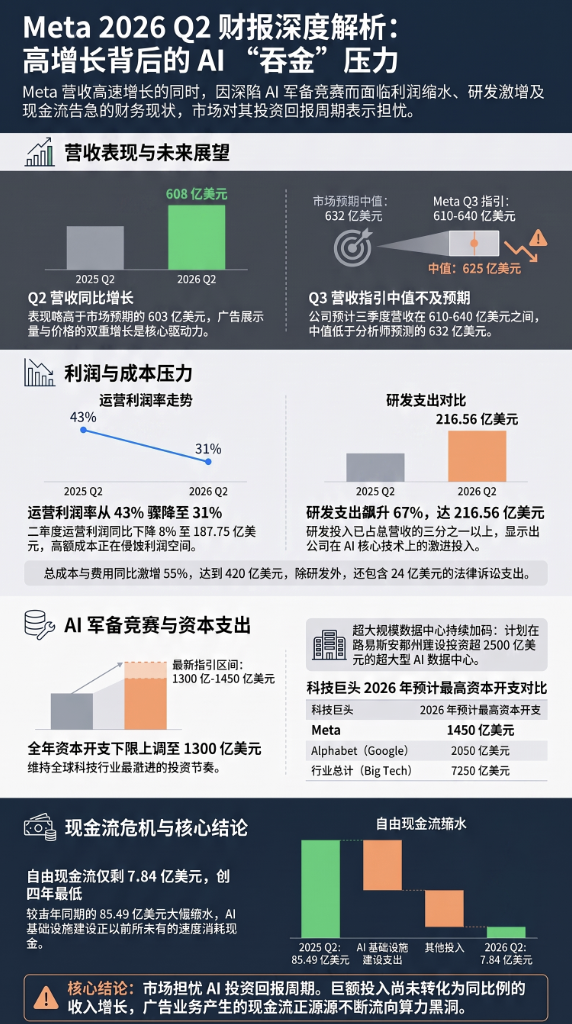
Meta’s operating profit in Q2 declined 8% year-over-year to $18.775 billion, with operating margin falling sharply from 43% a year earlier to 31%. Net income decreased 14% year-over-year to $15.848 billion, and earnings per share came in at $6.18, down 13% year-over-year.
Profitability pressure primarily stems from a significant increase in costs.
According to its financial report, Meta’s total costs and expenses in the second quarter reached $42 billion, surging 55% year-over-year, including $2.4 billion in legal settlement expenses and $1.18 billion in severance costs related to workforce reductions.
Research and development (R&D) expenditures continued to grow rapidly, reaching $21.656 billion in the quarter—a 67% year-over-year increase—accounting for more than one-third of total revenue.
Third-quarter revenue guidance fell short of expectations, as the pace of AI monetization continues to disappoint the market.
What truly triggered the stock price decline was the company’s forward-looking guidance.
Meta projected third-quarter revenue to be between $61 billion and $64 billion, with a midpoint of $62.5 billion—below the Bloomberg consensus analyst estimate of $63.2 billion. The company also expects foreign exchange headwinds to reduce revenue growth by approximately 1 percentage point.
This indicates that Meta’s massive AI investments have not yet translated into sufficiently rapid revenue growth.
Over the past year, Meta has been expanding its AI commercial initiatives, including launching a subscription-based consumer AI chatbot service and a paid large language model platform for developers, aiming to gradually establish new revenue streams. However, the vast majority of the company’s revenue still comes from advertising on platforms such as Facebook and Instagram, and its AI business remains some time away from achieving scalable profitability.
The market therefore continues to press a central question: When will Meta actually recoup its tens of billions of dollars in AI investments?
Minda Smiley, Senior Analyst at market research firm eMarketer, stated:
Meta's strong revenue growth was once again overshadowed by concerns over its capital expenditure outlook. Even though the company did not further raise its capital spending guidance, investors still seek greater clarity on its AI computing strategy and path to AI monetization.
AI-related capital expenditures remain at historically high levels, with an expected peak of up to $145 billion this year.
Capital expenditures remain the primary focus of the entire earnings report.
Meta revised its full-year 2026 capital expenditure guidance upward slightly to a range of $130 billion to $145 billion, compared to the previous range of $125 billion to $145 billion.
Although the company did not further increase its investment scale, this figure still indicates that Meta will continue to maintain one of the most aggressive data center investment paces in the global technology sector.
According to Bloomberg, Meta recently announced a partnership with BlackRock to build a $14 billion data center project in El Paso, Texas, and also plans to construct another hyperscale AI data center in Louisiana, with total investments expected to exceed $250 billion.
Meta is currently engaged in an AI infrastructure race against competitors such as Alphabet, OpenAI, and Anthropic, aiming to establish a leading foundation model and AI product ecosystem ahead of its rivals.
Free cash flow has fallen to its lowest level in nearly four years, as AI investments begin to significantly consume cash.
More than declining profits, it is cash flow that better reflects the financial pressure from AI investments.
The earnings report shows that Meta generated $31.862 billion in operating cash flow in the second quarter, but after accounting for capital expenditures of $31.08 billion, free cash flow amounted to just $784 million—down sharply from $8.549 billion in the same period last year, marking its lowest level in nearly four years.
This underscores the immense scale of Meta’s current AI investments—the company is building AI infrastructure at an unprecedented pace, with the majority of cash generated from its advertising business continuously flowing into data centers, computing capacity, and AI research and development.
Legal litigation costs continue to rise.
In addition to AI investments, Meta also faces escalating legal risks.
The company has narrowed its full-year expense guidance to between $165 billion and $169 billion, which includes $2.4 billion in legal litigation-related expenses recognized in the second quarter.
Meta stated that it continues to face multiple significant legal and regulatory matters, particularly lawsuits filed by several U.S. states concerning the protection of minors. Numerous related cases are still pending trial this year and could result in substantial losses in the future.
The AI arms race continues.
Meta is not the only tech giant bearing the pressure of AI investment.
Capital expenditures by major U.S. technology companies are projected to reach as high as $725 billion combined this year, with the vast majority allocated to building AI data centers. Just last week, Alphabet further raised its full-year capital expenditure outlook to $20.5 billion, similarly raising market concerns.
Investors’ criteria for evaluating big tech companies have shifted: rather than focusing on revenue growth, they now place greater emphasis on whether AI investments can ultimately translate into sustainable profitability.
For Meta, advertising revenue remains robustly strong. However, as capital expenditures remain historically elevated over the long term and free cash flow rapidly diminishes, the market needs to see not only continued advances in AI capabilities but also tangible contributions from AI to revenue and profits. Until this outcome becomes clear, Meta’s share price may continue to be tested by the AI investment payback cycle.
Editor/KOKO