CEO Satya Nadella stated that demand for Azure continues to outstrip available capacity, and this supply-demand imbalance shows no signs of easing in the near term. Capital expenditures have been reduced to approximately $175 billion due to adjustments in accounting policies. Microsoft is shifting its business model from a 'per-seat' pricing structure to a dual-track system combining 'per-seat plus usage-based' pricing and is introducing an agent architecture with replaceable models to help enterprises retain control over their AI autonomy.
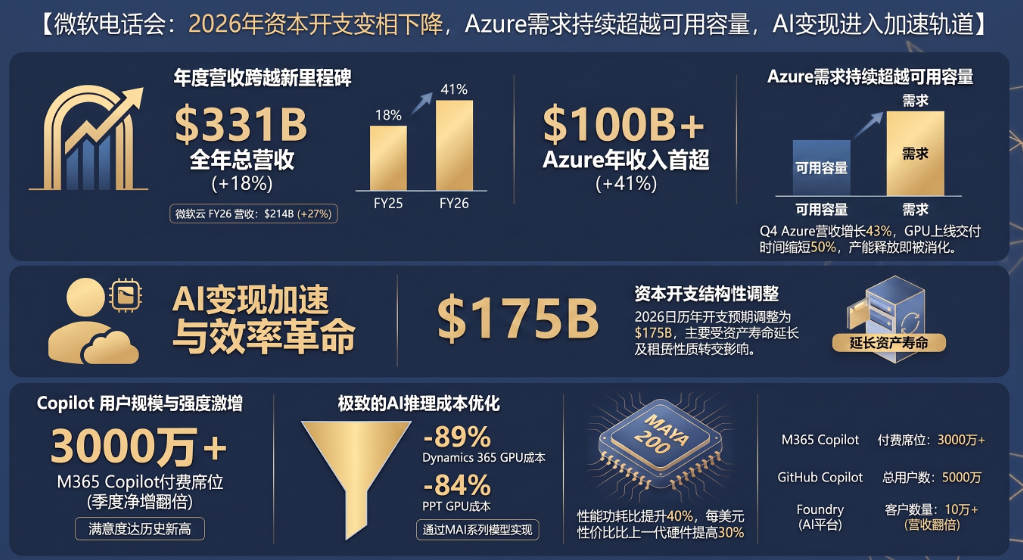
During Microsoft's fiscal year 2026 fourth-quarter earnings call, executives stated that AI demand remains a strong tailwind for the company, with Azure demand continuing to outstrip available capacity—a supply-demand imbalance not expected to ease in the near term. Capital expenditures were revised downward to approximately $175 billion due to changes in accounting policies.
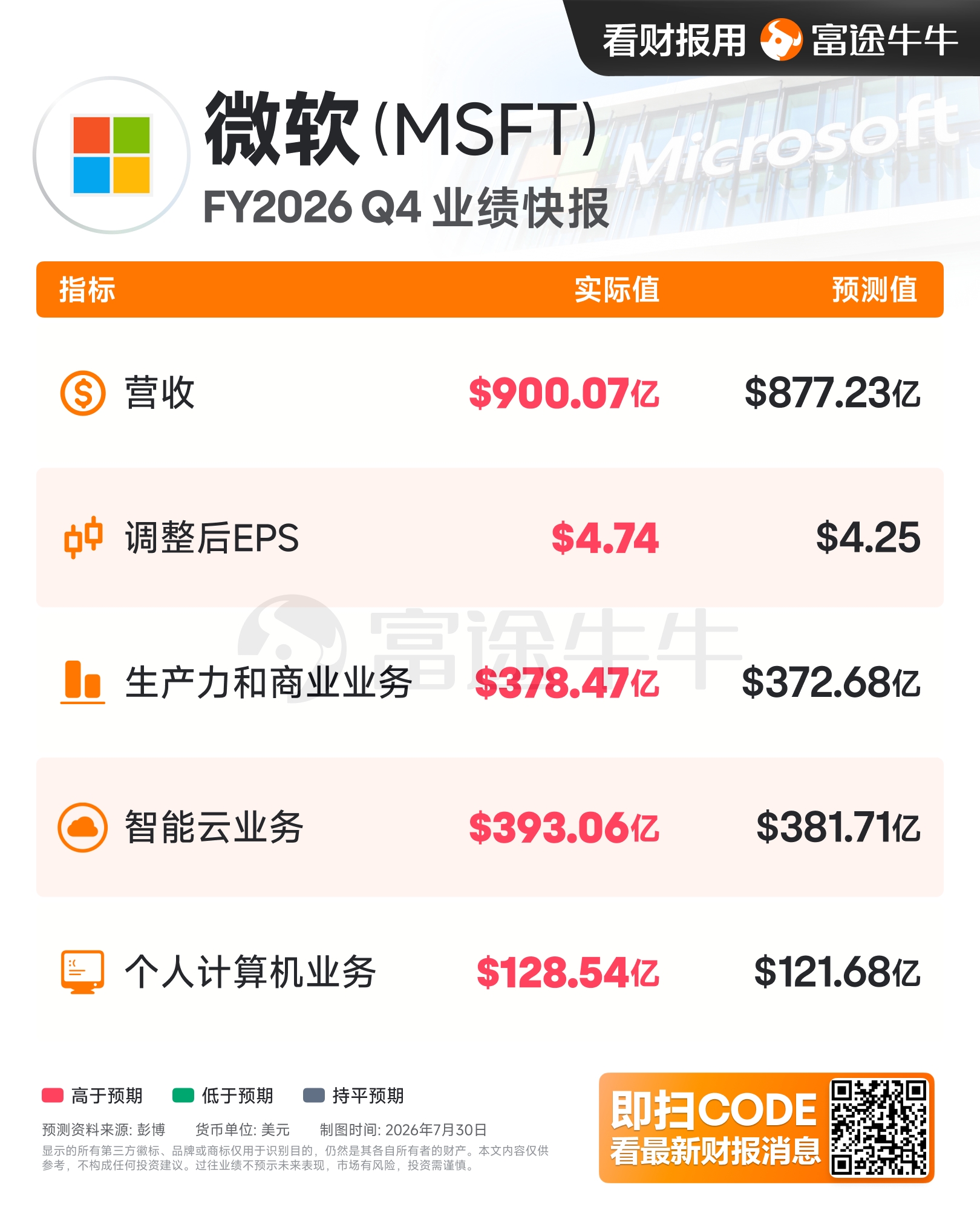
After U.S. market hours on the 29th (Eastern Time), Microsoft reported fiscal year 2026 fourth-quarter (Q4) results, with revenue rising 18% year-over-year to $90.01 billion, surpassing analyst expectations by 2.6%.
 Total revenue for the full fiscal year exceeded $331 billion, up 18% year-over-year. Microsoft Cloud revenue surpassed $214 billion, representing a 27% increase.
During the earnings call, Microsoft executives indicated that capital expenditures for the entire calendar year 2026 are still expected to be $190 billion as previously guided. However, due to a change in accounting methodology—specifically, an extension of the estimated useful lives of data centers and office buildings—the projected expenditure for this year has been adjusted downward to approximately $175 billion, roughly 8% below the original $190 billion estimate.
Azure’s growth rate accelerated further this quarter, rising from 40% to 43%, with guidance for approximately 45% growth next quarter—exceeding market expectations. CEO Satya Nadella noted that demand continues to exceed available capacity, and this supply-demand imbalance shows no signs of easing in the short term.
CFO Amy Hood emphasized that engineering teams have made significant progress in improving CPU and GPU efficiency, and newly released capacity was rapidly monetized within the quarter, serving as one of the key drivers behind the company’s better-than-expected performance.
AI Infrastructure Surges Amid De Facto Reduction in Capital Expenditures
The cloud business and AI infrastructure orders—key areas of investor focus—performed strongly in Q4. Revenue from Azure and other cloud services grew 43% year-over-year, exceeding expectations.
Microsoft CFO Amy Hood directly addressed the current supply-demand imbalance:
“The situation is clearly such that demand still exceeds our available supply. You can even see this reflected in spot-market asset pricing.”
To address this situation, Microsoft has significantly accelerated its infrastructure investments.
Microsoft CEO Satya Nadella revealed an astonishing pace of capacity expansion:
This quarter, we added 31 new data centers across five continents, bringing the total for the year to 88. We also added 1 gigawatt of computing capacity this quarter and remain on track to double our total computing capacity within just two years.
Regarding forward guidance, Amy Hood stated that despite the expanding base of capacity, Azure’s constant-currency revenue growth is expected to further accelerate to approximately 45% in the first quarter of fiscal year 2027.
Additionally, due to a change in the accounting policy for data center useful life (extended from 15 to 25 years), certain leases have been reclassified from finance leases to operating leases, and full-year capital expenditures for fiscal year 2027 are projected to be around $175 billion.
Protecting Core Enterprise IP, Model Choice, and the 'Agent Architecture'
In response to analysts’ concerns about enterprises’ use of open-source models and intellectual property protection, Satya Nadella offered market insights that also form the core logic behind Microsoft’s future AI architecture design.
Satya Nadella emphasized:
This will not be a model where you hand over all your knowledge and get nothing in return. Every enterprise will evaluate which providers are genuinely helping them create value and knowledge.
Based on this market understanding, Microsoft has introduced a foundational architecture that decouples models from contextual memory and orchestration tools, enabling any model to be swapped out at any time.
He stated that Copilot, GitHub Copilot, and Security Copilot have all been built according to this architecture, and Microsoft is working to extend this design pattern to all its enterprise customers. Nadella said:
You can use cutting-edge models, and you can also use multiple models simultaneously—or, when you prefer not to rely on any external model, train your own proprietary model using your accumulated outputs, tracking records, and contextual data.
He also cited the recent Hugging Face security incident as an example, emphasizing the systemic risks of relying on a single model: "You cannot be held hostage by a denial-of-service event affecting a single model." Satya Nadella stated:
When we talk about cutting-edge models, we often assume it’s a single entity. But true cutting-edge capability means that every company can have its own frontier—possessing the model choice, cost control, and business capabilities necessary to shape its own destiny.
Hood added from a financial perspective that, regardless of whether customers ultimately choose a third-party model provider or run their own models, the Azure platform serves as the underlying infrastructure, giving Microsoft significant exposure to growing demand. She stated:
This infrastructure is highly interchangeable.
Business Model Transformation: A Dual Approach of "Subscription + Usage"
Beyond infrastructure, the commercialization and revenue sustainability of AI applications represent another core concern for investors.
According to financial results, M365 Copilot now has over 30 million paid seats, with net new seats doubling quarter-over-quarter. GitHub Copilot, aimed at developers, has reached 50 million users, and its revenue grew more than 60% quarter-over-quarter, accelerating from the prior period.
More importantly, Microsoft is redefining the billing logic for its AI products, which will significantly expand its total addressable market.
Satya Nadella delivered a significant signal at the meeting:
We are evolving our business model from a purely 'per-seat' pricing structure to a hybrid 'per-seat plus consumption-based' model, which will further expand our total addressable market and deliver greater value to customers.
This means that as AI becomes increasingly embedded across all aspects of enterprise workflows, Microsoft's revenue will no longer be constrained solely by the number of employees in an organization, but will instead be directly tied to the actual consumption volume of large AI models by enterprises.
Customer service and business applications are already leading the way. Satya Nadella noted:
Customer service is at the forefront of this transformation, with usage-based credit consumption in this category growing fourfold quarter-over-quarter.
Supply-Demand Dynamics and Cost Pressures: Flexibility Management and Long-Term Confidence
Analyst Mark Moerdler raised dual concerns regarding potential oversupply in AI infrastructure and rising hardware costs. In response, Hood emphasized the inherent flexibility built into Microsoft’s capital expenditure structure.
Hood stated:
Our capital expenditures have shifted significantly toward short-duration assets—primarily CPUs and GPUs—allowing us to adjust procurement cadence relatively quickly if demand conditions change. Additionally, the timing of land acquisition and data center construction remains highly flexible.
She also highlighted that Microsoft’s highly diversified portfolio across geographies, customer segments, and industries, along with the ability of its first-party applications to absorb its own computing capacity, provides a critical buffer against demand volatility.
Regarding the impact of rising hardware prices on profit margins, Hood stated that cloud computing still offers significant cost advantages compared to customers building their own servers, and newly signed contracts already reflect the adjusted pricing. Hood said:
For both our customers and ourselves, we hope the pricing can remain effective over the long term.
Nadella added that the right product portfolio mix, a diversified customer base, and continuous efficiency improvements are the three key factors for navigating industry cycles. Nadella said:
There will be ups and downs, but the long-term structural shift is clear. We are very confident in our business mix, our margin structure, and—most importantly—the value we create for our customers.
Full Transcript of Microsoft’s Q4 Earnings Call (AI-Assisted Translation):
Operator:
Good day, everyone, and welcome to Microsoft’s fourth-quarter fiscal year 2026 earnings call. All participants are currently in listen-only mode. A question-and-answer session will follow the formal presentation. Please note that this call is being recorded. I am now pleased to introduce Jonathan Nelson, Vice President of Investor Relations at Microsoft. Please go ahead.Jonathan Nelson, Vice President of Investor Relations:
Good afternoon, everyone, and thank you for joining us today.Joining me on the call are: Chairman and Chief Executive Officer Satya Nadella; Chief Financial Officer Amy Hood; Chief Accounting Officer Alice Jolla; and Brian Duff, Deputy General Counsel and Corporate Secretary.
You can access our earnings press release and financial summary presentation materials on Microsoft’s Investor Relations website. These materials are intended to supplement our prepared remarks today and include reconciliations of differences between financial measures presented in accordance with Generally Accepted Accounting Principles (GAAP) and non-GAAP financial measures.
During today’s conference call, when providing commentary on our financial outlook, more detailed presentation materials will be posted on Microsoft’s Investor Relations website.
During this conference call, we will discuss certain non-GAAP items. The non-GAAP financial measures provided should not be viewed as substitutes for or superior to financial performance measures prepared in accordance with GAAP. These measures are presented as supplemental disclosures intended to provide investors with additional insight into the company's fourth-quarter results and the impact of specific items and events on financial performance.
Unless otherwise stated, all growth comparisons referenced during today’s call are relative to the same period in the prior year.
Where applicable, we will also provide growth rates on a constant currency basis to help assess the performance of our underlying business, excluding the effects of foreign exchange rate fluctuations. If constant currency growth rates are the same as reported growth rates, we will refer only to growth rates.
Prior to the release of the full transcript, we will post our prepared remarks to the website immediately following the conclusion of the call. Today’s conference call is being webcast live and recorded. If you ask a question, it will be included in the live webcast, the transcript, and any future use of the recording. You may replay the call and access the transcript on Microsoft’s Investor Relations website.
During this conference call, we will make forward-looking statements, including predictions, expectations, or other statements regarding future events. These statements are based on current expectations and assumptions and involve risks and uncertainties.
Actual results may differ materially from these forward-looking statements due to factors discussed in today’s earnings press release, comments made during the conference call, and the 'Risk Factors' section of our Form 10-K, Form 10-Q, and other reports and filings submitted to the U.S. Securities and Exchange Commission.
We undertake no obligation to update any forward-looking statements.
With that, I’ll turn the call over to Satya.
Satya Nadella, Chairman and Chief Executive Officer:
Thank you very much, Jonathan.We concluded the fiscal year with strong performance and set new records. Overall, our total revenue for the year exceeded $331 billion, an 18% increase year-over-year; Microsoft Cloud revenue surpassed $214 billion, up 27%; and Azure revenue exceeded $100 billion, growing by 41%.
Looking ahead, we have two objectives.
First, to ensure AI empowers every individual, amplifying their autonomy and aspirations.
Second, to empower every organization to establish its own continuous learning loop, ensuring they do not outsource their core intellectual property.
Next, I will outline how we are achieving this goal across our entire technology stack, beginning with our AI platform and infrastructure.
This quarter, we added 31 new data centers across five continents, bringing the total number of new data centers this year to 88, in response to accelerating demand. We are also bringing new capacity online at an unprecedented pace. In the past fiscal year, we reduced the time required to deploy and activate GPUs in large-scale regions by nearly 50%.
Overall, we added 1 gigawatt of capacity this quarter and remain on track to roughly double our total capacity within two years.
We are also extracting greater efficiency from our existing infrastructure through optimizations at the chip, system, and software levels. For example, since the beginning of the year, we have quadrupled the throughput of Copilot workloads.
AI sovereignty is increasingly becoming a priority for customers, and we are expanding our portfolio to meet this demand. Just last week, we announced a partnership with Mistral to bring its models into Microsoft Sovereign Cloud, enabling customers to run these models in public cloud, customer-controlled environments, and fully isolated environments.
We continue to advance the modernization of our infrastructure, adopting the latest products from NVIDIA and AMD while also driving innovation in our proprietary chips. Maya 200 is scaling continuously. Compared to the latest-generation hardware in our infrastructure, it delivers 30% higher performance per dollar and currently supports both OpenAI and MAI models.
In addition, we will be among the first cloud providers to deploy next-generation, large-scale AI infrastructure based on AMD Helios and NVIDIA Vera Rubin.
When running agents, CPUs are equally important as GPUs. Our Cobalt virtual machines are supporting our own first-party workloads as well as customer workloads from companies including Adobe, ARM, Elastic, OpenAI, Sprintler, and TomTub.
By the end of this month, we expect to have deployed Cobalt 200 racks in more than 25 data centers globally to rapidly expand capacity.
Next, I will discuss how we are building an end-to-end platform on top of this infrastructure to run, govern, and distribute applications and agents.
First is model selection. Every customer wants to choose the right model for each task based on quality, latency, cost, and compliance. We offer the broadest model catalog in the cloud, with over 11,000 models, including the latest from OpenAI, Anthropic, Mistral, xAI, and our own MAI series.
Since the beginning of the year, the number of customers developing with models from multiple providers has grown fivefold.
For example, Levi Strauss & Co. is using models from OpenAI and Anthropic on Foundry to integrate over 1,000 domain-specific agents into a unified enterprise AI platform.
We are also accelerating the development of our own models. We have released more than ten new models covering image, speech, transcription, programming, and security, including our first reasoning model, MAI Thinking One. All models are designed with cost-effective inference for enterprise use cases at their core.
We are co-designing these models with our proprietary chips. When running MAI models on Maya 200, we achieve a 40% improvement in performance per watt.
More importantly, we are building a new model system in which the orchestration layer, context, memory, and action space are all decoupled from any single model family, thereby pushing the frontier of the cost-outcome curve.
This is not only about cost—it also delivers additional benefits in business continuity and resilience, as each model is interchangeable.
This is precisely the system we use in our own products, and it has already delivered strong results.
For example, millions of developers are already using MAI Code 1 Flash in GitHub Copilot, achieving higher code acceptance rates and reducing median token usage by 10%, while still retaining access to cutting-edge capabilities from OpenAI and Anthropic.
In Excel, MAI Code 1 Flash delivers quality comparable to GPT-56 on the most common tasks, but at significantly lower operational costs.
In cybersecurity, when used in conjunction with our multi-agent security orchestration layer, MAI Cyber 1 Flash outperforms the much larger Mithos model—at half the cost.
More broadly, across our model deployments, we have observed substantial efficiency gains, including an 89% reduction in GPU costs in Dynamics 365 following the adoption of MAI Voice 2 Flash, and up to an 84% reduction in GPU costs in PowerPoint after implementing MAI Image 25.
This system is now available to all enterprises as part of Foundry.
The next layer is enterprise data and context.
Data assets are evolving from primarily supporting human-facing applications to powering intelligent agents. Customers are rapidly adopting AI-optimized databases—such as Cosmos DB and SQL—to provide agents with fast, secure, real-time access to data and context required for memory and retrieval.
PostgreSQL revenue grew by 55%, marking its third consecutive quarter of accelerating growth. Meanwhile, the number of customers using both PostgreSQL and Foundry increased by 80%, as clients increasingly adopt PostgreSQL as their database of choice for AI workloads.
We are further advancing this strategy with Horizon DB, our new fully managed PostgreSQL service on Azure, which delivers three times the throughput of self-hosted deployments.
In analytics, we now serve over 40,000 paying Fabric customers, an increase of more than 60% year-over-year. Over 17,000 customers currently use both Foundry and Fabric, up 60% year-over-year. Enterprises are connecting agents to real-time operational data, analytics, and unstructured data within Fabric.
This quarter, we also launched Rayfin, an SDK designed for agent-first development that provides backend-as-a-service capabilities for applications built in Fabric. Over 2,500 customers are already using Rayfin, which is currently powering backends for applications developed with version 2.
On top of this data asset, we are building the IQ layer, which combines data with model capabilities to deliver the right context at the right time.
Tens of thousands of customers, including nearly 90% of Fortune 500 companies, are leveraging enterprise context through Foundry, Fabric, and Work IQ to underpin their agents.
This quarter, we also introduced Web, enabling agents to access real-world intelligence from across the internet. Today, the most popular AI assistants, including ChatGPT, are already utilizing this capability.
Beyond model selection, data, and context, we have architected Foundry as a complete application and agent technology stack.
It enables agents to access the IQ layer, required tools, persistent state and memory, secure sandboxes, scoring criteria and evaluation mechanisms, and even their own self-improvement feedback loops.
We now have 100,000 Foundry customers, with revenue more than doubling year-over-year.
For example, Telefónica has adopted Foundry as the foundation of its enterprise platform. Its first agents focus on mission-critical network operations. Overall, the number of Foundry customers achieving an annualized token run rate of 1 trillion tokens has quadrupled year-over-year.
Finally, with Agent 365, we provide a control plane that extends enterprises’ existing governance, identity, security, and management frameworks to the agents they build.
Just two months after launch, Agent 365 has registered nearly 40 million agents across tens of thousands of companies.
Next, I will introduce the applications and agents we are building on this platform for individuals and organizations.
In knowledge work, we now have over 30 million paid Microsoft 365 Copilot seats, with net new seats more than doubling quarter-over-quarter.
Copilot is rapidly evolving from a chat tool into a collaboration tool and further into autonomous agents.
Last month, we fully launched Co-work, helping customers complete multi-step tasks based on their work data while adhering to enterprise security and compliance requirements.
This quarter, we also introduced Autopilots—fully compliant, long-running autonomous agents, including always-on personal agents powered by OpenClob.
This quarter, we are bringing these Copilot experiences together, including integrating coding capabilities into a super-app that spans both consumer and commercial user experiences. This is an important step, and I look forward to sharing more details soon.
More broadly, we have been steadily enhancing Copilot’s quality and performance, and we are highly encouraged by recent customer feedback.
Over the past three quarters, user satisfaction scores have doubled and are now at an all-time high; in this quarter alone, we reduced latency by 25%.
These quality improvements, combined with ongoing product innovation, are driving record levels of usage intensity.
The number of conversations per user has nearly doubled year-over-year; average weekly engagement has now reached levels comparable to Outlook and Teams.
Moreover, the time it takes for customers to progress from deployment to achieving what we define as high usage—approximately 80% of their user base becoming monthly active—has shortened from several months to just a few days over the past year.
The number of customers with more than 50,000 seats has grown more than sevenfold year-over-year; the number of enterprise customers deploying Copilot to the majority of their knowledge workers has increased nearly 75% quarter-over-quarter, indicating that Copilot has become a core component of their operations.
For example, NHS England is rolling out Copilot to 505,000 clinicians and staff. This is one of the largest healthcare deployments of its kind to date, following pilot results that showed Copilot saves employees an average of 43 minutes per day.
KPMG is expanding its deployment to over 276,000 professionals globally; HSBC has committed to purchasing 200,000 seats to accelerate its workforce transformation.
AstraZeneca, Boeing, Infosys, Coca-Cola, Procter & Gamble, Stellantis, Tata Consultancy Services, UPMC, and Wells Fargo & Co have each purchased 60,000 or more seats.
We are also encouraged by the market response to the newly launched E7 suite. Customers are increasingly adopting our integrated AI offering, which combines Copilot, E5, Entra, and Agent 365.
Within just two months of its launch, hundreds of enterprise customers have purchased millions of seats for the E7 suite. This quarter, EY deployed E7 to 400,000 employees—the largest single order we have received to date.
In addition, we are evolving our business model from a purely per-seat pricing structure to a hybrid model that combines per-seat and usage-based pricing, further expanding our total addressable market and delivering greater value to customers.
Earlier this month, we introduced usage-based billing for Co-work, and thousands of customers are already paying for and actively using it.
In the business applications space, we are reimagining Dynamics 365 for an agent-first world.
We are exposing over 650,000 MCP operations across sales, finance, supply chain, human resources, and customer service, enabling agents to access business context and take action using the same data models, rules, permissions, security guardrails, and audit trails as all application users.
We are also transitioning from a single per-seat model to a 'seat plus usage' model.
Customer service is at the forefront of this transformation. Usage-based credit consumption in this category has grown fourfold month-over-month, with customers such as Northern Trust leveraging our tools to drive proactive intelligence.
In the developer space, GitHub Copilot now has 50 million users.
This quarter, we launched usage-based billing. Since the new model took effect, we have continued to see growth in commercial and enterprise seats, as well as significant consumption revenue. Copilot revenue increased by more than 60% quarter-over-quarter.
The GitHub platform now has 225 million users globally. Organizations across industries—including more than 90% of Fortune 500 companies—have chosen GitHub for AI-powered software development.
The era of agents is being built on GitHub. Every major programming agent operates on the platform, and currently, one in every three pull requests on GitHub involves an agent.
In the security domain, we are helping customers protect their AI deployments while using AI to strengthen their security posture.
To date, Purview has audited more than 50 billion Copilot interactions to meet compliance obligations, representing a nearly 360% year-over-year increase.
Earlier this week, we launched Project Perception, a comprehensive multimodal agent-based security system that combines multiple groups of agents to simulate attacks, investigate threats, and drive remediation.
As Perception transitions from private preview to broader availability, we expect to offer this capability to customers through a consumption-based pricing model.
In healthcare, we anticipate automating over 100 million patient visits in the current calendar year, with 28 million completed this quarter—a doubling compared to the same period last year.
Mass General Brigham has deployed Dragon Copilot to more than 4,000 healthcare providers. A prior study found that ambient AI can reduce burnout by 21%.
In scientific research, Microsoft Discovery—now generally available—provides a comprehensive platform for building and governing agent-based workflows tailored to science and engineering. Early adopters include BHP Group Ltd, GlaxoSmithKline, and Pacific Northwest National Laboratory.
Whether through our high-value experiences or our AI platform and infrastructure, our focus remains on helping customers translate AI into measurable outcomes.
The world’s most comprehensive and valuable data resides within each customer tenant. This presents a significant opportunity to transform customers’ workflows, domain expertise, and accumulated judgment into AI systems that continuously learn and improve with every use.
To help customers seize this opportunity, we launched Microsoft Frontier Co this month—the industry’s largest outcome-driven engineering organization.
We will embed 6,000 industry and engineering specialists with our clients to co-design, co-innovate, and continuously drive large-scale improvements to AI systems.
Over the past year, we have been piloting this model, completing more than 330 projects for 164 clients, including numerous global leaders across various industries.
For example, our FDE team collaborated with Novo-Nordisk A/S to build an agent that helps analyze clinical data while meeting its stringent compliance requirements.
We also partnered with London Stock Exchange Group (LSEG) to embed AI into LSEG Workspace, enabling financial professionals to ask complex questions and quickly find answers across both structured and unstructured financial content.
Finally, I will discuss our Devices and Consumer business.
Regarding our Xbox business, we are making necessary decisions across content portfolio, platform, and operations to reposition the business for long-term growth.
We possess the industry’s strongest intellectual property assets and a globally distributed network of outstanding studios. We believe we can integrate these strengths and expect to return the business to growth in fiscal year 2027.
On Windows, we are investing to ensure it delivers best-in-class quality and foundational capabilities, while also positioning it as the premier platform for running secure edge AI.
We see a significant opportunity for Windows to become the offload platform for boundless intelligence—combining powerful on-device computing with enterprise-grade security.
In search and advertising, both Bing and Edge have grown their market share for five consecutive years. LinkedIn continues to deliver strong engagement across its platform, with membership growing at a double-digit rate for the fifth consecutive year.
Recruiters from over 20,000 companies are using our AI-powered solutions to shorten hiring cycles and improve candidate matching. Seat count increased by 140% quarter-over-quarter.
Finally, I am energized by the opportunities ahead.
I have never been more confident in Microsoft’s opportunity to drive sustainable, long-term growth and ensure the benefits of AI are broadly shared.
Next, I’ll turn the call over to Amy to review our financial results and outlook.
Amy Hood, Chief Financial Officer:
Thank you, Satya. Good afternoon, everyone.This fiscal year, we generated over $331 billion in revenue, with growth accelerating to 18%, driven by strong demand for the Azure platform and first-party AI applications and services.
Operating income grew faster than revenue, increasing by 21% to over $155 billion. We continue to expand operating leverage while investing consistently in long-term growth.
For the quarter, revenue was $90 billion, up 18% year-over-year and 17% on a constant currency basis.
Gross profit increased by 15%, and operating income grew by 18%.
Earnings per share were $4.74, up 23% year-over-year, after adjusting for the impact of the investment in OpenAI.
Foreign exchange impacts were broadly in line with our guidance.
Compared to the forward-looking guidance provided during the April earnings call, several one-time items impacted this quarter’s financial results, increasing diluted earnings per share by $0.27.
These items include a $3.2 billion gain from the investment in Anthropic and lower-than-expected costs related to the voluntary retirement program, partially offset by Xbox-related severance and impairment charges.
After adjusting for these items, we exceeded expectations on revenue, operating income, and earnings per share, driven by strong demand and effective execution during the quarter.
Gross margin was 67%, down year-over-year, primarily due to a shift in sales mix toward Azure and ongoing investments in AI infrastructure and increased product usage; however, continued efficiency gains in Azure and Microsoft 365 Commercial Cloud partially offset these effects.
Operating expenses increased by 10%, primarily driven by continued investments in R&D computing capacity, talent, and data to support product development across the portfolio.
General and administrative expenses were affected by a lower prior-year base and the aforementioned one-time items.
Operating margin increased slightly year-over-year to 45%.
Total company headcount declined by 2% year-over-year.
Other income and expenses amounted to $2.8 billion, primarily driven by gains from our investment in Anthropic, after adjusting for the impact of our investment in OpenAI.
Capital expenditures totaled $41 billion, including the impact of higher component prices referenced in our guidance.
Approximately two-thirds of capital expenditures were allocated to short-lived assets, primarily CPUs and GPUs. Customers are increasingly building solutions that leverage both AI and non-AI infrastructure.
The remaining expenditures were directed toward long-lived assets.
This quarter, total finance lease obligations amounted to $5.6 billion, primarily related to large data center facilities; cash payments for property, plant, and equipment totaled $35.8 billion.
Cash flow from operations was $55.4 billion, an increase of 30% year-over-year, primarily driven by strong cloud billing and collections, partially offset by higher operating lease payments.
Free cash flow was $19.6 billion, reflecting higher capital expenditures.
Finally, we returned $10.2 billion to shareholders through dividends and share repurchases, bringing total cash returned to shareholders this fiscal year to over $43 billion.
Next, we present results for our commercial business.
Excluding the impact of OpenAI, commercial bookings grew by 18%, driven by strong execution of our core annuity sales model and reflecting broad-based demand across regions and customer segments.
Including OpenAI’s Azure commitment, bookings increased by 10%, or 11% on a constant currency basis.
Commercial remaining performance obligations (RPO) grew by 84% to $678 billion.
All sequential growth in commercial RPO this quarter came from customers outside of frontier model companies. Excluding OpenAI, RPO increased by 25%.
Including OpenAI, the weighted average duration of RPO is 2.3 years, with approximately 30% expected to be recognized as revenue within the next 12 months, representing a 37% year-over-year increase.
The portion of RPO to be recognized as revenue beyond the next 12 months grew by 112%.
Microsoft Cloud revenue was $59.3 billion, up 27% year-over-year, reflecting strong demand for Azure and first-party AI applications and services.
Annual cloud revenue exceeded $214 billion, with nearly 90% coming from customers outside of frontier model companies.
Microsoft Cloud gross margin came in better than expected at 65%, down year-over-year primarily due to a shift in sales mix toward Azure, continued investment in AI infrastructure, and higher product usage; however, ongoing efficiency gains partially offset these effects.
Below is an overview of segment performance.
Revenue from the Productivity and Business Processes segment was $37.8 billion, up 14% year-over-year.
For Microsoft 365 Commercial Cloud, revenue increased by 16% after normalizing for a comparable basis that adjusts for a two-percentage-point increase in current-period revenue recognition compared to the same period last year; on a reported basis, revenue growth was 14%.
Building on Copilot momentum from the third quarter, net new paid seats more than doubled sequentially, bringing total paid seats to over 30 million.
Premium offerings, including Copilot, E5, and early market adoption of E7, drove average revenue per user (ARPU) growth this quarter.
Microsoft 365 Commercial paid seats grew 6% year-over-year, with customer base expansion across all segments, primarily driven by products for small and medium-sized businesses and frontline workers.
Microsoft 365 Commercial product revenue grew 19%, exceeding expectations, primarily driven by large, long-term Microsoft 365 contracts. These contracts increased current-period revenue recognition for Windows Commercial on-premises components.
Consumer Cloud revenue grew 24%, or 22% on a constant currency basis, also driven by higher average revenue per user; consumer subscriptions increased by 7%.
LinkedIn revenue grew 12%, or 10% on a constant currency basis, primarily driven by Marketing Solutions.
Dynamics 365 revenue grew 13%, or 12% on a constant currency basis, against a high comparative base from the same period last year.
ERP bookings growth remained healthy, while CRM growth continued to moderate due to extended sales cycles.
Segment gross profit grew 14%, or 13% on a constant currency basis. Gross margin declined slightly due to increased usage of Microsoft 365 Copilot; we continue to invest in product quality and drive further efficiency improvements.
Operating expenses increased by 11%, primarily driven by the aforementioned shared R&D investments.
Operating profit rose by 15%, or 14% on a constant currency basis; operating margin improved year-over-year to 58%.
Next, we present the Intelligent Cloud segment.
Revenue was $39.3 billion, an increase of 32% year-over-year, or 31% on a constant currency basis.
Azure and other cloud services revenue grew by 43%, with growth accelerating compared to the same period last year.
Customer demand continues to outpace available capacity.
Revenue growth exceeded expectations, primarily due to improved efficiency of our CPU and GPU fleets and process enhancements that enabled earlier delivery of new capacity.
New capacity added to Azure this quarter was rapidly monetized.
GitHub Copilot consumer revenue was stronger than expected following the business model change in June, which also positively impacted results. The change was designed to align pricing with usage and value delivered.
On-premises server business revenue was essentially flat year-over-year, declining by 1% on a constant currency basis.
Performance exceeded expectations, primarily due to the structure of renewed contracts resulting in higher revenue recognition in the current period.
Gross profit for the segment increased by 24%, while gross margin declined year-over-year, mainly due to a shift in sales mix toward Azure and our continued scaling of AI infrastructure ahead of demand growth; however, ongoing efficiency improvements in Azure partially offset this impact.
The segment’s gross margin was also affected by increased usage of GitHub Copilot, although margins improved during the quarter following the transition in June to a usage-based pricing model.
Operating expenses increased by 10%, primarily driven by the aforementioned shared R&D investments.
Operating income grew by 31%. Despite strong emphasis on efficiency and return on investment, operating margin remained largely flat year-over-year at 41%.
We now provide further details on the More Personal Computing segment.
Revenue was $12.9 billion, down 4% year-over-year and down 5% on a constant currency basis.
Windows OEM and devices revenue declined by 7%, with Windows OEM revenue down 5%, primarily due to lower PC market demand and a high prior-year comparable base driven by the end-of-support for Windows 10.
Performance exceeded expectations as OEMs and channel partners continued to build inventory in anticipation of rising component costs.
Search advertising revenue (excluding traffic acquisition costs) increased by 10%, or 9% on a constant currency basis, driven by higher revenue per search from Edge and Bing, as well as growth in search volume.
Growth was impacted by third-party partnerships.
Xbox revenue declined by 10%, or 11% on a constant currency basis.
Xbox content and services revenue decreased by 10%, compared to a high prior-year base driven by strong first-party content performance.
Segment gross profit declined by 2%, while gross margin increased year-over-year, primarily driven by lower amortization expenses following the acquisition of Activision Blizzard.
Operating expenses increased by 8%, or 7% on a constant currency basis, primarily due to ongoing shared R&D investments and Xbox impairment charges mentioned above.
Operating income declined by 14%, or 15% on a constant currency basis; operating margin decreased year-over-year to 21%.
Before discussing our outlook, I would like to note that starting in fiscal year 2027, we will extend the estimated useful lives of our data centers and office buildings from 15 years to 25 years, reflecting our operational history and our judgment regarding the expected utilization of these assets.
The impact of this update has been incorporated into today’s guidance.
This change affects only the timing of future depreciation recognition and is expected to have a minimal positive impact on operating income in fiscal year 2027.
The more significant impact relates to capital expenditures. As a result of this update, a greater portion of future data center leases will be classified as operating leases rather than finance leases.
Finance leases are included in capital expenditures, whereas operating leases are not.
Aside from the impact of changes in useful lives, our expectations for capital expenditure investments in the 2026 calendar year remain unchanged.
However, due to the reclassification of finance leases to operating leases, we have adjusted our capital expenditure outlook to approximately $175 billion.
We now present the business outlook.
We begin with some full-year commentary for fiscal year 2027.
First, we remind you that for Microsoft 365 Commercial and Server products—key performance indicators—we will face a higher transactional purchasing base due to product launch timing, and we expect revenue for both segments to decline by a mid-single-digit percentage over the full fiscal year.
Growth in Windows OEM and Devices will be impacted by declining PC market demand. Rising component costs have increased device pricing, compared to the prior-year period, which benefited from Windows 10 support services and higher inventory levels.
As a result, we expect revenue from this segment to decline by a high-single-digit percentage in the current fiscal year.
Turning to foreign exchange.
Assuming current exchange rates remain stable, we currently expect foreign exchange to reduce full-year revenue growth by less than 1 percentage point, with no material impact on cost of goods sold or operating expense growth.
At the company level, driven by strong momentum in our commercial business, we continue to expect double-digit growth in both revenue and operating income for the next fiscal year.
Operating expenses are expected to increase in the high single digits, reflecting continued investments in R&D computing capacity, talent, and data.
Given demand signals across our entire product portfolio, we anticipate capital expenditures for fiscal year 2027 to increase year-over-year.
Despite ongoing investments to meet growth demands, full-year operating margin is expected to decline by less than 1 percentage point.
Additionally, we expect to maintain positive free cash flow in fiscal year 2027.
Finally, we expect our effective tax rate for fiscal year 2027 to be approximately 20%.
Next, we provide guidance for the first fiscal quarter. Unless otherwise specified, all figures below are denominated in U.S. dollars.
Based on current exchange rates, we expect foreign exchange to reduce total revenue growth by less than 1 percentage point and to have no material impact on cost of goods sold or operating expense growth.
Across business segments, foreign exchange is expected to reduce revenue growth in the Productivity and Business Processes segment by approximately 1 percentage point, reduce revenue growth in the Intelligent Cloud segment by less than 1 percentage point, and have no material impact on the More Personal Computing segment.
We begin with the commercial business.
Excluding the impact from OpenAI, we expect healthy growth in commercial bookings, driven primarily by strong execution of our core annuity sales model, building on an expanding base of expiring contracts.
As a reminder, the significant OpenAI contract signed last year will result in some quarter-over-quarter volatility in bookings and RPO growth rates.
Microsoft Cloud gross margin is expected to remain broadly stable on a sequential basis.
Below is segment-level guidance.
For the Productivity and Business Processes segment, we expect revenue of $36.7 billion to $37.0 billion, representing year-over-year growth of 11% to 12%.
For Microsoft 365 Commercial Cloud, on a constant currency basis and adjusted for a one-percentage-point favorable impact from accelerated revenue recognition in the prior-year period, we expect revenue growth of approximately 16%; on a reported basis, we expect growth of 15%.
Sequential growth driven by momentum in Copilot, E5, and E7 will be partially offset by new seats with lower average revenue per user in frontline worker and small and medium-sized business SKUs.
As premium SKUs continue to gain market traction and monetization opportunities expand with the addition of usage-based offerings on a per-seat licensing basis starting in July, we expect acceleration in commercial cloud revenue growth over the course of the fiscal year.
Commercial product revenue is expected to grow at a mid-single-digit rate, primarily driven by the timing of long-term contract signings, partially offset by the aforementioned prior-year comparable impact.
Microsoft 365 Consumer Cloud revenue is expected to grow at a mid-teens rate, moderating sequentially as we face the favorable impact from last year’s price increase.
Growth will continue to be driven by increases in average revenue per user and subscriber growth.
For LinkedIn, we expect high single-digit revenue growth.
For Dynamics 365, we expect low double-digit revenue growth, broadly stable quarter-over-quarter, primarily driven by continued ERP growth, though impacted by the aforementioned booking trends.
In the Intelligent Cloud segment, we expect revenue of $40.95 billion to $41.25 billion, representing a 33% to 34% year-over-year increase.
For Azure, we expect revenue growth of approximately 45% on a constant currency basis. As customer demand continues to outpace supply, we will remain focused on improving efficiency to narrow the gap between supply and demand.
Despite strong fourth-quarter performance, we still expect growth to accelerate in the first half of the year.
Please note that Azure’s year-over-year growth rate may fluctuate from quarter to quarter due to the timing of capacity rollouts and contract structures.
In our on-premises server business, we expect revenue to decline in the low-to-mid single digits, primarily due to ongoing customer migration to cloud offerings and the aforementioned tough prior-year comparable.
In the More Personal Computing segment, we expect revenue of $12.2 billion to $12.7 billion. We will continue to face a strong prior-year comparable and navigate complex PC market dynamics influenced by component pricing and inventory levels.
Windows OEM and devices revenue is expected to decline in the low 20% range, primarily driven by the aforementioned market dynamics.
As in the prior quarter, the range of potential outcomes remains wider than normal.
Search advertising revenue (excluding traffic acquisition costs) is expected to grow at a mid-single-digit rate, slowing sequentially due to the impact from third-party partnerships.
Growth will continue to be driven by steady trends in revenue per search and search volume.
Xbox content and services revenue is expected to decline at a mid-single-digit rate.
Hardware revenue is expected to decline year-over-year.
As a result, at the company level, we expect revenue of $89.85 billion to $90.95 billion, representing year-over-year growth of 16% to 17%. Accelerated growth in commercial businesses will be partially offset by the aforementioned PC market dynamics.
We expect cost of goods sold to be $29.6 billion to $29.8 billion, an increase of 23% to 24% year-over-year.
Operating expenses are expected to be $16.8 billion to $16.9 billion, up 7% to 8% year-over-year, primarily driven by continued investments in computing capabilities and talent.
Operating margin is expected to be roughly flat year-over-year.
Excluding any impact from the investment in OpenAI, other income and expenses are expected to be approximately negative $100 million. Interest income will be fully offset by interest expense, which includes interest payments related to data center finance leases.
We expect our effective tax rate for the first fiscal quarter to be approximately 20%.
Next, let’s discuss capital expenditures.
We expect capital expenditures to exceed $50 billion, which includes the impact from lease reclassifications due to the useful life extensions of data centers and office buildings.
Finally, in fiscal year 2026, we accelerated both revenue and operating profit growth while expanding our operating margin.
Our sales and product engineering execution continued to strengthen in the second half of the year.
As we enter fiscal year 2027, we will remain focused on delivering products that generate meaningful return on investment for our customers, thereby driving sustainable long-term growth for Microsoft and its shareholders.
We’ll now move to the Q&A session, Jonathan.
Q&A Session
Jonathan Nelson, Vice President of Investor Relations:
Thank you, Amy.We’ll now open the floor for questions. Out of respect for other participants, please limit yourself to one question each.
Operator, please repeat the question instructions.
Operator:
The first question comes from Karl Keirstead of UBS Group. Please go ahead.
Karl Keirstead, Analyst:
Okay, thank you very much, Satya.I’d like to set aside the numbers for a moment and ask you to elaborate further on your opening remarks regarding model selection and enterprise intellectual property protection.
My question has two parts.
First, given that many enterprises may initially be reluctant to adopt open models, how significant do you expect the momentum toward adoption of open versus customized models to be over the next one to two years?
Second, considering Microsoft also has considerable exposure to cutting-edge lab operations, how do you stand to benefit from this shift?
Thank you very much.
Satya Nadella, Chairman and Chief Executive Officer:
Thank you, Karl.Our thinking is that, ultimately, the goal is to enable enterprises to control their own destiny—what I refer to as building their own human capital and token capital.
At its core, if a company is a learning machine, it needs to own its own learning machine.
That is the true objective.
A model is merely an input factor, not a form of extraction of the enterprise’s knowledge. In a sense, ultimately every company will evaluate which providers genuinely help them achieve outcomes and generate knowledge.
I believe this is already quite clear today and will become increasingly evident.
This will not follow the pattern of 'you come in, take all my knowledge, benefit from it, and leave me with nothing.'
Therefore, given this trajectory, our platform architecture is very clear: the orchestration layer must be decoupled from the model itself.
When the orchestration layer ensures that your memory, context, and everything else are externalized, it means any given model can be replaced at any point in time.
You should also be able to use cutting-edge models—there is no reason not to do so.
But you can also use multiple frontier models.
If you look at some of the data I just shared, it clearly illustrates how to leverage frontier models for their capabilities and lower-cost models for their value proposition.
In fact, when you prefer not to rely on any external models, you can train your own model, as you have access to all outputs, all execution trajectories, and all contextual information.
This is precisely the enterprise design architecture we are promoting.
We ourselves are already using this architecture. Copilot was built this way, GitHub Copilot was built this way, and Security Copilot was also built this way.
We aim to democratize this design pattern so that every enterprise can adopt it.
Within this framework, both open-weight and closed-weight models will coexist.
By the way, one point we’ve previously discussed bears repeating: even from the Hugging Face incident, the key takeaway should be that you cannot depend on any single model.
You may need multiple models—even to remediate issues caused by a single model.
This is the right mindset: you should not be constrained by a single model’s refusal to respond.
There is a larger design space here.
We often think of frontier capabilities as a single entity, but what 'frontier' truly means is that every company possesses its own frontier capabilities—equipping it with the ability to make choices, manage costs, and control its own destiny.
Amy Hood, Chief Financial Officer:
Carl, I’d like to add one more point regarding the latter part of your question.This is precisely why building a platform is so critical. As Satya mentioned in his remarks, the platform should be able to deliver the right model for the right task on the Azure architecture.
Therefore, regardless of which model or model family customers choose—or whether they run their own models—we continue to see growing demand. The Azure platform is highly efficient in delivering these capabilities.
Thus, this type of infrastructure should be viewed as a highly substitutable and reusable resource.
Karl Keirstead, Analyst:
Very helpful, thank you.Jonathan Nelson, Vice President of Investor Relations:
Thank you, Karl.Operator, please move to the next question.
Operator:
The next question comes from Brent Thill of Jefferies. Please go ahead.Brent Thill, Analyst:
Thank you, Amy.Azure growth has accelerated to 43% and is guided toward the mid-40s, which is impressive performance.
I’d like to ask what you and Satya see as the underlying drivers—what exactly is fueling this growth?
There’s also a lot of discussion in the market about capacity constraints. Are we still operating in the same supply-demand environment, or is Microsoft executing better within the constraints we all face?
Thank you.
Amy Hood, Chief Financial Officer:
Thank you, Brent.First, constraints still exist within the system.
We have consistently stated over multiple consecutive quarters that demand continues to exceed available supply, and this remains true today.
You can even see this reflected in some pricing within the spot market for assets.
When discussing how to achieve better delivery, our primary focus is on efficiency—extracting more output from all existing resources in our current fleet.
This applies equally to improving the efficiency of both the CPU fleet and the GPU fleet.
This quarter, our engineering team made particularly strong progress in unlocking as much additional capacity as possible.
Given the supply-demand imbalance we have consistently discussed, any efficiency gains we achieve can be rapidly monetized within the same quarter.
I believe this dynamic indeed had a positive impact on the current quarter.
I would also note that over the past 90 days, we have improved several processes to significantly shorten the time it takes for CPUs and GPUs to move from delivery to integration, activation, and operational use.
Similarly, when we are able to achieve these improvements, they can be quickly monetized.
Given our operational scale, which spans our entire hyperscale fleet, efficiency improvements that can be rapidly commercialized will drive accelerated quarterly growth.
This is also one of the factors we expect to continue seeing and discussing in the first fiscal quarter.
Jonathan Nelson, Vice President of Investor Relations:
Thank you, Brent.Operator, please go to the next question.
Operator:
The next question comes from Mark Moerdler of Bernstein Research. Please go ahead.Mark Moerdler, Analyst:
Thank you very much for taking my question, and congratulations on your solid and outstanding quarterly results.Amy, market sentiment around AI remains extremely volatile.
The market is concerned both about potential future supply oversupply and about rising component prices impacting margins.
I have two related questions.
If there is indeed overbuilding and excess capacity in areas such as data centers and chips, how does Microsoft protect itself?
Conversely, given the rising prices we are seeing for hardware and components, how do you manage this to avoid having to significantly raise product prices or negatively impact profit margins?
Thank you.
Amy Hood, Chief Financial Officer:
Thank you, Mark.These two questions are somewhat connected, so I’ll start with the first one.
Currently, the supply-demand situation clearly shows demand exceeding available supply, and this imbalance is quite extreme.
However, when considering a longer time horizon, I’d like to remind everyone that many costs—particularly those within capital expenditures—have clearly shifted toward what I would call shorter-lived assets, primarily CPUs and GPUs, which have relatively short lead times.
Therefore, if the demand environment changes, you can simply slow down spending in this area, which actually represents the largest component and the primary driver of cost of goods sold.
Investments in land and data center construction are, in fact, highly flexible. They represent a smaller share of the overall cost structure.
The timing of most of these projects can be adjusted, particularly the construction projects themselves; alternatively, you could stagger the deployment schedules for GPU and CPU installations.
Therefore, when it comes to managing such situations, hyperscale cloud providers have long practiced maintaining flexibility and the necessary understanding to navigate shifting demand.
Another important factor, Mark, is that you have an exceptionally diversified portfolio across geographies, customer segments, and industries.
Even looking at our backlog or the new additions to this quarter’s RPO, the sources span Microsoft’s broad product and customer portfolios.
Thus, when we can defer the deployment of certain higher-cost components in the short term, benefit from a large and flexible portfolio, and leverage substantial first-party application workloads—beyond just the Azure platform—to utilize the capacity we build, we gain greater agility in responding to these changes.
Regarding pricing, I believe it affects everyone in broadly similar ways across many dimensions.
What we are currently focused on is ensuring we maximize efficiency to continue delivering exceptional value to our customers.
We also remind customers that, frankly, cloud services still offer significant advantages compared to customers purchasing servers on-premises themselves, as price increases in on-premises server procurement would be far more difficult for them to absorb.
Therefore, under these circumstances, cloud services can still deliver a high return on investment.
As you mentioned, we are increasing capacity.
However, a significant portion of this was clearly also sold through new contracts, and we were able to reflect the relevant circumstances in our pricing to ensure that value is sustained for both customers and ourselves over the long term.
Satya Nadella, Chairman and Chief Executive Officer:
If I may add to Amy’s comments, I think she has summarized it very well.We are all reading the book '1873.'
In my view, the first priority must be getting the product form right—that is where we are investing substantial effort.
Second, we must get the product portfolio right.
Amy discussed our work on Copilot, super apps, integration across various product forms, and agent-first foundational capabilities extending all the way to Azure.
The entire product portfolio must truly work together in synergy.
Customer structure is also critically important.
We must recognize the breadth of geographic structure, customer segmentation structure, and workload structure, and incorporate all these factors when building capacity.
Then, it is also essential to operate an efficient railway.
Ultimately, we must continuously improve efficiency. Amy just mentioned how we enhanced efficiency in the most recent quarter.
Efficiency is not a result that suddenly appears one day; it requires continuous and sustained effort.
Therefore, we are highly focused on all these aspects.
We also recognize that there will be ups and downs throughout the cycle.
However, the long-term structural shift is clear. We are very optimistic about Microsoft’s ability to participate in this transformation with the right business mix, the right profit structure, and—most importantly—the right value creation for customers.
Mark Molder, Analyst:
Very good, thank you very much.Jonathan Nelson, Vice President of Investor Relations:
Thank you, Mark.Operator, please move to the next question.
Operator:
The next question comes from Adam Wood of Morgan Stanley. Please go ahead.Participant: Good evening, everyone.
Thank you for taking my question, and congratulations on closing the fiscal year with a very strong performance.
I’d like to ask about Microsoft 365 Copilot.
Clearly, performance this quarter was very strong, with paid seats exceeding 30 million and growth accelerating significantly.
Could you elaborate on how customers are transitioning from pilots to broader deployments?
Is this still primarily pilot-driven at this stage, or are we beginning to see more large-scale deployments?
Additionally, as we consider product monetization—including new seat additions, migrations to higher-value SKUs such as E7, and consumption-based billing—what do you see as the primary monetization driver or source going forward?
Thank you.
Satya Nadella, Chairman and Chief Executive Officer: Thank you, Adam, for the question.
I’ll answer first, and then Amy can add补充.
I believe we should start with the product form.
As you can see, even within this quarter alone, the product form has undergone quite significant changes.
We now have chat, Co-work, Autopilot, and code capabilities, all converging into what will become a flagship super-app designed for different user roles.
If we look at usage patterns, there are also many interesting data points.
The time between purchasing a license and starting to use the product has been drastically reduced—from several months in the past to just a few days now.
The intensity of usage itself has also increased significantly.
Our usage intensity has already reached levels comparable to everyday communication tools like Outlook or Teams.
The second point is enterprise-wide integration.
It is no longer an isolated tool sitting somewhere on its own—it has already been integrated into the enterprise ecosystem.
For example, you mentioned E7.
It integrates governance capabilities through Agent 365, thereby incorporating security operations and financial operations, and is also connected to all business processes.
For instance, both CRM and ERP systems are merely skills and plugins that can be integrated into Co-work.
Therefore, you can connect enterprise-wide workflows into the super app, which will further drive usage—these factors all reinforce one another.
Another point concerns the business model.
We currently have a per-seat pricing model as well as a usage-based pricing model.
Thus, this is a 'seat plus usage' model.
We have already observed an increase in average revenue per user driven by products such as E7.
But what truly matters is that as we deliver greater value to our customers and achieve more enterprise-level outcomes, if I look back historically, Office had a far narrower scope compared to Copilot.
This is the first time we truly have an enterprise-wide tool supported by a dual pricing model based on both seats and usage.
Therefore, the potential market size is even broader.
We will remain highly focused on driving customer value and scaling our business as that value grows.
Amy Hood, Chief Financial Officer: Adam, I touched on some of this in my prepared remarks.
I believe that part of the year-over-year growth in average revenue per user we’ve seen stems from E5 plus Copilot licenses.
Satya just mentioned this point.
E7 will also drive further growth, offering particularly compelling value within the Agent 365 suite.
Satya referenced security operations and financial operations. More broadly, every organization will need observability into—and the ability to manage—token expenditures across all business processes.
This is precisely the capability that E7 delivers.
The product was available for only part of the quarter, but we are very encouraged by the value customers are already seeing in this SKU.
I believe we will continue to focus on this throughout the year.
Finally, Satya discussed how the total addressable market will continue to expand throughout the year.
When I consider this expanding spend-based total addressable market, what truly matters is usage and consumption revenue growth.
As more experiences are integrated and IT becomes more deeply involved in the process, understanding of Microsoft 365’s capabilities will undergo significant change.
This will be very interesting for you, Adam.
I believe one of your colleagues published a document on return on invested capital.
So, I handed that PDF file to Copilot and said, 'Please build me a new Power BI dashboard.'
The key point is that it built a rich semantic model and connected to my Fabric and OneLake, ingesting data from all external sources into it.
In fact, it even included the latest U.S. Securities and Exchange Commission filings from all of the 'Magnificent Seven' companies.
On this basis, the code repository itself resides on GitHub, while the final output is stored on my site.
For me, this is a classic example of an enterprise-grade workflow.
As a knowledge worker, I can create a dashboard.
Data engineers can go into Fabric to find this asset.
Professional developers can go to the code repository and find it on GitHub.
Moreover, all of this has already been registered in Agent 365.
This is precisely the new way of working described by Amy: establishing a novel collaboration model while ensuring IT security and manageability.
Participants:
Very helpful, thank you.Jonathan Nielsen, Vice President of Investor Relations:
Thank you, Adam.Operator, please move to the next question.
Operator:
The next question comes from Brad Zelnick of Deutsche Bank. Please go ahead.Participant:
Thank you very much for taking my question.Satya, we understand that cybersecurity is central to all of Microsoft’s businesses.
With the recent release of the latest frontier models, the competitive landscape has shifted. This week, you launched Project Perception.
Could you elaborate on what this moment specifically means for Microsoft’s cybersecurity business, and what it signifies for the broader market’s trust in Microsoft?
Thank you.
Satya Nadella, Chairman and Chief Executive Officer: Thank you for your question.
I think you’re absolutely right. There has been a very significant shift—not only in the capabilities required for cybersecurity products themselves, but also in how cybersecurity operations are conducted.
Because ultimately, enterprises must transform not only their products but also their own operational practices to protect themselves.
Therefore, our focus begins by applying the same approach we’ve taken in knowledge work and programming—starting with an intelligence-first, model-first methodology.
The capability introduced through Perception essentially states: we need to ensure we have red team agents continuously conducting red teaming exercises and identifying vulnerabilities.
Then, we need blue team agents continuously performing threat triage and response; and green team agents responsible for remediation.
Thus, you can build a continuously operating agent system that delivers the cybersecurity defense capabilities you require.
It will clearly leverage all available signals—whether from Defender, Entra identity, network telemetry, or application security. Together, these signals provide contextual awareness essential to building effective defensive capabilities.
I would also note that in the field of cybersecurity, a multi-model approach has become particularly critical, which also relates to the first point.
This is not merely driven by cost considerations.
In fact, data from MDASH in Cybergym demonstrates that with MAI Cyber 1 Flash, we can achieve the same level of performance at 50% lower cost.
The reason is that 90% of tasks are handled by the Cyber Flash One model, while the remaining 10% are still delegated to cutting-edge models.
Therefore, in environments that are inherently pipeline-driven, matching the right model to the right task is an extremely important characteristic.
For us, this is a critically important point.
Moreover, from a resilience perspective, if for any reason a particular model becomes unavailable, you cannot afford to be left unable to continue operations.
You still need to be able to sustain cybersecurity operations.
Therefore, both cost and resilience are critical criteria.
This is precisely the capability we are building—whether in programming, cybersecurity, or knowledge work.
We are very excited about Perception and what it means for the future of our security business.
Jonathan Nelson, Vice President of Investor Relations:
Thank you, Brad.Operator, we have time for one final question.
Operator: The final question comes from Gabriela Borges of Goldman Sachs. Please go ahead.
Gabriela Borges of Goldman Sachs: Good afternoon, everyone. Thank you.
Amy, I’d like to ask about return on invested capital.
You’ve already provided commentary on capital expenditures as well as on monetization.
Could you please tie these two aspects together?
As you evaluate and track the return on invested capital from current capital expenditure decisions, how does the situation compare with a year ago?
Additionally, what levers could still be deployed going forward? For example, could in-house chips become a driver for further monetization?
Thank you.
Amy Hood, Chief Financial Officer: Thank you, Gabriela.
Frankly, my methodology hasn’t changed over the past year.
I think a more appropriate way to frame it is that we have greater confidence in the expansion of the total addressable market and greater confidence in leveraging margin drivers stemming from product enhancements and infrastructure improvements.
We’ve already discussed some of these levers on today’s call, including how we continue to drive efficiency across both the application-layer and infrastructure-layer technology stacks.
But you’re right—we haven’t covered everything yet.
I believe Satya has actually already addressed many of these points.
We clearly still have opportunities to continue pursuing the best chip price-performance ratio, including investments in first-party chips.
Efforts around model diversification also present an opportunity to improve margins.
Delivering optimal results in a more efficient manner—whether through higher token utilization efficiency or a more efficient cost structure—serves as a margin lever.
These factors collectively enhance our confidence in the return on invested capital generated by our current and future ongoing investments.
When considering our product portfolio structure, knowledge work, programming, security, and what I refer to as the Agent 365 layer, together constitute a broad opportunity pool.
This might sound a bit opportunistic, but it is indeed the case.
Certainly, on the Azure side, we also benefit from model efficiency, chip and component efficiency—including investments in first-party solutions—and the overall infrastructure efficiency of operating at hyperscale.
Therefore, we have considerable levers available to continuously drive improvement, and this is where we are focusing our efforts.
But as I mentioned, this is an ongoing process of refinement.
Strive to improve a little bit every day, and then a little bit more.
And we excel at this kind of continuous refinement, ensuring that we deliver these values for our clients.
Jonathan Nelson, Vice President of Investor Relations: Thank you, Gabriela.
This concludes the Q&A session of today’s earnings call.
Thank you all for joining us today, and we look forward to speaking with you again soon.
Satya Nadella, Chairman and Chief Executive Officer: Thank you very much.
Amy Hood, Chief Financial Officer: Thank you.
Operator: Ladies and gentlemen, this concludes today’s conference. You may now disconnect your lines. Have a pleasant rest of your day.
Editor/rice