
① Samsung's Q2 earnings report showed that robust AI-driven demand continued to fuel growth in its memory chip business, driving significant year-over-year increases in both revenue and profit, with operating profit surging 1,814% to reach a new all-time high; ② Samsung Electronics has now recorded record-high quarterly revenue and operating profit for three consecutive quarters; ③ The semiconductor division posted operating profit of KRW 89.2 trillion for the quarter, an increase of over 250-fold compared to the same period last year.
On Thursday morning, South Korean memory chip giant Samsung Electronics released its second-quarter financial results. The report showed that robust demand for artificial intelligence (AI) continued to drive growth in its memory chip business, leading to a significant year-over-year increase in both revenue and profit for Q2, with operating profit surging by 1,814%—reaching a new all-time high.
Below is a comparison of Samsung Electronics' second-quarter results against LSEG SmartEstimates consensus forecasts:
Revenue: KRW 171.5 trillion, up 130% year-over-year and 28% quarter-over-quarter (market expectation: KRW 172.65 trillion)
Operating profit: KRW 89.5 trillion, up 1,814% year-over-year and 56% quarter-over-quarter (market expectation: KRW 88.13 trillion)
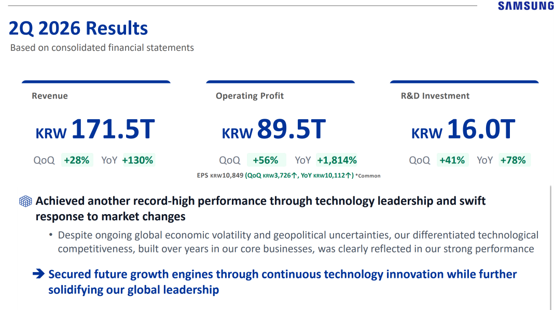
This marks the third consecutive quarter in which both Samsung Electronics’ revenue and operating profit have reached record highs for any single quarter in the company’s history. Both figures are consistent with the preliminary earnings guidance the company issued earlier this month.
In addition, Samsung Electronics reported a 1,299.9% year-over-year surge in net profit for Q2, amounting to KRW 71.6245 trillion.
Virtually all profits came from semiconductors
Nearly all of Samsung Electronics’ profit in the second quarter stemmed from its semiconductor business. The semiconductor division recorded operating profit of KRW 89.2 trillion for the quarter, representing a more than 250-fold increase compared to the same period last year. However, sharply rising chip prices negatively impacted Samsung’s mobile business division, which reported a quarterly loss for the first time.
Specifically, the Device Solutions (DS) division, responsible for Samsung’s semiconductor operations, reported sales of KRW 127.5 trillion and operating profit of KRW 89.2 trillion, both setting new historical records.
The Device Experience (DX) division, responsible for the company's finished devices business, reported quarterly sales of KRW 48 trillion and an operating loss of KRW 800 billion.
Additionally, Harman, Samsung Electronics’ subsidiary handling automotive electronics, recorded sales of KRW 4.6 trillion and operating profit of KRW 400 billion; Samsung Display reported sales of KRW 7.5 trillion and operating profit of KRW 700 billion.
Storage demand growth is expected to accelerate.
Samsung Electronics expects strong demand for AI chips this year, with supply remaining persistently tight.
The company forecasts robust server-centric demand in the second half of 2026, driven by continued capital expenditure on AI infrastructure and widespread adoption of agent-based AI. Concurrently, demand growth for server DRAM, enterprise solid-state drives (eSSDs), and high-bandwidth memory (HBM) is expected to accelerate.
The company stated that although demand from the mobile and PC markets is expected to moderate, the overall market is still projected to remain in a supply-deficit condition.
Last week, Samsung Electronics unveiled its latest product lineup, including new foldable smartphones, and announced an expanded strategic collaboration with Broadcom in memory and foundry technologies.
Significant stock price volatility
Following Samsung's strong earnings report, its share price experienced significant volatility: it initially rose by 4% early Thursday but later erased all gains and turned negative, before reversing course again to move into positive territory. As of the time of reporting, the stock was up 7.67% at KRW 224,500.
In recent weeks, global semiconductor stocks have faced sustained selling pressure as investor concerns deepen over how much return will be generated from massive AI-related capital expenditures. Samsung Electronics’ share price has declined more than 40% from its record high reached in June.
The previous day, SK Hynix, Samsung Electronics' domestic rival in South Korea, also reported record second-quarter profits, but fell short of analysts' exceptionally high expectations, causing its share price to plunge by nearly 10%.
Editor/rice