
① Since early July, as U.S.-Iran tensions escalated, Brent crude oil prices surged by as much as 20%, while the S&P 500 Index remained largely flat with limited volatility, indicating that markets have not fully priced in the tail risks potentially arising from the conflict;
② Macro research firm MRB Partners has reminded investors of two critical red lines to monitor amid Middle East tensions: whether U.S. ground forces directly engage in combat and whether the Bab el-Mandeb Strait becomes blocked.
Research institutions recently advised investors to closely monitor two 'red lines' regarding the Middle East situation to determine when to reduce equity portfolio risk—specifically, by cutting equity positions and lowering risk exposure.
 Industry analysts noted that since U.S.-Iran tensions intensified in early July, Brent crude oil prices have risen by as much as 20%, yet the S&P 500 index has remained relatively flat with limited volatility, suggesting that most investors have not yet fully priced in the tail risks of further conflict escalation, and equity markets have not adequately responded to potential worst-case scenarios.
In a recent report, global macro research firm MRB Partners stated that investors should pay close attention to several red lines in the conflict to identify the right moment to reduce equity holdings, adding that two of these red lines are 'drawing increasingly closer to becoming reality.'
The report stated:
“The conflict in the Middle East is far from over and could still disrupt risk asset markets and the global economy. Although the most likely scenario remains a de-escalation before any red line is fully crossed, the probability of an extreme negative outcome has increased. Furthermore, episodic flare-ups may persist over the coming period.”
First red line: Direct involvement of U.S. ground troops in combat
MRB pointed out that the United States has struggled to prevent Iran from disrupting shipping through the Strait of Hormuz and cannot rule out the possibility of deploying troops to secure strategic locations within and around the strait. Such a move would very likely escalate the conflict further. The report stated:
“U.S. forces stationed in the region would become targets for Iranian retaliation, easily resulting in significant casualties and entangling the U.S. in a protracted military quagmire.”
To date, the United States has primarily relied on long-range strikes and naval deployments. However, the White House has recently sent mixed signals: on one hand, it has paused airstrikes on Iran to allow space for diplomatic efforts; on the other, it has publicly stated that if diplomacy fails, it would not rule out resuming robust military action.
The U.S. and Iran had previously paused their mutual attacks briefly. However, tensions have escalated again over the past two days, with reciprocal strikes continuing.
According to the latest media reports, U.S. Central Command stated that U.S. forces launched strikes against Iran beginning at 8 p.m. Eastern Time on July 29 (8 a.m. Beijing Time on July 30), describing the operation as 'a strong response to Iran’s attempted attack yesterday on U.S. military bases in the Middle East.'
Industry analysts note that for markets, the key observation point remains unchanged: should U.S. forces land and seize critical chokepoints such as straits, it would signal a shift from long-range confrontation to ground-level entanglement, further escalating the conflict. This would rapidly intensify stagflation expectations, weigh heavily on overall equity valuations, and likely trigger a systemic risk-off mode in markets.
Second red line: Closure of the Bab el-Mandeb Strait
The Bab el-Mandeb Strait lies on the opposite side of the Arabian Peninsula, connecting the Red Sea with the Gulf of Aden, and serves as a critically important shipping lane.
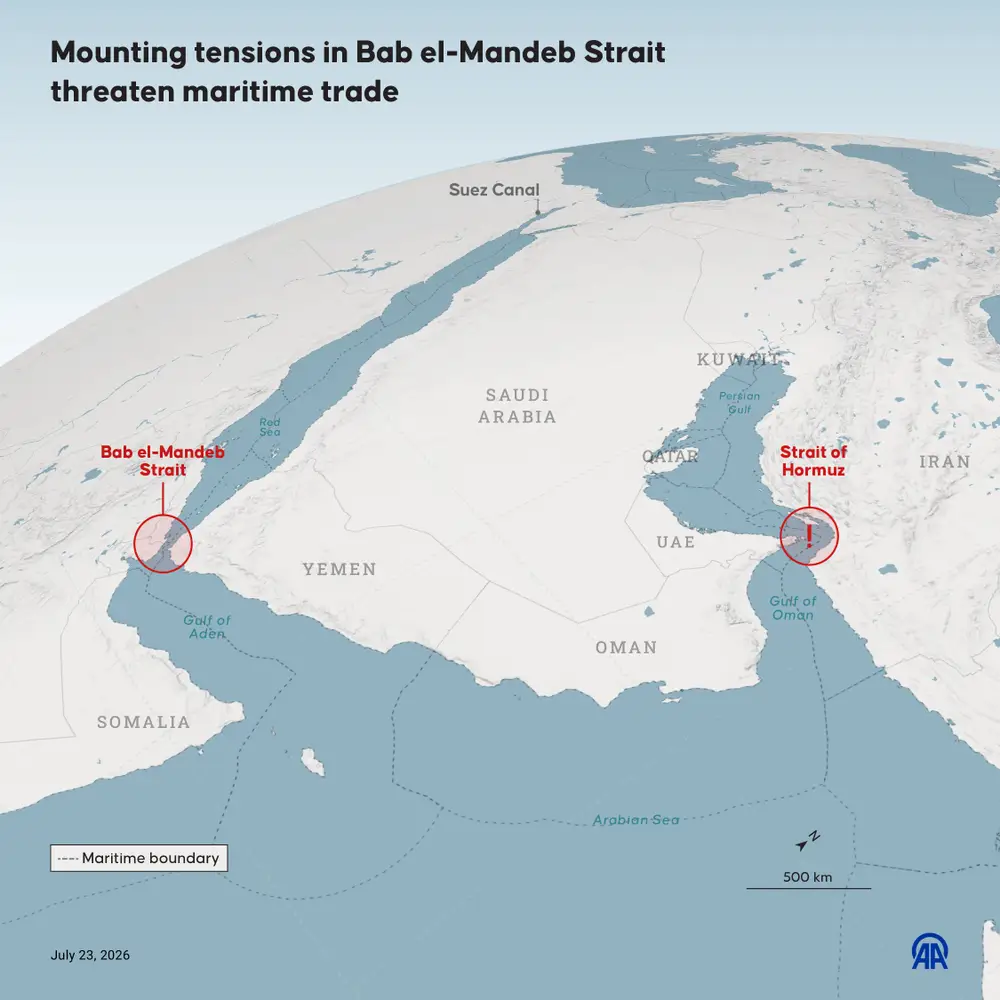
Note: Bab el-Mandeb Strait on the left, Strait of Hormuz on the right
Following the U.S.-Iran standoff, many exporters have treated the 'Red Sea–Bab el-Mandeb' route as an alternative corridor if the Strait of Hormuz becomes obstructed. However, this route runs close to Yemen’s coast, which is controlled by Houthi forces.
MRB warned in its report that Houthi attacks on passing tankers represent a major risk for escalation. Recent developments over the past week have confirmed this threat: Houthi forces have persistently targeted Saudi oil tankers and petroleum facilities along the Red Sea coast, while also enforcing a maritime blockade. Some tankers have been forced to reroute or remain stationary, causing traffic through the Bab el-Mandeb Strait to decline.
The waterway has not yet been fully closed, but sustained and frequent vessel attacks are pushing the blockade risk highlighted by MRB toward a critical threshold.
The report stated:
If such attacks continue and are compounded by disruptions to shipping through the Strait of Hormuz, the oil market will face its worst-case scenario: a 20% reduction in global oil supply. Furthermore, if the conflict spreads further into the Red Sea, it could force the United States to open a second front, significantly increasing the complexity of ceasefire negotiations.
 Want to select stocks or get a stock diagnosis? Curious about the opportunities and risks in your portfolio? For all your investment questions,Just ask Futubull AI!

Editor/melody