
Goldman Sachs' trading desk warned that although market deleveraging is nearing its end, institutional leverage remains elevated, and substantive risk reduction has yet to be achieved. In August, U.S. equities face multiple headwinds, including capital outflows and asymmetric selling by CTAs, leading to range-bound volatility in the near term, with corporate buybacks serving as the most reliable support. With extreme risks—such as a sharp rise in cross-asset correlations—intensifying, the current environment presents an optimal window to proactively establish protective positions (e.g., put options).
Goldman Sachs’ top trading team warned that markets are undergoing a sharp unwinding of momentum and positioning. Although the deleveraging process is nearing its end, risks have not been fully cleared, and multiple key events will continue to suppress volatility. In the current market environment, the value proposition of proactively buying protective positions is rising.
On July 29, Gail Hafif, Brian Garrett, and Lee Coppersmith of Goldman Sachs’ Prime Brokerage and Flows team described the market conditions since July in their latest 'Flows' report as “a beach vacation day hit by monsoon and tsunami warnings.”
 The report noted that markets have experienced a clear reversal of momentum and position unwinding over recent weeks. While institutional portfolios have undergone some cleanup, global gross leverage remains at the 93rd percentile over a five-year lookback period, indicating that meaningful risk reduction has yet to be achieved. Meanwhile, retail activity is cooling off, and corporate buybacks are returning to the market—a force that will serve as the most stable and reliable source of near-term buying support.
Looking ahead to August, upside potential is expected to be constrained by seasonal fund outflows, limited appetite among institutions to take aggressive positions, and dealers’ positive gamma positioning, leading equities into a range-bound trading pattern. Additionally, from a systematic strategy perspective, the S&P 500 has already breached its short-term trigger level; if prices continue to decline, selling pressure from the CTA community will be unleashed. Moreover, downside selling volumes significantly outweigh upside buying volumes, resulting in markedly asymmetric estimated flows—systematic selling could reach $24.9 billion over the next week in a down market scenario, far exceeding the approximately $2.3 billion of buying in an up market scenario.
Against this backdrop, Goldman Sachs’ trading team outlined three core recommended trades: going long on correlation (an anti-dispersion strategy), buying three-month put options on IWM, and establishing short-dated options protection on GSXURFAV—the basket of retail-favorite stocks. The team explicitly stated that as the probability of a macro-driven Corr1 (correlation convergence) event continues to rise, single-stock volatility remains elevated, and the window for entering protective trades is opening.
Deleveraging has entered its "late stage," but markets are still trudging through the wreckage.
Goldman Sachs’ trading team noted that markets have undergone significant momentum and positioning unwinds over recent weeks. Although this round of deleveraging (de-grossing) may have entered its late phase, several critical unresolved events lie ahead—including geopolitical developments, the Federal Reserve’s policy trajectory, and earnings season—which will sustain elevated market volatility.
According to institutional positioning data, global gross leverage remains at the 93rd percentile over a five-year lookback and the 65th percentile over a one-year lookback. This highlights a key contradiction: despite notable recent deleveraging activity, institutional positioning remains extremely crowded over longer horizons, and substantive derisking has not yet occurred.
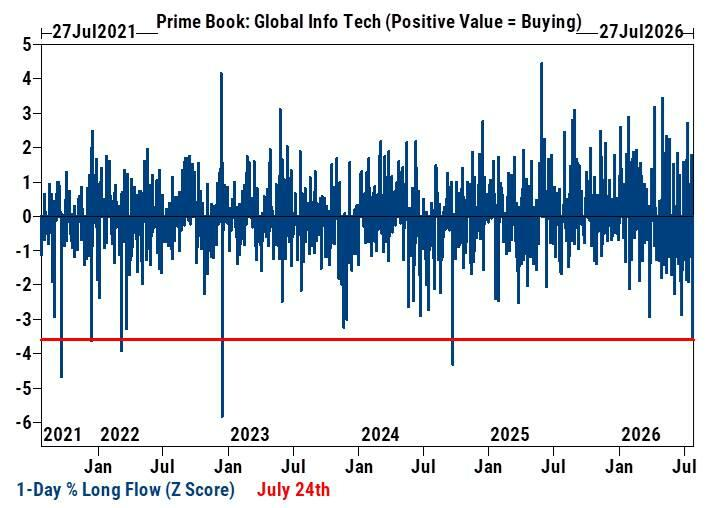
The report specifically highlighted that the global information technology sector is under the most pressure. On Goldman Sachs’ proprietary prime brokerage book, global IT long-side selling last Friday was the largest since September 2024, with a Z-score of -3.6—one of the most pronounced unwinds in the past five years.
The report argues that positioning-related burdens no longer pose a headwind to markets, and fundamentally driven, healthy trading activity is poised to gradually return. “However, before discussing any meaningful re-leveraging, we must first navigate through the wreckage left behind over the past few weeks.”
Fund Flows: Retail Activity Cools, Passive Funds Hit Record Inflows, Potential "Buyer Strike" in August
Goldman Sachs’ trading desk clearly assesses that equities will remain range-bound in the near term. From a fund flow perspective, the team notes that August faces multiple headwinds and lacks upside “fuel.”
On one hand, mutual funds historically tend to hold cash ahead of midterm elections and deploy capital more aggressively afterward. This implies limited equity contribution from this buyer group until election outcomes are clear. Overseas investors also show a tendency to moderately reduce U.S. equity exposure between now and one month before the election.
On the other hand, August—alongside May—is historically among the worst months for net equity outflows from mutual funds and ETFs. Rising geopolitical concerns, energy price pressures, and monetary policy uncertainty are setting the stage for a temporary "buyer strike" in August.
Notably, year-to-date inflows into equity ETFs and mutual funds combined have reached a record $659 billion.
Of this, passive equity funds recorded net inflows of $742 billion year-to-date, while actively managed funds saw net outflows of $83 billion—highlighting retail investors’ pronounced appetite for momentum and leverage this year.
July alone saw $34 billion flow into U.S. equity funds, marking the third-largest July inflow in over two decades.
Goldman Sachs’ trading desk expects this momentum to cool significantly in August, with early signs already emerging.
Gamma Structure Constrains Upside, Amplifies Downside
The gamma structure in the options market further reinforces the view of a range-bound equity market. Goldman Sachs data shows dealers currently hold positive gamma on the S&P 500, with gamma increasing as prices rise and decreasing on the downside.
This setup implies that upward price moves will be constrained, making it difficult for the market to sustain a smooth rally; meanwhile, on the downside, gamma positioning will amplify the magnitude of declines. However, Goldman Sachs’ trading desk believes that a significant downward move is likely already in its later stages.
Systematic strategy-related pressures are also non-negligible. The S&P 500 has breached Goldman Sachs’ estimated short-term trigger level of 7,453 points. Should prices continue to decline, systematic strategies such as CTAs will unlock additional selling pressure. Currently, systematic strategies collectively hold approximately $196.3 billion in net long U.S. equity exposure—ranking at the 48th percentile over a three-year lookback period—with CTA positioning similarly situated at the 44th percentile. Against the backdrop of weakening market liquidity, any incremental selling pressure could exert an amplified impact.
Goldman Sachs’ quantitative estimates show that over the coming week: if markets trade flat, net selling would amount to approximately $1.3 billion; if markets rise, net buying would total around $2.3 billion; and if markets decline, net selling could surge to as high as $24.9 billion. The stark divergence across these three scenarios clearly illustrates the current downside skew in capital flows.
Goldman Sachs specifically notes that as market liquidity deteriorates, the market impact of selling pressure will be magnified, resulting in a pronounced asymmetry in flow forecasts under downside scenarios.
Corporate buybacks provide the most reliable support
Amid these multiple headwinds, corporate buybacks have emerged as the most critical structural support factor emphasized by Goldman Sachs’ team.
According to the report, roughly 31% of S&P 500 constituents (by count) are currently within their share repurchase open windows; this proportion is expected to rise to approximately 53% by next weekend, and by mid-August, over 90% of constituents will enter their open repurchase periods.
Goldman Sachs expects that as an increasing number of companies emerge from earnings blackouts and actively execute repurchases during post-earnings open windows, discretionary buyback demand will see a notable jump throughout August.
The report characterizes this dynamic as “the most supportive and reliable source of capital inflows for U.S. equities heading into August,” which should help maintain a consistent floor of buying interest while investors digest the lingering effects of deleveraging.
Corr1 risk intensifies: narrowing dispersion between single-stock and index volatility serves as a warning signal
This is the most cautionary segment of the report regarding market structure.
Goldman Sachs noted that the S&P 500’s one-month implied correlation (1m Implied Correlation) has risen slightly during the recent sell-off. Previously, single-stock volatility stood at historically elevated levels while index volatility remained relatively low, creating an unprecedented spread between the two. As single-stock volatility retreats from those highs, this spread is now narrowing.
Against a backdrop of persistently elevated macro uncertainty and a market in the process of unwinding momentum-driven enthusiasm, the probability of a 'Corr1 event'—an extreme risk scenario characterized by a sudden surge in market correlations approaching 1, causing individual stocks and the index to plummet in unison—is rising and has now entered investors’ risk radar.
Regarding small-cap stocks, Goldman Sachs pointed out that the Russell 2000 (IWM) has historically underperformed during the first two weeks of August, and this pattern is likely to persist this year. Uncertainty surrounding monetary policy and geopolitics will exert compounded downward pressure, and the index’s relative strength year-to-date implies room for a pullback.
Based on the above analysis, Goldman Sachs’ trading team (Gail Hafif, Brian Garrett, Lee Coppersmith) offers three specific protective trade recommendations:
Reverse Dispersion: Go long on correlation by selling volatility swaps on the top 50 S&P 500 constituents while simultaneously going long on S&P 500 index volatility swaps, profiting from an anticipated rise in correlation.
Three-month put options on IWM: The current one-month 25-delta IWM put options rank at the 48th and 46th percentiles based on one-year and five-year historical lookbacks, respectively, indicating reasonable hedging costs. These options also serve as a hedge against rising interest rate risk.
Short-dated options protection on GSXURFAV: Establish short-term options positions on Goldman Sachs’ basket of retail-favorite stocks (GSXURFAV) to guard against potential volatility following a cooling of retail investor activity.
Finally, Goldman Sachs’ Portfolio Strategy Team reviewed historical patterns in U.S. equity market performance during midterm election years:
Pre-election period: The market generally trades sideways with limited directional bias;
Post-election to year-end: the stock market exhibits a trend of rising prices;
Volatility: moderately increases starting in late summer and accelerates notably in the month leading up to the election.
Moreover, mutual funds tend to hold higher cash positions ahead of midterm elections and deploy capital more actively only after election results are known. Foreign investors follow a similar pattern, typically engaging in modest net selling of U.S. equities about a month before the election.
The team believes this implies limited near-term incremental buying from mutual funds and foreign investors. However, this does not constitute a significant headwind for equities. The broader takeaway is that the market currently lacks a near-term 'catalyst' for upward movement, while potential upside opportunities may emerge toward year-end.
Editor/Deng