
U.S. military escorts have opened energy supply routes, but daily tanker charter rates are nearing $500,000. Despite ongoing hostilities in the Middle East, shipping traffic through the Strait of Hormuz has increased in recent days, with the U.S. stating its navy has escorted several tankers through the waterway. According to data from market intelligence firm Kpler, 14 cargo vessels transited the Strait of Hormuz in both directions on Wednesday, and one very large crude carrier (VLCC) has already been booked to load cargo at a Persian Gulf port.
Zhitong Finance APP has learned that, despite the ongoing U.S.-Iran military hostilities in the Middle East, shipping activity through the critical Strait of Hormuz has rebounded in recent days—a development that surprised investors. Meanwhile, the United States reported that its navy escorted several large oil tankers through the waterway.
Earlier on Thursday, the 'Al Areesh' sailed openly out of the Persian Gulf carrying liquefied natural gas (LNG) from Qatar—the country’s first export cargo in three weeks. Meanwhile, according to vessel-tracking data, the liquefied petroleum gas (LPG) carrier 'CYH Yongchun' appeared to transit the strait with its transponder switched off.
 According to data compiled by market intelligence firm Kpler, a total of 14 bulk commodity carriers traversed the Strait of Hormuz in both directions on Wednesday, up from single-digit levels the previous week. These figures remain subject to revision as new information becomes available. Additionally, a very large crude carrier (VLCC) has been provisionally booked at a daily rate nearing $500,000, scheduled to load cargo next week at an unnamed Persian Gulf port, with potential delivery to China.
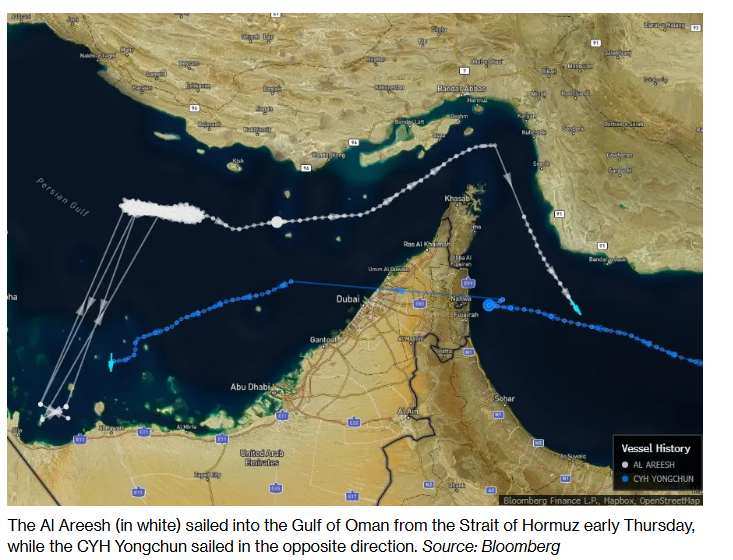
The latest compiled chart above shows vessel movements as of July 30, 2026: earlier on Thursday, the 'Al Areesh' (in white) passed through the Strait of Hormuz into the Gulf of Oman, while the 'CYH Yongchun' sailed in the opposite direction.
Shipowners and global commodity traders are closely monitoring vessel traffic through both the Strait of Hormuz and the Bab el-Mandeb Strait in the Red Sea, seeking early signals of how shipping responds to the evolving security environment. As waves of U.S.-Iran geopolitical attacks continue—including frequent assaults on tankers—shipping volumes through these strategic waterways have fluctuated accordingly.
The fundamental cause of the current sharp escalation in U.S.-Iran tensions lies in the fact that a prior brief ceasefire failed to resolve the core dispute over control of the Strait of Hormuz and the right of free navigation. A preliminary understanding reached on June 18 temporarily revived shipping activity, but the U.S. subsequently demanded that Iran cease all attacks on vessels, fully reopen the waterway, and refrain from imposing any transit fees; Iran, however, insisted on maintaining its authority over the strait’s security and passage regime.
In July, the U.S. conducted successive airstrikes on Iran’s southern coastal areas, missile sites, and drone facilities in an effort to forcibly restore maritime access. In response, Iran expanded its retaliation beyond maritime targets to include military bases or ports in U.S. allies such as Qatar, the UAE, Kuwait, and U.S. forces stationed in Jordan. The immediate trigger for the latest escalation was Iran’s missile strike on U.S. troops in Jordan, prompting a U.S. operation lasting approximately two hours that targeted dozens of Islamic Revolutionary Guard Corps command centers and drone facilities. Simultaneously, the U.S. and Saudi Arabia struck Iran-aligned militias inside Iraq, while Houthi forces attacked Saudi energy infrastructure—transforming the bilateral U.S.-Iran confrontation into a multi-front energy war spanning the Gulf, Iraq, the Red Sea, and the eastern Mediterranean.
Following intensified U.S. strikes against Iran in mid-July, transit volumes through the Strait of Hormuz dropped sharply. Tehran then launched retaliatory attacks on military bases or ports in U.S. allied countries, including Kuwait. This week, after a brief ceasefire, hostilities resumed, yet U.S. Energy Secretary Chris Wright stated that oil continues to flow out under U.S. military support.
In a media interview, he stated: “We are deploying U.S. military forces to escort oil and gas shipments out of the Strait of Hormuz.” He added that, over the past week, an average of approximately 6.5 million barrels of oil per day had moved through the critically important strait out of the Persian Gulf. “We are restoring the supply of oil and refined products from this region to global markets.”
In the Red Sea, some tankers have been observed entering the Gulf of Aden, indicating intentions to dock at Saudi Arabia’s Yanbu port, despite the persistent threat of military attacks by Iran-backed Houthi forces. Some Asian buyers appear to be taking delivery of cargoes at Egypt’s Mediterranean port of Sidi Kerir, through which Saudi Arabia has historically exported a portion of its crude oil.
Other significant developments in Middle Eastern shipping:
Strait of Hormuz, Persian Gulf, Gulf of Oman
A Norwegian-flagged product tanker appears poised to depart; two Suezmax tankers linked to Iran, the 'Chloe' and the 'Kariz', have entered the strait and are currently anchored offshore near Bandar Abbas, Iran, awaiting further instructions.
The very large crude carrier (VLCC) 'Jamaica Prosperity' has been provisionally chartered by the shipping division of an Asian charterer for loading a cargo from the Persian Gulf on August 3 at a rate of Worldscale 465, equivalent to a daily hire rate of nearly USD 500,000.
Southern Red Sea
According to Kpler data, 21 bulk commodity vessels transited the Bab el-Mandeb Strait in both directions on Wednesday, down from 38 the previous day. Only Russian crude oil passed through this strategic chokepoint, totaling approximately 3.5 million barrels, though some vessels may have transited with their transponders switched off.
The Korea-controlled very large crude carrier (VLCC) 'V Glory' was recently observed approaching the Gulf of Aden before deactivating its tracking signal; the Saudi-flagged vessel 'Samha' was also observed taking the same action on Thursday.
On Wednesday, several vessels were provisionally booked to load cargo from Yanbu in August, with the option to transit via the Bab el-Mandeb Strait en route to South Korea.
Northern Red Sea
Late Wednesday night, two liquefied natural gas (LNG) carriers were attacked near the Egyptian port of Damietta, close to the entrance of the Suez Canal; no group has claimed responsibility for the incident as of yet.
The very large crude carrier (VLCC) 'Takamatsu Maru,' flying the Japanese flag, has become the latest vessel to alter its course and head to Sidi Kerir port on Egypt's Mediterranean coast; the ship had previously departed from the United States and is currently located in the waters off southeastern Africa.
The vessels 'Bidbid' and 'VL Prosperity' have arrived at Sidi Kerir and are currently loading cargo, despite earlier reports indicating their destinations were in Asia.
Three VLCCs that departed from Yanbu—'Olympic Luck,' 'DHT Gazelle,' and 'DHT Mustang'—are currently anchored offshore Sidi Kerir with no clear destination.
Resumption of navigation through the Strait of Hormuz fails to erase war risk premium: oil prices regain pricing power over inflation, forcing global central banks to extend their high-rate cycles.
Overall, energy shipments through the Strait of Hormuz under military escort remain extremely limited. Qatar’s first visible LNG carrier in three weeks has exited the strait, and commodity vessel traffic has rebounded slightly from single-digit levels. The U.S. reported that approximately 6.5 million barrels of oil per day were shipped out of the Persian Gulf last week under military support. However, prior to the conflict, the Strait of Hormuz carried roughly 20.9 million barrels per day of crude oil and liquid fuels—equivalent to about 20% of global consumption.
Thus, current throughput merely confirms the strait is not fully blocked, not that supply chains have normalized. Vessels turning off transponders, tanker daily charter rates nearing $500,000, Red Sea diversions, and soaring insurance costs indicate that risk premiums have spread beyond spot supply shortages to shipping, insurance, refining, and inventory systems. Brent crude, the international oil benchmark, surged sharply in the latest escalation of geopolitical tensions, briefly rallying back toward the $100 psychological threshold and spiking nearly 10% intraday—highlighting how commodity traders are continuously repricing between 'limited resumption' and 'further war escalation.'
For the Federal Reserve, this highly constrained resumption scenario means monetary policy must shift from assessing a one-off energy shock to guarding against second-round effects through energy–transportation–commodity prices–wage channels. On July 29, the Fed voted 9–3 to maintain the federal funds rate at 3.50%–3.75%, with three members advocating an immediate 25-basis-point hike, signaling a clear rise in hawkish sentiment within the committee.
As long as crude prices remain elevated, shipping costs continue to transmit through the economy, and core inflation remains sticky, a September rate hike by the Fed will remain the baseline risk, effectively closing the window for rate cuts. Only if Hormuz shipping conditions sustainably improve and Brent crude stabilizes below pre-conflict levels might the Fed consider another pause. The European Central Bank faces even tighter constraints due to the eurozone’s higher dependence on imported energy: headline inflation stood at 2.8% in June, with energy inflation at 8.5%, and wage growth is projected to rebound to 2.7% by early 2027, lowering the threshold for a 'precautionary' rate hike in September or October. The Bank of England is also more likely to keep rates at 3.75% for an extended period, while disinflationary emerging economies heavily reliant on energy imports will see their rate-cut cycles delayed.
Editor/Deng