
① Meta’s second-quarter revenue grew by 28%, but surging expenses and one-time charges led to profits and earnings per share falling short of expectations; ② AI has already improved content recommendations, ad targeting, and delivery efficiency, with Advantage+ generating annualized revenue of $75 billion; ③ Capital expenditures may rise sharply over the next two years, free cash flow is expected to turn negative by 2027, and the timeline for profit realization has been further delayed.
Cailian Press, July 30 (Editor: Xia Junxiong) — Social media giant $Meta Platforms (META.US)$ saw its share price plummet following the release of its latest earnings report. Goldman Sachs believes that Meta Platforms’ existing business already provides evidence that AI investments can generate near-term returns, but there remains insufficient visibility into the company’s long-term scale of compute investment, external commercialization models, and capital recovery timeline.
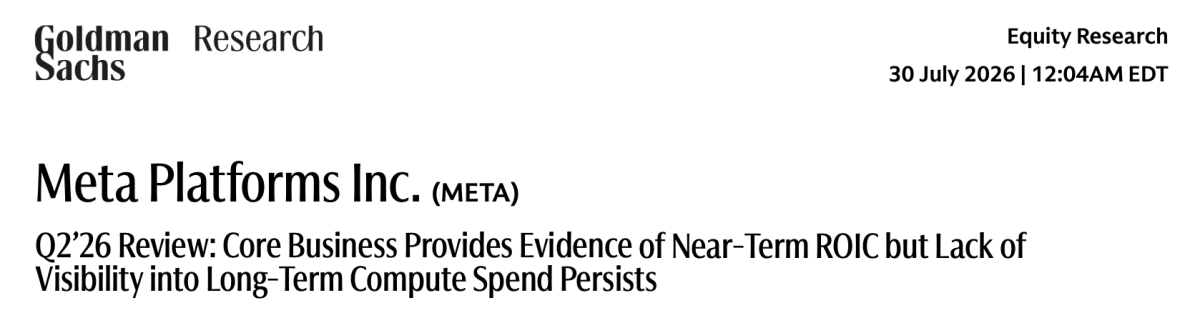
Based on this assessment, Goldman Sachs maintained its “Buy” rating on Meta while lowering its 12-month price target from $815 to $725.
 Strong revenue performance, but profitability fell short of expectations
According to the earnings report, Meta’s total second-quarter revenue reached $60.801 billion, up 28% year-over-year, exceeding Goldman Sachs’ forecast of $60.242 billion and the market consensus of $60.357 billion. Family of Apps revenue amounted to $60.370 billion, an increase of 28% year-over-year, including $59.363 billion in advertising revenue, up 27.5% year-over-year.
By region, advertising revenue in the U.S. and Canada totaled $26.337 billion, up 31.4% year-over-year, significantly surpassing expectations; European revenue stood at $14.085 billion, up 23.9%; Asia revenue reached $10.847 billion, up 18.6%; and revenue from other regions was $8.094 billion, up 34.8%. Other revenue totaled $1.007 billion, a 72.7% year-over-year increase, while Reality Labs (metaverse business) generated $431 million in revenue, up 16.5% year-over-year.
However, rising expenses eroded profitability. Meta reported second-quarter GAAP operating income of $18.775 billion, below Goldman Sachs’ estimate of $19.977 billion and the market expectation of $21.492 billion; its operating margin was 30.9%, 4.7 percentage points lower than anticipated.
Operating income from the core Family of Apps segment was $23.394 billion, with a margin of 38.8%; meanwhile, Reality Labs posted an operating loss of $4.619 billion. Earnings per share came in at $6.18, below Goldman Sachs’ forecast of $6.75 and the market consensus of $7.19. A one-time charge of approximately $3.6 billion weighed on profitability, including $2.4 billion in litigation-related expenses.
AI has already enhanced the core advertising business
Goldman Sachs noted that the most positive signal from the earnings report is that Meta is already seeing tangible results from its AI investments within its existing advertising business.
Management stated that AI has improved the quality of content recommendations on platforms such as Facebook and Instagram, enhanced user engagement, and simultaneously boosted ad targeting, delivery effectiveness, and monetization efficiency.
The adoption of AI-powered advertising products has also been rapid, with Advantage+-related businesses already generating an annualized revenue run rate of $75 billion in the second quarter.
This is particularly significant for Meta. In the AI race among large tech companies, foundational models and consumer-facing AI assistants typically require considerable time to establish mature monetization models. However, Meta possesses a vast advertising system that enables it to first apply AI to enhance recommendation efficiency and ad return on investment, and then directly monetize these improvements through its existing business model.
Meta has outlined multiple pathways for AI monetization.
In addition to strengthening its advertising business, Meta has proposed a multi-layered AI monetization framework.
On the consumer side, the company plans to develop more personalized AI agents; on the business side, it may offer AI tools to advertisers, content creators, and small and medium-sized enterprises (SMEs), monetizing through subscriptions, usage-based pricing, or performance-based fees tied to actual business outcomes.
The enterprise market also represents a potential growth avenue, with specific opportunities including foundational model APIs, 'business-in-a-box' tools to help enterprises build and scale their operations, and model licensing along with other enterprise AI services.
More notably, Meta may directly sell computing capacity or enter into cloud computing licensing agreements. Management aims to offer these services externally at prices above its own cost of computing capacity while supply remains tight in the short term. If successfully implemented, this model would provide an additional channel of return on its substantial data center investments.
Additionally, management mentioned subscription offerings such as Meta One and the potential to generate revenue by leveraging third-party competitive models.
However, the report emphasized that the company has not yet disclosed revenue projections, launch timelines, or clear profitability paths for these initiatives, meaning these opportunities currently remain largely within the realm of long-term strategic potential.
Capital expenditures are nearly doubling, putting pressure on cash flow.
Goldman Sachs forecasts that Meta's capital expenditures will increase from $72.215 billion in 2025 to $142.935 billion in 2026, representing a year-over-year growth of 97.9%; further rising to $220.215 billion in 2027, up 54.1% year-over-year; and reaching $231.225 billion in 2028.
The ratio of capital expenditures to revenue is expected to rise from 35.9% in 2025 to 56% in 2026, peaking at 70.9% in 2027, and remaining elevated at 62.4% in 2028. Given management’s emphasis on maximizing computing capacity between 2026 and 2027, Goldman Sachs has raised its cumulative capital expenditure forecast for 2027–2028 by approximately 14%.
Alongside rising chip procurement and data center construction costs, depreciation, employee compensation, infrastructure expenses, legal fees, and third-party model API costs are also increasing. Goldman Sachs expects Meta’s GAAP total expenses to grow by 43.1% to $168.470 billion in 2026 and by 30.9% to $220.557 billion in 2027.
High capital expenditures will directly compress cash flow.
Goldman Sachs forecasts that Meta’s free cash flow will decline from $46.109 billion in 2025 to $13.905 billion in 2026, turn negative at -$26.071 billion in 2027, and recover to $12.126 billion in 2028.
This implies that even if AI continues to drive revenue growth, the incremental revenue in the near term could be offset by infrastructure spending and depreciation expenses.
Goldman Sachs revises earnings forecasts: higher revenue, lower profits
Goldman Sachs expects Meta’s third-quarter revenue to reach $63.702 billion, close to the upper end of the company’s guidance range of $61–64 billion; however, it has lowered its earnings per share (EPS) forecast from $7.22 to $6.48, a reduction of 10.2%.
For 2026, Goldman Sachs has slightly raised its revenue forecast to $255.409 billion but reduced its EBITDA forecast to $123.753 billion and lowered its EPS estimate from $33.28 to $31.65.
The 2027 revenue forecast has been raised by 1.3% to $310.507 billion, while the earnings per share (EPS) forecast has been lowered by 12.1% to $31.39, and the operating profit forecast reduced by 15.8%, with the operating margin declining from 34.9% to 29%. For 2028, the revenue forecast was increased by 3.8% to $370.837 billion, while the EPS forecast was revised downward by 3.1% to $37.83.
These adjustments indicate that Goldman Sachs places greater confidence in Meta's ability to leverage AI to drive revenue growth, but also believes that investments in computing infrastructure, depreciation, and rising expenses will delay profit realization.
Risks include intensifying competition among internet platforms for users and advertising budgets, sustained pressure on margins from long-term investments, regulatory and antitrust scrutiny, declining shareholder returns, and the failure of businesses such as instant messaging, social commerce, and the metaverse to achieve commercialization.
Editor/Deng