
Mutual fundsMarket indecision, cooling retail sentiment, total leverage remaining near five-year highs, and potential CTA-driven selling are constraining the S&P 500’s ability to break out broadly; meanwhile, the semiconductor sector has received industry-specific tailwinds from Lam Research’s order guidance, sustained AI-related capital spending, tight memory supply-demand dynamics, and short-covering in heavily shorted positions.
Ahead of the U.S. stock market open on Thursday, semiconductor stocks closely tied to AI computing infrastructure surged collectively, signaling what appears to be a long-overdue, exuberant short-covering rally in a sector recently mired in extreme deleveraging and crowded-position unwinds, amid persistent pessimism over lackluster returns on AI-related capital expenditures.
Following the U.S. market open on Thursday, the semiconductor sector staged a dramatic rebound—shifting from forced liquidation of extremely leveraged positions to aggressive short-covering—with Lam Research, a leading semiconductor equipment giant specializing in high-aspect-ratio (HAR) etching tools for 3D NAND, at the center of the rally. $Lam Research (LRCX.US)$ Its share price surged more than 20% at one point, driven by better-than-expected earnings and a significant upward revision to its forward guidance.
 When viewed alongside recent results from other leaders in the AI computing infrastructure supply chain, such as$Samsung Electronics (005930.KR)$、$United Microelectronics (UMC.US)$and$Taiwan Semiconductor (TSM.US)$、$SK hynix (SKHY.US)$ and $Seagate Technology (STX.US)$ the conclusion becomes clearer: physical-layer demand linked to AI computing infrastructure has not deteriorated in tandem with the sharp decline and unwinding of highly leveraged positions reflected in stock prices. However, it would be premature to declare that the latest surge in U.S. semiconductor stocks marks the definitive restart of a new primary uptrend in the global AI computing trade theme.
Chris Caso, a strategist at top Wall Street investment firm Wolfe Research, noted that$PHLX Semiconductor Index (.SOX.US)$the stock had roughly doubled over the prior three months before pulling back about 25% from its peak, and recent weakness appears more like a post-rally reset of expectations. Caso expects demand for AI chips to outstrip supply through at least 2028 and continues to list$NVIDIA (NVDA.US)$as his top pick in AI chip investments, arguing that earlier market concerns about a slowdown in hyperscaler cloud capex have not materialized; instead, intensifying competition around AI agents leaves hyperscale cloud providers with no option but to keep investing.
Meanwhile, Goldman Sachs’ trading desk highlighted the market’s lack of “juice,” suggesting that while oversold bounces may occur, a true trend reversal still requires broader balance-sheet repair. According to their trading desk metrics, total hedge fund leverage globally remains at the 93rd percentile of its five-year range; should the S&P 500 continue to trade below key CTA trigger levels, systematic selling pressure could amount to approximately $15.7 billion over the next week and $68 billion over the next month.
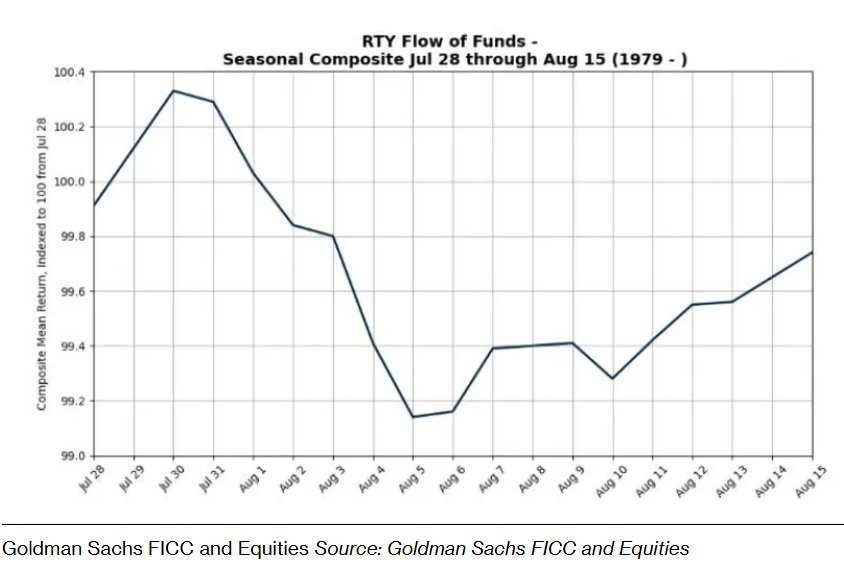
Moreover, Goldman Sachs’ trading desk noted that retail trading activity has cooled,Mutual fundsand overseas investors have adopted a wait-and-see stance ahead of the U.S. midterm elections. August is also a seasonally weak month for fund flows. Although corporate buybacks provide reliable support, they may not be sufficient to immediately propel high-beta stocks to break out again.
With CTA-driven selling looming and retail enthusiasm showing no signs of recovery, Goldman Sachs warns the S&P 500 remains trapped in 'rubble-range' volatility.
According to Goldman Sachs’ market trading desk, this state of lacking clear direction is likely to persist for now. Multiple conflicting factors are keeping$S&P 500 Index (.SPX.US)$trapped within the trading range established since early June, a situation unchanged even after Wednesday’s decline. The most significant factor is positioning: although hedge funds and retail investors no longer hold leveraged positions at extreme levels, they still show little willingness to take on additional risk aggressively.
Senior traders at Goldman Sachs, including Gail Hafif, stated that total leverage among global hedge funds currently hovers around the 93rd percentile of the past five years’ data. Mutual funds and overseas investors are likely to remain on the sidelines until after the U.S. midterm elections in November. Meanwhile, even if renewed corporate buyback activity provides tailwinds, its impact could be offset by seasonally weak fund outflows typical of August.
In a recent client research report, Goldman Sachs traders wrote: 'In the near term, sources of 'juice' capable of fueling a sustained rally are extremely limited. Before we can meaningfully discuss any substantive re-risking, we must first navigate through the rubble left behind over the past few weeks.'
This view provides further ammunition for skeptics: the S&P 500 has been stuck in a 350-point trading range for nearly two months and is unlikely to break out in the near term.
The benchmark U.S. equity index fell 1.5% on Wednesday, closing at its lowest level since June 10.$NASDAQ 100 Index (.NDX.US)$It declined by 2.1%, extending its cumulative drop from the record high reached in June to 11%. This sell-off occurred amid growing market concerns over the pace of spending by major U.S. technology firms, while elevated oil prices could reignite inflationary pressures.
Goldman Sachs traders noted that the near-term market environment is unlikely to become significantly easier. According to Goldman Sachs data, August has historically been one of the weakest months in terms of overall equity fund flows; in terms of net outflows from mutual funds and ETFs, August ties with May for the largest withdrawals of the year.
Goldman Sachs traders expect mutual funds to remain cautious ahead of the U.S. midterm elections in November. They observed that, historically, such investors typically keep cash on the sidelines before the vote and redeploy it afterward. Overseas investors also tend to reduce their U.S. equity exposure in the months leading up to the election.
Retail investors have also begun pulling back significantly. Goldman Sachs noted that average daily trading activity so far this month is more than 3% below the five-year average, signaling another source of equity demand is weakening. Data from Vanda Research showed that retail investors sold individual stocks on Tuesday at the highest rate since the onset of the COVID-19 pandemic.
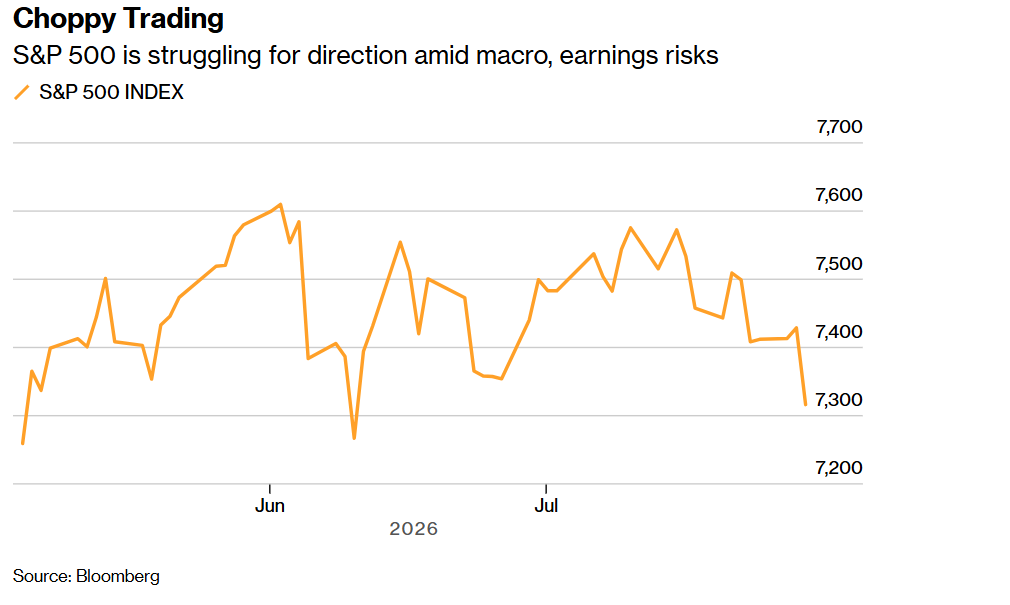
The chart above highlights choppy trading—amid macroeconomic and earnings risks, Goldman Sachs believes the S&P 500 is unlikely to find clear direction in the near term.
Systematic investment strategies—specifically CTA (Commodity Trading Advisor) strategies—represent another potential source of volatility. Goldman Sachs estimates that many institutional investors employing these high-risk strategies, often referred to as 'fast money,' follow market momentum rather than fundamentals and currently hold approximately $196 billion in U.S. equities, a level considered moderate by historical standards. However, the S&P 500 is now trading below a key trigger level for CTA strategies, which implies that further market declines could prompt around $15.7 billion in U.S. equity selling over the next week and potentially up to $68 billion over the next month.
U.S. semiconductor stocks surge! Amid the debris of deleveraging, opportunities may be quietly emerging—could semiconductors lead the counteroffensive?
For bullish investors seeking signs of relief, corporate share buybacks in the U.S. equity market are expected to provide some support. Goldman Sachs’ buyback desk indicated that roughly 31% of S&P 500 constituents are currently in their so-called open repurchase windows. The firm’s strategy team expects this proportion to exceed 50% by next weekend and reach 90% by mid-August.
Goldman Sachs traders wrote in a research note: 'This will bring one of the market’s largest sources of buying back into equities. For the upcoming month of August, this represents the strongest and most reliable inflow supporting U.S. stocks.'
On the morning of July 30, U.S. semiconductor stocks staged a broad-based rally, led comprehensively by Lam Research,$SanDisk (SNDK.US)$、$Western Digital (WDC.US)$Seagate Technology, Micron Technology—the super-giants in semiconductor equipment and memory—as well as Arm, AMD, Intel, the dominant players in the AI computing supply chain, along with Taiwan Semiconductor$ASML Holding (ASML.US)$、$Broadcom (AVGO.US)$and NVIDIA, indicating that capital is not merely covering short positions in a single oversold semiconductor stock but is instead re-entering the entire AI computing supply chain on a large scale.
Semiconductor equipment, memory, CPU/IP, wafer foundry, and interconnect segments all strengthened simultaneously. This dynamic does not contradict Goldman Sachs’ view that the broader market lacks the “fuel” for a sustained rally—cautious mutual funds, cooling retail sentiment, total leverage still near five-year highs, and potential CTA-driven selling pressure collectively constrain the S&P 500’s ability to break out decisively. Semiconductors, however, have received support from Lam Research’s order guidance,$Microsoft (MSFT.US)$This contrasts with sector-specific catalysts such as Meta-led sustained AI-related capital expenditure, tight memory supply-demand dynamics, and short-covering driven by extremely bearish positioning. Thus, this appears more like a structural leadership shift toward AI hardware within a range-bound market: a powerful short-term rebound setup is already in place, but only if gains persist after the market opens, semiconductor market breadth continues to improve, and keyTechnical Analysislevels confirm a breakout, will it signal that investor positioning has genuinely evolved from 'chasing a semiconductor bounce' to committing to a new primary uptrend in semiconductors.
This rally is underpinned by stronger earnings catalysts than a typical technical rebound. Lam Research reported record quarterly revenue of $6.72 billion for June, up 15.1% quarter-over-quarter, with non-GAAP operating margins rising to 38.4%. The company guided for next-quarter revenue midpoint of $8.1 billion and adjusted EPS of $2.15. Management explicitly stated that AI demand is reshaping wafer fabrication equipment needs through higher-layer NAND, advanced DRAM, HBM, and complex packaging technologies.
Arm Holdings, provider of the ARM instruction set architecture for consumer electronics and AI data center servers, reported year-over-year revenue growth of 22% to $1.29 billion for the same period, with data center royalty revenue more than doubling. The company also projected over $2 billion in demand for its custom data center CPUs over the next two fiscal years. Meanwhile, Microsoft Azure revenue grew 43%, with an expected 45% increase next quarter, while maintaining its actual AI infrastructure expansion plans—demonstrating that cloud computing investment is translating into cloud revenue, enterprise orders, and cash flow, rather than merely accumulating idle GPUs.
The core bullish thesis on Wall Street is now being validated by earnings reports. Chris Caso of Wolfe Research expects demand for AI chips to outstrip supply at least through 2028 and continues to rank NVIDIA as the top AI chip investment. He argues that earlier market concerns about a slowdown in hyperscale cloud capex have not materialized; instead, competitive dynamics around AI agents leave hyperscalers with 'no choice but to invest.'
Wolfe Research has also raised earnings forecasts for both NVIDIA and Broadcom, noting that NVIDIA’s upcoming Rubin systems and unbooked business opportunities remain underappreciated by current consensus expectations. Caso further suggested that memory shortages could extend the DRAM and NAND price upcycle into 2028 or even 2029. Bank of America, meanwhile, projects global cloud and AI infrastructure capital expenditures to approach $1.5 trillion by 2027, representing 40%–50% year-over-year growth. These views converge on a common underlying thesis: expanding model training scales, rising inference concurrency, persistent agent operations, and the evolution of data centers from single-node to clustered architectures will simultaneously drive demand for GPUs, custom ASICs, HBM, server DRAM, NAND, advanced packaging, etch/deposition equipment, and high-speed interconnects.
According to the latest research report from Citigroup, Wall Street’s financial giant, the AI-era arms race is shifting from 'whose model is the smartest' to 'who can sustainably produce intelligence at the lowest cost and highest efficiency under physical constraints.' The rapid convergence of open-weight models like Kimi K3 toward the performance frontier of closed-source models implies accelerating commoditization of model capabilities. However, simultaneous expansion in parameter scale, long-context handling, and multi-step agent reasoning is shifting bottlenecks away from raw FLOPs toward HBM capacity and bandwidth, GPU high-speed interconnects, cluster scheduling, and power availability. NVIDIA research also notes that as model scale, sequence length, and batch sizes grow, HBM often becomes the primary scaling constraint. Meanwhile, the International Energy Agency (IEA) forecasts that electricity demand from AI data centers is growing significantly faster than overall power demand, while grid infrastructure deployment cycles typically lag behind those of data centers.
A recent research report led by Brian Nowak, senior analyst at Morgan Stanley, examines the world’s five largest hyperscale cloud providers and manufacturers (Meta,$Amazon (AMZN.US)$, Microsoft, Google,$SpaceX (SPCX.US)$) to approximately $1.2 trillion and $1.4 trillion for 2027 and 2028, respectively. The firm also raised its 2026 capital expenditure outlook for major U.S. tech companies sharply from $433 billion a year ago to $805 billion.
Based on Samsung Electronics’ closing share price of approximately KRW 207,000 on July 30, 2026,$SK Hynix (000660.KR)$and a closing price of KRW 1,322,000, Nomura, the Wall Street financial giant, has set a target price of KRW 670,000 for Samsung Electronics—one of the leaders in the AI computing infrastructure supply chain—implying a potential upside of 225% over the next 12 months, and a target price of KRW 4,700,000 for SK Hynix, implying a potential upside of approximately 255.5%.
Nomura’s analyst team stated that Samsung and SK Hynix should no longer be viewed merely as traditional memory stocks tied to PC and smartphone cycles, but rather redefined as structurally growing AI infrastructure assets. This view rests on three pillars: AI training, inference, and data center expansion are driving memory demand to outpace supply growth; HBM and general-purpose memory markets are entering a synchronized supercycle; and both companies’ forward price-to-earnings ratios of around 6x significantly lag Taiwan Semiconductor’s level of approximately 20x, failing to reflect their improving earnings sustainability and return on equity (ROE). Consequently, Nomura raised its target price for Samsung from KRW 590,000 to KRW 670,000 and for SK Hynix from KRW 4,000,000 to KRW 4,700,000.
Editor/lambor