
Market analysts noted that if Japanese authorities indeed take action this time, the funding is very likely to come from a reduction in foreign exchange reserves. Such an operation—selling U.S. Treasuries to buy yen—has become a standard tool in Japan’s arsenal for countering excessive depreciation of its currency.
On Thursday during U.S. trading hours, the U.S. dollar plunged by over 500 pips against the Japanese yen, breaking below the 159 level to reach its lowest point since May 15; several yen-denominated currency pairs also tumbled by more than 100 pips.
After months of persistent weakness, the yen staged a dramatic rebound, fueling strong market speculation that Japan’s Ministry of Finance may have once again intervened covertly in foreign exchange markets.
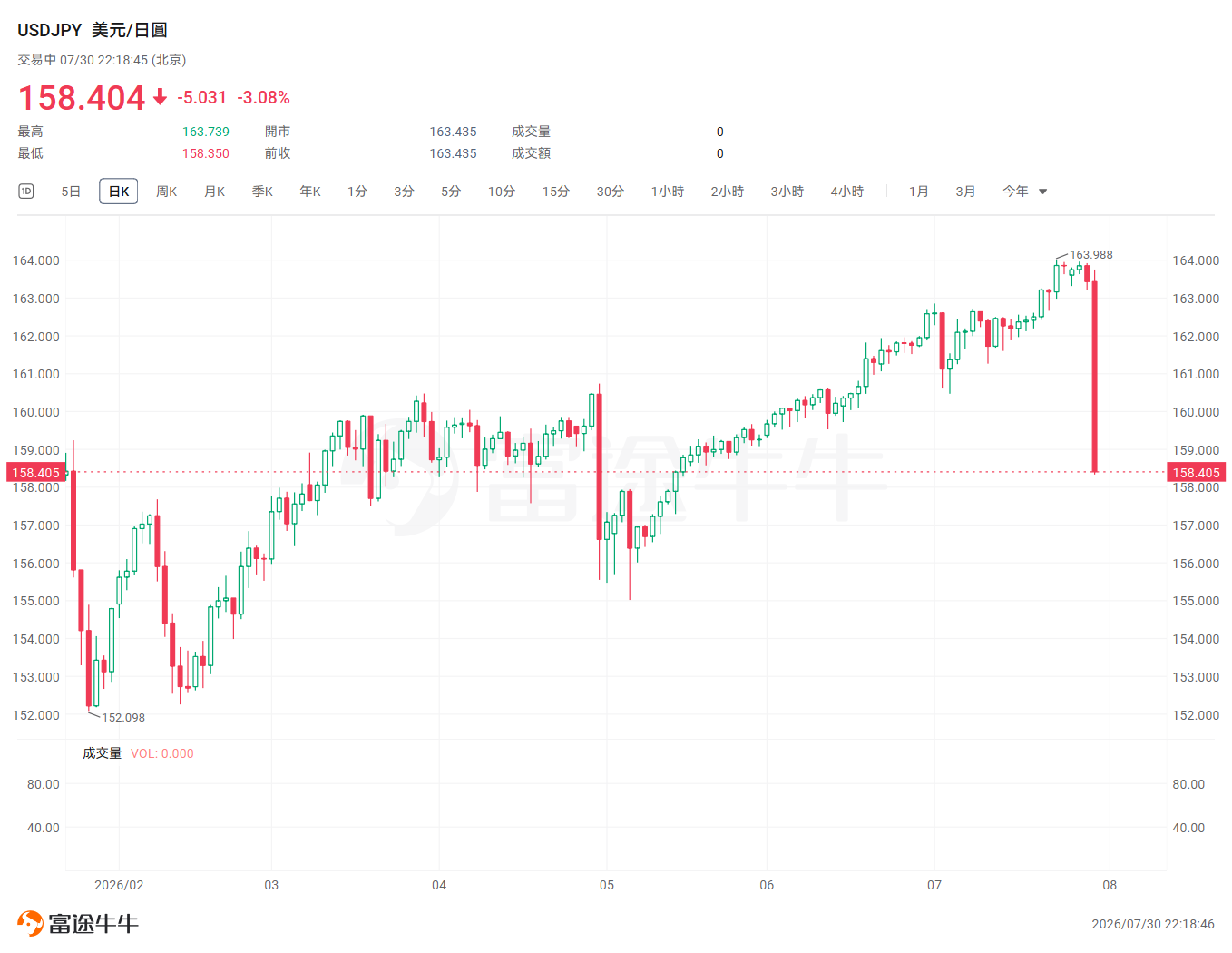
 This move not only marked the yen’s largest single-day gain since Japan’s massive intervention in April but also provided a significant boost to bulls just as the currency had approached a nearly 40-year low.
Previously, the yen remained under sustained pressure. Although Japanese authorities spent a record 11.73 trillion yen (approximately USD 73.2 billion) between April 28 and May 27 to support the currency, the wide interest rate differential between the U.S. and Japan left the yen weak even after it breached the psychologically critical 160 level. Today’s sudden surge is difficult to explain solely by market dynamics.
Market analysts noted that if Japanese authorities did indeed intervene, the funding likely came from selling foreign securities held within Japan’s foreign exchange reserves. According to previously released reserve data from the Ministry of Finance, Japan may have recently liquidated substantial holdings of U.S. Treasuries to generate the trillions of yen in liquidity required for intervention. This 'sell U.S. Treasuries, buy yen' maneuver has become a standard tool in Japan’s arsenal to counter excessive depreciation of its currency.
The yen remains at an extreme multi-decade low. Despite the authorities’ massive financial outlays, the sustainability of any yen rebound faces significant challenges amid the Federal Reserve’s persistently high interest rate environment.
In the early hours of Thursday, the Federal Reserve concluded its July policy meeting, as expected holding rates steady at 3.75%. However, the accompanying policy statement highlighted persistent inflation concerns and geopolitical risks, leaving the door open for another rate hike later this year. With this uncertainty resolved, global investors quickly shifted their focus from Washington to Tokyo.
Friday’s Bank of Japan policy decision has now become a pivotal variable for market direction this week and potentially for the remainder of the year. If Japanese officials express heightened concern about inflation or signal potential intervention, it could trigger a large-scale reversal of carry-trade flows, causing significant volatility across currency markets, U.S. Treasury yields, and global equity assets.