
Amazon Q2 2026 Financial Results:
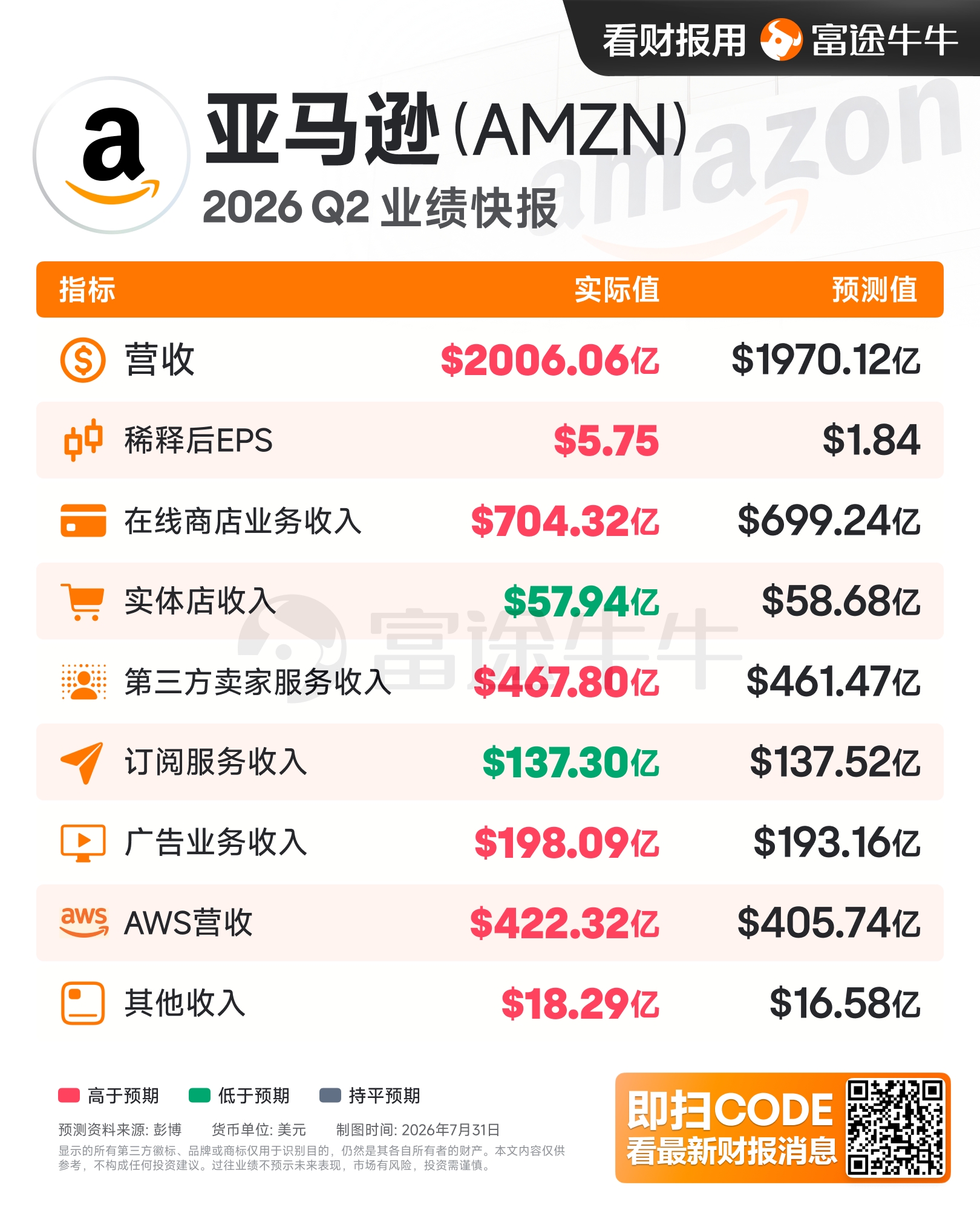
Revenue was $200.6 billion, an increase of 20% year-over-year;
North America segment sales increased by 16% year-over-year to $116.2 billion.
International segment sales grew by 15% year-over-year to $42.2 billion.
 AWS segment sales rose by 37% year-over-year to $42.2 billion.
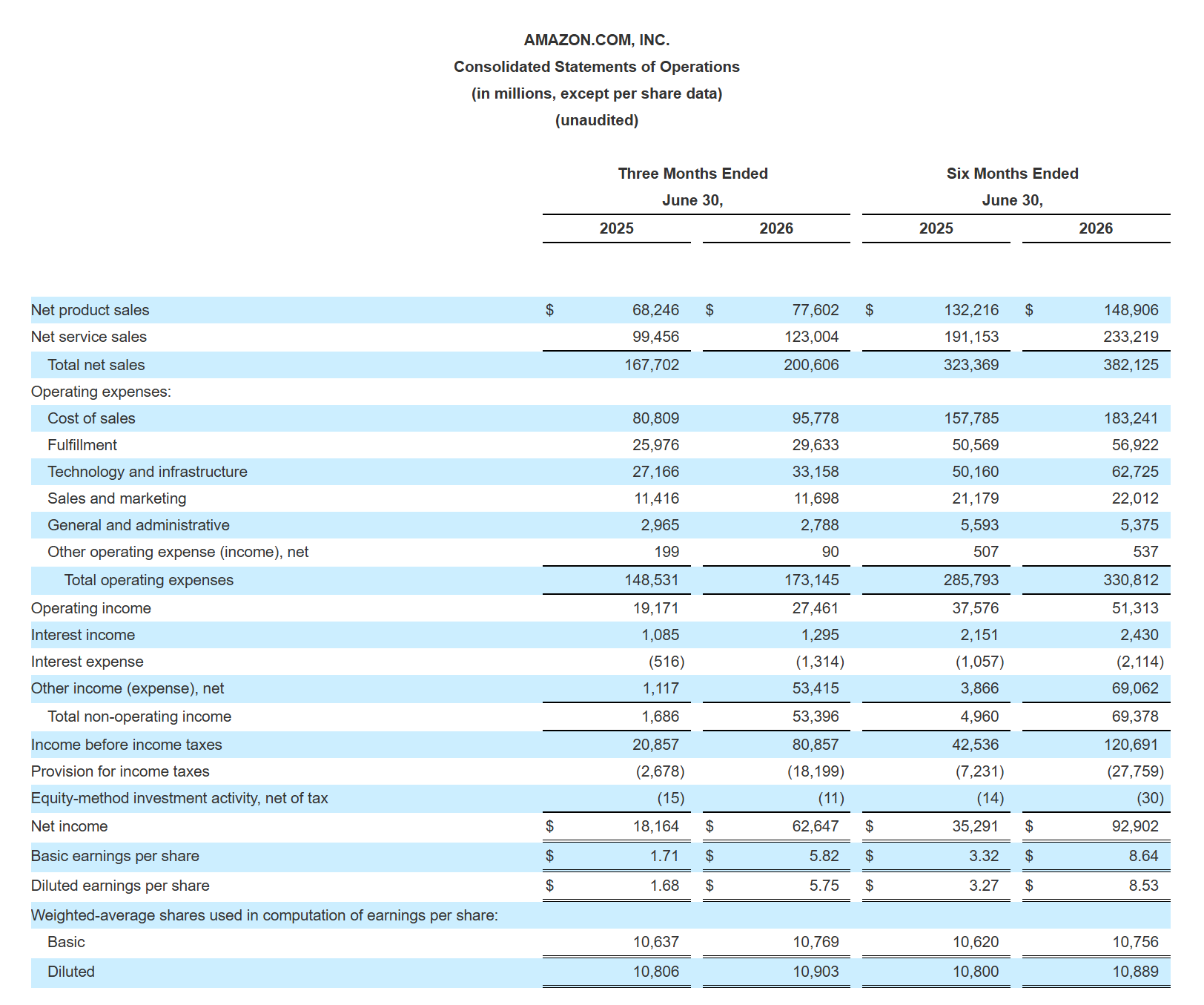
Net income increased to $62.6 billion, or $5.75 diluted earnings per share, compared to net income of $18.2 billion, or $1.68 diluted earnings per share, in the second quarter of 2025.
Net income for the second quarter of 2026 includes $53.4 billion of non-operating, pre-tax other income, primarily from our investment in Anthropic.
Andy Jassy, President and Chief Executive Officer of Amazon, stated:
“AWS is thriving, with second-quarter year-over-year growth of 36.7%—the fastest pace in 18 quarters. Both our artificial intelligence and chip businesses have each surpassed $25 billion in annualized revenue. In physical stores, we once again set a new record in the first half of the year for Prime delivery speed, with the number of items eligible for same-day or next-day delivery increasing by over 40%. Growth in grocery and everyday essentials significantly outpaced other categories. Additionally, our advertising business delivered strong performance, growing 26% year-over-year. These developments are incredibly encouraging, and we look forward to bringing even more exciting innovations to customers in the second half of the year and beyond.”
Cash Flow:
Operating cash flow for the trailing twelve months ended June 30, 2025, increased by 33% to $161.4 billion, compared to $121.1 billion for the prior twelve-month period.
Over the past twelve months, free cash flow turned into a net outflow of USD 7.6 billion, primarily due to a year-over-year increase of USD 66.1 billion in purchases of property and equipment, after excluding gains from asset sales and policy-related subsidies. This increase was largely driven by investments related to artificial intelligence. In contrast, for the twelve months ended June 30, 2025, free cash flow was a net inflow of USD 18.2 billion.
Highlights:
AWS’s artificial intelligence (AI) business is now generating an annualized revenue run rate exceeding $25 billion, with year-over-year growth in the triple-digit percentage range.
The chip business has surpassed $25 billion in annual revenue, also achieving year-over-year growth in the triple-digit percentage range.
Trainium continues to gain momentum, with multi-year, multi-gigawatt commitments from Anthropic and OpenAI—the world’s two leading AI labs. A growing number of AI startups are adopting Trainium, including unicorn companies such as NEURA Robotics and Odyssey. Additional commitments have also been made by startups like TwelveLabs, Decart, Poolside, Karakuri, Inc., Metagenomi Therapeutics, Inc., NetoAI, and Splash Music, as well as large enterprises including Uber and Pinterest.
Graviton5 has officially launched. Graviton delivers 30% to 40% better price-performance than comparable instances and offers 25% higher compute performance than Graviton4. Ninety-eight percent of the top 1,000 EC2 customers are already using Graviton, with committed revenue nearly tripling quarter-over-quarter. Graviton5 adoption is growing at nearly twice the pace of Graviton4.
Amazon Bedrock has added more than 10 new fully managed foundation models, including OpenAI’s GPT-5.6, Anthropic’s Claude Opus 5, Google DeepMind’s Gemma 4, and SpaceXAI’s Grok 4.3. Amazon Bedrock offers the broadest selection of leading models, delivering exceptional performance along with the governance and security controls required by enterprises. Adoption continues to accelerate rapidly—hundreds of thousands of customers now use Bedrock, with more new customers added in the past six months than in the first two years combined following its launch. Customer spend in Q2 also exceeded the cumulative total of all prior quarters.
The preview of AWS Continuum is now available. It identifies, prioritizes, validates, and remediates code vulnerabilities. Continuum begins by ingesting a team’s existing vulnerability backlog and then performs comprehensive scans using new state-of-the-art models. It leverages agents and each organization’s unique business context to prioritize critical vulnerabilities, validates them in sandboxed environments, and recommends fixes.
Bedrock AgentCore has introduced several new capabilities, providing enterprises with the building blocks needed to deploy and operate agents quickly and securely at scale. New features include payments (enabling agents to autonomously execute transactions), web search (allowing agents to access knowledge without leaving AWS), and Harness (which further accelerates the integration of all infrastructure required for agent deployment).
Amazon Quick is an intelligent AI work assistant that helps users manage, search, and automate digital workloads across email, calendars, local or cloud-based files, and custom workflows. This update significantly enhances Quick’s capabilities by introducing autonomous agents that users can configure using simple, natural language. These agents run continuously in the background to perform multi-step tasks. Additional enhancements include a personalized activity feed that consolidates emails, messages, calendar events, and tasks into a single prioritized view, and 16 new integrations—including Adobe, Moody's, and Snowflake. Quick seamlessly interoperates with leading SaaS tools such as Slack, Salesforce, Jira, Teams, and ServiceNow; enforces existing corporate access controls; and can perform actions like scheduling meetings, drafting and sending emails, updating CRM records, and building dashboards.
Microsoft has ported its specification-driven coding agent, Kiro, to the iOS platform. Developers can now initiate new projects, monitor progress, control agents, and interact with Kiro conversations directly from their mobile devices, desktops, command line, or web browsers. Kiro delivers 50% better cost efficiency than alternative solutions and has seen a threefold increase in usage quarter-over-quarter.
The AWS DevOps Agent has introduced several new features. It is an always-on software operations assistant designed to help developers securely and reliably release software, including release management capabilities that perform readiness reviews of code changes and autonomously test releases to identify potential issues before deployment.
Launched on-demand scalable serverless AI infrastructure, including:
Lambda MicroVM is a new version of the widely adopted AWS Lambda serverless compute service. It delivers instant startup times, fully scales up or down based on demand, and now offers a stateful runtime with sessions that can persist for up to 8 hours—making it ideal for long-running agent loops, multi-step pipelines, or persistent database engines.
The next-generation OpenSearch Serverless enables agents to rapidly search massive datasets, scaling capacity up to 20 times faster than the previous generation and reducing costs by up to 60% compared to peak provisioning.
This log analytics engine, purpose-built for Amazon OpenSearch Service, is designed to handle the surge in log volume generated by agent workloads. Compared to existing general-purpose engines, it delivers up to 4x better price-performance, ingests up to 2x more data on the same hardware, executes analytical queries up to 2x faster, and retains up to 3x more data at the same cost—enabling teams to balance insights against budget constraints and retain and analyze more observability data.
AWS announced a $1 billion investment to create the AWS Forward-Deployed Engineering team, composed of AI engineers who work directly with customers to co-develop and deploy agentic AI solutions in days rather than months. Early customers include the Allen Institute, Cox Automotive, the NBA, the NFL, Ricoh, and Southwest Airlines.
AWS announced the official launch of Secret Cloud for regulated industries, offering defense contractors a faster and more secure pathway for classified innovation. Northrop Grumman is the first to run classified workloads on the platform and has committed up to $1 billion in cloud credits to accelerate cloud migration and modernization across the U.S. Intelligence Community.
Amazon announced that its global data centers achieve more than seven times the water efficiency of the industry average. Amazon also stated that it has completed 75% of its goal to achieve water positivity in global data center operations by 2030 and has already achieved water positivity in its direct operations in India—meeting its target ahead of schedule, originally set for 2027.
AWS announced new agreements with Warner Bros. Discovery, Vodafone, Siemens Energy, Ryanair, Pinterest, Snowflake, Moody's, Danske Bank, the WNBA, PennyMac, Fiserv, WPP Enterprise Solutions, Vonage, Recursive, fal, Chai Discovery, Odyssey, TwelveLabs, Reactor, OpenRouter, Dash0, the New York State Office of Information Technology Services, the State of Iowa, the University of South Florida, and the University of Utah.
Amazon continues to expand its ultra-fast delivery service, Amazon Now, which delivers thousands of everyday essentials in 30 minutes or less, now available in 80 additional towns across the U.S. and multiple major cities in Egypt. Amazon Now currently serves over 250 towns across nine countries globally and is highly popular with customers, achieving over 80% month-over-month growth in both sales and units sold, and over 60% month-over-month growth in the number of customers served.
Added millions of new products, including over 700,000 items from well-known brands such as ADT Blu, Bobbi Brown, BROWN GIRL Jane, CR7 Underwear, LeGer, Mamonde, OLIVA COSMETICS, Rabanne, and Ted Baker.
We integrated Rufus and Alexa+ into Alexa for Shopping, an intelligent shopping assistant that delivers personalized recommendations, product comparisons, price history, and shopping automation through features like price alerts and automatic purchases. In the second quarter, global adoption and engagement with Alexa for Shopping rose significantly, with active users nearly doubling and interactions increasing by more than fivefold year-over-year.
Amazon launched its Supply Chain Services, enabling any business to move, store, and deliver everything from raw materials to finished goods using the same supply chain infrastructure as Amazon. Procter & Gamble, 3M, Lands' End, and American Eagle Outfitters are among the first customers.
Amazon Business achieved an annualized gross sales volume of $60 billion and continues to expand its product assortment—increasing the number of available items by nearly 30% compared to last year—including same-day delivery of fresh groceries for businesses in over 2,300 towns across the United States.
Amazon introduced the next-generation Proteus robot, an autonomous robot designed to assist fulfillment center employees by transporting loads weighing up to 1,300 pounds, thereby reducing physical strain and further enhancing safety. Powered by artificial intelligence, employees can now control Proteus using simple, conversational language.
In the first six months of this year, Amazon Pharmacy more than tripled its number of new customers, and same-day prescription deliveries grew nearly fivefold. Additionally, by automatically applying manufacturer discounts to a broader range of commonly prescribed medications, Amazon has saved customers nearly $250 million in out-of-pocket costs year-to-date—a more than 400% increase compared to the same period last year.
Expanded Ads Agent is an AI-powered tool that simplifies campaign planning, launch, and management, reducing setup and targeting tasks that previously took hours to just minutes. So far this year, the tool has expanded to 11 additional countries. Advertisers using Ads Agent achieved an 8% lower cost per impression and a 6% lower cost per conversion compared to those not using the tool.
Alexa+ has expanded to Germany, Austria, France, and Brazil, with hundreds of millions of users now experiencing the new Alexa service—and user numbers continue to grow month over month. Alexa continues to drive significant business growth, particularly in the U.S. market. In the U.S., customers who shop using Alexa spend over 40% more per order on average than those who do not use the service, and users who have experienced Alexa+ are nearly 25% more likely to subscribe to Prime.
The Campus Chronicles attracted 36 million global viewers in its first 12 days on Amazon Prime Video, making it the third most-watched series premiere in Prime Video history.
The NBA’s inaugural season on Prime Video delivered strong viewership, with Game 7 of the Eastern Conference Semifinals peaking at 6.5 million U.S. viewers—surpassing the viewership of the 2025 televised Game 7. In Europe, NBA viewership on Prime Video more than doubled year-over-year, achieving record-high average ratings.
The second season of NASCAR on Prime Video averaged 2.3 million viewers and featured the youngest audience for a NASCAR broadcaster since 2017.
Four additional launches were completed for Amazon's low Earth orbit satellite network, Project Kuiper, bringing the total number of satellites in orbit to nearly 400—sufficient to begin offering initial satellite internet services this year.
Zoox received approval from the National Highway Traffic Safety Administration (under Part 555 exemption) to charge fares—becoming the first purpose-built autonomous robotaxi to receive such an exemption—paving the way for Zoox to launch paid commercial services for customers.
Through the Amazon Disaster Relief Program, support was provided for post-earthquake relief efforts in Venezuela, including the donation and delivery of over 650,000 emergency relief items to more than a dozen nonprofit organizations. An unprecedented collaboration with Airlink, the U.S. Department of State, and the World Food Programme established weekly humanitarian cargo flights to Caracas, delivering approximately 120 metric tons of aid.
Q3 Financial Guidance:
Net sales are expected to range between $197 billion and $202 billion, representing a 9% to 12% increase compared to Q3 2025. Excluding the impact of Prime Day in both 2025 and 2026, the year-over-year growth rate for Q3 2026 would improve by nearly 400 basis points. This outlook incorporates an estimated 80-basis-point adverse impact from foreign exchange rate fluctuations.
Operating income is expected to range between $22.5 billion and $26.5 billion, compared to $17.4 billion in Q3 2025.
Editor/Liam