
The yen posted its largest intraday gain against the U.S. dollar in two and a half years. Japan deployed a record-breaking intervention of approximately USD 73.2 billion between late April and late May this year, yet downward pressure on the yen has not been fundamentally alleviated. Market attention has now shifted to whether authorities will confirm this latest intervention, as such data is typically released only after several weeks; in the near term, yen volatility is expected to remain elevated. Citi expects the yen to weaken in the near term and recommends going long on USD/JPY ahead of the Bank of Japan’s policy meeting, as the BOJ Governor is unlikely to adopt a more hawkish stance than anticipated.
On Thursday, the Japanese yen surged sharply against the U.S. dollar, posting its largest intraday gain in two and a half years, with market participants widely speculating that the unusual move stemmed from renewed intervention by the Japanese government to support the yen.
During early U.S. trading on Thursday, July 30, the dollar fell below the 160 level against the yen, plunging nearly 500 pips within an hour to briefly dip below 158.00, marking a daily decline of 3.3%—the steepest one-day drop since December 2023. Since early June, the yen has remained under persistent pressure, repeatedly breaching the 160 mark and hovering near its lowest levels in nearly four decades, fueling heightened market expectations of official intervention.
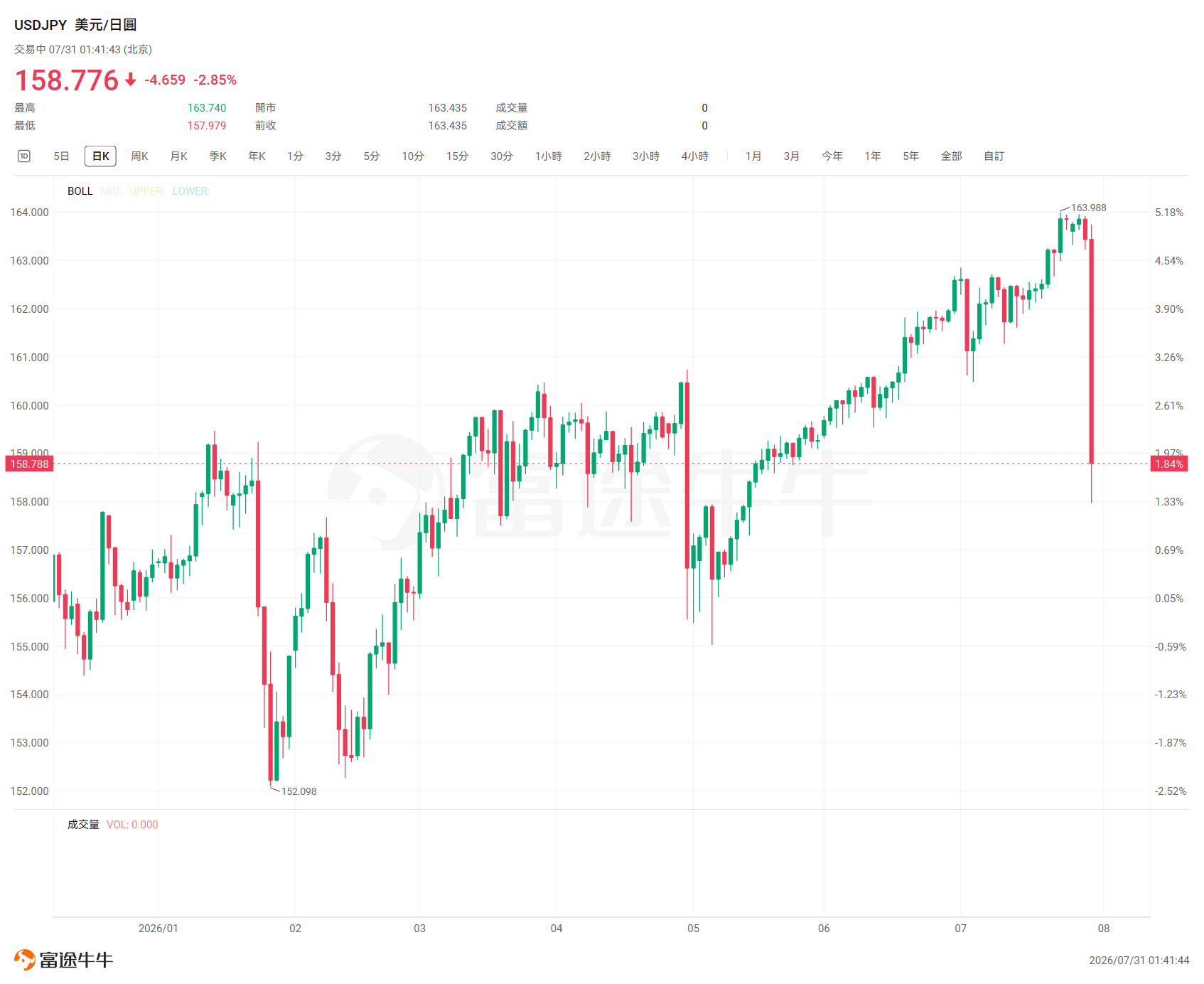
 The sharp, rapid rebound in the exchange rate over such a short period closely resembles the price action typically observed during Japan’s past interventions, prompting heightened vigilance in the foreign exchange market. Geoffrey Yu, Senior Strategist at Bank of New York Mellon, commented: “Such a significant move strongly suggests that the Japanese government likely intervened in the currency market. However, the effectiveness of this intervention remains to be seen.”
If officially confirmed as government action, this would mark Japan’s latest move following large-scale interventions earlier this year, underscoring its continued efforts to curb excessive yen depreciation.
Win Thin, Chief Economist at Bank of Nassau 1982, stated that if Thursday’s sharp yen move was indeed driven by Japanese government intervention, then “the timing of the move was quite astute,” as it “went with the prevailing market momentum rather than fighting against it.”
The day before the yen’s sharp rally, the Federal Reserve announced on Wednesday—following its policy meeting—that it would keep interest rates unchanged and refrained from immediately raising rates in response to rising oil prices driven by Middle East tensions, thereby providing favorable tailwinds for the yen’s rebound.
The Fed’s rate decision on Wednesday weakened the dollar, forcing traders to reassess their expectations for the timing of the next rate hike. The yen strengthened on Wednesday, with USD/JPY briefly falling below 163.30 after the Fed’s announcement, halting its advance toward last Thursday’s high near 164.00—the highest level since late 1986.
Record-breaking intervention scale, yet depreciation pressures persist; markets await official confirmation
Despite implementing unprecedented foreign exchange interventions this year, the Japanese government has not fundamentally alleviated downward pressure on the yen.
According to Bloomberg, data from Japan’s Ministry of Finance shows that between April 28 and May 27, Japan conducted approximately ¥1.173 trillion (about USD 73.2 billion) in foreign exchange interventions—the largest on record. Market participants widely believe that authorities likely sold portions of their overseas assets, including U.S. Treasuries, to fund these operations.
However, these large-scale interventions only temporarily stemmed the yen’s decline. With the interest rate differential between the U.S. and Japan remaining elevated, the yen recently fell below the 160 level again, hitting a roughly four-decade low and prompting market doubts over whether foreign exchange interventions alone can reverse the long-term depreciation trend.
Although the Federal Reserve has maintained steady rates for the fifth consecutive meeting as of this week, traders still anticipate further rate hikes later this year, which would keep the U.S.-Japan interest rate differential elevated at levels unfavorable for the yen.
Market attention has now shifted to whether Japan’s Ministry of Finance will confirm this latest intervention.
By convention, the Japanese government typically does not immediately confirm foreign exchange interventions; relevant data is usually released several weeks later. Consequently, until an official statement is issued, markets can only infer whether authorities have entered the market based on intraday price movements and trading patterns, implying that yen volatility is likely to remain elevated in the near term.
Earlier in July, during a media interview, Jun Murakami, Japan’s top foreign exchange official, did not reiterate the Ministry of Finance’s standard rhetoric on exchange rate policy, including the usual phrase “ready to take decisive action at any time,” which is typically interpreted as a signal of potential market intervention.
Citi expects the yen to weaken in the near term and recommends going long on USD/JPY ahead of the Bank of Japan’s upcoming policy meeting.
The latest move in the yen comes just ahead of the Bank of Japan's interest rate decision scheduled for this Friday. Markets widely expect the central bank to hold rates steady following its June rate hike.
The Bank of Japan’s June rate hike raised its policy rate to the highest level since 1995, as investors had previously been concerned that the central bank was lagging in its response to inflation.
Citi believes the yen still has room to weaken further, as Bank of Japan Governor Kazuo Ueda is unlikely to deliver a more hawkish signal than markets anticipate following this week’s meeting.
Citi analysts wrote in a report: “We have established a one-month long USD/JPY 160.50/162 call spread position.”
These analysts noted that the sharp decline in USD/JPY “is consistent with moves observed during previous (Japanese) intervention periods.” However, they added, “we believe Governor Ueda is unlikely to adopt a more hawkish stance than expected at tonight’s Bank of Japan meeting, which could lead to market disappointment.”
The analysts wrote: “We expect USD/JPY to rebound tonight and subsequently resume its upward trend.”