
The Terra model's price has been reduced by 20%; the Sol model now features a Fast mode, offering up to 2.5x speed improvement, priced at twice the standard mode, with unchanged intelligence capabilities.
OpenAI launched a summer 'promotion' campaign.
In the early hours of the 31st Beijing time, OpenAI CEO Sam Altman announced a new pricing matrix for the entire GPT-5.6 product line, with the entry-level model Luna seeing a price reduction of up to 80%, further lowering the price floor in the AI API market.
 This adjustment covers three models. The Luna model saw the most aggressive price cut, while the Terra model was reduced by 20%. The flagship Sol model introduced, for the first time, a 'reverse premium' pricing model, adding a new Fast mode that doubles the speed at twice the standard price, with no change in intelligence level.
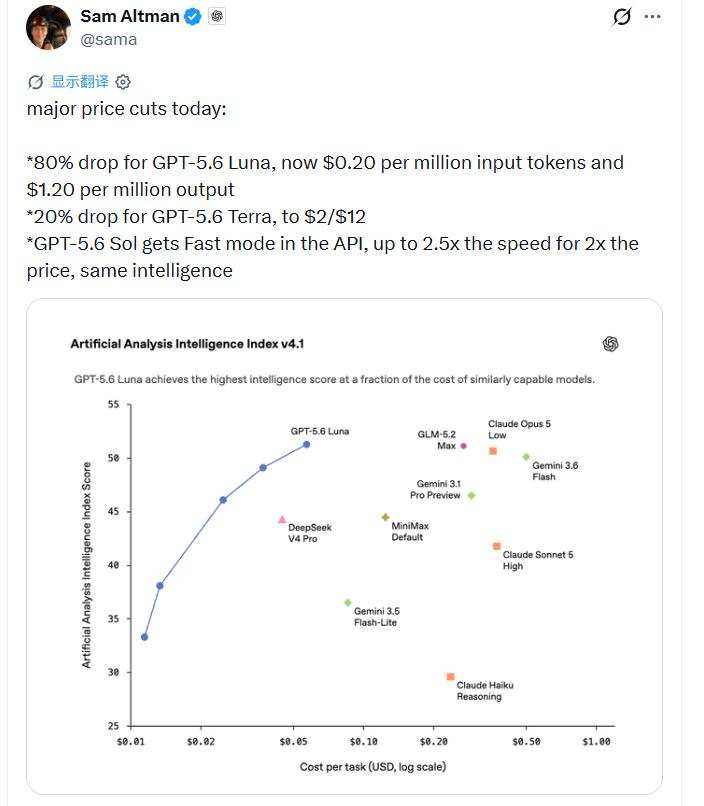
Altman stated on social media that OpenAI’s goal is to 'deliver the best price-to-intelligence ratio at every tier,' clearly outlining the company's competitive strategy in the AI API market—using tiered pricing to serve the full spectrum of customers, from cost-sensitive developers to users requiring high performance.
Luna’s significant price cut resets the benchmark for entry-level pricing
Among the GPT-5.6 product line, the Luna model experienced the most substantial price reduction. Input pricing dropped to $0.20 per million tokens and output pricing to $1.20 per million tokens—a reduction of 80% from previous levels—pushing the cost of lightweight inference to an exceptionally low level.
This pricing gives Luna a clear cost advantage in high-frequency, large-scale invocation scenarios, making it especially suitable for developers and enterprise clients handling large volumes of text classification, content generation, or simple Q&A tasks. For users with limited budgets and moderate performance requirements, Luna’s new pricing significantly lowers the barrier to accessing GPT-5.6 capabilities.
Terra receives modest price reduction, reinforcing its mid-tier positioning
Compared to Luna’s aggressive adjustment, the Terra model saw a more moderate 20% price reduction, with new pricing set at $2 per million tokens for input and $12 per million tokens for output.
This restrained adjustment reflects Terra’s role as a mid-tier offering—balancing performance and cost for use cases that demand more capability than entry-level models but do not yet require flagship-level compute power. The 20% reduction maintains the model’s relative value proposition while exerting some pricing pressure on competitors.
Sol Fast Mode: Trading price for speed, tailored for latency-sensitive scenarios
The Sol model has not been repriced in this update; instead, a new Fast mode has been introduced. This mode offers up to 2.5x faster response speeds at the API level, priced at twice the standard rate, with no change to the model's intelligence level.
This design follows a clear logic: for real-time conversations, streaming generation, or production environments highly sensitive to latency, developers can pay a premium to gain higher throughput without compromising performance.
By launching Fast mode, OpenAI has effectively introduced 'speed' as an independent pricing dimension, offering enterprise users with high-concurrency and low-latency requirements a new pathway for adoption.
Price competition continues to intensify, placing pressure on the competitive landscape
This round of price adjustments represents OpenAI’s latest move to exert sustained pressure in the AI API market. Altman has explicitly stated that the company’s goal is to deliver 'the best price-to-intelligence ratio at every tier,' indicating that these price cuts are not one-off actions but part of a systematic competitive strategy.
The 80% price reduction for the Luna model is particularly noteworthy. This magnitude is sufficient to directly challenge competing offerings with similar positioning in the market and may compel other AI model providers to adjust their pricing accordingly.
For developers and enterprise users, the continued decline in API call costs means ongoing improvements in the marginal economics of AI applications, facilitating faster commercial deployment across more use cases. Overall, this adjustment further strengthens OpenAI’s pricing leadership in AI infrastructure.
Editor/Stephen