
The Federal Reserve's decision this week to hold rates steady continues to roil the bond market. Long-end U.S. Treasury yields have remained elevated following the release of the latest economic data, as persistent inflation and resilient labor market conditions have heightened market divergence over the future path of rate hikes, steepening the yield curve and fueling demand for safe-haven assets.
The yield on the 30-year U.S. Treasury note surged by more than 10 basis points on Wednesday to its highest level since 2007, and held near 5.20% on Thursday.
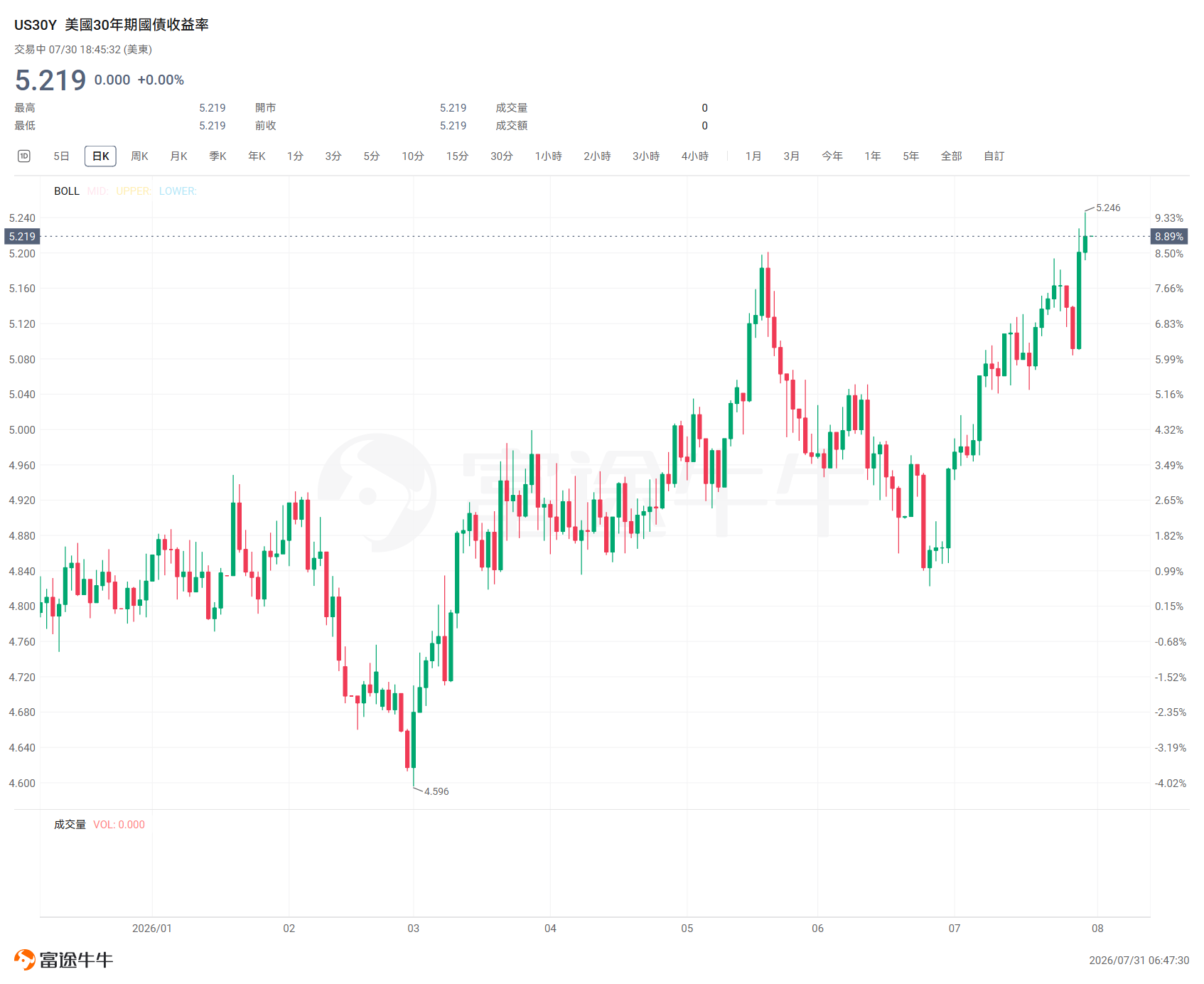
On Thursday, the U.S. reported that the June PCE price index declined by 0.1% month-over-month—the first monthly drop since 2020—with the year-over-year increase narrowing to 3.7% from April’s 4.1%. The core PCE price index, excluding energy, saw its annual rate ease slightly from 3.4% to 3.3%, while rising just 0.1% month-over-month, below the market expectation of 0.2%.
 Additionally, oil prices, which had dipped in June, rebounded after the U.S. resumed military action against Iran, exacerbating market concerns over Middle Eastern supply risks.
Interest rate swap markets now imply approximately a two-thirds probability of a 25-basis-point rate hike by the Federal Reserve in September, down from the level fully priced in prior to the Fed’s policy announcement.
Long-end yields remain elevated as inflation expectations jump
Following the Fed’s decision to hold rates steady, long-end U.S. Treasury yields have struggled to retreat, with market concerns about the persistence of inflation providing key support.
The 30-year breakeven inflation rate—a market-based gauge of inflation expectations—jumped by 6 basis points in a single day on Wednesday, marking its largest one-day increase since the day after Trump won the presidential election in November 2024.
Oil prices climbed again after the U.S. resumed military strikes on Iran, further reinforcing inflation expectations amid heightened uncertainty over Middle Eastern supply prospects.
Jens Peter Sorensen, Chief Analyst at Danske Bank A/S, stated:
"If inflation does not ease, long-end bond yields face further upside risk, leaving markets to speculate how many more rate hikes may be needed—and suggesting that the timing of such hikes could come later than currently expected."
Short-end yields declined, and the yield curve steepening trend continued.
In contrast to the long end, short-dated U.S. Treasury yields continued to decline on Thursday, with yields across the 2-year to 5-year maturities all falling by approximately 5 basis points to hit their lowest levels of the week.
This move was partly driven by developments in the UK market—following the Bank of England's policy meeting, UK gilt traders reduced their bets on a September rate hike, pulling British yields lower. The yen’s gain of over 3% against the dollar in a single day also provided support to short-end U.S. Treasury yields.
As a result, key yield spreads widened further, climbing to their highest levels since May: the spread between 2-year and 10-year yields approached 45 basis points, while the gap between 5-year and 30-year yields expanded to 84 basis points, reflecting a persistently steepening yield curve.
Large institutional investors are betting on further increases in long-end yields through the options market.
The steepening yield curve has triggered significant hedging demand in the derivatives market, with investors increasingly turning to Treasury options to hedge against further upside risks in long-end yields.
On Thursday, a $13 million options trade emerged, betting that the 10-year Treasury yield would rise to 4.80%—its peak from last year—within several weeks.
On Wednesday, a large options trade targeting Treasury futures for September was executed, aiming for the 30-year yield to climb to around 5.3% within several weeks. Both options expire on August 21.
The Federal Reserve's credibility is being questioned, casting doubt on its projected rate hike path.
The Federal Reserve Chair Waller's decision to hold rates steady this time has raised market doubts about his resolve to combat inflation, thereby increasing uncertainty around the interest rate hike path.
Torsten Slok, Chief Economist at Apollo Global Management, stated in an interview:
"We need to discuss the credibility of the Committee—it cannot remain just words; it must ultimately be backed by action."
Markets had previously priced in approximately a 40% probability that the Fed would raise rates at this meeting to signal Waller's anti-inflation stance, but that expectation was unmet. Swap markets now indicate a reduced likelihood of a September rate hike, and the probability of a second rate increase this year has halved from around 80% to roughly 40%.
Editor/Stephen