
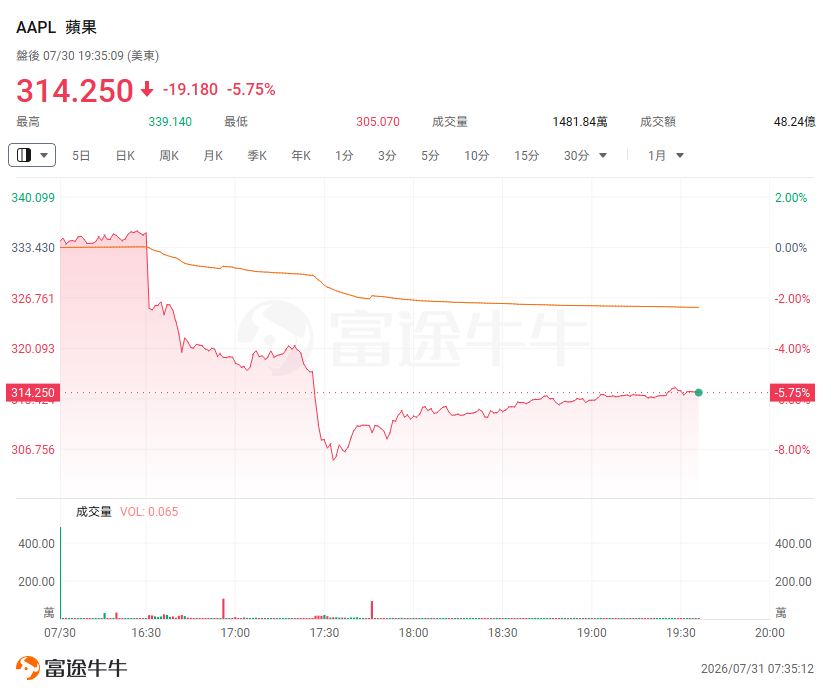
① Apple’s latest earnings report showed both revenue and profit exceeding expectations, with strong performance from the iPhone segment, though the company warned that rising memory costs and constrained supply of advanced-process chips would weigh on growth in the next quarter; ② outgoing CEO Tim Cook hinted that adding more memory suppliers could help alleviate the pressure; ③ following weaker-than-expected guidance, Apple’s stock fell more than 6% in after-hours trading.
July 31 (edited by Shi Zhengchen) — Tim Cook’s farewell earnings report as Apple’s long-serving CEO was released under the shadow of Taiwan Semiconductor’s capacity constraints and soaring memory prices.
Early Friday morning Beijing time, consumer electronics giant $Apple (AAPL.US)$ released its third-quarter fiscal 2026 earnings report ended June 27. As of the time of writing, the company’s stock fell 6% in after-hours trading due to supply shortages weighing on its sales guidance for the current quarter. If the decline holds through Friday’s market close, Apple will relinquish its title as the world’s most valuable public company back to $NVIDIA (NVDA.US)$ 。
 The report showed that Apple posted Q3 revenue of $109.417 billion, up 16% year-over-year, and net income of $29.789 billion, an increase of 27% year-over-year. Diluted earnings per share came in at $2.02 (including a favorable impact of $0.11 per share from tariff refunds), surpassing market expectations. Cash and cash equivalents on the balance sheet rose by $3.6 billion during the quarter, reaching $39.5 billion.
Apple stated that this was one of its strongest June quarters ever, setting new records for both earnings per share and operating cash flow for any June quarter in the company’s history.
By product category, the iPhone remained Apple’s primary growth driver, generating $54.252 billion in revenue, a 22% year-over-year increase and a record for the period.
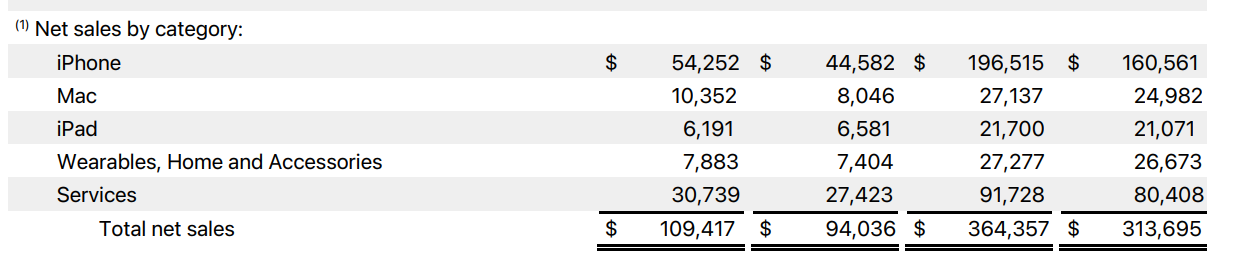
Mac revenue totaled $10.352 billion, up approximately 29% year-over-year. Apple launched several new computers in March, including the MacBook Neo, the MacBook Pro powered by the M5 chip, and the MacBook Air. According to Cook, Mac sales in emerging markets—particularly China—reached an all-time high in Q3.
iPad revenue came in at $6.191 billion, down slightly year-over-year. Wearables, Home, and Accessories revenue reached $7.883 billion, up about 8% year-over-year.
Services revenue—which includes Apple Music, the App Store, iCloud subscriptions, streaming video, and other digital offerings—was $30.739 billion in Q3, growing only 12%, a disappointing performance.
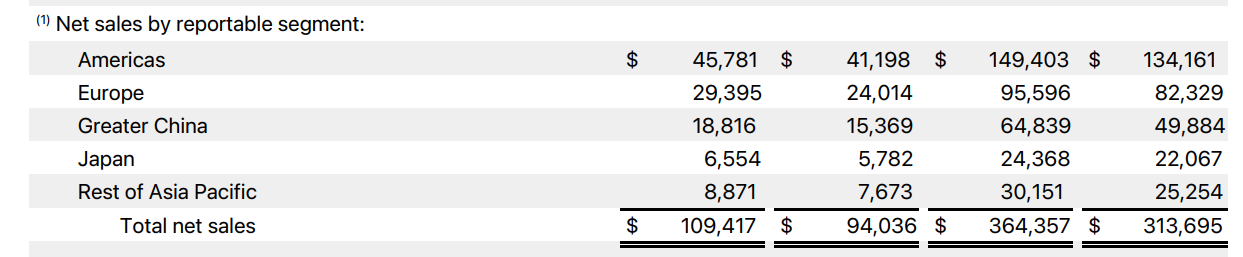
Regionally, Apple reported Q3 revenue of $18.82 billion in Greater China, an increase of over 22% year-over-year, tying with Europe as the fastest-growing region.
The primary trigger for the stock decline occurred during Apple’s earnings call, where Chief Financial Officer Kevin Parekh stated that revenue growth for the fourth fiscal quarter ending in September is expected to be between 9% and 11%, significantly below the market consensus expectation of 12.1%.
Palepu also noted that iPhone, Mac, and iPad sales in the current quarter will be impacted by 'increasingly severe supply constraints.'
Cook, often lauded as a 'supply chain maestro,' added that the current flexibility of the supply chain is below normal levels, with issues primarily arising in the production of advanced-process chips.
Cook indicated that supply constraints in the June quarter were concentrated on Mac products, mainly because demand levels were 'far above expectations,' but the sequential impact of these constraints on iPhone, Mac, and iPad will expand significantly.
Well-known leaker Mark Gurman immediately remarked that this amounts to Cook acknowledging Apple made forecasting errors in its chip procurement needs, leading to the current supply constraints.
Subsequently, Cook began elaborating extensively on the challenges posed by rising memory costs.
Cook stated that Apple paid more for memory in the March quarter than it did in the December quarter (of the prior year), and expenses in the June quarter were higher still. Memory costs are expected to rise further in the September quarter.
Regarding market rumors that Apple is attempting to source memory chips from Chinese memory manufacturer ChangXin Technology, Cook offered an indirect response.
Cook said, 'We are still assessing the situation from the perspective of supply sources. As is well known, the DRAM market is primarily served by three suppliers. Clearly, having more suppliers would be beneficial and help alleviate pressure on the supply side. The impact on pricing remains unclear, but it could potentially provide some support on the supply front.'
Editor/rice