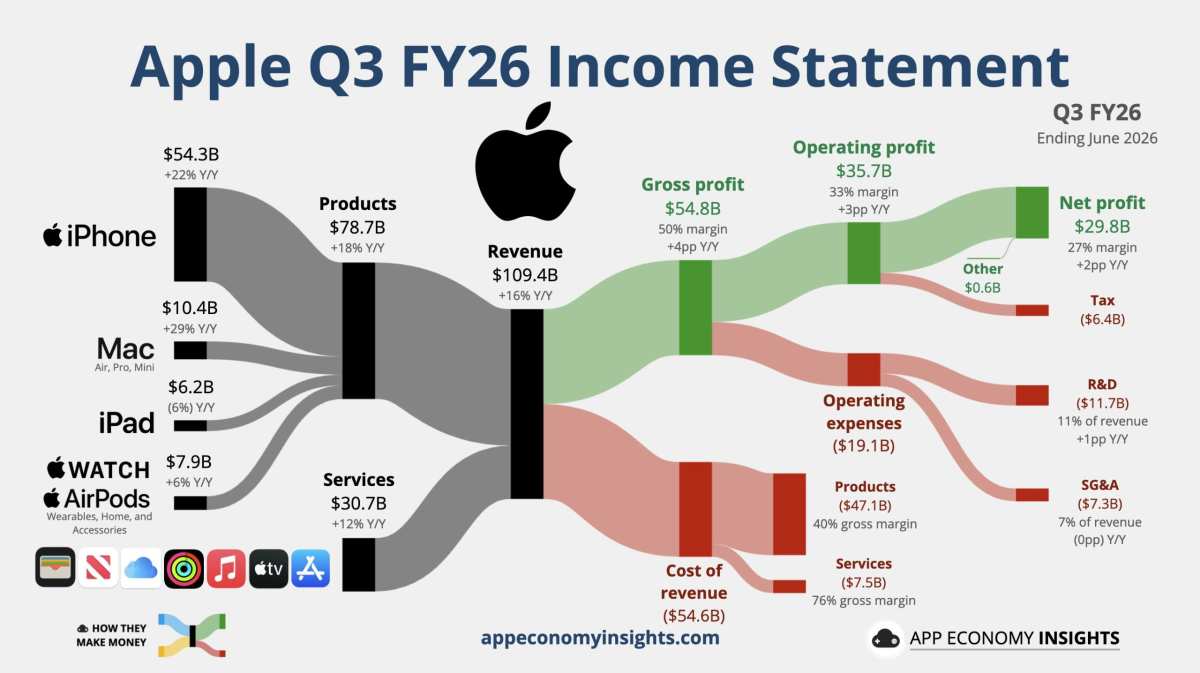
In the third fiscal quarter, Apple reported a 16% year-over-year increase in total revenue, slightly above analyst expectations, and earnings per share (EPS) rose 29% year-over-year to a new record high for the period. The better-than-expected results were primarily driven by a U.S. government tariff refund. Mac revenue exceeded expectations by 20%, while iPad revenue fell 10% short of forecasts. Services revenue grew 12% year-over-year but declined slightly quarter-over-quarter, coming in nearly 2% below expectations. Revenue from Greater China increased 22% year-over-year, though this growth rate was slower than expected. Operating cash flow reached a record high for the period, and the company declared a cash dividend of $0.27 per share.
$Apple (AAPL.US)$ Overall revenue and earnings for the previous fiscal quarter, as well as sales growth of its flagship iPhone product, were stronger than Wall Street expectations, but performance in the services segment and in China—a key market—fell short of forecasts. Executives also indicated that supply shortages of components such as memory chips would have a greater-than-expected negative impact on the company’s revenue.
On Thursday, July 30, Eastern Time, Apple reported that for its fiscal third quarter ended June 27, 2026, revenue rose approximately 16% year-over-year to $109.42 billion, slightly above analyst expectations, while earnings per share (EPS) increased by about 29% year-over-year to $2.02, nearly 7% higher than analysts had projected. Apple Chief Financial Officer (CFO) Kevan Parekh stated that both EPS and operating cash flow for the third fiscal quarter reached record highs for the company during this period.
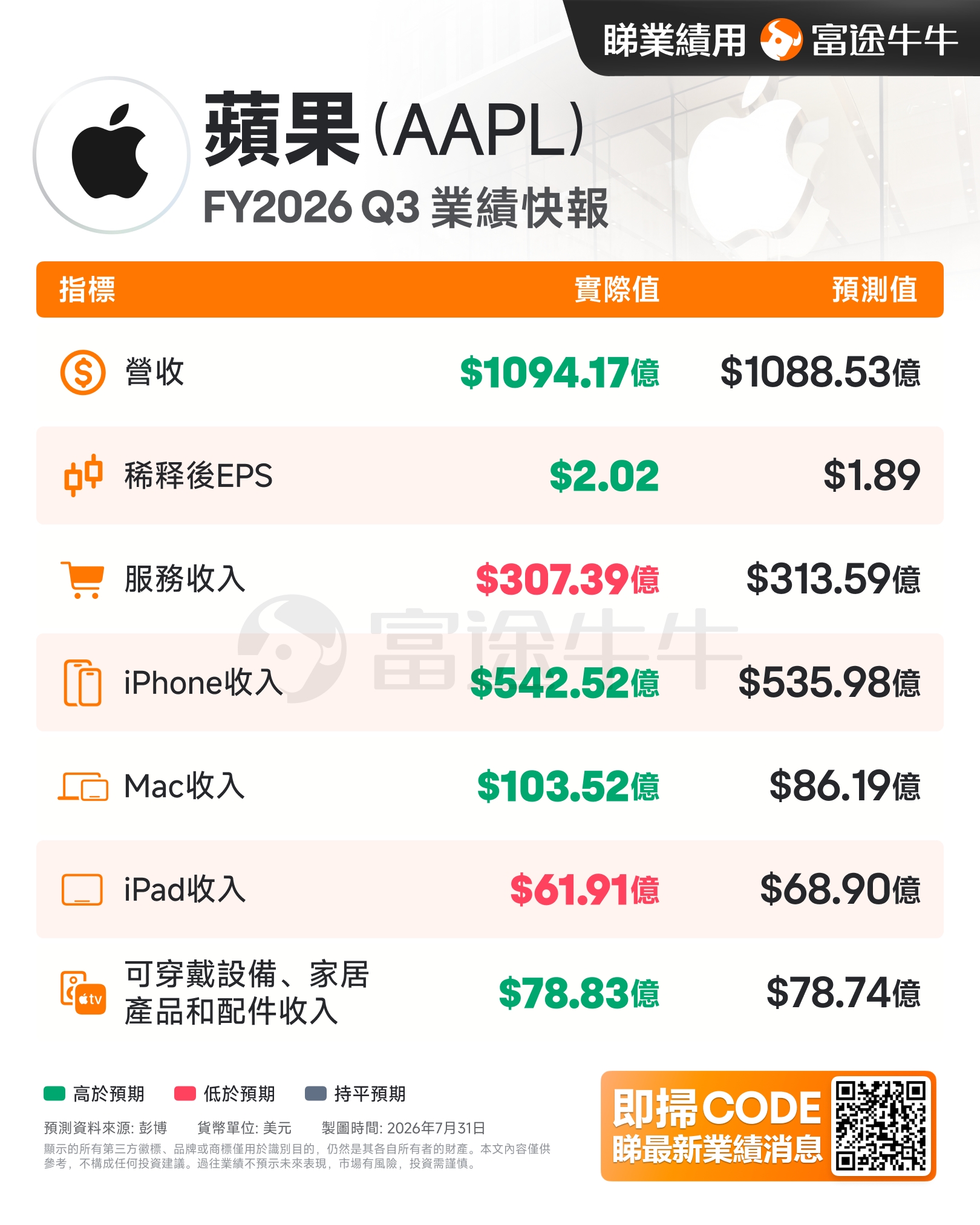
 By business segment, Apple’s hardware products overall outperformed expectations: Mac revenue was approximately 20% above analyst forecasts, iPhone revenue grew nearly 22% year-over-year—slightly exceeding expectations—while iPad revenue was about 10% below expectations, and Wearables revenue was roughly in line with forecasts. Apple CEO Tim Cook said the company delivered its strongest June-quarter performance in history, with double-digit revenue growth across iPhone, Mac, Services, and all geographic regions.
Services revenue, which accounts for nearly 30% of Apple’s total revenue, rose 12% year-over-year to $30.74 billion—nearly 2% below analyst expectations. This marks a slowdown from the prior quarter’s 16% year-over-year growth and a sequential decline of nearly 0.8%, ending a streak of over three years in which Apple consistently set new quarterly records for Services revenue. The underperformance of this segment carries greater implications for Apple’s valuation thesis, as Services is widely viewed by the market as a high-margin, stable-growth engine.
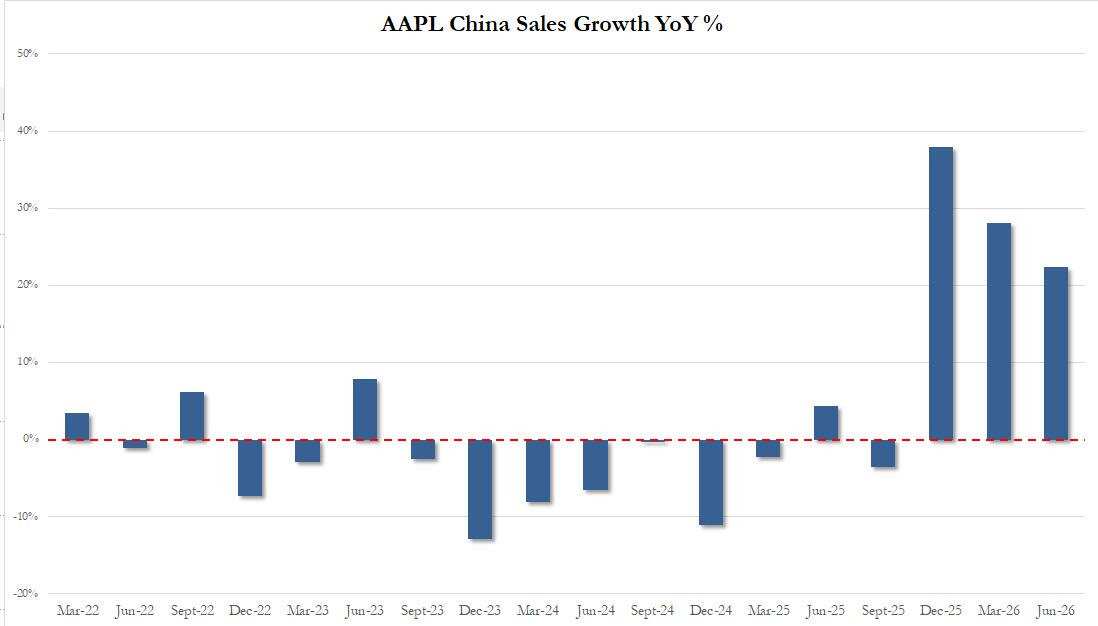
In terms of regional markets, Apple reported revenue of $18.82 billion in Greater China—the region receiving the most attention—falling nearly 4% short of analyst expectations. Year-over-year growth slowed to 22%, failing to meet expectations of roughly flat growth compared to the prior fiscal quarter. Apple’s revenue shortfall in China, the world’s largest smartphone market, may reignite investor concerns regarding iPhone demand, local competition, and the sustainability of growth.
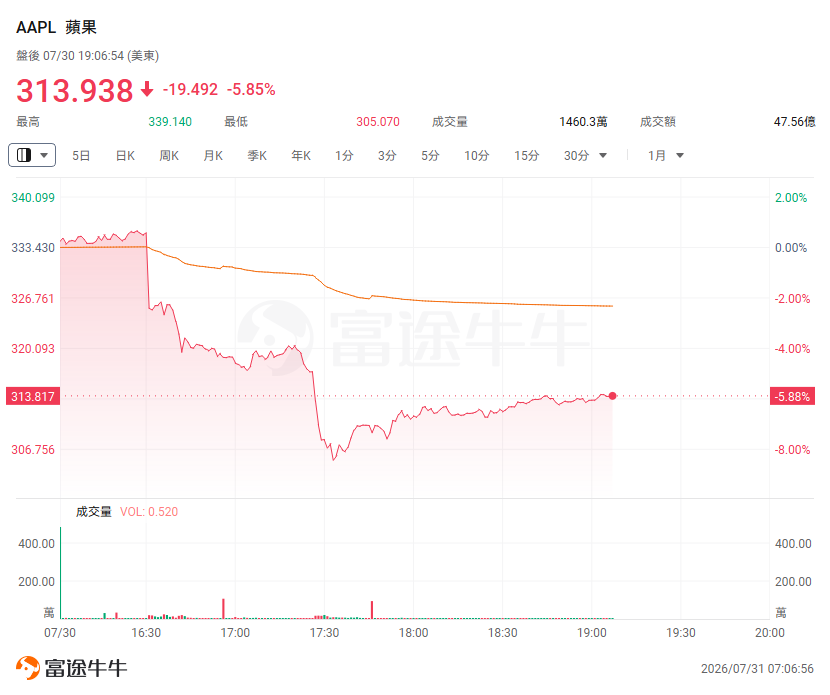
Market reaction indicated that Apple’s seemingly better-than-expected earnings report failed to impress investors. Prior to the earnings release, Apple’s stock closed down 1.4% in regular trading, and after the announcement, extended-hours losses widened further, dropping more than 4%.
During the subsequent earnings call, Apple provided fourth fiscal quarter revenue guidance of 9%–11% growth, which was generally below analysts’ expectation of 12.1%. CFO Parekh stated that component supply constraints would affect iPhone, Mac, and iPad businesses in the fourth fiscal quarter, and that foreign exchange volatility was also limiting growth. The company’s share price accelerated its decline, dropping more than 8% in after-hours trading before rebounding slightly to a loss of approximately 6%.
Analysts attribute the accelerated stock decline to multiple factors: the EPS beat was largely driven by one-time tailwinds rather than broad-based acceleration in core operations; excluding the impact of U.S. government tariff rebates, EPS was only marginally above expectations. The Services segment’s revenue miss directly undermined market confidence in profitability and long-term growth prospects. The weaker-than-expected Greater China revenue suggests that prior market optimism about a recovery in Chinese demand was overly optimistic. Additionally, Apple’s commentary on foreign exchange headwinds and supply constraints dragging revenue—particularly supply chain pressures affecting core hardware—implies that last quarter’s strong hardware performance may not carry smoothly into the current quarter.
Total Revenue Slightly Beat Expectations—Limited Upside Surprise
Apple reported third-quarter revenue of $109.42 billion, exceeding market expectations by approximately $570 million—an outperformance of only about 0.5%. While total revenue did surpass forecasts, the margin was modest. Revenue grew nearly 16.4% year-over-year, almost matching the prior quarter’s pace and slightly above the midpoint of Apple’s own guidance range of 14%–17%.
Structurally, revenue in the third fiscal quarter was primarily driven by products:
Product revenue amounted to $78.68 billion, exceeding the expected $77.25 billion;
Services revenue came in at $30.74 billion, below the expected $31.36 billion.
In other words, Apple’s revenue beat in the last quarter was not driven by its services segment, but rather by stronger-than-expected performance in its hardware product lines. This is particularly significant for Apple: in recent years, the market has been willing to assign Apple a higher valuation largely due to the rising share of services revenue, which offers more stable cash flows and higher margins. If the revenue beat stems mainly from hardware while services underperform, investors will naturally discount the quality of earnings.
EPS beat expectations largely due to Trump-era tariff refunds; dividend maintains shareholder returns but fails to offset growth concerns
Apple reported EPS of $2.02 for the third fiscal quarter, above the market expectation of $1.89—a nominal beat of $0.13, or approximately 6.9%.
However, the earnings report notably included a $0.11 benefit from refunds related to Trump-era tariffs. Excluding this one-time factor, Apple’s adjusted EPS for the third fiscal quarter would have been approximately $1.91—only $0.02 above market expectations.
This is also a key reason behind the after-hours share price decline: while the market does not dispute Apple’s strong profitability—even as the company announced record-high EPS and operating cash flow—investors are more concerned about how much of these earnings stem from sustainable operations. If the EPS beat is largely attributable to a one-time tariff refund rather than accelerating revenue, expanding margins, or robust services growth, the market reaction tends to be negative.
Concurrently with the earnings release, Apple’s board announced a cash dividend of $0.27 per share. Combined with the company’s statement that operating cash flow reached a record high, Apple’s cash generation capacity remains robust, and its commitment to shareholder returns remains unchanged.
However, at current share prices, dividends are not a decisive factor. Apple investors are more focused on medium- to long-term variables such as the iPhone replacement cycle, services growth rate, demand in China, and the rollout of AI-related products.
Although this earnings report shows the company's fundamentals remain solid, it has not fully alleviated these concerns.
Overall product revenue exceeded expectations, with Mac delivering the biggest surprise and iPad significantly lagging behind.
From a revenue composition perspective, Apple reported product revenue of $78.68 billion in the third fiscal quarter, above analysts’ expectation of $77.25 billion, making it the primary driver of the quarter’s revenue beat.
By category:
Business | Third Fiscal Quarter Revenue | Analyst Estimates | Performance |
|---|---|---|---|
iPhone | $54.25 billion | $53.6 billion | Exceeding expectations |
Mac | $10.35 billion | $8.62 billion | significantly exceeded expectations |
iPad | $6.19 billion | $6.89 billion | clearly fell short of expectations |
Wearables, Home and Accessories | $7.88 billion | $7.87 billion | Broadly in line with expectations |
Total products | $78.68 billion | $77.25 billion | Exceeding expectations |
iPhone remains Apple’s core revenue driver, contributing $54.25 billion in the third fiscal quarter—nearly half of total revenue—and exceeding expectations by just 1.2%. Its performance appears more like 'holding the baseline steady.' Mac emerged as the biggest surprise, generating $10.35 billion in revenue, $1.73 billion above market expectations, representing an upside of approximately 20%, and serving as a key offset to weakness in other segments.
In contrast, iPad revenue came in at $6.19 billion, roughly $700 million below market expectations, indicating that demand for tablets or their upgrade cycle remains unstable. Wearables, Home, and Accessories performed broadly in line with expectations, showing no significant incremental growth.
This contrasts with Apple’s broad-based growth in the second fiscal quarter, during which iPhone revenue grew 22% year-over-year, Mac rose 6%, iPad increased 8%, and Wearables, Home, and Accessories grew 5%. By the third fiscal quarter, the growth profile became more divergent: iPhone and Mac supported overall results, while iPad lagged, reflecting a lack of across-the-board product strength.
Services revenue hit a record high but fell short of expectations, marking the most valuation-sensitive miss
Apple reported services revenue of $30.74 billion in the third fiscal quarter, below analysts’ expectation of $31.36 billion—a shortfall of approximately $620 million. Although the company noted in its announcement that services continued to set new records, the market focused more on the fact that this high-margin segment failed to meet expectations.
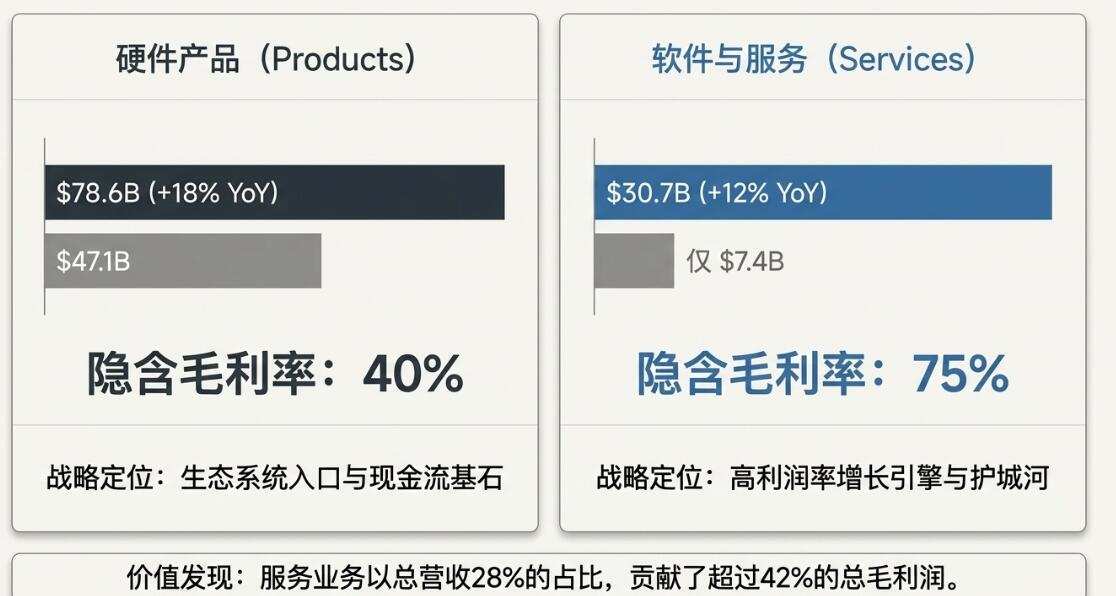
Services—including the App Store, Apple Music, iCloud, AppleCare, payments, and advertising—have become a key driver of Apple’s recent valuation reassessment. Compared to hardware, services typically offer higher gross margins, stronger customer retention, and more stable cash flows, leading the market to demand higher growth rates from this segment.
In the second fiscal quarter, Apple’s services revenue grew by 16.3% year-over-year, serving as a critical support for both profitability and valuation. Although services revenue remained substantial in absolute terms in the third fiscal quarter, it fell short of expectations, challenging the market’s prior assumption of sustained high growth in this segment.
This is also a key reason why Apple’s after-hours share price did not rise despite beating revenue and EPS expectations: if the outperformance was primarily driven by hardware—particularly Mac sales, which are more cyclical—and services underperformed, investors would revise downward their outlook for future profit margins and valuation levels.
Greater China revenue missed expectations, with the recovery trajectory falling short of market expectations.
Greater China generated $18.82 billion in revenue in the third fiscal quarter, below analysts’ expectation of $19.58 billion—a shortfall of approximately $760 million, or about 3.9%.
This figure drew particular attention. In the second fiscal quarter, Apple’s Greater China revenue grew by 28.1% year-over-year. Although this marked a slowdown from the nearly 38% growth recorded in the first fiscal quarter, it still signaled a clear recovery. At that time, Apple also posted double-digit growth across the Americas, Europe, Japan, and the rest of Asia-Pacific, making Greater China a key source of upside potential for the company’s global growth.
However, Greater China failed to meet market expectations in the third fiscal quarter, indicating that investors’ earlier bet on a strong rebound in the region has not fully materialized. Analysts had expected revenue growth in this market to moderate slightly to 27.4%, but Apple reported actual growth of 22.4%.
In the Chinese market, Apple faces multiple headwinds, including competition from domestic premium smartphone brands, pricing and promotional pressures, and fluctuations in replacement cycles. For a company with total annual revenue exceeding $100 billion, a $760 million shortfall in Greater China alone is sufficient to offset a significant portion of positive surprises from other segments.
More importantly, Greater China’s performance affects not only near-term revenue but also market perceptions of the resilience of global iPhone demand. If the growth trajectory in China continues to flatten, Apple’s potential upside in the upcoming iPhone cycle will be reassessed.
Fourth-quarter guidance falls short of expectations, as supply constraints and currency exchange rates emerge as new pressures.
What truly triggered the post-market sell-off was the fourth-quarter guidance provided during the earnings call.
Apple's management projected that revenue for the fourth fiscal quarter—the current quarter—would grow by 9% to 11%. This guidance range is generally below analysts’ consensus expectation of 12.1%. In other words, even at the high end of the range (11%), it still falls short of market expectations.
Management also noted that total revenue in the fourth fiscal quarter would be weighed down by two factors: foreign exchange headwinds and supply constraints. Specifically, iPhone revenue will be affected by supply limitations, with growth expected in the mid-teens—i.e., a mid-range increase of approximately ten-something percent. Mac and iPad products will also face supply chain disruptions.
This dealt a significant blow to market sentiment. The reason is that Apple had just reported stronger-than-expected iPhone and Mac performance in the third fiscal quarter, leading investors to anticipate that this momentum would carry into the fourth quarter. However, management has now explicitly flagged supply constraints, implying that even if end-demand remains robust, Apple may not be able to fully convert it into shipments and revenue for the current quarter.
For a company like Apple—with high valuation and elevated expectations—supply constraints do not merely imply a simple 'deferral of demand.' Instead, they necessitate downward revisions to analysts’ models regarding revenue cadence, gross margin assumptions, and near-term earnings forecasts.
 AI-powered earnings snapshot highlights key takeaways—build your options strategy! Open Futubull > Stock Page > Click [Company] >Earnings Update

Editor/rice