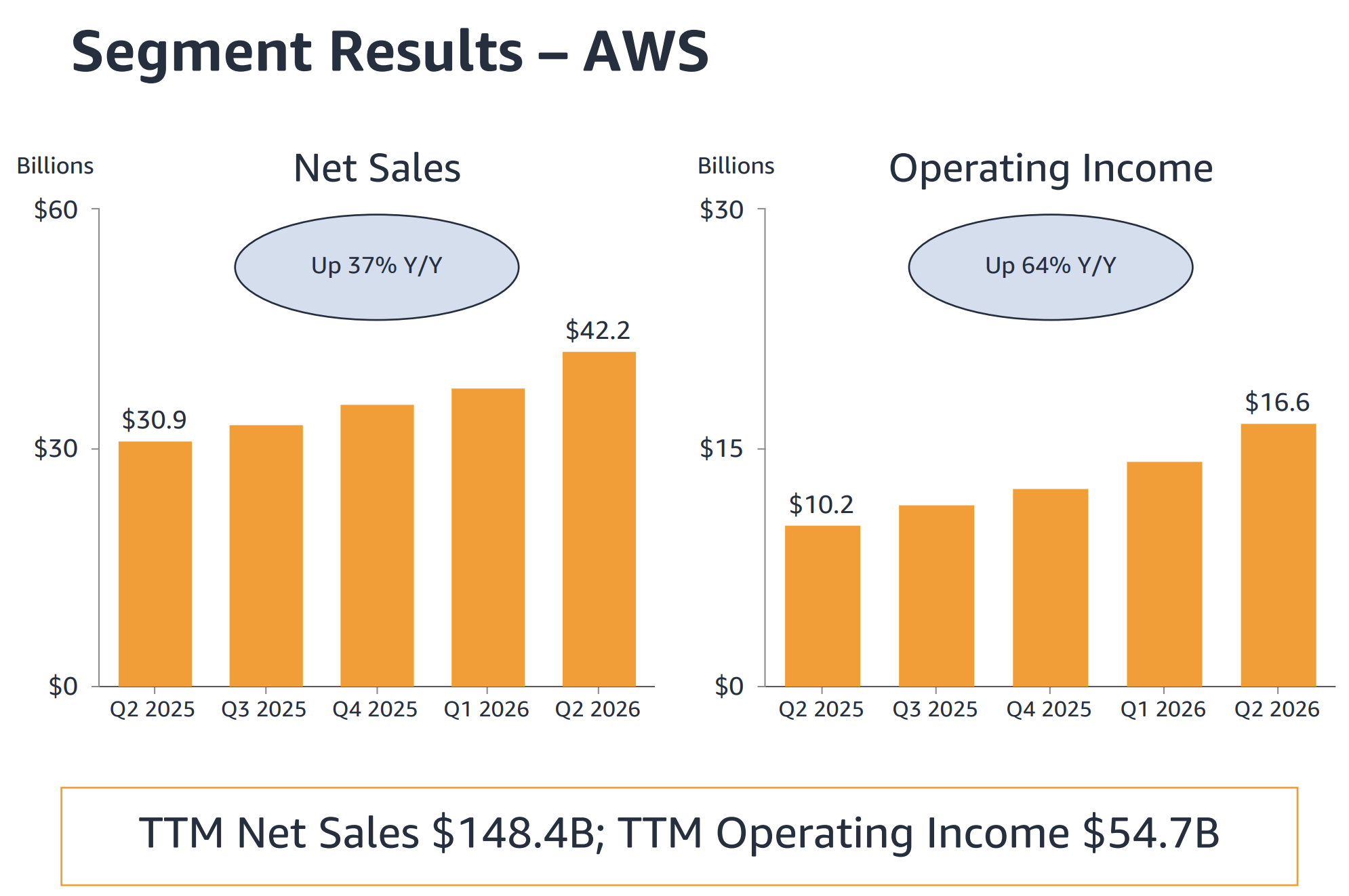
Amazon reported AWS revenue of $42.2 billion in Q2, up 37% year-over-year, exceeding the market expectation of $40.6 billion. The company projected Q3 revenue between $197 billion and $202 billion and operating income between $22.5 billion and $26.5 billion, with midpoint guidance below market expectations. Capital expenditures were raised from the previous estimate of $200 billion to $220 billion, and free cash flow came in at -$7.6 billion. Despite the increased capital expenditure outlook, Amazon's after-hours share price rose more than 9% at one point.
$Amazon (AMZN.US)$ (Amazon) second-quarter results once again demonstrate that its substantial investments in artificial intelligence infrastructure are translating into momentum for cloud business growth. Against the backdrop of sustained rising enterprise demand for AI, revenue growth at Amazon Web Services (AWS), the company’s core cloud computing segment, has accelerated significantly, marking its fastest pace in the past 18 quarters.
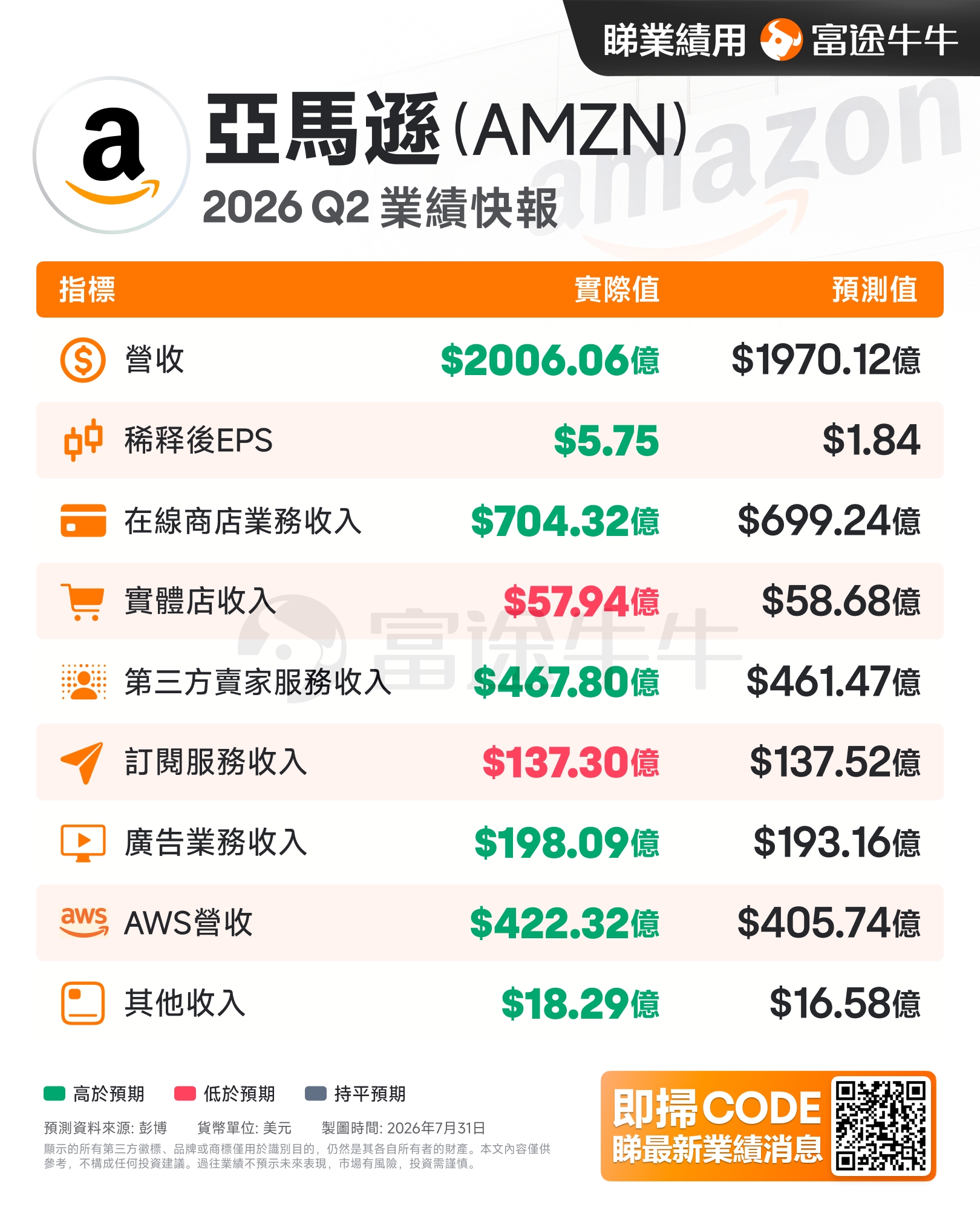
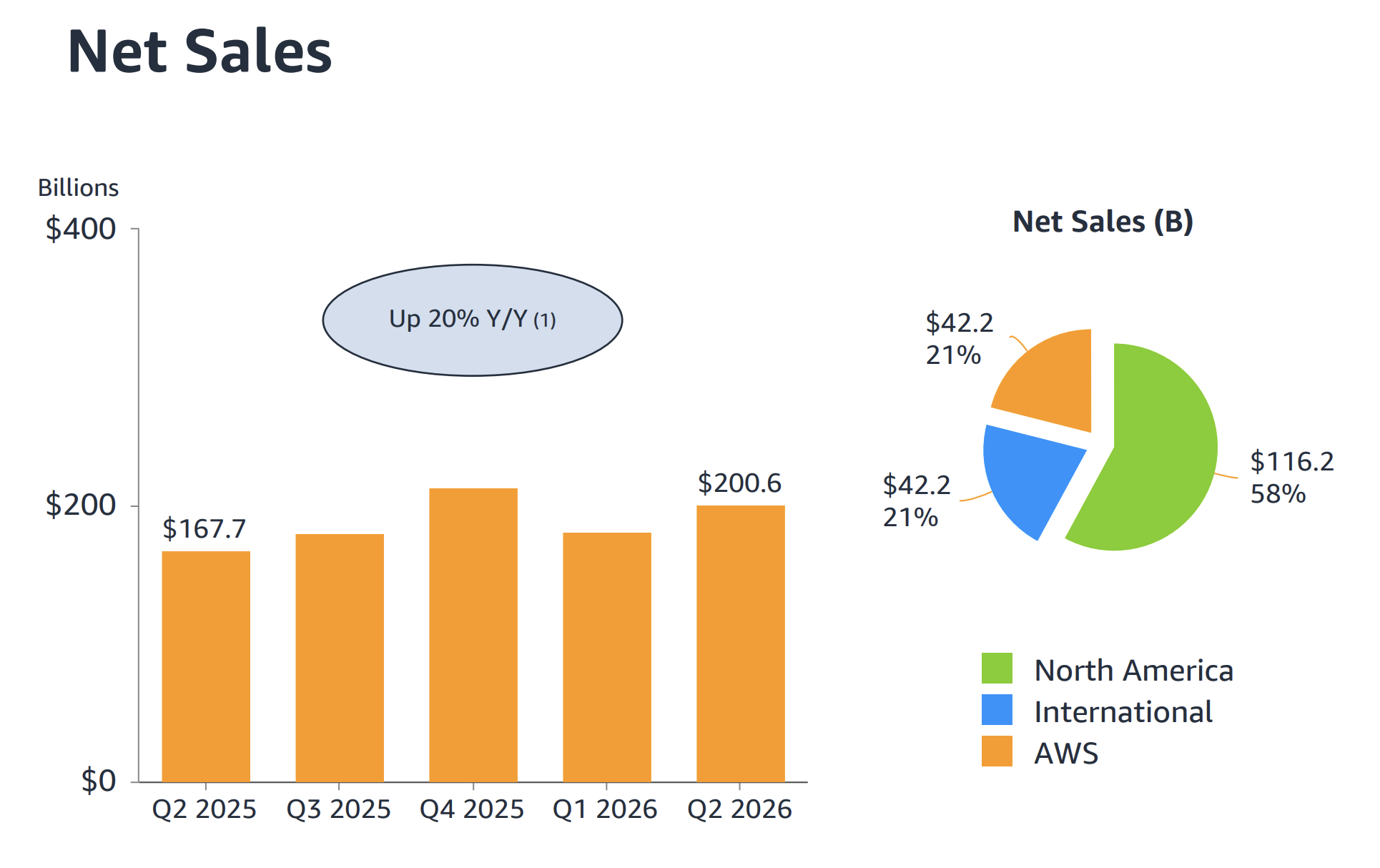
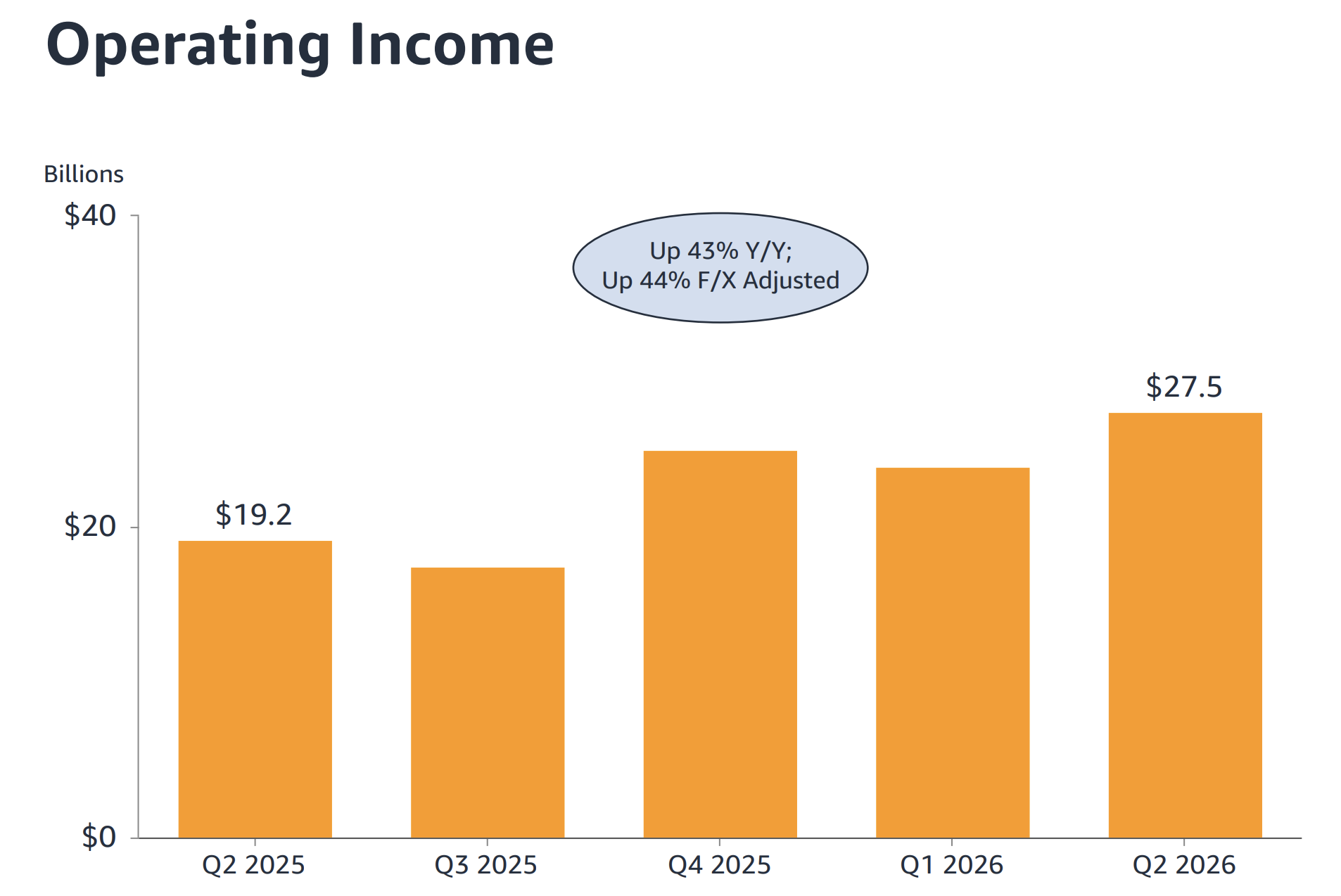
Amazon reported second-quarter revenue of $200.6 billion, up 20% year-over-year, and operating income of $27.5 billion, an increase of 43%. AWS generated $42.2 billion in revenue, up 37% year-over-year, exceeding market expectations of $40.6 billion, pushing AWS’s annualized revenue run rate to $169 billion.
 Amazon CEO Andy Jassy stated that AWS’s AI-related business has already surpassed $25 billion in annualized revenue and continues to grow at a triple-digit year-over-year rate.
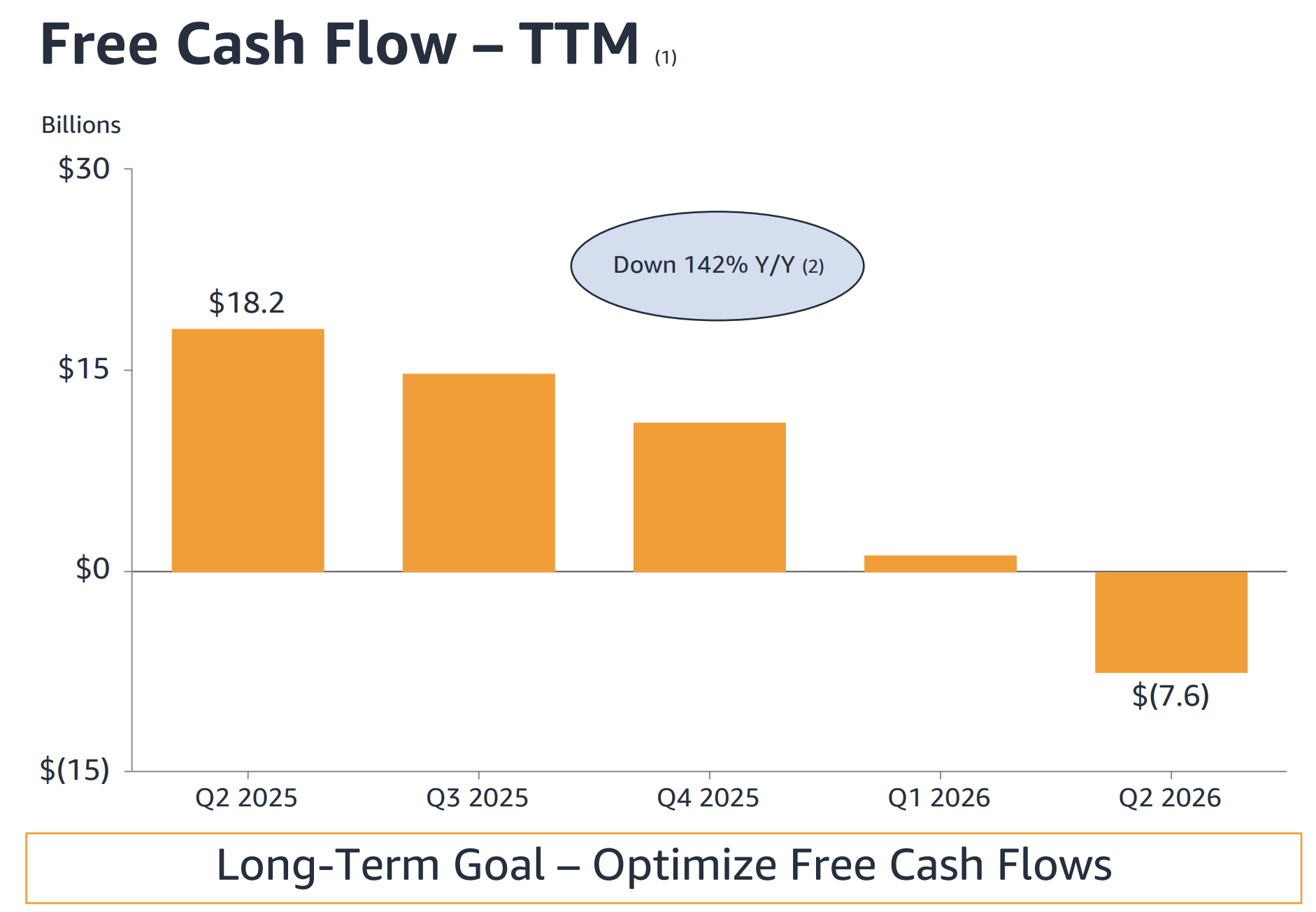
Amazon raised its capital expenditure outlook for 2026 from the previous estimate of $200 billion to $220 billion. Jassy indicated that the majority of this spending will be directed toward AI. The significant capital outlays have resulted in negative free cash flow over the past 12 months, with a net outflow of $7.6 billion.
The company also projected third-quarter revenue between $197 billion and $202 billion and operating income between $22.5 billion and $26.5 billion, with midpoint guidance below market expectations.
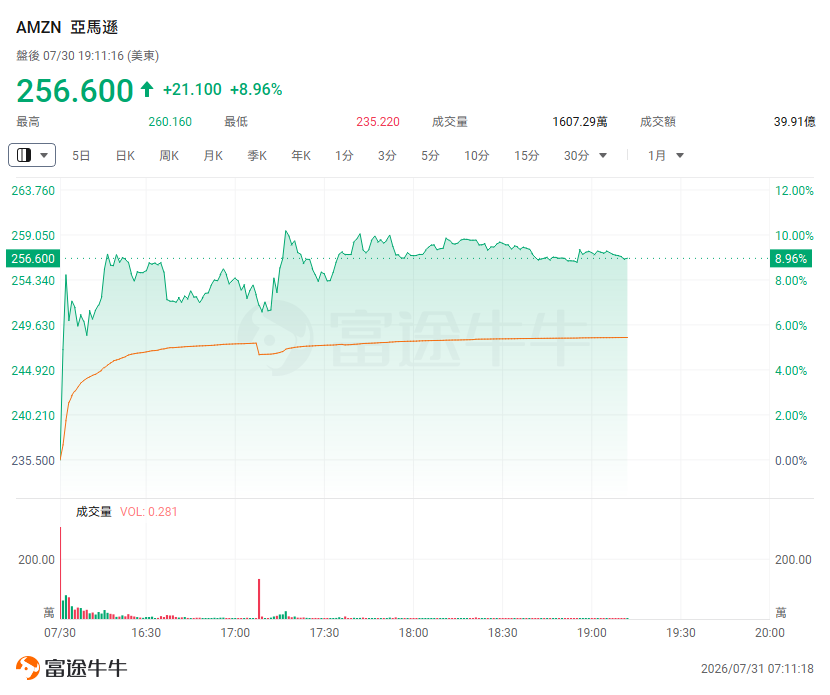
Previously, $Alphabet-C (GOOG.US)$ shares fell due to an increase in capital expenditures, while $Microsoft (MSFT.US)$ surged as it maintained capital spending unchanged. This time, Amazon was not negatively impacted by higher capital expenditures; following the earnings release, its after-hours share price rose more than 9% at one point.
AWS growth significantly exceeded expectations, with AI-driven cloud demand emerging as the primary catalyst.
Amazon Web Services (AWS) reported Q2 revenue of $42.2 billion, surpassing the market expectation of $40.6 billion, representing a 37% year-over-year increase.
AWS’s accelerating growth continues the trend recently reflected in the earnings reports of Microsoft Azure and Google Cloud: enterprise customers are substantially increasing their AI-related cloud spending, propelling the global cloud services market into a new expansion cycle. Jassy stated:
“AWS is thriving, with second-quarter year-over-year growth of 36.7%—its fastest pace in 18 quarters.”
Financial statements show that AWS reported an operating profit of $16.6 billion in the second quarter, up 64% year-over-year, with an operating margin rising to 39.4%, significantly higher than 32.9% in the same period last year.
The improvement in AWS’s profit margin indicates that cloud computing operations are generating stronger profitability as demand for AI infrastructure grows.
Capital expenditures were increased, and third-quarter guidance fell short of expectations, yet the stock price surged sharply.
Amazon raised its 2026 capital expenditure outlook from the previous estimate of $200 billion to $220 billion, with the CEO stating that the majority of this spending will be directed toward AI-related initiatives. The heavy capital outlays have turned free cash flow negative over the past 12 months, resulting in a net outflow of $7.6 billion; however, investors reacted indifferently given AWS’s strong growth momentum.
Amazon expects third-quarter revenue to range between $197 billion and $202 billion, representing year-over-year growth of 9% to 12%; operating profit is projected to be between $22.5 billion and $26.5 billion, up 29% to 52% year-over-year.
Analysts had previously expected average revenue of $203.9 billion and profit of $25.1 billion; the midpoint of Amazon’s guidance range was slightly below market expectations.
In recent years, tech giants such as Amazon, Microsoft, and Google have continued to expand investments in data centers and AI infrastructure. This year, markets have been concerned about whether the rapid increase in AI-related capital spending might compress cash flows.
Reuters noted that large U.S. technology companies are expected to invest more than $700 billion in AI-related initiatives this year. Such massive capital outlays have previously sparked market concerns about 'overbuilding AI infrastructure.' However, Microsoft, Google, and Amazon all stated that current investments are necessary to meet customer demand and alleviate constraints on computing capacity supply.
Microsoft reported on Wednesday its fastest cloud business growth since 2022 and indicated it would maintain unchanged capital expenditures for the year; its stock rose on Thursday by the largest single-day percentage since 2008. In contrast, Alphabet’s share price declined last week after its capital expenditures exceeded expectations and it posted negative free cash flow for the first time since its IPO over two decades ago.
AI products such as Bedrock and Trainium are accelerating commercialization.
In addition to infrastructure, Amazon is advancing the commercialization of AI application layers.
The company stated that its Amazon Bedrock platform currently supports more than 10 managed foundation models, including OpenAI GPT-5.6, Anthropic Claude Opus 5, Google DeepMind Gemma 4, and SpaceXAI Grok 4.3. Bedrock already serves hundreds of thousands of customers, with customer spending in the second quarter exceeding the cumulative total of all prior quarters combined.
Additionally, Amazon continues to advance its strategy of developing proprietary AI chips.
Both Anthropic and OpenAI have made multi-year, large-scale compute commitments to Trainium chips, and an increasing number of AI startups are adopting Trainium. The annualized revenue from Trainium AI chip business now exceeds USD 25 billion.
The market believes that proprietary chips will help AWS reduce its reliance on NVIDIA GPU supply chains while expanding profit margins in its cloud business.
E-commerce operations remain solid, and advertising revenue continues to grow at a high rate.
Beyond AWS, Amazon’s core retail business also maintained growth.
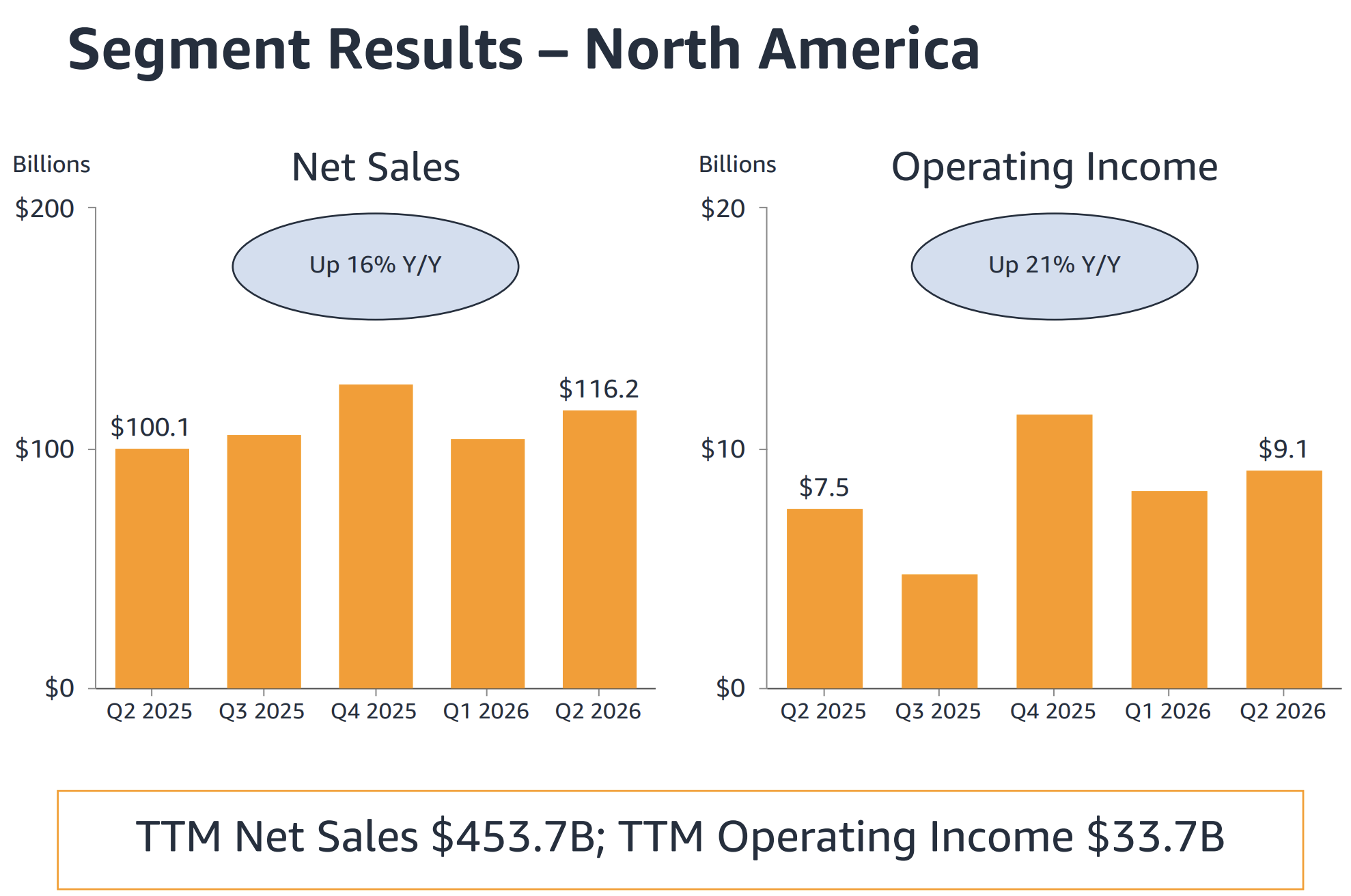
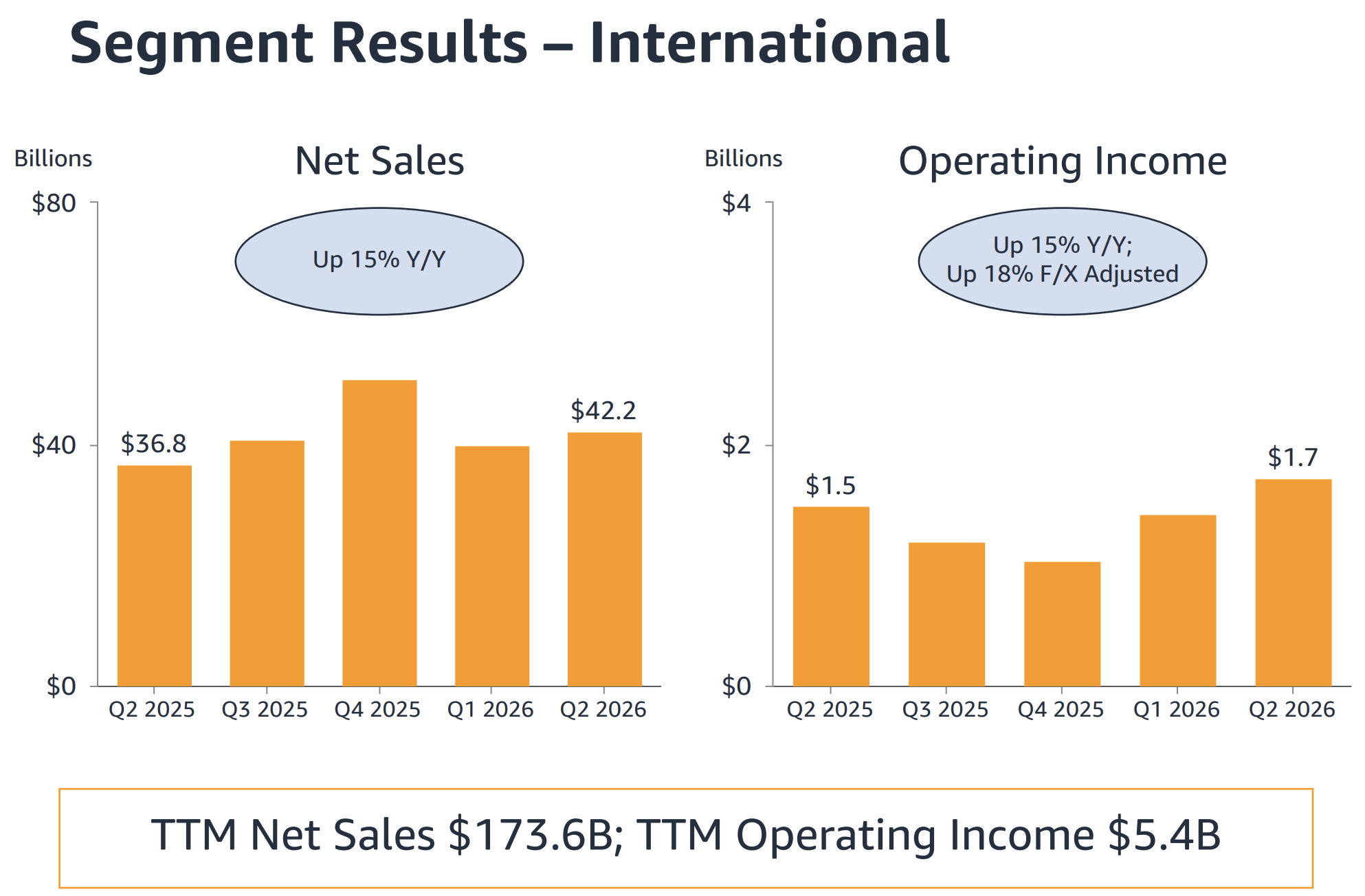
In the second quarter, North American sales rose 16% year-over-year to USD 116.2 billion, while international sales increased 15% year-over-year to USD 42.2 billion.
On the online retail front, Amazon continued to expand its delivery capabilities. Jassy noted that Prime members received even faster delivery services in the first half of the year, with the number of items eligible for same-day or next-day delivery growing by over 40%.
The second quarter also included Amazon’s annual Prime Day promotional event. According to Reuters, the event drove consumer purchases of electronics, home appliances, and daily necessities, with Adobe Analytics estimating global spending during the event exceeded USD 26.4 billion.
Meanwhile, advertising has become a significant driver of Amazon's profit growth. Financial results show that advertising revenue reached $19.8 billion in the second quarter, an increase of 26% year-over-year.
The sharp rise in net income was primarily driven by investment gains; operating profit better reflects underlying business performance.
Amazon reported second-quarter net income of $62.6 billion, a 245% year-over-year increase, with diluted earnings per share of $5.75.
However, the substantial increase in net income was largely attributable to investment gains.
According to the financial report, the company recorded approximately $53.4 billion in pre-tax other income in the second quarter, primarily from investments in companies such as Anthropic.
Excluding this effect, the market placed greater emphasis on the company's operating profit performance. Second-quarter operating profit reached $27.5 billion, up 43% year-over-year, with an operating margin rising to 13.7%.
 AI-powered earnings snapshot highlights key takeaways—build your options strategy! Open Futubull > Stock Page > Click [Company] >Earnings Update

Editor/rice