AWS reported second-quarter revenue of $42.2 billion, an increase of 36.7% year-over-year, with an operating profit margin of 39%. The strong synergy between AI and AWS has not only generated a massive backlog of nearly $500 billion in committed orders but also given management strong confidence in the return on its planned $220 billion in future capital expenditures. Andy Jassy further stated that AWS ultimately has the potential to become a $1 trillion annual revenue business.
Fueled by robust demand for AI infrastructure, Amazon's AWS cloud business recorded its fastest growth rate in 18 quarters, with management stating that even a massive capital expenditure of $220 billion would be insufficient to meet the compute capacity demands over the next two years.
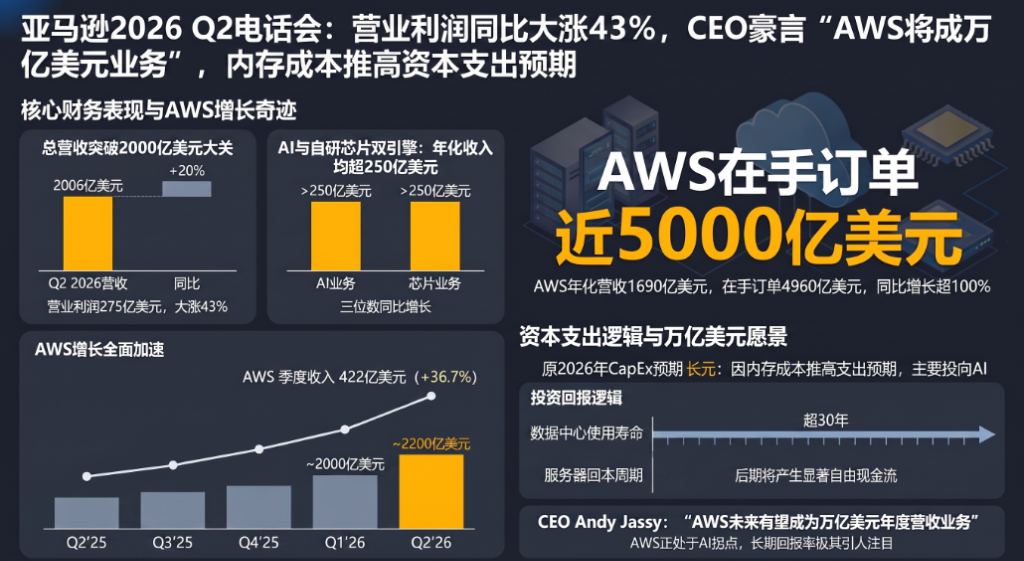
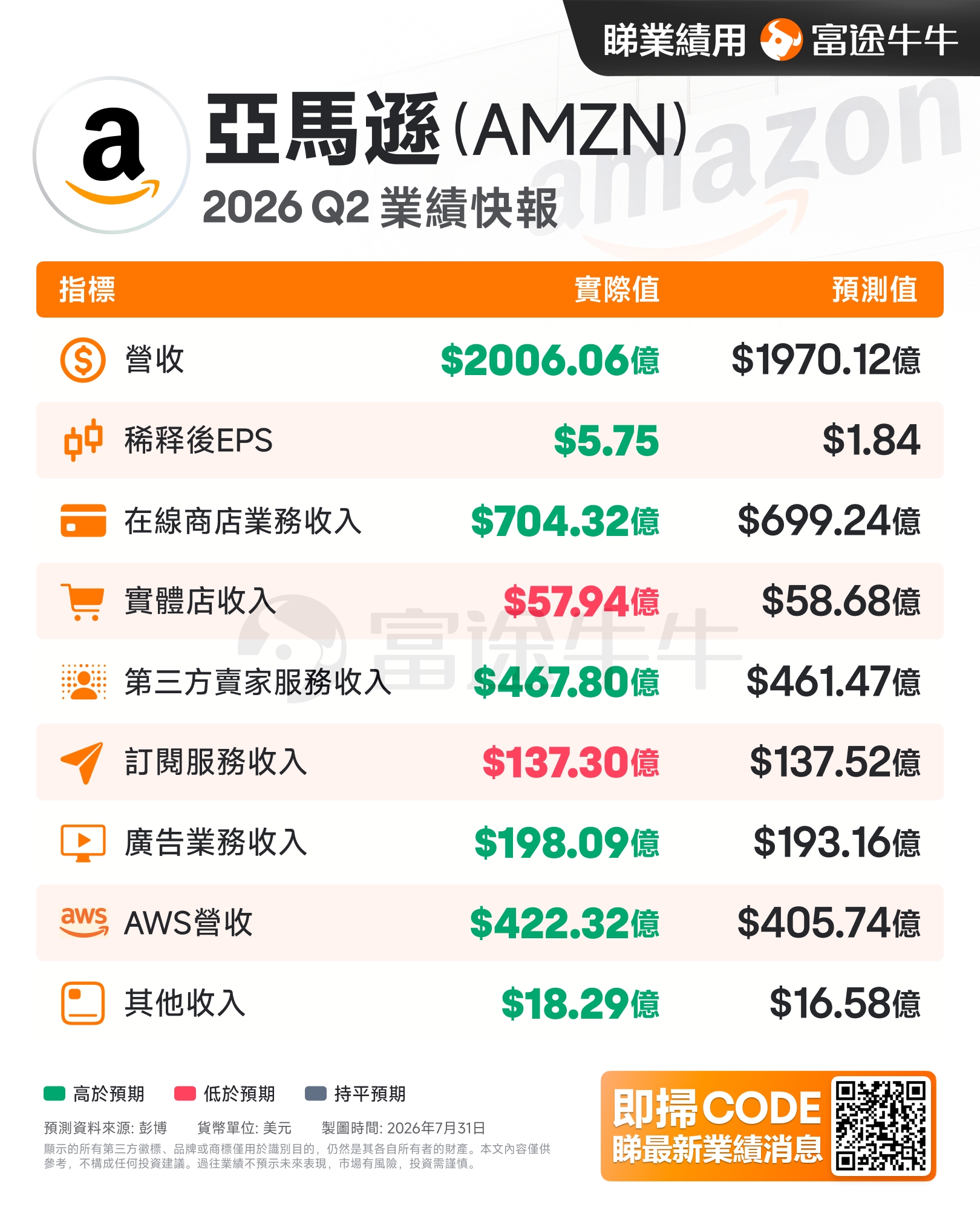
After the U.S. market close on July 30 local time, Amazon released its second-quarter 2026 financial results, reporting global revenue of $200.6 billion, a 20% year-over-year increase; operating income surged 43% year-over-year to $27.5 billion.
 In the second quarter, AWS emerged as the central focus of the earnings report. AWS generated quarterly revenue of $42.2 billion, an increase of 36.7% year-over-year, with an operating profit margin of 39%. This also marked AWS’s fifth consecutive quarter of accelerating growth.
During the earnings call, Amazon President and CEO Andy Jassy emphasized optimistically:
“AWS is currently thriving... This is our fastest growth rate in the past 18 quarters, and it’s worth noting that AWS’s revenue back then was less than half of what it is today.”
The strong synergy between AI and AWS has not only generated nearly $500 billion in committed orders but also given management strong confidence in the returns from its planned $220 billion in capital expenditures. Andy Jassy further stated that AWS ultimately has the potential to become a $1 trillion annual revenue business.
Additionally, Andy Jassy projected that the company will further increase its investment in artificial intelligence, with capital expenditures expected to reach $220 billion this year. In February, Amazon had indicated that its capital spending would reach $200 billion this year and reaffirmed this forecast unchanged in April.
Andy Jassy noted that rising memory prices have pushed up Amazon’s capital expenditure outlook. He believes the company’s current spending spree is unlikely to slow down in the near term. Andy Jassy said:
“But even so, we still don’t have enough capacity to meet all demand in 2026, and I believe the same will hold true for 2027. In fact, our projected demand for 2028 is already astonishing.”
Soaring Compute Capacity and Record Backlog: AWS’s Ambition for Trillion-Dollar Revenue
As Amazon’s profit engine, AWS posted its fastest growth rate in 18 quarters this period. Data shows AWS revenue grew 36.7% year-over-year, accelerating for the fifth consecutive quarter, with quarterly sequential revenue increasing by over $4.6 billion—80% higher than its previous largest sequential gain.
“AWS is thriving right now,” Jassy told the market in highly compelling terms, painting a vivid picture of the cloud business:
“Our backlog has reached $496 billion, growing triple digits year-over-year. AWS is now an annualized revenue run-rate business of $169 billion—if it were a standalone company, it would rank 24th on the Fortune 500 list.”
Even more notably for the market, Amazon’s monetization capabilities in AI are becoming evident. Not only has its chip business achieved an annualized revenue run rate exceeding $25 billion (with triple-digit year-over-year growth), but its AI-related revenue run rate has also surged sequentially to surpass the $25 billion mark. Jassy attributed this breakout performance to a dual-engine effect:
“AI growth is driving our core business because post-training reinforcement learning and agent tool usage primarily occur on CPUs, not AI accelerators.”
Faced with such a steep demand curve, Jassy provided highly ambitious guidance during the meeting:
“We have long believed that AWS could become a business generating hundreds of billions of dollars in revenue. We now believe it will be at least twice that amount and very likely evolve into a trillion-dollar annual revenue business in the future, accompanied by highly attractive free cash flow and return on invested capital.”
$220 Billion in Capital Expenditure: An Investment That Pays for Itself in Under Three Years
Wall Street’s biggest current concern is: when will the tech giants’ massive AI-related capital expenditures start yielding returns? Amazon has provided an exceptionally clear financial roadmap.
Due to rising memory costs and overwhelming unmet demand, Amazon has raised its projected cash capital expenditures for 2026 from approximately $200 billion to around $220 billion. Moreover, Jassy revealed:
“Even at this level, we still won’t have sufficient capacity to meet all demand in 2026, and I believe this dynamic will persist into 2027. In fact, the demand we’ve already reserved for 2028 is already astonishingly high.”
Faced with this astronomical level of expenditure, Jassy elaborated in detail on why the company is confident about its return on invested capital (ROIC). He categorized investments into data centers with lifespans exceeding 30 years and servers and networking equipment with lifespans of approximately five to six years.
“For servers and networking equipment, on average, these investments break even in less than three years. This means that in the two to three years following breakeven, we will… generate substantial free cash flow. For data centers with lifespans exceeding 30 years, we should capture the economic benefits across at least five to six generations of servers. We are seeing margins and returns in AI that align with—and are actually slightly ahead of—what we observed in our core business at the same stage of development.”
CFO Brian reinforced this point, noting that AWS’s operating margin increased by 650 basis points year-over-year in the second quarter.
A Dual Approach: Comprehensive AI Application Deployment and the Vision of External Sales for In-House Chips
On top of its infrastructure, Amazon is aggressively advancing its presence in the AI application and model layers. In response to market questions about whether 'Amazon needs to have its own leading-edge foundation model,' Jassy gave a clear answer: AWS can be extremely successful even without its own frontier model, because 'there won’t be a single model that dominates everything.'
However, Amazon has not abandoned its in-house development efforts, for the following reason:
“This gives us additional control over costs... In the coming years, you’ll see at least six models with comparable performance, all available on Bedrock—one of which will be our own.”
On the AI application front, Amazon has launched several killer services. For example, its AI-powered work assistant, Amazon Q, has already been adopted by major corporations such as BMW and 3M; the newly introduced AWS Continuum leverages large models to directly identify and fix code vulnerabilities. Jassy stated plainly: 'It’s now difficult to discuss AI with enterprises without addressing security concerns, and we expect Continuum to grow rapidly.'
On the hardware chip front, in addition to Graviton processors being used by 98% of the top 1,000 customers, the AI-optimized Trainium chips have secured multi-year commitments from Anthropic and OpenAI. During the Q&A session, Jassy even revealed a significant new development—Amazon is considering selling its custom-designed chips directly to third parties:
“An increasing number of customers are interested in us providing them with Tranium chips directly—even outside of our cloud services—and we are actively engaged in these discussions and explorations. I expect it is very likely we will do so in the future.”
Retail operations accelerate: Fresh grocery business finds its 'breakthrough'
Beyond cloud and AI, Amazon’s traditional commerce base remains solid. Advertising revenue reached $19.8 billion in the second quarter, up 26% year-over-year. In the highly competitive retail delivery segment, Amazon has deployed a dual strategy of 'ultra-low prices plus ultra-fast delivery.'
“We now offer same-day delivery of perishables in 2,300 cities across the U.S.... Nine of the top ten best-selling items are perishable goods. Since the beginning of this year, the number of monthly active customers purchasing perishables has increased by 50%... We have found a breakthrough in our same-day perishables business within our same-day delivery facilities.”
Translated excerpt from Amazon's Q2 2026 earnings call:
Andy Jassy, President and Chief Executive Officer:
Thank you, Dave. We reported revenue of $200.6 billion, up 20% year-over-year. Operating income was $27.5 billion, up 43% year-over-year. Q2 was another very strong quarter for Amazon. I’ll start with AWS, which is thriving, and I’ll share the data, our view on why this is happening, and our confidence in the return on invested capital equation—even as capital expenditures remain high over the next few years.
First, the numbers: Revenue grew 36.7% year-over-year, marking the fifth consecutive quarter of accelerating growth—our fastest pace in 18 quarters, when AWS’s revenue was less than half of what it is today. On a sequential basis, we added over $4.6 billion in revenue, roughly 80% higher than our previous largest quarterly increase. Our backlog stands at $496 billion, reflecting triple-digit year-over-year growth.
AWS is now a business with an annualized revenue run rate of $169 billion. To put this in perspective, if it were a standalone company, it would rank 24th on the Fortune 500 list. Our chip business now has an annualized revenue run rate exceeding $25 billion, also growing at a triple-digit year-over-year rate.
Our AI business has seen substantial sequential growth in revenue run rate and now also exceeds $25 billion, with triple-digit year-over-year growth. Customers choose AWS because we offer the broadest set of capabilities they desire; they want their AI inference workloads located close to their other applications and data—and more of those applications and data reside on AWS than anywhere else. Additionally, AWS delivers the strongest security and operational performance.
We are seeing strong growth in both AI and non-AI segments (which we refer to as our core business), with each driving the other. AI growth fuels our core business because post-training reinforcement learning and agent tools primarily run on CPUs rather than AI accelerators. This is an advantage for AWS, as our Graviton chips are the most powerful CPU chips available, offering 30% to 40% better price-performance than alternative options. Customers also need a place to store their AI data and run vector databases—another area where AWS holds a significant edge, given our unmatched breadth and depth of capabilities in these core infrastructure domains.
Our perspective spans the entire AI technology stack from top to bottom. We have a unique portfolio of offerings that excites our customers. As we’ve consistently stated over the past 18 months, technically capable companies will build their own foundation models—not necessarily massive frontier models, but smaller models leveraging their proprietary data. There is no easier service for this purpose than our SageMaker AI platform.
Customers also require high-performance, cost-effective inference services, which is precisely why Amazon Bedrock was created. Bedrock not only offers the best selection of leading models—with exceptional performance and the governance and security controls enterprises demand—but is also growing at an exceptionally rapid pace. Beyond best-in-class model building and inference, customers need simpler ways to build, operate, and leverage agents.
For example, even after you’ve built an agent, numerous complex operational issues remain. A production-grade agent requires a secure execution environment, memory to maintain context, an identity to act on behalf of users, integrations with tools and data sources, and mechanisms to monitor its behavior under real-world traffic. Reliably integrating all these components is challenging, yet doing so resolves many critical production deployment hurdles.
This is why we built Bedrock Agent Corp. It provides pre-packaged, managed infrastructure, which our team continuously iterates on. Recent enhancements include policies (giving companies deterministic control over agent behavior), payments (enabling agents to autonomously execute transactions), web search (grounding agent knowledge without leaving AWS), and a new tool that further accelerates customer integration—including the ability to create agents using “strands.” While some companies will build specialized agents from scratch, most will opt for turnkey solutions.
Code agents are a prime example, with several successful agents currently available, including Cloud Code, Codex, and our own specification-driven Curo, which delivers 50% better cost-performance than other solutions and has seen its usage triple quarter-over-quarter.
Another such service is Amazon Quick, an intelligent AI work assistant that helps you manage, search, and automate digital workloads across email, calendars, local or cloud files, and custom workflows.
Unlike other products in this space, Quick also enables management within leading SaaS tools such as Slack, Salesforce, Jira, Teams, and ServiceNow. It leverages a company’s existing access controls so that users only see content within their permission scope, and then takes actions such as scheduling meetings, drafting and sending emails, updating CRM records, and building dashboards.
In the second quarter, we significantly enhanced Quick’s capabilities by introducing autonomous agents that customers can configure using natural language to run continuously in the background and execute multi-step tasks. We also added a personalized activity feed—consolidating emails, messages, calendar events, and tasks into a single prioritized view—and 16 new integrations, including Adobe, Moody's, and Snowflake. Quick is gaining strong momentum, with companies such as 3M, Allianz, AstraZeneca, Autodesk, BMW, Exxon, FINRA, Hyundai, Intuit, Mondelez, Moody's, NBA, NFL, Life Insurance, and Southwest Airlines already using it.
We also offer services like Amazon Connect (our contact center service) and AWS Transform (for automated software migration), both of which are growing rapidly. I’d also like to highlight a service I find particularly compelling. As frontier models become increasingly powerful, they make it easier to uncover security vulnerabilities in technical applications—many of which have never been identified by humans.
This is clearly concerning for companies tasked with protecting critical data. We recently launched AWS Continuum, which discovers, prioritizes, validates, and remediates code vulnerabilities. It begins by importing a team’s existing backlog of vulnerabilities and then uses new frontier models to perform comprehensive scans. Continuum employs agents contextualized within each company’s specific business environment to prioritize issues by reasoning through questions such as: 'Is the affected component deployed? Is it reachable? Is it on a production path? What would be the impact if exploited?'
It then validates vulnerabilities in a sandboxed environment, ensuring teams don’t waste time chasing false positives. Finally, it recommends remediation steps. In today’s conversations with enterprises about AI, it’s nearly impossible not to address security—and we expect Continuum to grow rapidly.
As I mentioned earlier, our chip business is now running at an annualized revenue rate exceeding $25 billion. Given our leadership in cost-performance chips—Tranium in AI and Graviton in CPUs—we are exceptionally well-positioned in this AI transformation. Beyond multi-year, multi-gigawatt commitments from the world’s two leading AI labs, Anthropic and OpenAI, Tranium adoption is expanding among AI startups, including unicorns like Neurobotics and Odyssey, as well as emerging companies such as 12 Labs, Descarte, Poolside, Karakuri, Neto AI, and Splash Music. Major enterprises like Uber and Pinterest are also adopting Tranium. Graviton is used by 98% of our top 1,000 EC2 customers. Revenue commitments have nearly tripled quarter-over-quarter, and Graviton 5 is growing at almost twice the pace of Graviton 4.
We also maintain a deep partnership with NVIDIA and will continue making AWS the best place to run NVIDIA chips, as many customers will continue running on NVIDIA for the foreseeable future. We firmly believe customers need choice—choice benefits customers, fosters competition, and drives down inference costs, which customers care deeply about.
Let me take a moment to discuss how we view the return on this investment. Earlier this year, we stated our plan to invest approximately $200 billion in cash capital expenditures in 2026, the majority of which will support AI and AWS. Even at this elevated—or higher—spending level, we have a clear line of sight to strong financial returns.
Let me explain the reason. Investment consists primarily of two components: data centers and the servers and networking equipment placed within them. These have different capital cycles. Capital expenditures for data centers begin about two years before we can start generating revenue by placing servers inside them. Once a data center opens and servers are installed, we immediately begin generating substantial revenue and continue monetizing these facilities for over 30 years without needing to reinvest that initial upfront capital. Servers and networking equipment have a shorter cycle. We typically purchase this equipment just a few months before deployment, giving us strong visibility into customer demand before incurring the expenditure. If there is no demand, we simply do not spend that capital. On average, investments in servers and networking equipment achieve payback in less than three years. Server lifespans are currently at least five to six years, and most of our current AI capacity is under contracts with terms of at least five years. This means that for two to three years after payback, we generate significant free cash flow from these servers and networking assets. It is also worth noting that AWS has a strong track record of shortening the payback period for server equipment. We have already made meaningful progress—without compromising customer experience—in extending the usable life of this equipment. Therefore, for data centers with useful lives exceeding 30 years, we should capture the economic benefits of at least five to six generations of servers as I previously described. Moreover, because subsequent generations beyond the first do not require re-investment in the underlying data center infrastructure, their overall economics are even better. This implies that in the near term, when demand forces us to build so many data centers simultaneously before we can begin monetizing them, we will incur substantial capital expenditures and face free cash flow headwinds—until these facilities come online, are monetized, and the servers within them have been utilized for several years. Over time, as revenue growth outpaces incremental capital spending (which will happen at some point), the resulting revenue, free cash flow, and return on invested capital will be very attractive. We experienced a similar dynamic during the first era of cloud computing, though over a longer timeframe, as demand accumulation was more gradual then compared to the AI era. However, we are seeing margins and returns in AI that align with—and actually slightly exceed—what we observed in our core business at a comparable stage of development. We now expect cash capital expenditures in 2026 to be approximately $220 billion, an increase from our prior estimate of roughly $200 billion, driven largely by rising memory costs. Even at this level, however, we still will not have sufficient capacity to meet all demand in 2026, and I believe this dynamic will persist into 2027 as well. In fact, the demand we have already committed to for 2028 is already staggering. Keep in mind that enterprises are still in the very early stages of deploying inference at scale in their production applications today. We have long believed AWS could become a business generating hundreds of billions of dollars in annual revenue. We now believe it will be at least twice that amount and very likely evolve into a trillion-dollar annual revenue business in the future, accompanied by highly attractive free cash flow and return on invested capital. I’ll now turn to the Stores business.
We have also expanded Amazon’s ultra-low-priced selection on Amazon.com in the U.S. by nearly 20 times since its launch, and now offer over 6 million items priced below $10. We continue to provide everyday low prices that match or beat competitors and deliver deep discounts during promotional events.
We are pleased with customer response to Prime Day, during which customers purchased millions of deals, over 80% of which were the lowest prices of the year, with hundreds of thousands of items discounted by 40% or more. We are the second-largest grocer in the U.S., and our grocery business continues to grow rapidly across both perishable and non-perishable categories.
Since the beginning of this year, our monthly active customer base for perishables has grown by more than 50%. Orders containing perishables delivered via same-day delivery average more than three times the units per order compared to typical orders. Fresh groceries now occupy six of the top 20 best-selling items on amazon.com. In the first half of this year, new customer sign-ups for Amazon Pharmacy more than tripled, and same-day prescription deliveries grew nearly fivefold.
This year alone, we have saved customers nearly $250 million in out-of-pocket costs—a year-over-year increase of over 400%. We continue to accelerate overall delivery speeds and achieved record-breaking customer delivery speeds again in the first half of this year. Through Prime, we offer same-day delivery on millions of items—40 times the selection of a typical large-format retail store—and our same-day delivery network continues to expand.
Globally, in the first half of this year, the number of items we delivered via same-day or next-day service increased by over 40% compared to the same period last year. We also continue expanding our ultra-fast service, Amazon Now, which offers delivery in 30 minutes or less on thousands of everyday essentials. In Q2, we added 80 new cities and towns in the U.S. and launched the service in several major cities in Egypt. Amazon Now now operates in over 250 cities and towns across nine countries globally. Customer response remains strong, with total sales and units sold growing by over 80% quarter-over-quarter, and the number of customers served increasing by over 60% quarter-over-quarter.
We recently launched Amazon Supply Chain Services, enabling any business to use the same supply chain that powers Amazon to move, store, and deliver everything from raw materials to finished goods. We already have several large customers, including Procter & Gamble, 3M, Lands’ End, and American Eagle Outfitters. The Stores team also continues leveraging AI to innovate and serve customers. Customers love the Alexa shopping experience or AI-powered shopping assistant, which provides personalized recommendations, product comparisons, price history, and automates shopping through features like price alerts and auto-purchases.
Over the past 12 months, more than 350 million customers have used it, and engagement accelerated in Q2, with active users nearly doubling and interactions growing over fivefold year-over-year. We’ve also expanded Amazon Lens, which allows customers to take a photo of any item and instantly find the same or similar products on Amazon. This feature has now rolled out to 10 additional countries and is available in 21 countries globally. Next is Amazon Advertising, where we saw strong growth across all products, generating $19.8 billion in revenue, up 26% year-over-year. Sponsored Products remains our largest offering and a key growth driver.
In addition, an increasing number of shoppers are discovering products through our agentive and conversational experiences, including Alexa Plus and Alexa Shopping features. Shoppers who click on sponsored prompts are 48% more likely to convert into a sale and spend 21% more on average than those who don’t click. We continue to see growing engagement with Prime Video advertising and live sports. In our first year with the NBA, we onboarded over 30 new advertisers, and ad inventory for Thursday Night Football, the NBA, WNBA, and NASCAR is completely sold out. Advertisers are increasingly adopting cross-sports strategies: brands advertising across multiple sports achieve 2.3 times higher non-duplicated reach compared to single-sport advertisers, and cross-sport audiences spend 12% more and place 17% more orders on Amazon.
Finally, we’re using AI-powered tools—including Ad Agents—to make it easy to create, launch, and optimize full-funnel marketing campaigns, reducing hours of setup and targeting work to just minutes. Advertisers using Ad Agents see an 8% lower cost per impression and a 6% lower cost per acquisition. We’ve expanded this capability to 11 new countries this year. We’re also seeing sustained momentum in several other areas—I’ll just highlight a few.
First, in entertainment, the inaugural season of NBA on Prime Video achieved strong viewership. Game 7 of the Eastern Conference Semifinals reached a peak audience of 6.5 million viewers in the U.S., surpassing the same matchup broadcast on traditional television a year earlier. In Europe, NBA viewership on Prime Video more than doubled year-over-year, achieving the highest average viewership on record. Globally, our series 'Off Campus' attracted 36 million viewers within its first 12 days of release, making it the third-highest debut ever on Prime Video.
Alexa Plus has expanded to Germany, Austria, France, and Brazil, with hundreds of millions of customers now using the new Alexa experience. We’ve observed that Alexa drives business growth wherever it is introduced. For example, in the U.S., customers who shop using Alexa spend over 40% more per order on average than those who do not use Alexa. Customers who have tried Alexa+ are nearly 25% more likely to subscribe to Prime. Finally, Amazon LEO now has nearly 400 satellites in orbit—sufficient to begin offering initial satellite internet service this year. We have already secured significant revenue commitments from enterprise and government customers, and more than 20 partners will extend our network coverage globally.
We continue to be in the midst of some of the most transformative changes of our lifetimes, building multiple new long-term businesses that will make customers’ lives better and more convenient while delivering substantial free cash flow and returns on invested capital for our shareholders and the business. With that, I’ll turn the call over to Brian.
Brian T. Olsavsky, Chief Financial Officer:
Thank you, Andy. Let me start with our overall revenue performance: global revenue was $200.6 billion, up 20% year-over-year (excluding foreign exchange impacts). These results include the impact of shifting Prime Day into the second quarter, which applied to most of our major countries, including the U.S.
In Q2, we reported global operating income of $27.5 billion. This includes approximately $1.2 billion in benefits from two items that reduced expenses this quarter. First, we received about $600 million in tariff-related refunds. This is recorded in our North America segment and represents the vast majority of the refunds we expected to receive. Second, we recorded approximately $600 million in a separate gain related to changes in the fair value of energy contracts subject to derivative accounting treatment. This primarily affects the AWS segment. These energy contracts were entered into to secure power supply for current and future operations. Certain terms in these contracts subject them to derivative accounting. Derivatives are measured at fair value each reporting period, and changes in fair value are recognized in our operating statement as unrealized gains or losses within operating expenses. While the impact of these fair value measurements may vary, these adjustments were not material in prior quarters.
Certain provisions in these contracts subject them to derivative accounting treatment. Derivatives are measured at fair value each reporting period, and changes in fair value are recognized in operating expenses as unrealized gains or losses on our income statement. While the impact of these fair value measurements may vary, these adjustments were not material in recent quarters. Turning now to segment results: North America segment revenue was $116.2 billion in the second quarter, up 16% year-over-year. International segment revenue was $42.2 billion, up 15% year-over-year (excluding foreign exchange impacts).
Global paid units grew 17% year-over-year. Prime remains a key pillar of our business, and our double-digit year-over-year membership growth reflects the value our offerings deliver at scale. We’re seeing broad-based momentum across input metrics that drive customer experience—including expanded selection, competitive pricing, and faster delivery.
Turning to profitability, North America segment operating income was $9.1 billion, with an operating margin of 7.9%. International segment operating income was $1.7 billion, with an operating margin of 4.1%. Within our fulfillment network, we’ve made progress optimizing inventory placement, shortening delivery distances, reducing handling touches per package, and increasing sortation rates. We are expanding deployment of robotics and automation, which have been integral to our operations for decades. We are upgrading our facilities with next-generation technologies and expect to more than double the number of robotic arms like Cardinal and Sparrow by 2026. We continue to reduce overall service costs despite transportation cost pressures from rising fuel prices due to Middle East conflicts and elevated line-haul rates driven by capacity constraints. Excluding the impacts of higher fuel and line-haul costs, transportation cost growth has lagged behind low-single-digit global unit growth, consistent with last quarter’s pace. The impact of these cost increases on operating income was partially offset by the FBA fuel and logistics surcharge we implemented in April. Looking ahead, we see significant opportunities to further improve productivity across our global fulfillment network while continuing to raise the bar on delivery speed. While operating margins may fluctuate and progress may not always be linear, we are taking a disciplined approach to achieve sustained, long-term improvements in service costs. Turning to AWS, segment revenue was $42.2 billion, up 36.7% year-over-year, driven by both core services and AI offerings. AWS now has an annualized revenue run rate of $169 billion. Customers continue to accelerate cloud migrations and expand usage of our core AWS services. At the same time, an increasing number of customers are accelerating their move to the cloud to fully capture the benefits of AI. We observe a strong linkage between AI spending and core business growth: as customers invest in AI, we see corresponding increases in consumption of our core services. We expect this relationship to strengthen over time as more AI workloads move into full production and drive additional demand for our core services. AWS operating income was $16.6 billion, reflecting our strong growth and disciplined focus on operational efficiency. Investments in software and process improvements have optimized server capacity, and our lower-cost custom chips and networking hardware have helped build a more efficient infrastructure. Turning to cash capital expenditures, they totaled $53.1 billion in the second quarter, primarily related to AWS and generative AI as we invest to support strong customer demand. We will continue to make significant investments, particularly in generative AI, as we believe this represents a massive opportunity with the potential to drive long-term revenue and free cash flow growth. Before turning to guidance, I’d like to briefly address the impact of tariff-related refunds on our results. We are participating in the tariff refund process, and as previously mentioned, we received approximately $600 million in the second quarter. This amount is limited for several reasons. First, our teams undertook extensive pre-buying and inventory pre-positioning efforts to avoid tariff costs. Second, for the majority of products sold in our stores, we are not the importer of record, as suppliers typically handle imports and pay associated tariffs. In cases where we did incur tariff-related cost increases, we largely absorbed those costs rather than passing them on to customers. This is evident in how we’ve maintained highly competitive pricing over the past year—according to third-party research firm Profitero, our product prices are, on average, 14% lower than those of other retailers. We have identified a limited number of instances where we can retrospectively demonstrate that specific import fees were passed through to customers. In those cases, we will proactively contact affected customers and issue automatic refunds. Otherwise, like other large retailers, we will use these refunds to continue investing in low prices for customers. Finally, I’ll provide our financial guidance. Third-quarter net sales are expected to be between $197 billion and $202 billion. I’d like to highlight two factors contributing to the sequential deceleration in net sales growth from Q2 to Q3. First, the timing of Prime Day shifted this year, with promotions occurring in Q2 across most of our major countries, including the U.S. In 2025, Prime Day will fall entirely within Q3. Excluding the impact of Prime Day timing in both 2025 and 2026, Q3 2026 year-over-year growth would be nearly 400 basis points higher. We recognize that the shift in Prime Day timing introduces some noise into modeling financial performance. However, adjusting for this impact, we see strong customer engagement, growth, and continuation of H1 trends in our store business heading into Q3. Second, our Q3 guidance assumes, based on current exchange rates, an approximately 80-basis-point unfavorable year-over-year impact from foreign exchange rates. Third-quarter operating income is expected to be between $22.5 billion and $26.5 billion. I want to thank teams across the company for their hard work and customer obsession. We remain committed to delivering greater value to the broad range of customers we serve across all our businesses—the only reliable path to creating lasting value for shareholders. With that, let’s move to the Q&A session.
Q&A Session
Operator:
Thank you. We’ll now open the call for questions. (Operator instructions) Our first question comes from Doug Anmuth of JPMorgan. Please go ahead.
Douglas Anmuth, Analyst:
Great. Thank you for taking the question. One for Brian and one for Andy. Brian, many assume that AI workloads will have lower margins, at least in the near term. Could you discuss the drivers behind AWS’s 39% operating margin in the second quarter and how we should think about its sustainability?
Then, Andy, Bedrock has seen strong customer growth, with customer spend this quarter exceeding the sum of all prior quarters combined. But given Amazon’s full suite of cloud services, does Amazon need to own its own leading frontier model?
Brian T. Olsavsky, Chief Financial Officer:
Thank you. Doug, I’ll take the first question. Yes, we’re pleased with AWS’s growth in both revenue and margin expansion in the second quarter, especially considering the scale of our business. Despite significant investments, you can see that AWS margins remain strong—we improved by 650 basis points year-over-year, or 520 basis points excluding the derivative accounting gain I mentioned.
We’ve previously stated that these margins will fluctuate. They depend on various factors, including our investment levels, product mix, and the proportion of AI versus non-AI workloads. But I’d emphasize that the AWS profitability you’re seeing is not accidental. It results from disciplined efficiency gains, capacity optimization—which benefited us significantly in Q2—and rigorous control of fixed costs.
So to reiterate, they will fluctuate, but the year-over-year performance has been very strong, and we recognize that.
Andy Jassy, President and Chief Executive Officer:
Yes. I’d like to add to what Brian said. As I mentioned in my opening remarks, we’re seeing AI follow a margin trajectory very similar to what we observed with our earlier core businesses—and slightly faster than we saw back then. So we’re optimistic about that.
Regarding your question about Bedrock and our own frontier models, my view is that AWS and Amazon could have a very successful business even without owning our own frontier model. That’s largely because there won’t be a single model that dominates everything—you can already see that today.
You can see that it’s not just Anthropic, and it’s not just OpenAI. You’re seeing more and more companies showing interest in open models. And we have all of these models available in Bedrock. This is one of many reasons why Bedrock is growing so rapidly. If you’re a company building critical AI applications, you need to ensure access to all available models.
They will overtake each other at different points in time. There will be many different models whose capabilities are actually comparable. And you need the leading option—one that offers the right balance of performance, cost-effectiveness, governance, and security. Right now, no other service provides all of this like Bedrock does.
We also use these models. Nevertheless, we are developing our own frontier models for several reasons. First, it gives us additional control over costs—both for our own consumer applications and as we work to reduce costs for our customers. Having a player like us consistently focused on improving price-performance and lowering costs for customers, we believe, will help make models more cost-effective overall. I also think it allows us to better control what our models prioritize. We have demands from both external customers and internal business units, and there are certain priorities for which we need our models to be particularly strong during training—this gives us control over development speed. So my view is that over the next few years, you’ll see at least six models with comparable performance, all available in Bedrock—and one of them will be our own.
Operator:
The next question comes from Justin Post of Bank of America. Please go ahead.
Justin Post, Analyst:
Great. Thank you. Thinking about AWS’s accelerating growth, is this really being driven by the significant amount of capacity coming online this quarter? You’ve been more transparent than peers about adding gigawatts of capacity. Could you share some insights on how much additional capacity you might add in the second half compared to the first half, and your outlook for 2027? Thank you.
Andy Jassy, President and Chief Executive Officer:
Yes. I think—there are several reasons we’re seeing such significant growth, and we’re very pleased and excited about it—this marks the fifth consecutive quarter of acceleration, and the largest acceleration in 18 quarters. I believe multiple factors are driving this. First, customers are choosing AWS partly because it offers the broadest set of capabilities across both cloud core and AI, partly because of its strongest operational performance and security, and also because as more companies move their inference workloads into production, they want those workloads close to their other workloads and data—and more of those workloads and data reside on AWS than anywhere else.
I think several other factors are also at play in the core business. AI is clearly growing at a very rapid pace—as we’ve discussed, it’s already generating an annualized revenue run rate well above $25 billion. But the core business is also growing very quickly. I believe at least a few dynamics are contributing to this.
First, more and more enterprises are formulating transformation plans to migrate from on-premises data centers to the cloud. Keep in mind, by the way, that globally, 85% of IT spending still occurs on-premises. That ratio will flip over the next 10 to 20 years, and you’ll see increasing numbers of enterprises migrating—or planning to migrate—to the cloud, and we’re winning the majority of those migrations thanks to the capabilities and advantages I mentioned earlier. Second, AI is growing so rapidly that it’s also boosting the core business. This is because post-training reinforcement learning and all tool usage happen on CPUs and core infrastructure. With our industry-leading Graviton CPUs, AWS becomes an even more attractive choice. So yes, we are adding substantial capacity, but many other factors are also driving growth. I expect we’ll continue—we’re progressing at the pace of capacity expansion we discussed a few quarters ago, when we said that by the end of 2027, our power capacity will double compared to 2025, and we remain firmly on that trajectory.
Operator:
Thank you. The next question comes from Brian Nowak of Morgan Stanley. Please go ahead.
Brian Nowak, Analyst:
Thank you for taking my question. I have two questions for Andy. Thank you for clarifying the distinction between long-term data center investments and investments in servers and networking. My first question is this: as you look ahead to 2027, considering upcoming demand and other factors, have you reached a point where you could begin slowing down those long-term data center expenditures in 2027, or is it still too early, and will you continue needing to open new data centers over the next two to three years?
My second question is that, over the past roughly 90 days, the company has publicly discussed the possibility of selling Trainium chips to third-party data centers at some point. When do you think this could happen, and how would the return on invested capital compare with that of core AWS workloads?
Andy Jassy, President and Chief Executive Officer:
Regarding your first question, Brian, we currently see very strong demand. Beyond what we’ve discussed for 2026, most of our capacity for 2027—as I mentioned a few minutes ago—is already being significantly expanded, and much of it has already been booked. We’ve also reserved a considerable amount of capacity for 2028.
So I think it’s helpful to take a step back and look at our view of current demand and the adoption curve. We believe the AI adoption curve right now is very dumbbell-shaped. On one end of the dumbbell are AI labs consuming enormous amounts of compute resources, along with a small number of highly successful generative AI applications, such as Cloud Code and ChatGPT.
On the other end of the dumbbell are enterprises that are already deriving tangible value from AI through cost avoidance and productivity gains—examples include automated customer service, business process automation, or fraud detection. In the middle of the dumbbell are all the current enterprise production workloads, some of which are already using inference extensively, but most of which have not yet done so.
This situation will change dramatically over time. In my view, the largest absolute portion will be existing enterprise production workloads and new businesses and workloads built by startups. So I believe we’re still in the relatively early stages of AI demand growth. I think it will transform every customer experience we know today, and it will create all kinds of new things we’ve never imagined. I’m not sure whether the adoption trajectory in the middle of the dumbbell will be as extremely steep as what we’re currently seeing on the AI lab side.
But we have substantial demand ahead of us, and we will continue investing in this business to maintain the significant market share leadership position we hold today. As I mentioned earlier, we believe this has the potential to become a trillion-dollar revenue business for AWS, and we intend to remain the leader.
Regarding Trainium sales: we’re very excited about the development of our chip business. As I mentioned earlier, it currently generates over $25 billion in annualized revenue. We believe we offer industry-leading price-performance chips in both AI (Trainium) and CPUs (Graviton).
We’ve secured multi-year, multi-gigawatt commitments from two of the world’s leading AI labs—Anthropic and OpenAI—as well as growing adoption of Trainium by an increasing number of companies, as noted in my opening remarks. This is both exciting and highly promising. We are seeing tremendous demand for Trainium. Many customers are very interested in the form we currently offer. Additionally, we are seeing growing interest from customers who would like to purchase Trainium chips directly—even outside our cloud services. We are actively engaged in these discussions and explorations, and I anticipate we will likely pursue this path in the future.
Operator:
Thank you. The next question comes from Colin Sebastian of Baird. Please go ahead.
Colin Sebastian, Analyst:
Yes, good afternoon. Thank you very much. Andy, would it be fair to say that the company is becoming more deliberate in moving up the stack into the application layer through Kiro and Transform, and more broadly, in its plans around workplace productivity tools? Do you see these efforts helping to build out a broader platform offering that extends upward from infrastructure?
And Brian, given that both of you have discussed strong demand signals and additional capacity plans, what are your current thoughts on funding sources for construction over the next few years? Thank you.
Brian T. Olsavsky, Chief Financial Officer:
Hi, Colin. Let me address your second question first. Yes, as you’ve seen, we issued bonds this year. As we continue to fund AWS’s growth, we have many financing options available to us. Therefore, we will keep evaluating all alternatives and make appropriate decisions at the right time, but we have nothing specific to share on this today.
Andy Jassy, President and Chief Executive Officer:
On your first question, Colin: We see significant opportunities for both our customers and AWS in building some of these applications. Part of this stems from what customers tell us they want to own and use. Another part comes from Amazon’s own internal need for these capabilities.
So, you know, this is our code—agent-based coding services are one example. But Amazon Q is a very interesting example. Many people within our company wanted a truly intelligent AI assistant to help them with their work—first and foremost, because we have a highly document-driven culture.
People wanted to avoid having to read every document in great detail upon receipt; instead, they wanted summaries, the ability to draft their own analyses and responses, and to conduct business intelligence analysis through these agents. That was the original purpose of Amazon Q—to perform research, deliver business intelligence, and generate summaries. Then, as many internal users began adopting it, they asked, ‘Can you find a way to make it more efficient and easier for us to manage emails, Slack communications, calendars, and integrate all of these together?’ That’s exactly what the current version of Amazon Q is doing. As I mentioned in my opening remarks, not only has its adoption within the company been extremely rapid, but it’s also remarkable how many external enterprises have already deployed it into production with large numbers of employees actively using it. We see this opportunity spanning across different layers of enterprise needs. I believe Amazon Connect, our contact center service, is now used by all five major leading airlines, as well as many leading banks and healthcare companies, and continues to grow rapidly. AWS Transform makes software migration significantly easier and is highly valuable to enterprises. And then there’s our newest offering, Continuum. Today, it’s nearly impossible to have a conversation about AI with any large enterprise without them raising concerns about security—especially given all the noise and hype surrounding the security risks posed by today’s most powerful models. Continuum enables them to effectively leverage these models to identify vulnerabilities in their own code, design remediation plans, and assist in deploying those fixes. These are our first set of services. They’re all very promising, but we’re also developing several additional services that we believe will deliver significant value to both our customers and our business.
Operator:
Thank you. The next question comes from Jason Helfstein of Oppenheimer. Please go ahead. Jason, your line is now open. Okay. The next question comes from Ken at Wells Fargo & Co. Please go ahead.
Unidentified Participant:
Thank you very much. If I may, I have two questions. First, your reported remaining performance obligation (RPO) is 2.5 times that of Q3 2025—when you made comments about doubling capacity by the end of 2027. How does this RPO figure and its substantial expansion influence your outlook for future capacity? I understand you’ve addressed the situation through the end of 2027, but could you at least qualitatively discuss what this RPO implies for capacity in 2028 and beyond? My second, related question is: you’ve raised your capital expenditure guidance for this year due to supply chain inflation. Could you elaborate on how AWS’s pricing strategy accounts for future cost inflation, and whether your long-term contracts allow you to maintain stable return rates in the face of cost inflation? Thank you.
Andy Jassy, President and Chief Executive Officer:
Yes. Let me start with the backlog figure. Yes, as you noted, it continues to grow very significantly. I think this again reflects customers’ enthusiasm for using AWS, whether for core workloads or AI. We’ve taken that backlog into account—we’re certainly aware of it.
Therefore, all of this has already been incorporated into our capital expenditure forecasts. And, you know, over time, I expect we’ll continue signing more deals with customers. As I mentioned earlier, we’ll keep seizing opportunities to maintain our position as a significant market share leader.
Regarding the second question, on supply chain inflation—I would say that aside from a certain portion of demand being on-demand (without contracts), the majority of your transactions are typically governed by agreements and contracts. For transactions you’ve already signed, those prices and terms remain fixed for the duration of the contract. For newly signed agreements, you always take your costs into account and ultimately agree upon a price with the customer.
I think it’s no secret to any company globally that there is currently inflation in the prices of certain components, such as memory, hard disk drives, and SSDs.
Operator:
Our final question comes from Eric Sheridan of Goldman Sachs. Please go ahead.
Eric Sheridan, Analyst:
Thank you very much for taking my question. Perhaps shifting to the retail business—when you discuss expanding initiatives around quick commerce and broader offerings of consumables and grocery items, could you share what signals you’re seeing from consumers regarding adoption rates or overall consumption trends for these services? Additionally, as you roll out and scale these offerings, are there specific countries or regions showing differentiated results? Thank you very much.
Andy Jassy, President and Chief Executive Officer:
Yes. I’m very enthusiastic and excited about the pace at which our consumables and perishables business is currently growing. I believe this is partly due to our broader selection and partly simply due to the improvements we’ve made in delivery speed over the past two to three years.
When you can deliver products to people as quickly as we do today, with such a broad selection and at low prices, they start considering you for a larger share of their total purchases and shopping trips. As you know, we’ve been talking about our grocery business for quite some time, and we already operate a very substantial business in this area. Last year, the total gross merchandise value of this business exceeded $150 billion, making us the second-largest grocer in the U.S. A significant portion of this consists of non-perishables—the center-of-store items you’d find in a grocery store, such as consumables, canned goods, beauty products, and pharmaceuticals. Another large component is our Whole Foods Market business, which is the leading organic grocer. If you look at the growth in markets where Whole Foods operates, it has significantly outpaced that of comparable grocers, and its profit trajectory continues to move in the right direction.
We’ve found strong initial traction with a new urban format called 'Daily Shop,' and we’re scaling it very rapidly. On the other hand, we’ve always known that if we want to serve the number of customers who want us to serve them—and whom we want to serve—we must find a way to offer national brands and perishables at scale.
As we’ve discussed on earnings calls over the past few years, we’ve run many experiments during this period, but we’ve finally landed on an approach that truly moves the needle for us: offering perishables through our same-day delivery facilities. We can now provide same-day delivery of perishables in over 2,300 cities across the U.S.
If you look at these cities, nine of the top ten best-selling items are perishables. Since the beginning of this year, the number of monthly active perishables customers has increased by 50%. For same-day orders that include perishables, the average units per order are three times higher than those of regular orders.
Thus, we’re seeing very strong customer engagement with our consumables and grocery offerings. By the way, we haven’t stopped experimenting with other physical formats in grocery, but our same-day perishables offering through same-day facilities has clearly found a breakthrough.
It is changing the trajectory of our everyday essentials business. Thank you to everyone who dialed in with questions today. A replay of this call will be available on our Investor Relations website for at least three months. Thank you for your interest in Amazon, and we look forward to speaking with you again next quarter.
Editor/rice