
U.S. Treasury Secretary Bessent publicly endorsed Japan's foreign exchange market intervention, explicitly stating that the yen is "significantly undervalued"—the clearest signal from Washington to date. On Thursday, Japanese authorities aggressively bought yen, causing the dollar-yen exchange rate to plunge nearly 500 pips within an hour, marking its steepest single-day decline since December 2023. However, doubts remain over the effectiveness of the intervention, and Kazuo Ueda’s signal toward a rate hike during his afternoon press conference could prove to be the true turning point for the yen’s trajectory.
Japan has resumed foreign exchange market intervention after a three-month hiatus, and explicit public endorsement from the U.S. Treasury Secretary has imbued this move with far greater political signaling than technical significance.
On Thursday, U.S. Treasury Secretary Bessent stated that Japan may have already intervened in the currency market to support the yen, adding that the yen "appears to me to be significantly undervalued." This is the clearest public statement to date from the U.S. side regarding Japan’s foreign exchange intervention, marking a notable increase in coordination between Washington and Tokyo on exchange rate matters.
 Meanwhile, according to market sources, Japanese authorities conducted a large-scale intervention during Thursday's New York trading session, buying yen and selling dollars. The USD/JPY exchange rate plunged nearly 500 pips within an hour, briefly falling below the 158 level, posting a daily decline of 3.3%—its steepest single-day drop since December 2023—and was last trading at 160.641.
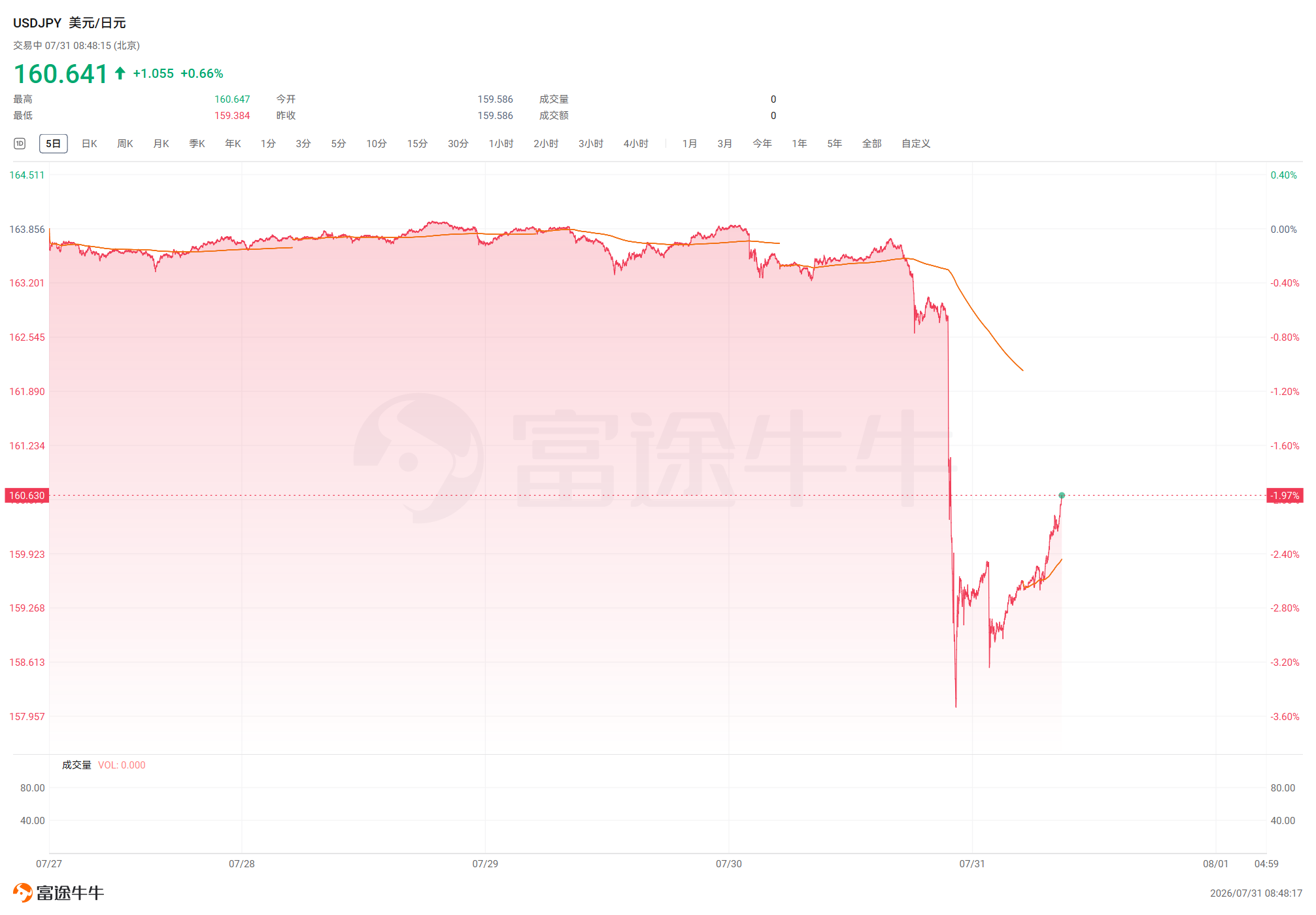
This intervention occurred just ahead of the Bank of Japan’s policy meeting. Markets widely expect the central bank to keep its benchmark interest rate unchanged at 1% on Friday but may signal further rate hikes.
Unusually strong U.S. endorsement signals warming coordination between Washington and Tokyo
Bessent’s remarks, relayed by a Fox Business reporter, were direct in tone. He not only acknowledged that Japan may have already intervened but also proactively characterized the yen’s valuation as “significantly undervalued,” thereby providing political backing from Washington for Japan’s foreign exchange actions.
According to a Nikkei report citing market sources, U.S. authorities also conducted so-called “rate checks” with several banks—a move typically seen as a precursor to potential U.S. intervention in the currency market. The Federal Reserve Bank of New York, acting on instructions from the U.S. Treasury Department, requested multiple banks to provide foreign exchange bid and offer quotes.
Jun Mura, Japan’s top foreign exchange official, said in an interview that the support received from U.S. authorities went beyond moral backing, noting that recent yen weakness had raised certain concerns, which they are currently evaluating and addressing accordingly.
Toru Suehiro, chief economist at Daiwa Securities, stated that if the U.S. indeed conducted rate checks as reported and potentially signaled support for a weaker dollar, this would be a positive development for Prime Minister Kishida’s cabinet.
Intervention timing 'rides the wave,' aided by the Federal Reserve’s policy decision
Analysts noted that the timing of this intervention was highly strategic. Just one day prior, the Federal Reserve announced it would hold policy rates steady, causing the dollar to weaken. The USD/JPY exchange rate had already retreated from around 163.30 following the Fed’s decision, creating favorable tailwinds for Japanese authorities’ market entry.
Win Thin, Chief Economist at Bank of Nassau 1982, commented that if Thursday’s sharp yen movement indeed stemmed from official intervention, then the timing was “quite smart,” as it represented “going with the trend rather than against it.”
Geoffrey Yu, Senior Strategist at Bank of New York Mellon, stated: “Such a significant move strongly suggests that the Japanese government likely intervened in the currency market. However, the effectiveness of the intervention remains to be seen.”
Yen remains under pressure; effectiveness of intervention in doubt
This marks Japan’s second large-scale foreign exchange intervention this year. In the first half of the year, Japan spent a record 11.7 trillion yen (approximately USD 73 billion) buying yen, but the boost proved short-lived, and the yen resumed its decline—falling below the 163 level earlier this month to hit a 40-year low.
The persistent weakness in the yen stems from cost-of-living pressures driven by higher energy import prices amid the Iran conflict. Finance Minister Satsuki Katayama has repeatedly warned of ‘decisive action,’ yet these statements have failed to provide sustained support for the yen. Atsushi Mimura, the top foreign exchange official responsible for determining the timing and method of intervention, has remained silent since the last intervention, fueling ongoing market speculation about when Tokyo might act again.
Earlier this month, the U.S. Treasury Department’s semiannual currency report also expressed concern over the yen’s weakness, noting that despite some narrowing of the U.S.-Japan interest rate differential, the yen’s depreciation has continued. The report warned that excessive exchange rate volatility is undesirable and urged the Bank of Japan to raise interest rates further, citing inflation’s erosion of household purchasing power.
Focus shifts to the Bank of Japan: Kazuo Ueda faces a dilemma
With the intervention now executed, market attention quickly turned to Bank of Japan Governor Kazuo Ueda’s press conference scheduled for 2:30 p.m. on Friday, with particular focus on his comments regarding the future path of interest rate hikes.
Kazuo Ueda currently faces a difficult balancing act: on one hand, the government led by Prime Minister Sanae Takaichi remains cautious about further rate hikes; on the other, allowing the yen to depreciate further would increase import costs and intensify inflationary pressures.
Washington’s stance, by contrast, is relatively clear—while supporting Tokyo’s foreign exchange intervention, U.S. officials have also explicitly stated their expectation that the Bank of Japan proceed with interest rate hikes. Striking a balance between political pressure and exchange rate stability will be the central focus of this press conference.
Editor/KOKO