
‘AI Prophet’ Aschenbrenner raised $45 billion from Wall Street investors based on a lengthy essay forecasting the future of AI, achieving a net return of 439% in the first half of this year. However, in July, AI-related stocks plummeted; his heavily weighted long positions in companies such as SK Hynix and SanDisk suffered sharp declines, while his short positions in software stocks moved inversely higher. Combined with approximately 4x leverage, this triggered a margin call. Within 36 hours, Citadel acquired all of his roughly $16 billion in public holdings at a discount.
A 24-year-old raised $45 billion on Wall Street with a lengthy essay predicting that AI would transform the world, and earned a staggering 439% return in the first half of this year. Yet, in the past month—amid a sharp downturn in AI-related stocks—he lost nearly all the fortune he had amassed over two years in one fell swoop.
On July 30, a report emerged from Wall Street:
 A hedge fund with only eight employees sold its entire public market position—approximately $16 billion worth of equities—in a single transaction to a counterparty within the past 36 hours.
The buyer was Citadel, one of the world’s largest hedge funds, founded by Ken Griffin, which manages $71 billion in assets.
The fund forced to cut its losses was Situational Awareness (SA), founded by 25-year-old Leopold Aschenbrenner.

Notably, Aschenbrenner’s fiancée, Avital Balwit, serves as chief of staff to Dario Amodei, CEO of Anthropic. The AI market collapse and his subsequent fire sale occurred just days before their wedding weekend.
Just weeks earlier, he had been one of the most celebrated figures on both Wall Street and in Silicon Valley.
Silicon Valley’s “AI Prophet” and “AI Stock Guru”
Leopold Aschenbrenner, a 24-year-old German national.
He entered Columbia University at age 15 and graduated first in his class at 19. After graduation, he joined OpenAI’s “Superalignment” team, which focuses on ensuring that future superintelligent systems align with human values. In 2024, OpenAI terminated his employment for allegedly leaking internal information. Aschenbrenner denies wrongdoing, stating he merely shared a largely non-confidential planning document with external researchers for feedback; he claims the real catalyst was an internal memo he authored criticizing OpenAI’s safety protocols.
After being fired, he did something few expected—he wrote a 165-page essay titled "Situational Awareness."
The core argument of the essay is that AI is advancing far faster than the public realizes, and by 2027, AI will be capable of conducting AI research autonomously, confronting humanity with genuine superintelligence. Achieving this will require explosive expansion in chips, memory, data centers, and power infrastructure.
The essay caused a sensation in Silicon Valley. Some hailed it as "the most important article in a decade." Podcast host Tim Ferriss dubbed him "the Nostradamus of AI."

In 2024, he launched a namesake fund, SA, with approximately $225 million in seed capital. Investors include Stripe co-founders Patrick and John Collison, former GitHub CEO Nat Friedman, and institutions such as Jane Street.
With no prior professional experience, he immediately assumed management of billions of dollars. The fund’s assets under management grew rapidly, peaking at nearly $45 billion by early July 2026.
The entire fund employs only eight people, four of whom are investment professionals.
Heavily weighted toward AI infrastructure, with leverage amplified fourfold
SA’s investment thesis is straightforward: since AI demands massive computing power and infrastructure, the fund heavily invests in companies providing these resources.
Long positions: $SK hynix (SKHY.US)$(Korean semiconductors/memory),$NEBIUS (NBIS.US)$(AI cloud platforms),$SanDisk (SNDK.US)$(storage chips),$Micron Technology (MU.US)$(memory chips), $CoreWeave (CRWV.US)$ (AI cloud computing),$Bloom Energy (BE.US)$(energy).
Short positions: shorting$Adobe (ADBE.US)$traditional software companies—the rationale being that AI will disrupt them.
Meanwhile, the fund amplifies its returns by borrowing from banks (i.e., using leverage), with a leverage ratio of approximately 4x.
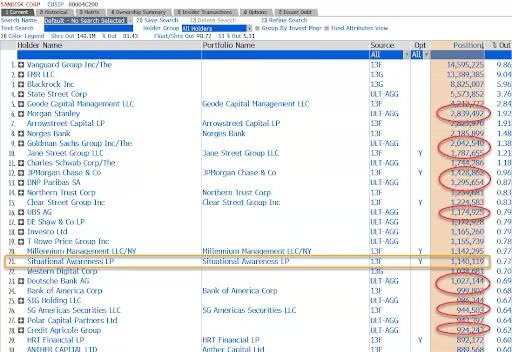
This structure has a distinctive feature: the bank holds physical shares, while SA synthetically obtains economic exposure and leverage through a 'total return swap' (TRS). The benefit is multiplied returns; the drawback is that if share prices fall, the bank will issue a margin call (requiring additional collateral).
From 2025 through the first half of 2026, this strategy delivered astonishing results.
As of the end of June 2026, SA’s net return reached 439%. Starting with less than USD 1 billion in assets under management, the fund peaked at approximately USD 45 billion in early July.
Some early investors achieved returns as high as 200% this year.
On July 24, Aschenbrenner wrote in a letter to investors: "Sometimes we specifically point out that now is an excellent time to add to your position—if you’ve been waiting." A postscript invited investors to contribute additional capital on August 1.
Hit from both sides within three weeks
However, the good times did not last. In July, AI-related stocks began to decline.
The market started questioning whether the high valuations of AI infrastructure could be sustained, prompting a significant outflow of capital from AI hardware stocks.
SA’s long positions were hit first and hardest:
$NEBIUS (NBIS.US)$down approximately 48% from its June peak, with a market capitalization loss of about $35 billion
$SanDisk (SNDK.US)$Down more than 56% in just over a month,
$CoreWeave (CRWV.US)$、$Micron Technology (MU.US)$、$SK hynix (SKHY.US)$All declined by more than 35% this month,
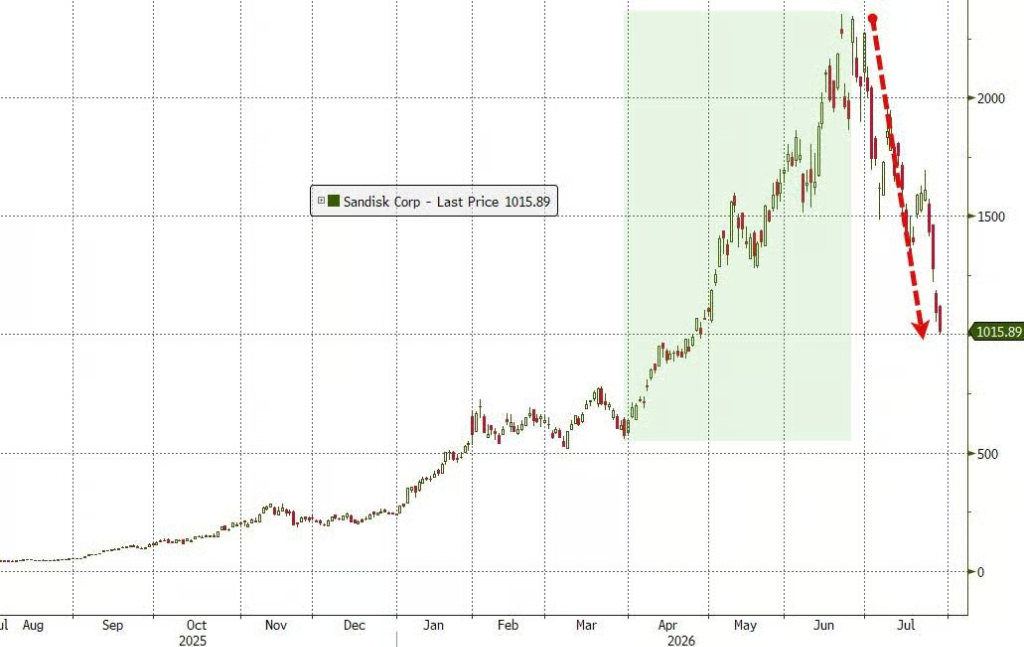
Meanwhile, software stocks shorted by SA (such as$Adobe (ADBE.US)$) have instead risen, resulting in losses on the short positions.
Both long and short positions are losing money simultaneously, and the 4x leverage has amplified the losses. Banks have started issuing margin calls.
This is what Wall Street refers to as a 'margin call': you borrowed money to buy stocks, the stock price fell, and the bank is now demanding additional collateral; otherwise, it will forcibly liquidate your position. This follows the same logic as margin-trading blowouts in China’s A-share market.
SA’s prime brokers include Bank of America, Goldman Sachs, and JPMorgan, all three of which have stepped in simultaneously to assist the fund in meeting margin calls or executing orderly position reductions.
Notably, Aschenbrenner’s fiancée, Avital Balwit, serves as chief of staff to Anthropic CEO Dario Amodei. The collapse occurred precisely during the weekend before their wedding.
36 hours, overnight auction
The crisis escalated rapidly within 36 hours.
Late on July 29, SA sent urgent appeals to multiple potential buyers, seeking to sell over $10 billion worth of stock to stabilize its position. This news was widely reported by media outlets including the Financial Times and Bloomberg.
Bidders included Millennium Management (a top global multi-strategy hedge fund) and Jane Street (one of SA’s investors).
Millennium made an offer but deemed the positions too risky to justify a high price.
Ultimately, Citadel emerged as the winner.
The transaction was completed early on July 30. Citadel acquired SA’s entire public equity portfolio—comprising both long and short positions—valued at approximately $16 billion, at a significant discount. This ranks among the largest emergency equity transactions in Wall Street history.
After news of the transaction’s completion emerged,$NASDAQ 100 Index (.NDX.US)$the stock surged more than 3% that day—relief swept through the market: SA would no longer need to dump shares into the market.
This is not the first time Citadel has undertaken such a move. Historically, it has stepped in during crises to acquire distressed assets, including those of Enron. In Ken Griffin’s own words, one reason for Citadel’s sustained success is: "Experience—the wisdom gained through losses and pain. My leadership team and I have navigated many of the market’s toughest moments together and learned hard lessons. But this enables us to be more effective investors during periods of turmoil and crisis."
Citadel was founded in 1990. SA was founded in 2024.
What remains
Following the transaction, SA’s assets under management plummeted from a peak of $45 billion to approximately $10 billion—a decline of more than 50%.
However, Aschenbrenner was not completely liquidated.
SA retained its entire private investment portfolio, worth approximately $10 billion, with the most significant holding being its stake in Anthropic, valued at around $5 billion. SA will continue operating as a private investment firm.
Whether this batch of private assets can be monetized depends on the valuation of companies like Anthropic at the time of their future IPOs.
This remains an open question.
Incidentally, Aschenbrenner’s fiancée, Avital Balwit, serves as Chief of Staff to Anthropic CEO Dario Amodei. SA was previously rumored to be selling its Anthropic stake, but a SA spokesperson denied this claim.
Where did he go wrong?
The most thought-provoking question about this matter is: Was Aschenbrenner wrong in his assessment of AI?
Not necessarily.
The long-term demand logic for AI infrastructure is still widely accepted by numerous institutions.
The issue lies in the portfolio structure.
Someone on X quoted Ken Griffin's earlier description of why fund managers fail: "Your portfolio is highly concentrated, with massive positions, yet you cannot clearly articulate the competitive advantage behind holding those positions."
This is precisely SA’s problem: it is heavily concentrated in a single theme (AI infrastructure), leveraged 4x, and placing both long and short bets on opposite sides of the same narrative. Once market sentiment shifts, there is no buffer whatsoever.
This structure can generate a 439% return during rallies—but equally, during downturns, it can blow up the entire public position within weeks.
As someone summarized: "He wasn’t wrong about AI. He was wrong about how he constructed his positions."
The Other Side of the Myth
Aschenbrenner’s story is one of the most extreme examples of this AI bull market.
One article, one narrative, eight people, $45 billion, a 439% return—and then, within three weeks, brought down by margin calls.
This is not the end of AI, nor is it the end of Aschenbrenner.
But it clearly illustrates one thing: being right about the direction does not guarantee you’ll survive long enough to see it materialize.
Editor/melody