Federal Reserve Chair Jerome Powell previously stated that, when assessing inflation, the Fed would consider a broader set of indicators beyond the PCE and hinted at a potential adjustment to its inflation framework after January next year. This remark triggered market volatility, with the 30-year breakeven inflation rate posting its largest single-day increase since 2024. Economists have questioned whether the working group might be providing cover for an effort to redefine the inflation challenge, noting that alternative metrics to the PCE are extremely limited.
A signal released by Federal Reserve Chair Waller regarding the inflation assessment framework is rippling through markets.
On Wednesday, Eastern Time, Waller stated at the Federal Reserve’s interest rate decision press conference that the range of inflation data he monitors now extends beyond the Fed’s long-standing preferred metric—the Personal Consumption Expenditures (PCE) price index.
 He also hinted that the Federal Reserve may provide some commentary on its inflation strategy framework after January next year. These remarks quickly sparked widespread debate among investors and economists.
The 30-year breakeven inflation rate immediately recorded its largest single-day increase since 2024. Some market participants noted that Waller’s comments on PCE were one of the key drivers behind this move.
Waller redefines the 'inflation lens'
Waller used pointed language during Wednesday’s press conference:
“We will achieve a 2% inflation target—no higher. But to reach that goal, I need to look at a broader set of inflation data than just the Personal Consumption Expenditures (PCE).”
The Personal Consumption Expenditures (PCE) price index has long been the Federal Reserve’s preferred inflation gauge, and policymakers also use it when making forecasts.
Official data shows that the PCE rose 3.7% year-over-year in June. Waller stated:
“We will continue using that metric.”
But he added:
Who knows what adjustments we might make to our strategy after January next year.
This statement relates to several working groups he previously established, one of whose tasks is to review the Federal Reserve's inflation framework and the economic data it monitors.
Michael Feroli, JPMorgan’s chief U.S. economist, was blunt about this in a client report:
These remarks appear to confirm external concerns that the establishment of the working groups is merely a cover for redefining the inflation challenge.
Limited options for alternative indicators
In the discussion around 'alternative PCE,' Jeffrey Lacker, former president of the Richmond Fed, poured cold water on the idea outright.
Lacker said:
What they could switch to—and, more importantly, by what criteria they would make such a choice—is far from obvious.
The former Fed official, known for his hawkish stance, emphasized:
You must select a reliable and broadly representative index. Currently, only two meet the criteria: the PCE price index and the CPI—nothing else.
The Consumer Price Index (CPI) rose 3.5% year-over-year in June, serving as the benchmark for pricing U.S. Treasury Inflation-Protected Securities (TIPS) and cost-of-living adjustments for Social Security benefits.
Lacker added that, over the long term, the two measures 'don’t differ significantly.' Kathy Bostjancic, Chief Economist at Nationwide, highlighted a key market concern:
Clarifying which inflation metrics he and the Federal Reserve will monitor is an urgent priority.
On Wednesday, Waller did not disclose what other indicators he might be considering—a gap that lies at the heart of current market unease.
Bond market alarm: Long-end premiums face repricing pressure
In the more than $2 trillion U.S. inflation-linked Treasury market, Waller’s remarks have already triggered a chain reaction.
JPMorgan strategists recommended that clients position for higher inflation expectations through five-year/five-year forward inflation swaps.
Citigroup economists Andrew Hollenhorst and Veronica Clark expressed a relatively optimistic view in their report on Thursday, forecasting that:
In the coming months, it will become increasingly clear that the broader set of inflation indicators Waller is monitoring will not show a worrisome acceleration.
However, Citi’s strategy team also warned that Wallsh’s stance could introduce a new trading range for the five-year forward inflation rate five years ahead—a metric that had been capped at around 2.5% for many years.
Jon Hill, Head of U.S. Inflation Strategy at Barclays, pointed to deeper market vulnerabilities:
A decline in market confidence in the Federal Reserve’s resolve to combat inflation—or an increase in uncertainty—would translate into higher term premiums and inflation risk premiums.
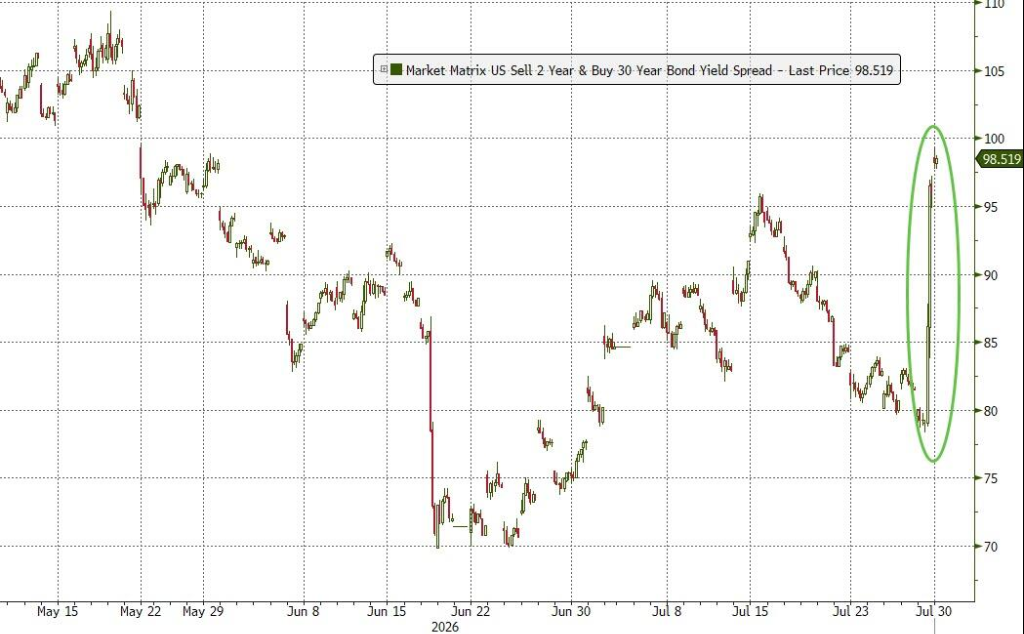
In the U.S. Treasury market, which exceeds $31 trillion, an upward move in term premiums would directly push up long-end rates. The U.S. yield curve, from 2-year to 30-year maturities, continues to steepen.
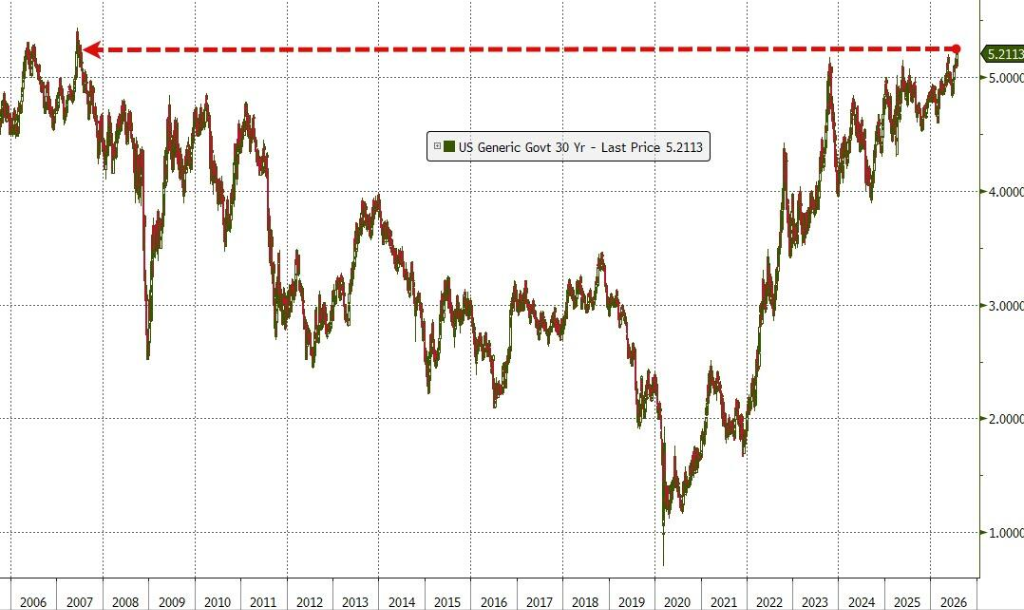
The 30-year Treasury yield remains near its highest level since 2007.