
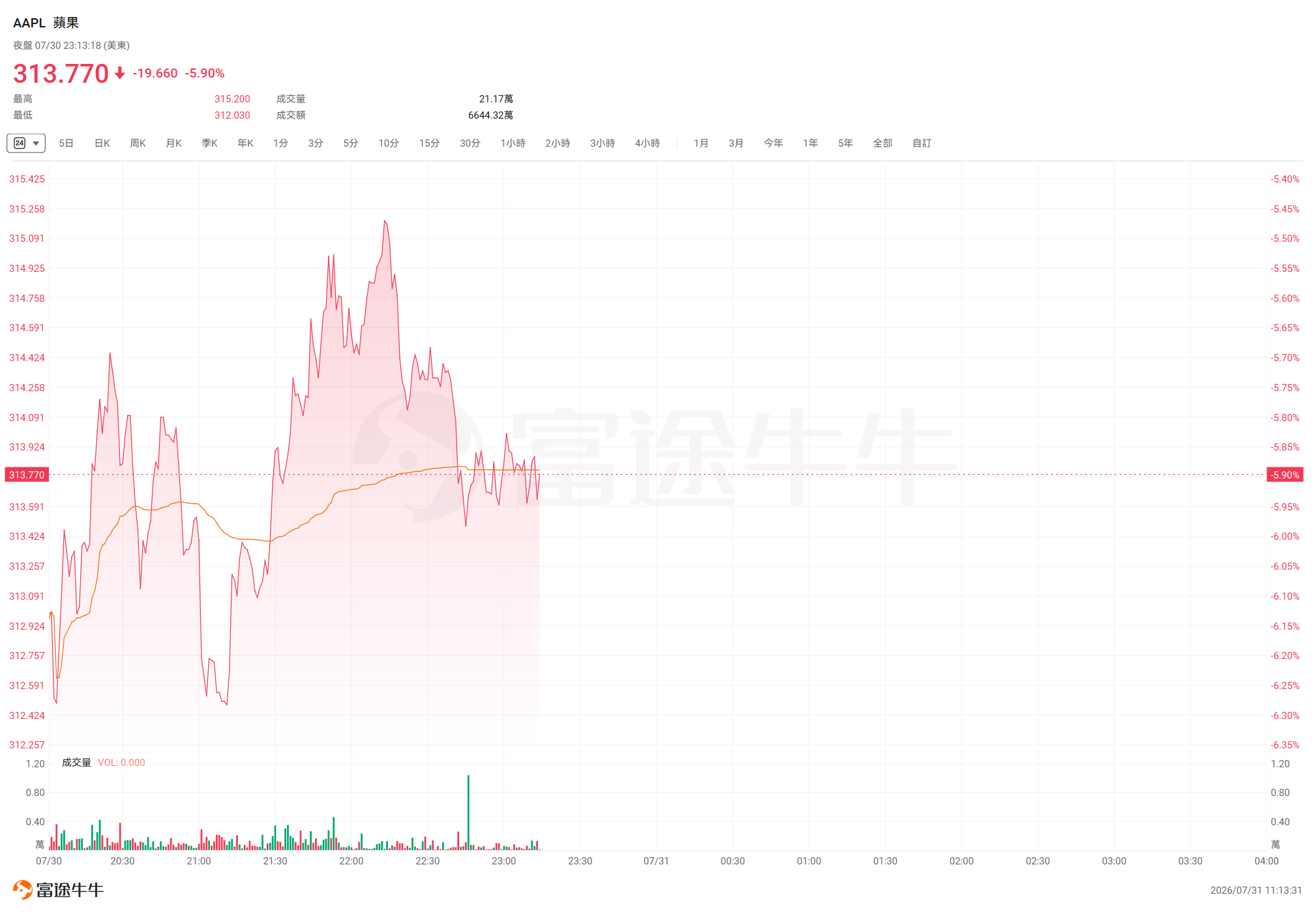
Apple reports its strongest June-quarter results in history—revenue of $109.4 billion and gross margin surpassing 50% for the first time—but shares plunged 6% in after-hours trading, wiping out over $300 billion in market value overnight.
The real crisis lies deep within the supply chain: Apple isn’t building AI data centers, but the costs of AI data centers are being transmitted through two channels—chips and memory—quietly eroding Apple’s profit margins on every iPhone and Mac. The Q4 gross margin guidance has been sharply revised down to 47%–48%.
In the early hours of July 31, Apple reported its third-quarter results for fiscal year 2026, posting revenue of $109.4 billion, a 16.4% year-over-year increase. Gross margin reached 50.1%, surpassing the 50% mark for the first time in the company’s history. Revenue, earnings per share (EPS), and operating cash flow all hit record highs for the same period in prior years.
 This is$Apple (AAPL.US)$the strongest June-quarter report in history. As of this writing, Apple shares extended their decline by nearly 6% in after-hours trading, settling at $313.63.
The market’s focus is on the fourth-quarter guidance—gross margin is projected to decline from 50.1% to a range of 47%–48%, a drop of 2 to 3 percentage points. While the numbers themselves appear unremarkable, the forces driving this decline are deeply embedded in Apple’s opaque supply chain.
The four major cloud providers are collectively allocating $725 billion in capital expenditures this year, exerting downward pressure on Apple’s manufacturing costs from the supply side. Taiwan Semiconductor’s advanced-process capacity is being heavily consumed by AI chips, while DRAM capacity is being absorbed by AI servers, causing memory chip prices to surge. Apple’s capital expenditures over nine months totaled less than $6.8 billion—over 100 times smaller than those of the cloud providers.
Although Apple does not build AI data centers, the costs associated with AI data centers are being transmitted through two channels—chips and memory—onto every iPhone and Mac.
This was Tim Cook’s final earnings call as CEO. On September 1, John Ternus, Senior Vice President of Hardware Engineering, will assume the role. On his first day in office, he will confront a cost squeeze originating from the supply side.
The Water in the 50% Gross Margin
Apple’s gross margin of 50.1% marks the first time it has breached the 50% threshold in its history. Although the figure appears impressive, it includes a one-time adjustment of approximately 2 percentage points related to tariff refunds. Excluding this adjustment, the underlying gross margin was about 48.1%, still up 1.6 percentage points year-over-year, driven by a higher mix of iPhone Pro models and an increased contribution from services.
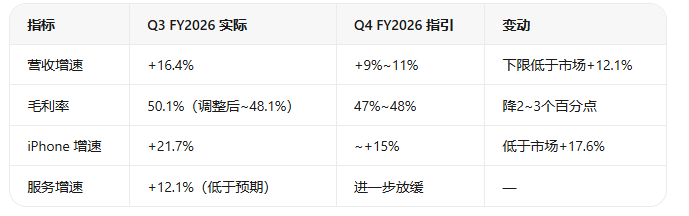
The real signal lies in the next quarter. CFO Luca Maestri provided a Q4 gross margin guidance midpoint of 47.5%, a sharp 2.6-percentage-point drop from this quarter’s 50.1%. Even on an adjusted basis, comparing 48.1% to 47.5%, it still represents a 0.6-percentage-point decline. Apple is absorbing rising supply chain costs directly into its margins.
R&D expenditure is another noteworthy metric. Quarterly R&D spending reached $11.7 billion, up 32.3% year-over-year—more than double the pace of revenue growth. Cumulative R&D investment over nine months totaled $34 billion, an $8.3 billion increase from the prior year. During the earnings call, Cook explicitly stated, “Apple as a whole is investing more in AI.” These funds are being directed toward in-house AI chips, Siri AI enhancements, and integration of AI capabilities into software platforms. However, AI-related paid services have yet to generate material revenue in the near term—R&D expenses are rising, but AI monetization remains elusive, thereby elevating Apple’s cost base.
Of the EPS of USD 2.02, USD 0.11 came from tariff refunds; excluding this, EPS was approximately USD 1.91—about USD 0.04 above market expectations. However, this outperformance stemmed solely from one-time factors, with no underlying operational improvement.
AI data centers are consuming Apple's supply chain.
$Apple (AAPL.US)$The deepest signal in this earnings report lies here.
Microsoft, Meta, Google, and Amazon together plan capital expenditures of USD 725 billion this year, a staggering 77% year-over-year increase. In contrast, Apple—opting not to build AI data centers—has recorded only USD 6.8 billion in capital expenditures over nine months, down 28% year-over-year.
Yet Apple cannot escape the cost pass-through from the AI infrastructure boom. Cloud providers demand training and inference chips, while Apple requires application processors and memory—but despite differing product needs, both must compete for capacity from the same pool of suppliers.
First channel: Taiwan Semiconductor’s advanced nodes. Apple’s custom SoCs rely on cutting-edge processes like N3. All N3 capacity for 2026 is already fully booked, with roughly 60% allocated to AI chip customers—a share expected to rise to 86% by 2027. AI chips are crowding out consumer electronics. On the earnings call, Cook confirmed that supply constraints in the June quarter were primarily centered on Macs and will extend to iPhones and iPads in the September quarter. He attributed this to 'demand growing too quickly'—without explicitly naming AI, though the industry well understands whose demand is absorbing the capacity.
Second channel: DRAM. Contract prices for memory chips surged by more than 90% in Q1, with Goldman Sachs forecasting full-year increases of 250% to 280%. The reason is straightforward: surging demand for high-bandwidth memory (HBM) from AI servers has led Samsung, SK Hynix, and Micron to prioritize HBM production, as its margins are three to five times higher than those of consumer-grade DRAM. This shift squeezes consumer DRAM capacity, driving up prices.
Cook described the memory price surge as a 'once-in-a-century flood.' Memory costs in the March quarter were already higher than in December, rose further in the June quarter, and are set to climb again in the September quarter. Apple reluctantly raised prices on multiple Mac, iPad, and home devices in June.
Inventory data confirms rising costs. The balance sheet shows inventory jumping from USD 5.7 billion to USD 11.1 billion—an increase of 94%. While part of this reflects proactive stockpiling against supply constraints, higher component prices—especially for memory—have directly inflated inventory value. For example, if the memory cost in an iPhone rises by 15%, the inventory value increases proportionally even if unit volumes remain unchanged.
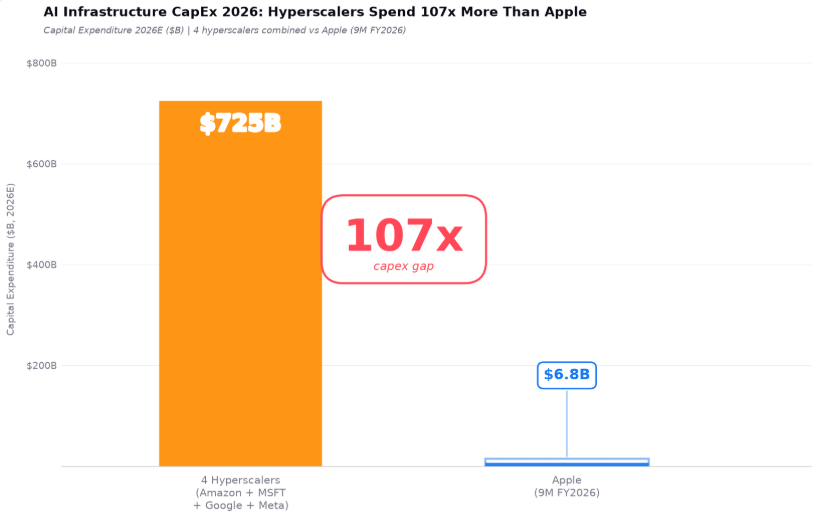
$725 billion and $68 billion—when placed side by side in the same table, Apple’s predicament becomes immediately clear: the bill for AI infrastructure cannot be avoided; it’s merely being paid another way—through chips and memory, flowing directly into gross margins.
Conflicting Signals from Doubling Inventory and Surging R&D
$Apple (AAPL.US)$Two additional data points on the balance sheet warrant deeper analysis.
Intangible assets surged from $11.1 billion to $20.3 billion—a single-quarter increase of $9.3 billion, or 83%. The financial report did not separately disclose the underlying transaction(s), but an increase of this magnitude typically indicates one or more sizable acquisitions or intellectual property deals. Against the backdrop of a 32% year-over-year rise in R&D expenses, Apple likely completed a technology or team acquisition in the AI space.
Services performance provides another cross-validation point. Services revenue reached $30.7 billion, up 12.1% year-over-year, slightly below last quarter’s $31.0 billion and approximately 2% below market expectations of $31.4 billion. As a core cash cow with a gross margin approaching 75%, slowing services growth directly dampened market confidence in Apple’s long-term earnings elasticity. Paid subscriptions surpassed 1.5 billion users, and public beta feedback on Siri AI has been positive, yet AI-related premium subscription services have not yet generated material revenue at scale.
Products are selling well, but production capacity can’t keep up. That is Apple’s core contradiction at present.
iPhone and Mac delivered strong results this quarter. iPhone contributed nearly half of total revenue with $54.3 billion in sales, up 21.7% year-over-year—the highest ever for a June quarter. Mac revenue reached $10.4 billion, a 28.7% year-over-year increase, significantly outperforming market expectations by roughly 20%. The MacBook lineup featuring the newly launched M5 chip in March continues to face supply shortages—one key reason being insufficient advanced-node manufacturing capacity. Mac sales hit record highs for the period in Greater China and Southeast Asia, among other emerging markets.
iPad was the only product category to post negative growth this quarter, with revenue of $6.19 billion, down 5.9% year-over-year and approximately 10% below market expectations. The primary driver is an extended tablet replacement cycle.
Cook’s Last Stand
Cook revealed during the earnings call$Apple (AAPL.US)$that the company is "evaluating all options" to diversify its DRAM supply sources.
Market reports point to Chinese memory manufacturer ChangXin Memory Technologies (CXMT). Cook indirectly responded: "The DRAM market is currently dominated by three suppliers; it would be beneficial to have more." Behind this statement lies a potential fundamental shift in Apple’s supply chain strategy—moving from heavy reliance on Samsung, SK Hynix, and Micron toward a broader supplier base that could include Chinese firms.
CXMT currently holds approximately 7.67% of the global DRAM market share and is the only Chinese manufacturer with large-scale DRAM mass production capabilities.
Cook did not directly confirm whether Apple is testing CXMT’s products, but the phrasing about 'evaluating all options,' coupled with the urgency described as a 'once-in-a-century flood' in memory pricing, sends a clear enough signal.
Ternus takes the helm—with supply as his first test.
On September 1, Cook transitioned to Executive Chairman of the Board, and John Ternus, Senior Vice President of Hardware Engineering, assumed the role of CEO.
At the end of the earnings call, Cook offered a calm and composed farewell: "Thank you to our shareholders—especially our long-term shareholders—for your trust over the years. This is my final earnings call. The transition has gone very smoothly, and I’m very much looking forward to John Ternus stepping into his new role."
Ternus’s first major challenge is highly concrete: inventory planning for the September product cycle—how many new iPhones to stock, how to price them, and whether wait times for Macs and iPads can be shortened. Demand has already been proven. What the September quarter must now demonstrate is whether these products can reach consumers on schedule.
Apple’s Q4 guidance projects iPhone revenue growth of approximately 15%, below the market expectation of 17.6%. Mac and iPad sales will also face 'increasingly severe supply constraints.' Combined with an estimated 2.5 percentage point drag from foreign exchange headwinds and continued deceleration in services growth, this is the performance landscape Ternus inherits.
Track three variables next quarter.
$Apple (AAPL.US)$The core tension in Q3 earnings stems from the supply side. Demand for both iPhone and Mac is rising, yet $725 billion in cloud providers’ capital expenditures is squeezing Apple’s gross margins and delivery capacity through two channels: Taiwan Semiconductor’s advanced nodes and DRAM. The Q4 gross margin guidance of 47%–48% is merely the first visible signal.
Next quarter, track three variables: the trajectory of DRAM contract prices, the shifting allocation ratio between AI and consumer electronics within Taiwan Semiconductor’s advanced process capacity, and whether CXMT can enter Apple’s DRAM supply chain. Any shift in these variables would alter Apple’s cost curve.
 Want to select stocks or get a stock diagnosis? Curious about the opportunities and risks in your portfolio? For all your investment questions,Just ask Futubull AI!

Editor/melody