
MiniMax has shaken up the AI video sector with a 'pricing bomb'—its first open-source multimodal model, H3, is priced at RMB 0.8 per second, just one-third of the industry flagship's rate, while ranking first globally in video editing capabilities. Following the announcement, its share price surged by 14% in a single day. Beyond the parameter arms race, MiniMax is carving out a differentiated path to breakthrough success through a dual-engine strategy of extreme cost-performance and open-source innovation.
At a pivotal juncture where China's domestic AI sector is shifting from a race centered on model parameters to one focused on cost efficiency and ecosystem competitiveness, $MINIMAX-W (00100.HK)$ a video generation model priced at just one-third of its peers' has dropped a "pricing nuclear bomb" into the market, directly challenging global competitors such as Sora.
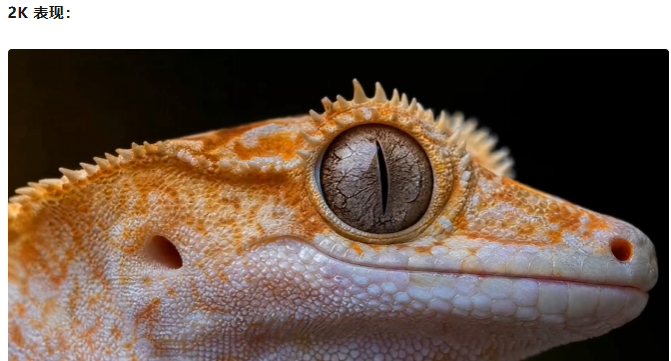
On July 31, MiniMax officially launched H3, its first open-source multimodal generative model. The model supports native 2K resolution output and can generate synchronized audio-visual content up to 15 seconds in length, ranking first globally on ArtificialAnalysis’s video editing capability leaderboard. Even more disruptive is its pricing strategy—video generation costs have been slashed to RMB 0.8 per second, only one-third of the price of comparable flagship models in the industry. MiniMax stated officially:
This is a general-purpose, fully multimodal generative model capable of unified understanding of multimodal contexts composed of text, images, video, and audio. It can output native stereo audio-video content and supports video generation up to 15 seconds at 2K resolution.
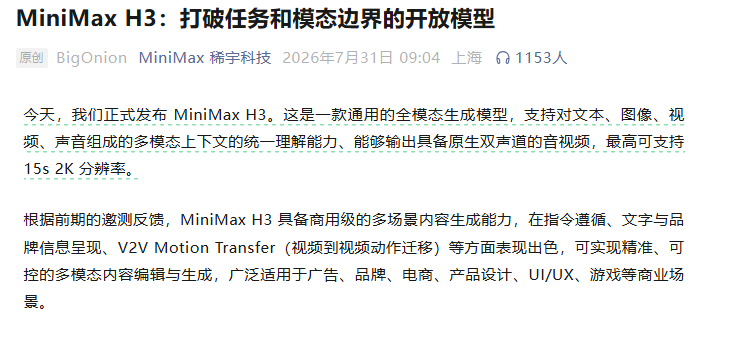
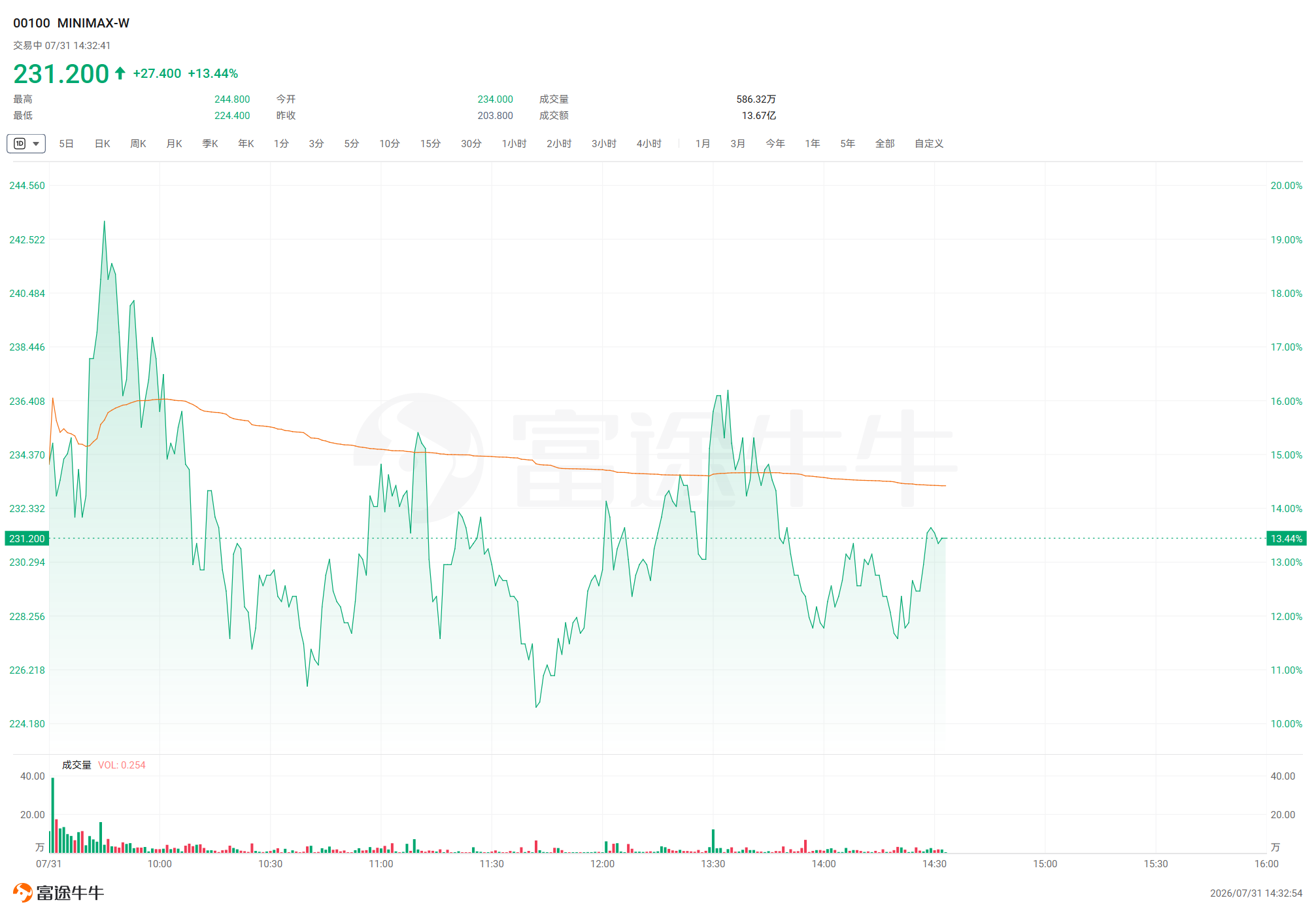
Buoyed by this announcement, MiniMax’s share price surged more than 13% in a single day, reversing the prior downward trend caused by share lock-up expirations and product price cuts. Investors now hold strong expectations that the H3 model will achieve commercial breakthroughs through extreme cost control.
Against a backdrop where leading industry players are tightening supply, MiniMax is carving out a differentiated path in the AI video generation space by leveraging 'extreme cost-performance plus open-source' as its strategic entry point—diverging sharply from the prevailing parameter-centric competition.
Unified multimodal architecture; ranked first globally in video editing
H3 is positioned as a general-purpose, fully multimodal generative model. Its technical architecture enables unified understanding of multimodal contexts comprising text, images, video, and audio, and it can generate audio-video content with native stereo sound, supporting video outputs up to 15 seconds in duration at 2K resolution.
In terms of capabilities, MiniMax particularly highlights H3’s performance in instruction following, accurate rendering of text and brand elements, and V2V Motion Transfer (video-to-video motion transfer)—a technology that precisely transfers motion characteristics from a source video to a target video, enabling controllable multimodal content editing. On the Artificial Analysis video model benchmark, H3 ranks first globally in video editing capability.

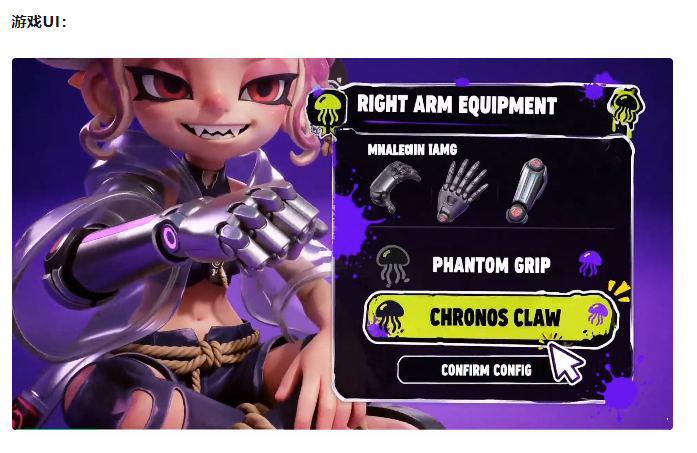

MiniMax stated that H3 offers commercial-grade content generation capabilities across diverse scenarios, making it widely applicable to advertising, branding, e-commerce, product design, UI/UX, and gaming. It is designed to lower the barrier for enterprises and developers to create high-quality video content.
Price penetrates industry floor; highly compressed tokenizer drives cost down to one-third of industry average
Another key highlight of this launch is the pricing for H3 video generation at RMB 0.8 per second. Specifically, H3’s 2K-resolution video generation is priced at RMB 0.8 per second—only one-third of the price of comparable flagship models in the industry.
This cost advantage stems from system-level optimizations: MiniMax has reduced the number of tokens required for video generation through a highly compressed tokenizer, while also implementing targeted tuning in heterogeneous training, load balancing, and GPU utilization efficiency. These measures significantly lower both training and inference costs without compromising model performance.
If this cost structure proves viable at scale, it could help H3 establish a differentiated competitive edge in commercial deployment. According to MiniMax, H3 is well-suited for cost-sensitive business scenarios such as advertising, e-commerce, product design, and gaming, offering enterprises a low-cost, high-efficiency solution for video content creation.

H3 video generation output
Open-source strategy: Enabling on-premises enterprise deployment to foster an open industrial ecosystem
Open-sourcing is one of the strategic priorities of H3’s launch. MiniMax stated that it plans to release the model weights within the next few days, subject to compliance with applicable laws and regulations. Enterprises will then be able to deploy the model locally and fine-tune it using their own data and business logic to better meet security and regulatory requirements.

“Chip manufacturers and developers can also jointly participate in adaptation and optimization efforts to reduce usage costs and broaden the scope of applications,” said a MiniMax spokesperson. “We are committed to continuously driving leading text and multimodal models away from closed services toward a more open and collaborative industrial ecosystem.”
An open-source approach is becoming an increasingly critical asset in the competition among domestic large models. On July 16, Moonshot AI released Kimi K3, a model with 2.8 trillion parameters—the largest open-source model globally by parameter count. Within 48 hours of its release, user request volumes neared the cluster’s capacity limit, prompting Moonshot AI to announce on July 19 the temporary suspension of new consumer subscriptions to prioritize compute resources for existing paying users.
Avoiding the parameter race: Can this differentiated path be sustained?
The market’s sharp reaction underscores investor confidence in H3’s commercial prospects. The company’s stock surged over 14% in a single day, successfully reversing a prior downward trend triggered by share lock-up expirations and product price reductions.
From a competitive landscape perspective, MiniMax has chosen a path distinctly different from the industry-wide race toward ever-larger model parameters. At a time when leading players are constrained by computational bottlenecks—forcing them to scale back supply as user request volumes approach the limits of their cluster capacity—MiniMax is attempting to build a moat around its commercial deployment through cost control and an open-source strategy, rather than engaging in a pure parameter-count competition.
The market will closely monitor the pace of community adoption following the official open-sourcing of H3, the timing of commercial order execution, and whether this 'volume-over-price' strategy can help MiniMax reclaim a central position in the AI race.
Editor/KOKO