
Kioxia reported Q1 operating profit of JPY 1.27 trillion, below the market consensus estimate of JPY 1.37 trillion; net profit was JPY 842.17 billion, also falling short of the estimated JPY 973.81 billion. Gross margin stood at 78%, slightly below the market expectation of 78.3%. Regarding long-term contracts, Kioxia stated it is making steady progress and aims to increase the coverage of long-term agreements to 50% of its annual shipments by 2028.
$Kioxia Holdings (285A.JP)$ The weaker-than-expected first-quarter results from the holding company, coupled with disappointing forward guidance, have raised investor concerns about the sustainability of the current memory chip upcycle, which has been driven by data center demand.
The US stock market opened today, $KIOXIA HOLDINGS CORPORATION UNSPON ADR EACH REP 0.1 COM (KXIAY.US)$ fell more than 8%.
 For the first quarter ended June 2026, the company reported operating profit of JPY 1.27 trillion, below the market consensus estimate of JPY 1.37 trillion; net profit attributable to owners of the parent was JPY 842.17 billion, also missing the estimated JPY 973.81 billion. Kioxia’s gross margin for the quarter was 78%, slightly below the expected 78.3%.
The company also provided a forecast for the first half of fiscal year 2026 (April–September), projecting operating profit of JPY 3.16 trillion, implying an expected operating profit of approximately JPY 1.89 trillion for the current quarter—also below market expectations.
On the same day as the earnings announcement, Kioxia's board approved a 1-for-3 stock split, effective October 1, 2026, and announced a share buyback program of up to JPY 800 billion (approximately USD 5 billion). Kioxia also announced that it expects to secure long-term contracts locking in 50% of its capacity by 2028.
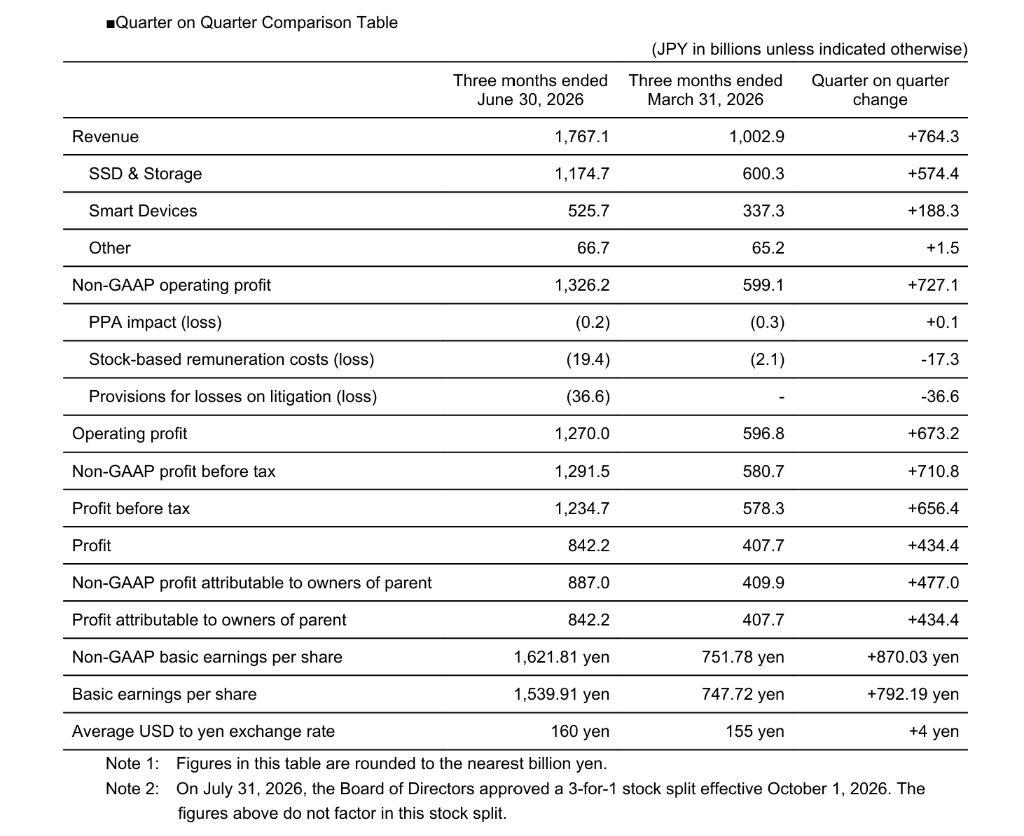
First-quarter results showed significant improvement but still fell short of expectations.
Kioxia reported revenue of JPY 1.7671 trillion for the first fiscal quarter of FY2026 (April–June 2026), more than quadrupling from JPY 342.8 billion in the same period last year and rising significantly from JPY 1.0029 trillion in the prior quarter. The growth was primarily driven by strong demand from data center clients fueled by generative AI, which pushed up average selling prices for NAND flash memory, alongside higher shipment volumes and a weaker yen.
By product segment, revenue from SSDs and storage products amounted to JPY 1.1747 trillion, while revenue from smart devices reached JPY 525.7 billion, with both categories showing substantial sequential growth.
Operating profit for the reporting period came in at JPY 1.2700 trillion, an increase of JPY 673.2 billion from the prior quarter but approximately JPY 100 billion below analyst estimates. The company explained that the profit growth was partially offset by litigation loss provisions (JPY 36.6 billion) and higher share-based compensation expenses. Net profit attributable to owners of the parent was JPY 842.2 billion, with basic earnings per share of JPY 1,539.91.
Non-GAAP operating profit (excluding the aforementioned non-recurring items) was JPY 1.3262 trillion, and Non-GAAP net profit attributable to owners of the parent was JPY 887.0 billion.
Kioxia announced that it expects to secure long-term contracts locking in 50% of its production capacity for 2028.
Forward guidance implies that growth may moderate.
For the current second fiscal quarter (July to September 2026), Kioxia forecasts revenue of JPY 2.39 trillion, operating profit of JPY 1.89 trillion, and Non-GAAP operating profit of JPY 1.90 trillion, all representing sequential increases from the prior quarter. The company stated that demand from data centers is expected to remain robust.
However, the implied pace of growth in this forecast has led some investors to question the sustainability of AI-related investment momentum. Bloomberg noted that the guidance disappointed the market and is seen as a signal that the historic AI-driven surge in NAND flash prices may be moderating.
Kioxia stated that due to the high short-term volatility in the semiconductor and memory industries, it does not provide full-year operating plans or progress updates, offering only quarterly forward-looking guidance.
Capacity strategy and competitive dynamics pose medium-term pressures.
Kioxia indicated that its capacity expansion plan is only slightly faster than the overall industry growth rate, aiming to avoid oversupply. While this conservative approach helps maintain price stability, it also carries the risk of gradual market share erosion.
According to Bloomberg, Samsung Electronics and SK Hynix are expected to launch next-generation NAND chips next year, with their current capital expenditure still primarily focused on DRAM capacity expansion. Once these two Korean giants shift investment toward NAND, Kioxia will face greater challenges in closing the gap in production scale.
Akira Minamikawa, an analyst at Omdia, stated that Kioxia needs to make additional efforts to attract U.S. hyperscale data center customers, who typically maintain closer ties with Korean suppliers. These data center operators often offer multi-year supply contracts, which provide chipmakers with clearer visibility into future demand.
Stock split and buyback reflect management’s confidence.
On shareholder returns, Kioxia’s board approved a 1-for-3 stock split on July 31, effective October 1, 2026, aimed at lowering the per-share price, enhancing market liquidity, and attracting a broader base of retail investors.
Meanwhile, the company announced a share buyback of up to JPY 800 billion, reflecting management's confidence in the company's long-term value. Kioxia’s share price experienced significant volatility this year—briefly surpassing Toyota Motor and SoftBank Group to become Japan’s most valuable company by market capitalization, before retracing approximately two-thirds of those gains within just one month, primarily due to investor concerns over the fragility of AI-related capital expenditures and growing uncertainty about the company’s outlook.
From a financial structure perspective, as of June 30, 2026, Kioxia reported total assets of JPY 4.7305 trillion and equity attributable to owners of the parent of JPY 2.4043 trillion, with its equity ratio rising sharply from 37.9% at the end of the previous fiscal year to 50.8%. During the period, the company also prepaid JPY 433.2 billion of long-term borrowings, further strengthening its balance sheet.
Edited by Joryn