
$Kioxia Holdings (285A.JP)$The holding company issued a disappointing profit outlook, and its earnings performance metrics fell short of expectations, suggesting that the unprecedented surge in NAND flash memory prices driven by artificial intelligence may be losing momentum.
According to Zhitong Finance APP, Kioxia Holdings Corp., the Japan-based global leader in NAND flash memory, released its latest financial results on Friday. The memory chip giant provided a relatively disappointing earnings outlook, and its core performance metrics announced the same day also missed consensus market expectations, indicating that Samsung,$SK hynix (SKHY.US)$, Kioxia, and$SanDisk (SNDK.US)$are engaged in increasingly fierce competition in the NAND flash market, and the unprecedented, AI-driven surge in NAND flash prices—fueled by strong demand for AI training and inference computing power—may be starting to moderate. Following the earnings release, the PTS private trading system briefly quoted around JPY 44,100, down approximately 5.2% from the official closing price, reflecting to some extent the market’s interpretation of the results as 'still showing robust growth but falling short of the market’s continually elevated, overly optimistic expectations.'
On Friday, the Japanese semiconductor powerhouse projected that its operating profit for the first half of the current fiscal year would reach approximately JPY 3.16 trillion (about USD 19.7 billion). This implies an expected operating profit of JPY 1.89 trillion for the current quarter, below prior optimistic market forecasts. The 'first half of the fiscal year' refers to the first half of Kioxia’s FY2026 (April–September 2026), comprising actual April–June operating profit of JPY 1.27 trillion and an estimated JPY 1.89 trillion for July–September, totaling JPY 3.16 trillion.
 The company also reported on the same day an operating profit of approximately JPY 1.27 trillion for the quarter ended June, which likewise missed analysts’ consensus estimates that had been repeatedly revised upward in recent weeks. For bullish sentiment on Kioxia’s stock, a critical development disclosed in the earnings report was the announcement of a 1-for-3 stock split effective October 1, along with a share repurchase program of up to JPY 800 billion, aimed at broadening its shareholder base and mitigating recent sharp declines and extreme short-term volatility in its share price.
In its latest results for April–June 2026, Kioxia reported total revenue of approximately JPY 1.7671 trillion, representing a year-over-year increase of 415.5%. NAND storage revenue, led by SSDs, totaled approximately JPY 1.1747 trillion, up 440% year-over-year, while revenue from smart devices reached about JPY 525.7 billion, surging 565% year-over-year. The company’s quarterly operating profit stood at approximately JPY 1.27 trillion, marking a roughly 28.3-fold year-over-year increase, with an operating margin of approximately 71.9%.
Compared to the prior quarter, revenue rose by approximately 76.2%, operating profit increased by about 112.8%, and net income attributable to owners of parent grew by around 106.6%. Management explicitly attributed this performance primarily to significantly higher average selling prices (ASPs) for NAND driven by demand from generative AI data centers. These newly released results clearly underscore one fact: the ongoing AI data center construction boom continues to strongly drive NAND demand, and with BiCS-10 now entering the sampling phase, it confirms that structural demand for high-capacity, high-bandwidth, and low-power NAND flash memory for AI data centers remains robust.
However, both the current quarter’s results and forward guidance came in below the market’s highly optimistic expectations, signaling that the pace of NAND price increases may be slowing. Kioxia’s latest operational data and outlook represent a 'fundamentally very strong but marginally cooling expectations' earnings report—constituting significant positive news for Kioxia’s medium- to long-term competitiveness, though not unambiguously bullish for its near-term share price. Nonetheless, the report provides fundamental support and industry confidence for a potential semiconductor sector rebound.
For the quarter ended June, demand from AI data centers, NAND average selling prices, and SSD business all surged simultaneously, driving earnings and cash flow to jump by an order of magnitude. However, the market had already priced in a near-perfect memory supercycle, and the next quarter’s operating profit guidance slightly undershot consensus expectations. Consequently, the core trading dilemma has shifted from 'whether strong AI-driven demand exists' to 'whether prices and profits can continue to exceed expectations.'
As NAND flash memory transitions from its traditional role—as what industry insiders long viewed as a 'cold data/capacity storage' asset—to become an 'expanded quasi-memory layer' in the AI inference era, Wall Street’s bullish sentiment toward Kioxia appears to remain strong. Nomura Securities previously maintained its 'Buy' rating on Kioxia and raised its target price from JPY 115,000 to JPY 126,000**, based primarily on the view that NAND bit prices are sustaining above earlier expectations and that supply-demand tightness has yet to meaningfully ease. At the Tokyo market closing price of JPY 46,500 on July 31, this target implies a potential upside of approximately 171.0%. However, Nomura’s target price was issued prior to this earnings release and does not yet reflect the new information that the JPY 1.89 trillion guidance fell short of consensus expectations.
JPY 800 billion share buyback fails to mask competitive anxieties: Samsung, together with$SK Hynix (000660.KR)$and Western Digital, is aggressively expanding NAND production capacity, escalating the battle for NAND market share.
Global investors had previously placed high hopes on Kioxia, as the company is one of the primary beneficiaries of the current record-breaking wave of AI data center construction. The former Toshiba chip unit supplies high-performance NAND storage chips used in data center servers, and its business growth is closely tied to the ever-increasing capital expenditures of major tech companies, including Meta Platforms Inc. and Alphabet, Google's parent company.$Meta Platforms (META.US)$ However, Kioxia faces competitors that are larger in scale and possess greater financial resources.
Samsung Electronics and SK Hynix are expected to launch next-generation NAND memory chips next year and plan to accelerate their NAND capacity expansion. Kioxia’s significant challenge lies in catching up with its South Korean rivals and U.S.-based NAND giant Western Digital in both output volume and NAND flash performance.$Samsung Electronics (005930.KR)$Samsung Electronics and SK Hynix are expected to launch next-generation NAND memory chips next year and plan to accelerate their NAND capacity expansion. Kioxia’s significant challenge lies in catching up with its South Korean rivals and U.S.-based NAND giant Western Digital in both output volume and NAND flash performance.
The company previously stated it plans to expand capacity only slightly faster than the industry average to avoid oversupply in the market. However, if Samsung and SK Hynix—currently focused primarily on expanding DRAM and the more complex manufacturing and packaging processes for HBM—redirect capital expenditures toward NAND, Kioxia could face the risk of losing market share.
Kioxia’s BiCS-10 technology will determine whether it can maintain its technological position in the cost, performance, and power efficiency competition for next-generation high-density NAND. Whether the CM10 enterprise SSD based on BiCS-10 secures certification from U.S. hyperscale cloud providers and wins multi-year contracts will decide if this technological edge translates into stable market share, capacity utilization, and cash flow. In particular, Samsung has already begun mass-producing the PCIe 6.0 enterprise SSD PM1763 based on its ninth-generation V-NAND—the most direct competitor to the CM10—while SK Hynix exerts strong competitive pressure with its 321-layer NAND and ultra-high-capacity QLC SSDs.
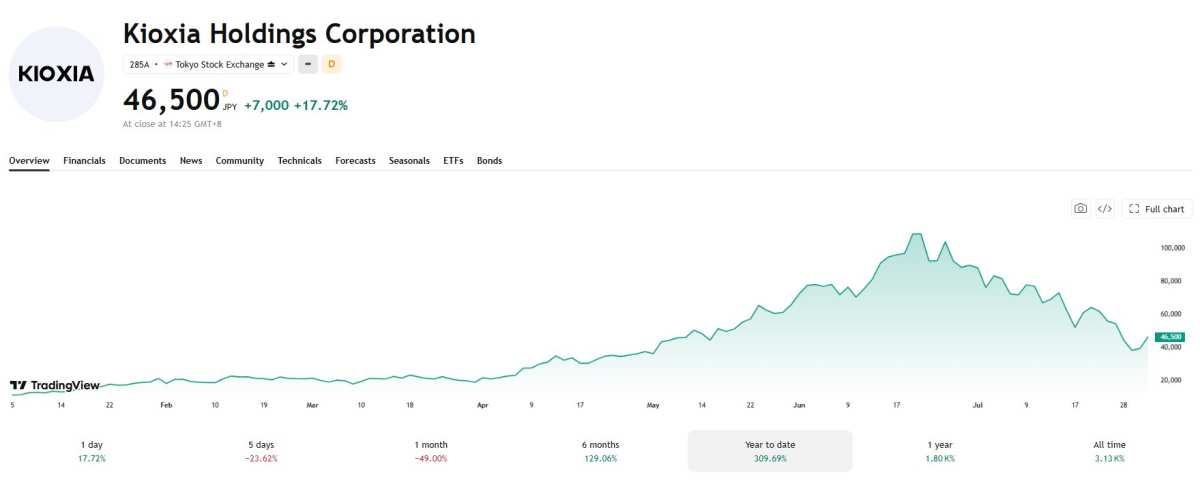
Kioxia Holdings' share price experienced significant volatility. At one point this year, the company briefly surpassed$Toyota Motor (TM.US)$and$SoftBank Group (9984.JP)$, becoming Japan's most valuable company by market capitalization for a short period. Subsequently, its stock price plummeted sharply as the global semiconductor sector entered a sustained downturn triggered by extreme deleveraging and forced liquidation of crowded positions—sparked by frequent circuit breakers in South Korean equity markets. This decline was further exacerbated by growing investor concerns over the fragility of AI-related revenue generation, particularly doubts that massive artificial intelligence spending by major tech firms would yield meaningful returns, as well as intensifying competitive pressures clouding Kioxia’s earnings outlook. Within just one month, the stock erased two-thirds of its prior gains.
Akira Minamikawa, an analyst at Omdia, stated that Kioxia must exert greater effort to attract so-called U.S. hyperscale cloud computing giants, as these companies maintain closer ties with South Korean suppliers. These hyperscalers, along with emerging 'new cloud' compute-leasing operators such as$CoreWeave (CRWV.US)$, typically offer multi-year supply contracts, enabling component suppliers to forecast future demand with greater clarity.
“Although the scale of this share buyback is unusually large for a Japanese company, it remains unclear whether it will be sufficient to offset the shortfall from unmet earnings expectations,” said Tomoichiro Kubota, chief market analyst at Matsui Securities.
Absolute growth remains impressive, but marginal deceleration amid fierce competition is starting to pose a risk.
Kioxia management forecasts revenue of JPY 2.39 trillion for July–September, a sequential increase of 35.2%; operating profit of JPY 1.89 trillion, up 48.8% quarter-over-quarter; and net income attributable to owners of parent of JPY 1.27 trillion, a 50.8% sequential rise. This clearly does not signal any weakening in AI compute demand but rather reflects the ongoing supercycle in memory chips. What is making the market cautious, however, is that the operating profit of JPY 1.89 trillion falls approximately 3.1% short of the JPY 1.95 trillion consensus estimate recently revised upward by eight seasoned Wall Street analysts surveyed by LSEG, implying that while NAND prices continue to rise, the pace of increase may no longer consistently exceed extremely optimistic expectations.
The stock price reaction also requires careful parsing: Kioxia closed at JPY 46,500 on July 31 in Tokyo trading, up 17.72% and hitting the daily trading limit. However, since the earnings report was released at 15:30 Japan time—after the market close—the same-day rally largely reflected a broader semiconductor sector rebound and short-covering ahead of the earnings release, rather than a direct response to the financial results themselves.
Nevertheless, after Kioxia released its earnings and forward guidance, the post-market session (PTS) price briefly traded around JPY 44,100, about 5.2% below the official closing price. This suggests the market interpreted the results as “exceptionally strong but not exceeding expectations,” rather than an unequivocally positive catalyst warranting broad valuation upgrades. Meanwhile, the announced share repurchase program—up to JPY 800 billion covering a maximum of 30 million shares—and the 1-for-3 stock split effective October 1 will improve per-share supply-demand dynamics and liquidity, but cannot substitute for the market’s latest assessment of the NAND pricing cycle.
PTS refers to Japan's Proprietary Trading System, an electronic platform operated by securities firms that allows investors to trade equities outside the Tokyo Stock Exchange. Some PTS platforms offer after-hours and overnight trading. Therefore, a 'PTS quote of JPY 44,100' represents a post-market transaction price formed after Kioxia’s official market close, which can be used to gauge immediate market reactions following earnings releases. However, due to typically lower trading volumes and liquidity compared to the main board, PTS prices may exhibit greater volatility and should not be regarded as equivalent to the next day’s official opening price.
Kioxia Holdings — The quintessential beneficiary among chipmakers in the NAND flash supercycle
Large-scale AI training datasets, model weights, checkpoints, vector databases, RAG corpora, multimodal data, logs, and inference outputs all require long-term residency in high-capacity storage. During training, massive datasets must continuously flow from object storage and local NVMe SSDs into GPU clusters. In the inference era, this further generates vast amounts of KV cache, long-context data, agent states, and retrieval results. HBM serves as the highest-bandwidth 'hot data layer,' DRAM functions as system working memory, and enterprise-grade NAND SSDs provide a 'warm data and persistence layer' with significantly greater capacity than HBM and lower cost. Thus, NAND does not replace HBM but instead scales alongside HBM and DRAM within the AI server memory hierarchy.
Of particular note,$NVIDIA (NVDA.US)$is actively driving the offloading of certain hyperscale, short-lifecycle KV Cache workloads from expensive GPU memory to rack- or cluster-level flash storage layers. Kioxia’s latest CM10 series is specifically engineered for AI inference, KV Cache, and NVIDIA CMX context storage solutions, featuring PCIe 6.0, NVMe 2.1, and BiCS-10 technology, with capacities ranging from 1.6TB to 61.44TB. Sequential read performance has improved by up to approximately 92% compared to the previous generation, while random read performance has increased by up to about 85%. The drives also support cold-plate liquid cooling. This evolution signifies that enterprise SSDs are transitioning from traditional back-end storage components into critical compute infrastructure that directly impacts GPU utilization, time-to-first-token latency, and inference throughput.
Kioxia’s 10th-generation BiCS FLASH (BiCS-10) employs 332-layer 3D NAND, 1Tb TLC dies, CBA wafer bonding, and OPS architecture, achieving a NAND interface speed of 4.8 Gb/s—33% faster than the 8th generation. Bit density has increased by 59%, while write and read energy efficiency have improved by 18% and 30%, respectively. The economic significance of these enhancements lies not merely in higher layer counts, but in enabling more bits per wafer while reducing per-unit-capacity power consumption, cooling costs, and server rack footprint—thereby improving Kioxia’s bit cost and customers’ total cost of ownership. BiCS-10 samples have begun shipping and will be manufactured at the Kitakami Fab2 facility, initially targeting enterprise and data center SSDs. The CM10 series is a downstream PCIe 6.0 enterprise SSD product line for AI data centers, built using BiCS-10 NAND.
Even more significantly, NAND flash is undergoing a fundamental transformation—from its long-standing industry perception as traditional 'cold data/capacity storage'—into an 'extended quasi-memory tier' critical for the AI inference era. It is poised to become one of the most important technological frontiers in the memory industry following the HBM super-storage paradigm. The emergence of the High-Bandwidth Flash (HBF) technology pathway, built on NAND flash, strongly reinforces this outlook. SanDisk, SK hynix, and Samsung have explicitly defined HBF as a new NAND form factor designed to address the AI 'memory wall,' aiming to deliver substantially larger memory capacity for inference workloads. They claim that HBF achieves performance approaching that of 'infinite-capacity HBM' in relevant inference benchmarks while dramatically expanding usable memory capacity.
Overall, these financial results and forward guidance represent a significant fundamental positive for Kioxia—validating its revenue mix, earnings elasticity, cash flow, and technology roadmap. However, for the near-term share price, this constitutes a 'floor-supportive rather than an immediate re-rating catalyst.' A sustained uptrend in the stock price will require next quarter’s actual operating profit to exceed consensus expectations of approximately JPY 1.95 trillion and demonstrate concurrent realization of BiCS-10 output, yield rates, and large-scale customer orders.
Nomura previously stated that realization of its bullish target price of JPY 126,000 hinges on three conditions: continued upward movement in NAND contract prices; Samsung and SK hynix continuing to allocate the majority of new capital expenditures to HBM and DRAM rather than aggressively expanding NAND capacity; and successful adoption of BiCS-10 and CM10 in the next-generation NAND market share competition—dominated by Samsung and SK hynix—and subsequent certification by U.S. hyperscale cloud providers leading to multi-year contracts. Thus, the JPY 126,000 target reflects a bull-case scenario in which the memory supercycle persists and Kioxia captures meaningful share in the AI enterprise SSD market, rather than an unconditional base valuation.
Editor/Deng