
Once the market confirmed that situational awareness no longer warranted disorderly selling, supply from sellers sharply declined, prompting short-covering and fundamental buying to enter simultaneously: South Korea's KOSPI surged a record 17.9%, Samsung Electronics and SK Hynix soared by approximately 28% and 30%, respectively, and the Philadelphia Semiconductor Index also rebounded strongly.
Citadel, the hedge fund giant led by Wall Street billionaire Ken Griffin, has struck a deal with the distressed upstart hedge fund Situational Awareness, helping to trigger a long-overdue, exuberant bullish rally across global AI computing-themed equities—particularly semiconductor stocks closely tied to AI computing power. This surge has ignited fierce debate among Wall Street traders over whether the worst of the AI selloff is behind them or if further blow-ups in the AI computing infrastructure supply chain remain ahead.
On Thursday’s U.S. equity market and Friday’s Asia-Pacific equity markets, semiconductor stocks closely tied to AI computing infrastructure executed a massive counteroffensive—from forced liquidation of extremely leveraged positions to aggressive short-covering. If we consider the recent earnings reports of$Lam Research (LRCX.US)$、 $Samsung Electronics (005930.KR)$ 、$United Microelectronics (UMC.US)$and$Taiwan Semiconductor (TSM.US)$、$SK Hynix (000660.KR)$ and $Seagate Technology (STX.US)$ leading companies across the AI computing infrastructure value chain alongside their forward-looking guidance, the conclusion becomes clearer: physical-layer demand for AI computing infrastructure has not deteriorated in tandem with the sharp plunge and unwinding of stock prices and excessively leveraged positions.
 South Korea’s benchmark KOSPI Composite Index, home to two global memory chip giants—SK Hynix and Samsung Electronics—plummeted in three consecutive trading sessions amid circuit-breaker-triggered selloffs before staging a record-breaking rally of 18%. Taiwan’s benchmark equity index, heavily weighted by Taiwan Semiconductor—the world’s dominant foundry controlling nearly all AI chip manufacturing capacity—rose 8%. Meanwhile, Japan’s Nikkei 225 Index, which includes numerous leaders in the AI computing infrastructure ecosystem, gained 4%.$Kioxia Holdings (285A.JP)$、 $Tokyo Electron Device (2760.JP)$ 、$Advantest (6857.JP)$On Thursday, the widely watched U.S. semiconductor bellwether index—the Philadelphia Semiconductor Index, often regarded as the 'global semiconductor barometer'—posted its largest single-day gain since April 2025.
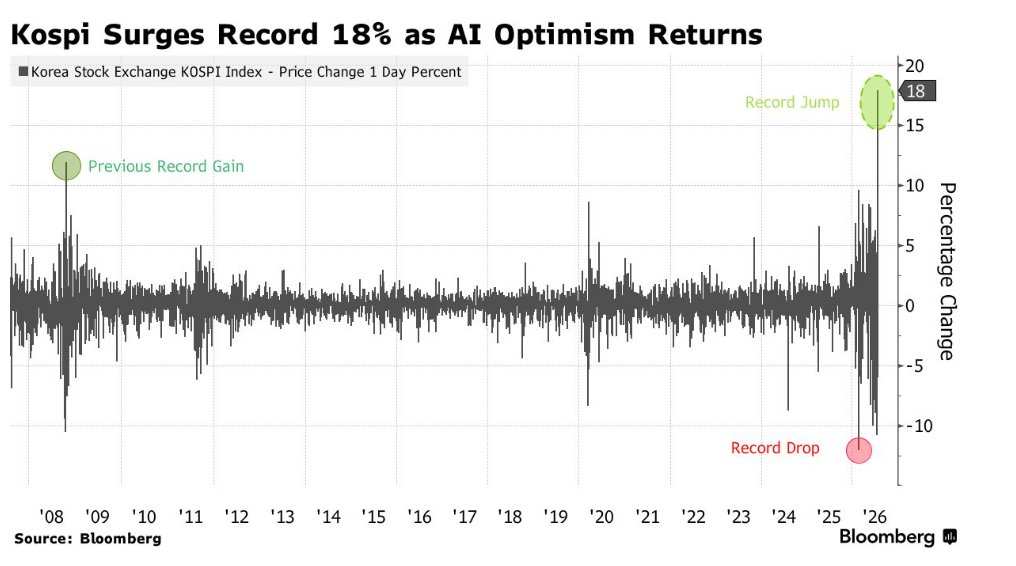
As illustrated in the chart above, the Korea Composite Stock Price Index surged a record ~18%, signaling a full return of AI-driven optimism.
To some market participants, Situational Awareness’s forced liquidation of nearly all its public equity positions tied to AI helps explain the persistent wave of forced deleveraging and intense selling pressure across global semiconductor markets throughout July: waves of selling repeatedly transmitted across global markets, escalating into even larger sell-offs. Before retail and professional traders significantly reduced their borrowing, margin financing in South Korea’s financial markets even hit a record high last month.
After Citadel acquired most of the public equity portfolio at a discount, the market no longer faced the prospect of a highly leveraged hedge fund dumping shares piecemeal on exchanges, and other investors were relieved of fears about unknown large-scale forced liquidation orders. Consequently, short covering, dealer hedging adjustments, and fundamental capital inflows jointly fueled the violent rebound in global semiconductor stocks beginning Thursday.
Citadel took over the majority of Situational Awareness’s public equity portfolio, effectively removing a persistent, indiscriminate, and price-insensitive forced seller from the market; this, combined with$Microsoft (MSFT.US)$、$Amazon (AMZN.US)$strong earnings results from major technology firms that alleviated concerns about AI investment returns, along with highly positive signals on expanding AI computing demand from supply-side players such as Taiwan Semiconductor, United Microelectronics (UMC), and Seagate Technology, triggered a record 17.91% surge in South Korea’s KOSPI. Micron, AMD, Taiwan Semiconductor, Samsung Electronics, and SK Hynix led a global chip-stock rebound. This shift largely indicates that marginal price setters in the market have rapidly transitioned from margin calls, leveraged ETF redemptions, and forced deleveraging toward short-covering, institutional and retail dip-buying, and sustained optimism about robust expansion in AI computing fundamentals.
While Situational Awareness’s deleveraging suggests the fiercest mechanical selling pressure may have passed, it does not confirm that all excessively leveraged institutions have been fully cleared from the market. Despite KOSPI’s near-18% single-day surge, it remains approximately 30% below its all-time high. The Philadelphia Semiconductor Index still posted a cumulative decline of over 20% in July and had previously retraced nearly 30% from its June peak. The vibrant, expansive risk appetite characteristic of AI-driven rallies may be returning, but confirmation of a sustained AI-led bull market will require supportive evidence from earnings reports, order flows, AI capital expenditure returns, and technical support holding firm on pullbacks.
From a 165-page AGI prophecy to the collapse of 'the most crowded long,' the 'AI narrative' correctly foresaw the industry trend but lost its position—its 439% myth undone by a leverage cliff.
Leopold Aschenbrenner’s rise stemmed from directly translating a set of deeply insightful technical judgments into capital market positions: graduating first in his class from Columbia University at age 19, he joined OpenAI’s 'Superalignment' team and, in 2024, published the 165-page report 'Situational Awareness,' arguing that AGI would compel the world to procure, at exponential rates, an entire integrated suite of AI data center components—including data center power equipment, liquid cooling systems, CPUs, DRAM/NAND/HBM memory, optical interconnects and communications, high-performance Ethernet networking infrastructure, transformers, and gas turbines.
A fund bearing the same name was subsequently established, attracting prominent capital such as Jane Street and the founder of Stripe. Its assets under management surpassed $20 billion within two years; as of the end of June 2026, the fund delivered a staggering year-to-date net return of 439% and cumulative returns exceeding 1,000% since inception, becoming the most legendary concentrated bet in this AI bull market and even hailed by some retail investors as 'the definitive playbook amid the AI investment frenzy.'
His collapse was not due to a sudden failure of the long-term AI investment thesis, but rather because the same macro narrative simultaneously gripped long positions, short positions, and the funding side. Situational Awareness held concentrated positions in SK Hynix,$SanDisk (SNDK.US)$、$NEBIUS (NBIS.US)$、$CoreWeave (CRWV.US)$、$Bloom Energy (BE.US)$AI-related storage, cloud computing, and power infrastructure assets, while maintaining short positions in certain software companies potentially disrupted by AI. After the crowded AI hardware trade reversed in July, long positions fell in unison while some shorts paradoxically rose, causing correlations to abruptly converge toward one during the stress period—turning what appeared to be a 'long-short hedged' portfolio into one suffering losses in the same direction.
The hedge fund he managed suffered a roughly 67% drop in July and had to choose between 'rapidly raising new capital' and 'selling its public market portfolio.' It ultimately transferred the majority of its approximately $16 billion public equities portfolio to Citadel. Prime brokers including Goldman Sachs, JPMorgan, Bank of America, and Citi coordinated the transaction. Following completion, the fund retained approximately $10 billion in assets, including private equity stakes such as Anthropic. Therefore, claims that 'the fund was completely wiped out' or that 'Citadel acquired all its assets' are inaccurate—the true casualty was its highly leveraged public market strategy.
The so-called 'overnight collapse' was in fact the culmination of weeks of paper losses crossing a funding threshold within 24–36 hours, suddenly triggering a liquidity event. The danger of leveraged portfolios lies not in being wrong on directional views per se, but in the fact that net asset value represents only a thin cushion beneath total exposure: using a four-times gross exposure as an illustrative mechanism, a 25% decline in the asset portfolio could theoretically erase all initial equity. Prime brokers would then raise margin requirements and reduce financing lines, forcing the fund to liquidate positions. Once the market identifies an institution as a price-insensitive forced seller, other trading desks may indeed preemptively sell overlapping holdings, buy protection, or establish short positions, further worsening execution prices.
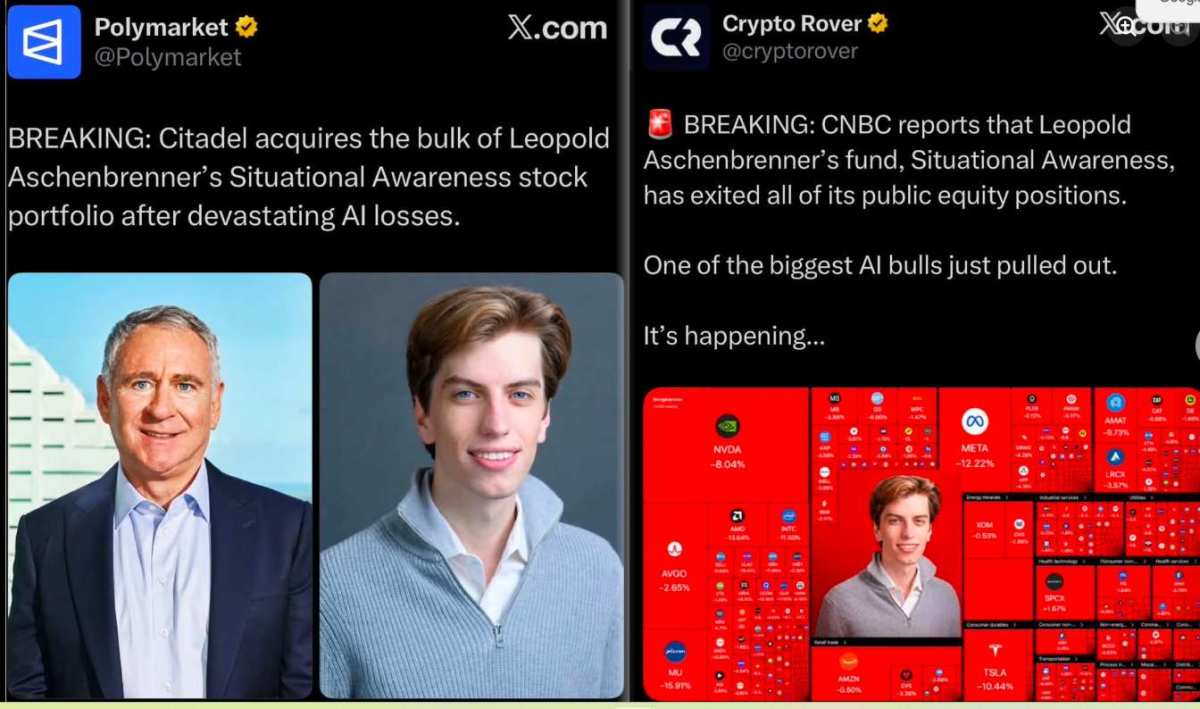
Citadel’s critical role was not about 'rescuing a genius,' but rather converting a potential wave of disorderly forced selling—persisting for weeks and continuously pressuring exchange order books—into a block transfer of assets absorbed by a financially stronger institution. Once the market confirmed that Situational Awareness no longer needed to engage in chaotic selling, supply from sellers sharply diminished, prompting short covering and fundamental buying to enter simultaneously: South Korea’s KOSPI surged a record 17.9%, Samsung Electronics and SK Hynix jumped approximately 28% and 30% respectively, and the Philadelphia Semiconductor Index also staged a robust rebound.
Has the blow-up of crowded AI trades truly come to an end, or is it merely the eve of a domino effect?
The most profound lesson from this fallen myth is this: Aschenbrenner may have correctly identified the long-term trajectory of the AI compute industry, but mistakenly equated technological certainty with stock price certainty. Demand for HBM, NAND, advanced packaging, CPUs, optical interconnects, power, and liquid cooling may continue to grow, yet superior investment strategies must withstand valuation compression, sudden correlation shifts, tightening funding conditions, and reversals in crowded positioning. The core insight of the Kelly Criterion is not 'bet heavily when your win probability is high,' but rather to maximize long-term compounding while avoiding ruin; once position sizing exceeds the optimal fraction, even correct long-term industry calls can be undone by short-term variance, eliminating investors before their thesis materializes.
Situational Awareness demonstrated the harshest rule of this AI bull market: the market does not reward those who see the future first, but those who see the future and possess sufficient liquidity to survive until it arrives.
‘This was indeed part of the persistent selling pressure over the past few weeks,’ said Calvin Yeoh, co-manager of the Merlion Fund at Blue Edge Advisors, referring to the ordeal faced by the hedge fund managed by Leopold Aschenbrenner. ‘At the same time, virtually all Korean retail traders employing extreme leverage strategies have already blown up, and there are no more large-scale sellers remaining in that segment.’
‘However, this doesn’t mean the market will rebound all the way back,’ Yeoh added. ‘It simply means that, for now, the deleveraging process has largely been completed.’
A rebound over the past two days brought a turbulent July to a close. The Philadelphia Semiconductor Index still posted a cumulative decline of more than 20% for the month, marking its worst monthly performance since the global financial crisis.
The KOSPI fell 22% in July, dragged down primarily by SK Hynix and Samsung Electronics—two stocks that had earlier propelled South Korea’s market to become the world’s best-performing equity market earlier this year. SK Hynix was previously held in Situational Awareness’s portfolio, and its American Depositary Receipts (ADRs) briefly traded below their issue price.
The sudden collapse of Situational Awareness’s moment of glory is hard not to associate with Long-Term Capital Management (LTCM) and the events of 2008.
Yeoh is not the only one who believes the selling pressure has temporarily eased, but this incident has also led investors to question whether other funds might be facing similar distress. Some traders have drawn parallels to the rapid implosion of LTCM in 1998, which posed systemic risks to financial markets and prompted Federal Reserve officials to orchestrate a bailout.
Other analysts have recalled how banks and funds were acquired one after another during the global financial crisis.
“If there’s already one Situational Awareness out there, how many similar institutions might still be lurking in the market?” said Cusson Leung, Chief Investment Officer at KGI International Wealth Management. “This morning, it reminded me of a very similar scenario—specifically, when JPMorgan acquired Bear Stearns in 2008,” he said in an interview. “Back then, the market saw a relief rally, only for Lehman Brothers to collapse shortly afterward.”
The value of assets held by Situational Awareness plummeted from $45 billion at the beginning of July to approximately $10 billion. Aschenbrenner was forced to liquidate positions to meet margin calls. Subsequently, according to a source familiar with the matter who requested anonymity due to the sensitivity of private information, Citadel, the hedge fund founded by Ken Griffin, contacted Situational Awareness and acquired the majority of its investment assets at a discount.
“The more important question is whether this is the only segment in the market that is excessively leveraged,” said Ulrich Urbahn, Head of Multi-Asset Strategy and Research at asset management giant Berenberg. “If other funds are similarly concentrated in AI, computing power, and semiconductors, then this liquidation might be just the first domino to fall—not the last.”
According to exclusive data from Bloomberg Intelligence, leveraged exchange-traded funds (ETFs) linked to Samsung Electronics and SK Hynix have seen substantial net outflows over the past two weeks; these products were previously viewed in South Korea as amplifiers of market volatility. Bloomberg Intelligence data shows that as of Thursday, the assets under management in these funds had plunged to $4.1 billion from over $11 billion on June 25. This week, the South Korean government pledged additional measures to stabilize the market and announced restrictions on retail investor participation in leveraged ETFs.
“We’ve already witnessed a large-scale unwinding of leveraged bets, a process that is nearing completion, and the bailout of Situational Awareness represents the final piece of the puzzle in the short term,” said Joshua Crabb, Head of Asia Pacific Equities at Robeco. “Asian markets have thus benefited sharply, as valuations were already low, and certain South Korean tech stocks tied to AI computing infrastructure have now become extremely cheap.”
Currently, this rebound is jointly driven by reduced positioning, lower valuations, and improved market sentiment.
‘This once again brings back the same old lesson from the Long-Term Capital Management episode,’ said Amir Anvarzadeh, equity strategist at Asymmetric Advisors based in Japan. ‘It’s precisely Keynes’ famous adage: “The market can remain irrational longer than you can remain solvent.”’
After the fall of the AI prophets, has that familiar euphoria around AI computing power finally returned?
Margin requirements effectively auto-liquidated highly leveraged buyers who could no longer secure financing. When a fund held concentrated positions in SK Hynix, memory, compute infrastructure, and other AI-related assets while using borrowed capital to amplify exposure, a decline in stock prices reduced collateral value, prompting lenders to demand additional cash or collateral. To meet margin calls, the fund had no choice but to sell the same assets, triggering a negative convexity loop: price decline → margin call → forced selling → further price decline. After Citadel acquired most of the fund’s public equity portfolio at a discount, the market was spared the burden of piecemeal dumping on exchanges, and other investors were relieved of fears over unknown large-scale forced liquidations. Short-covering, dealer hedging adjustments, and fundamental capital inflows thus jointly fueled a violent rebound.
Situational Awareness’s core strategy essentially used high leverage to express a view that, while potentially correct in the long run, entailed extreme short-term path dependency: AGI and autonomous agents will drive exponential global demand for computing power, warranting concentrated holdings in semiconductors, memory, data centers, power infrastructure, and private AI model companies, with returns amplified through leverage.
Public reports confirm that Situational Awareness employed significant leverage and faced margin calls from lenders, though the full details of its contractual positions have not been disclosed; thus, it cannot be definitively stated that all positions were structured via total return swaps (TRS). Generally, under the highly leveraged TRS framework, a fund need only post a fraction of initial margin to a prime broker to gain exposure to the economic returns of a stock or basket of stocks far exceeding its own capital. The fund captures upside gains and pays funding costs, but bears 100% of any downside losses. Prime brokers typically purchase the underlying shares to delta-hedge their exposure; when prices fall and the fund fails to meet variation margin calls, the bank terminates the swap, sells the hedging shares, or liquidates posted collateral—thereby converting paper losses into actual market sell orders.
In the view of major Wall Street banks, as this round of forced deleveraging nears its conclusion, the next super-bull cycle centered on AI computing power is showing signs of re-ignition—though it remains premature to declare that the primary uptrend has been fully confirmed by capital flows.
According to the latest forecast by JPMorgan strategist Mixo Das, deleveraging of Korea-related leveraged ETFs has likely been completed, particularly with hedge fund deleveraging approximately 90% finished—indicating that the 'irrational sellers' responsible for persistent cascading liquidations are nearly exhausted. This aligns with the reported transaction in which Citadel took over the bulk of Situational Awareness’s roughly $16 billion public equity portfolio: the continuous stream of forced selling pressure was removed from the market in one fell swoop, providing the necessary condition to halt the downward spiral in global AI assets.
JPMorgan research indicates that assets in Korea-related leveraged ETFs have declined from a peak of approximately $50 billion to $17 billion, and hedge funds’ gross leverage ratio has fallen from 5.7x to 3.2x. These figures signal that the negative feedback loop—comprising forced selling by leveraged ETFs tracking price declines, shrinking TRS financing, and synchronized unwinding of momentum strategies—is now waning.
Korean equities have indeed reached crisis-level valuations that appear highly attractive, yet a forward P/E ratio of 5x alone does not conclusively indicate an absolute bottom. The memory sector is highly cyclical; when profits are near cyclical peaks, forward P/E ratios naturally compress. Historically, the 'cheapest' P/E multiples have sometimes coincided precisely with earnings approaching their cyclical highs.
Fundamental industry dynamics are providing more sustainable fuel for this semiconductor rally than short-covering alone. Microsoft’s latest quarterly Azure revenue grew by 43%, surpassing the market expectation of approximately 39.98%, indicating that AI-related capital expenditures have begun translating into cloud revenue and cash flow. Amazon Web Services (AWS) reported a 37% year-over-year revenue increase, reaching $42.2 billion—significantly exceeding market expectations—and its order backlog surged from $364 billion to $496 billion. Management further noted that the majority of computing capacity for 2027 has already been reserved by customers, and even with its 2026 capital expenditure budget raised to $220 billion, demand still cannot be fully met. Lam Research’s midpoint revenue guidance for the next quarter stands at $8.1 billion, notably above the market consensus of $7.09 billion, demonstrating that AI-driven demand is spreading beyond GPUs to HBM, DRAM, NAND, advanced packaging, etch and deposition equipment, and enterprise-grade SSDs.
To genuinely confirm the primary upward trend in semiconductors, key semiconductor benchmark indices must hold above critical technical support levels during pullbacks and consolidations, outflows from South Korean leveraged ETFs must cease, and cloud providers such as Microsoft and Amazon must continue demonstrating that their capital expenditures can reliably convert into cloud revenue, order backlogs, and acceptable asset payback periods.
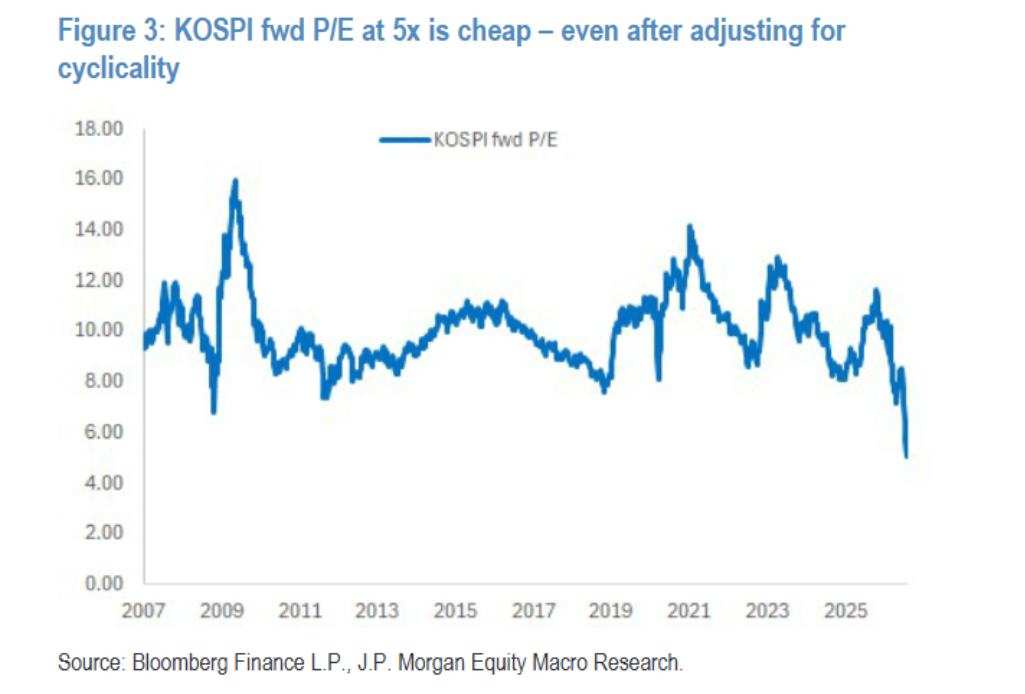
JPMorgan stated that the medium- to long-term bullish case for South Korean equities and AI-compute-related semiconductor stocks is fundamentally underpinned by the seemingly insatiable ongoing expansion of AI data centers in infrastructure components such as HBM, server DRAM, enterprise SSDs, and advanced memory solutions, coupled with disciplined supply-side management that continues to support spot and contract pricing. Recent earnings reports from U.S. cloud leaders and tech giants—including Amazon, Google, and Microsoft—have alleviated concerns about a slowdown in AI-related capital spending, driving the KOSPI index to a record single-day surge of 17.91% on July 31. Samsung Electronics and SK Hynix rose by approximately 28% and 30%, respectively, indicating that the rally stems not only from short-covering but also from renewed investor confidence in the fundamental thesis that AI capital expenditures are sustainably converting into cloud revenue, memory orders, and semiconductor profitability.
Editor/Deng