
The Japanese government may intervene again in the foreign exchange market on July 30, with a scale of approximately JPY 8.45 trillion, causing the USD/JPY exchange rate to plunge by nearly 500 pips and break below the 158 level. Although authorities have not officially confirmed this, market participants widely believe the signs of intervention are evident. Meanwhile, the Bank of Japan kept interest rates unchanged, and Kazuo Ueda sent a hawkish signal, though it did not significantly alter market expectations. Analysts note that, given the persistently wide interest rate differential between the U.S. and Japan, the yen is likely to remain under long-term downward pressure.
Japan’s latest foreign exchange market intervention may have been confirmed.
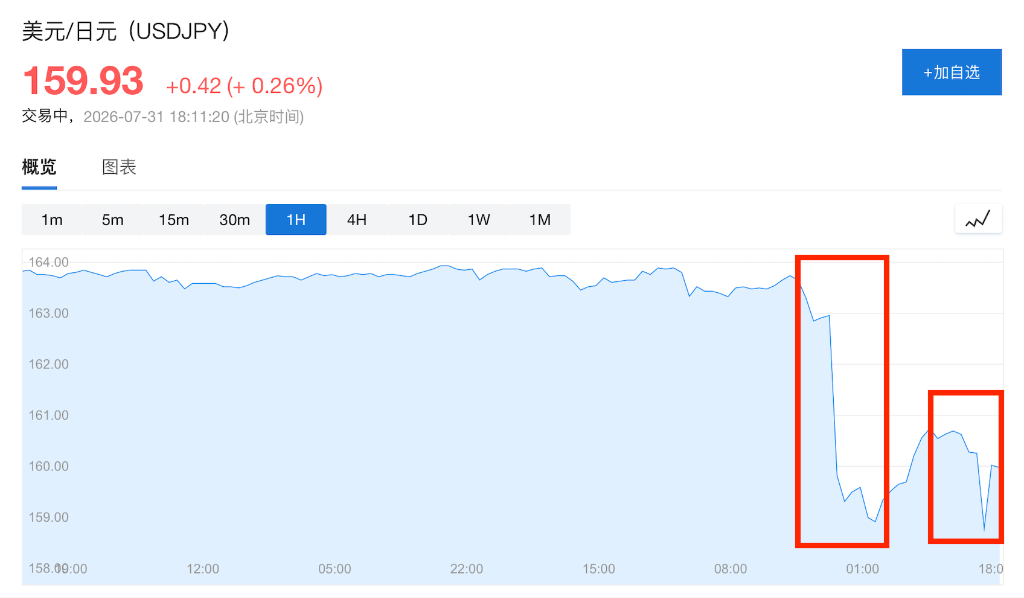
On July 31, according to Bloomberg’s analysis of Bank of Japan account data, the Japanese government likely entered the market on July 30 to buy yen and sell U.S. dollars, with an estimated intervention amount of approximately JPY 8.45 trillion (about USD 52.8 billion). During early U.S. trading hours that day, the dollar-yen exchange rate plunged nearly 500 pips in under an hour, briefly falling below the 158 level, for a daily decline of 3.3%—the largest single-day drop since December 2023.
 Although Japanese authorities have not officially confirmed the move, market speculation about intervention is intensifying. Finance Minister Satsuki Katayama stated she would 'not comment,' while Vice Finance Minister Junichi Mikami said he had 'nothing to add,' but noted that Japan had received support from the United States that went 'beyond mere moral backing,' further fueling market speculation about possible coordinated action between the U.S. and Japan.
On July 31, the yen rallied again before retreating; as of the time of writing, the dollar-yen exchange rate had returned to around 160. On the same day, Bank of Japan Governor Kazuo Ueda delivered a relatively hawkish message, pushing the dollar-yen rate down to as low as 158.63, though it subsequently weakened again, approaching the 160 mark.
Intraday plunge of 500 pips: markets pinpoint signs of official intervention
This market volatility occurred during the New York trading session on July 30.
Approximately 50 minutes after the New York market opened at 9:30 a.m. local time, the dollar-yen exchange rate rapidly dropped from around 162.5 to below 158, registering a maximum intraday decline of 3.3%. The sharp and concentrated price movement closely resembles patterns observed during Japan’s previous foreign exchange interventions.
According to Bank of Japan data, combined with broker estimates, the Japanese government likely deployed approximately JPY 8.45 trillion on July 30 to support the yen.
Citing market sources, Nikkei reported that the Bank of Japan and other government agencies conducted large-scale yen-buying operations during the New York trading session that day, and U.S. authorities also made foreign exchange inquiries. Typically, the U.S. Treasury Department requests banks—via the Federal Reserve Bank of New York—to provide foreign exchange quotes to assess market conditions or coordinate with allies. The U.S. Treasury has not yet responded to these reports.
On the same day, U.S. Treasury Secretary Bessent stated in an interview, 'The yen appears significantly undervalued, and the market will likely come to recognize that the yen should be stronger.' This remark was widely interpreted by markets as indirect U.S. support for Japan’s stance on the yen.
Geoffrey Yu, senior strategist at Bank of New York Mellon, stated that such a magnitude of volatility 'strongly suggests that Japanese authorities likely intervened in the foreign exchange market,' though the ultimate impact will depend on subsequent market reactions.
Record-breaking interventions in the first half failed to reverse the yen's weakness.
This suspected intervention marks what could be another round of large-scale foreign exchange market intervention by Japan this year, drawing significant market attention.
According to Bloomberg, citing data from Japan’s Ministry of Finance, Japan spent approximately ¥11.73 trillion (about $73.2 billion) on foreign exchange intervention between April 28 and May 27, setting a new historical record. Market participants widely believe that Japanese authorities primarily raised funds by selling foreign exchange reserve assets, including U.S. Treasury securities.
However, previous interventions did not have lasting effects. With the U.S.–Japan interest rate differential remaining elevated and carry trades still active, the yen came under renewed pressure. On July 23, the dollar-yen exchange rate briefly rose to 163.99, reaching its highest level in nearly 39 years and eight months. Market observers noted that without a clear shift in Japan’s monetary policy stance, foreign exchange intervention alone is unlikely to alter the yen’s longer-term trajectory.
Ueda signals hawkish tone but fails to shift market expectations
At its policy meeting on July 31, the Bank of Japan kept its policy interest rate unchanged at 1%, in line with broad market expectations.
Governor Kazuo Ueda struck a relatively hawkish tone during the press conference, repeatedly emphasizing upside inflation risks and noting that underlying inflation is nearing the 2% target. He indicated that if financial conditions remain excessively accommodative, the Bank of Japan could accelerate its pace of rate hikes. Ueda also highlighted that the exchange rate’s impact on inflation is intensifying, requiring the central bank to pay closer attention to price pressures stemming from yen volatility.
However, as the meeting did not deliver a clear signal of an earlier-than-expected rate hike, market reaction was muted. The dollar-yen pair dipped briefly before rebounding. Markets currently expect the Bank of Japan could raise rates again as early as October, although this outlook remains contingent on future developments in inflation, wage growth, and exchange rate movements.
Carry trades remain the core contradiction, limiting the yen’s upside potential
Analysts believe that Japan's latest intervention may alter the short-term trend but is unlikely to eliminate the fundamental factors exerting long-term downward pressure on the yen.
According to Bloomberg data, the 90-day rolling correlation coefficient between USD/JPY and the two-year U.S.-Japan overnight index swap (OIS) spread has risen to 0.44 from approximately 0.25 in March, indicating that the U.S.-Japan interest rate differential is playing an increasingly influential role in exchange rate movements.
As long as the U.S.-Japan interest rate differential remains elevated, carry trades could continue to support USD/JPY.
Citi analysts noted that the recent sharp decline in USD/JPY was 'consistent with patterns observed during previous interventions,' but added that further yen appreciation may face challenges, as Kazuo Ueda's policy remarks did not significantly exceed market expectations.
Editor/Deng